The Imperatorial Period and Some Denarii that Marked the End of the Roman Republic
Coins of war, ambition and propaganda at the end of the Republic.
The so-called imperatorial period, approximately between 82 and 27 BC if we count from the time of Marius and Sulla, is one of the most exciting periods in the history of Rome. It was a period of civil wars, struggles for power and figures who forever changed the course of the Roman world. All this is clearly reflected in the coins of the time, especially in the denarii, which, in addition to serving as a means of payment, became a powerful instrument of propaganda.
Although the Republic did not officially disappear until 27 BC, when Octavian received the title Augustus, the process of decomposition had begun much earlier. Many historians place the origins in the confrontation between Marius and Sulla. Marius, a prominent general and army reformer, introduced measures that made soldiers more dependent on their commanders than on the State itself. With this he opened the door for military generals to accumulate power capable of rivaling the Senate. Sulla, Marius’ former subordinate, would end up confronting him and triggering Rome’s first great civil war.
Numismatically, however, it is usually considered that the imperatorial period begins when Julius Caesar crosses the Rubicon in 49 BC. Since then, and until the beginning of the Empire, some 320 different types of denarii were minted in just 18 years. The comparison is revealing: in the previous almost 190 years, since the appearance of the denarius around 211 BC, around 600 types had been issued. This means that in less than two decades more than half of the numismatic activity of the previous two centuries was produced, a clear sign of the intense propaganda need of those turbulent years.
This article reviews the most relevant events of the time through their denarii, from Sulla to the last republican issues, showing the art and the message that each coiner wanted to convey.
Year 82 BC – Sulla takes Rome.
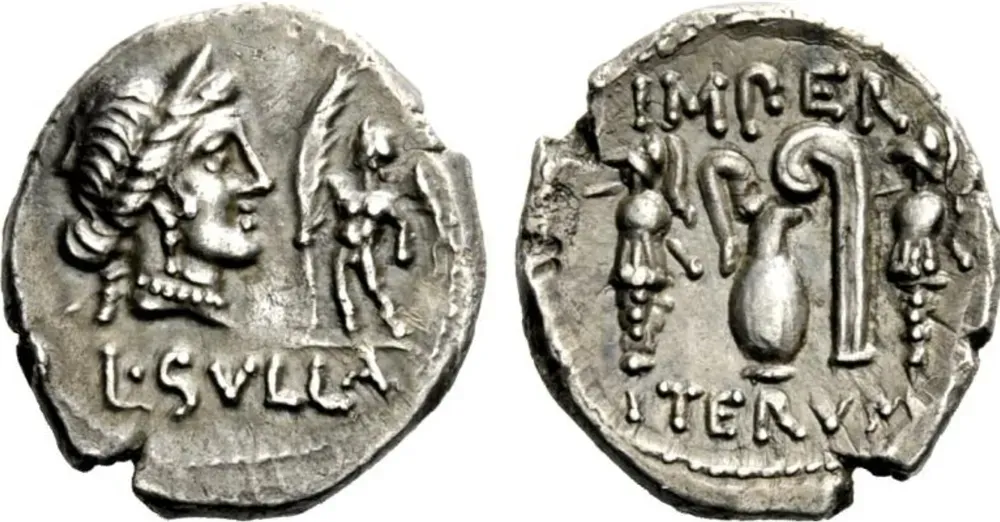
Crawford 359/2. Denarius minted by Lucius Cornelius Sulla in 82 BC.
Image courtesy of Numismatica Ars Classica
In 82 BC, Sulla took Rome by force and became dictator. After winning the Battle of the Colline Gate, he established a regime of terror that culminated in his dictatorship. The emphasis on Venus and war trophies on this earlier coin reinforces his image as an undefeated commander favored by the gods. During his dictatorship, Sulla eliminated thousands of political enemies through very bloody proscription lists. Even so, surprising as it may seem, he voluntarily renounced power.
Year 77 BC – Pompey ascends after the fall of Sulla.
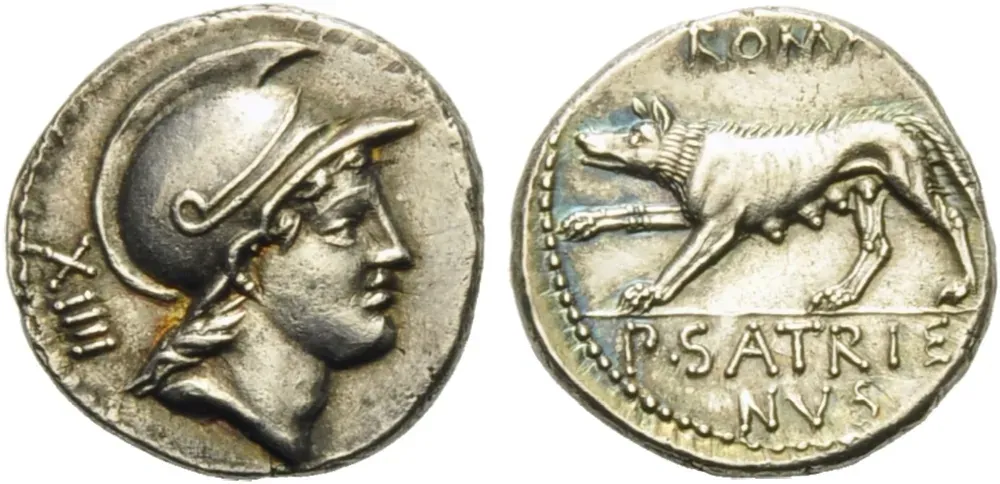
Crawford 388/1a. Denarius minted by P.Satrienus in 77 BC.
Image courtesy of Numismatica Ars Classica
Although Sulla had renounced the dictatorship and died in 78 BC, his reforms continued to shape Rome. New revolts, such as that of Marcus Aemilius Lepidus, attempted to reverse his legacy. That same year, the young Pompey was sent to Hispania to confront Quintus Sertorius, a proscribed general who had established an alternative government in the peninsula with local support. That campaign began to increase Pompey’s military prestige, placing him as the natural heir to Sulla’s authority.
In this well-known denarius, with the Roman she-wolf on the reverse, P. Satrienus seems to want to reinforce republican identity and stability in turbulent times.
Year 71 BC – Crassus crushes Spartacus’s rebellion.
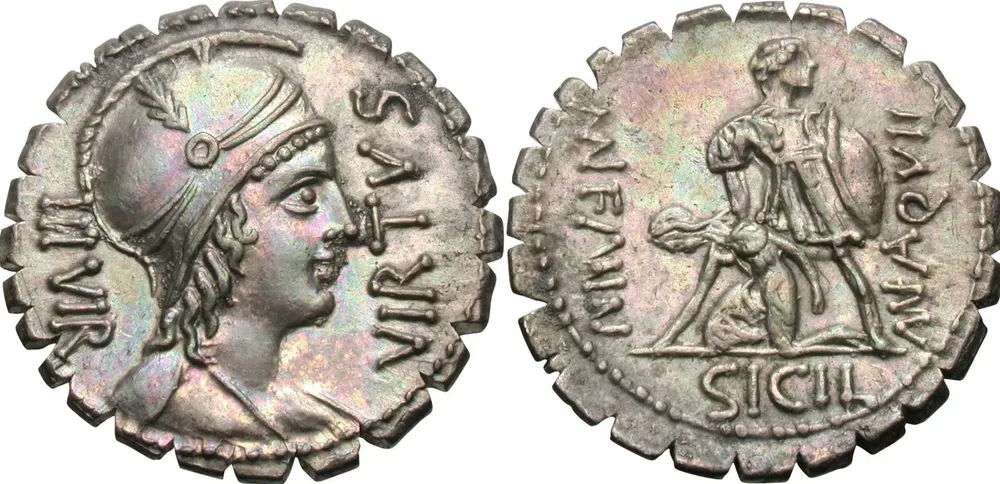
Crawford 401/1. Denarius minted by Manlio Aquillio in 71 BC.
Image courtesy of Gemini LLC
When this coinage was made, Crassus and Pompey were beginning to concentrate political power after the defeat of Spartacus. The moneyer Manlius Aquillius evoked the heroic figure of his ancestor, the consul Manius Aquillius, who in 101 BC had put down the slave revolt in Sicily. On the obverse appears the bust of Virtus, a symbol of military valor, while on the reverse we see Aquillius raising Sicily, represented as a fallen figure. The scene commemorates the restoration of order after the insurrection. This denarius combines family memory and propaganda, at a time when the memory of old victories served to reinforce the morale and authority of the Republic.
Year 67 BC – Pompey receives the Imperium against the pirates.
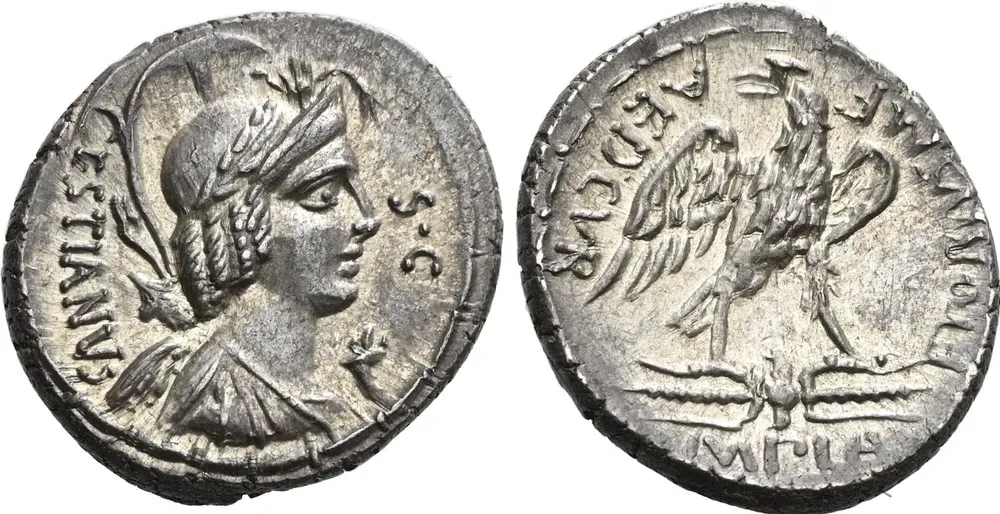
Crawford 409/1. Coined by Marcus Plaetorius Cestianus in 67 BC.
Image courtesy of Numismatica Ars Classica
M. Plaetorius Cestianus minted his denarius at a critical time for Rome, when the threat of Cilician pirates endangered trade and grain supplies in the Mediterranean. In response, in 67 BC the Senate approved the Lex Gabinia, which granted Gnaeus Pompey extraordinary powers to deal with this crisis. With unprecedented imperium and authority over the entire sea and coastal areas, Pompey eradicated piracy in just three months, thus consolidating his political and military prestige.
Plaetorius, curule aedile, minted this denarius with Vacuna and the eagle of Jupiter, symbols of protection and divine power, which can be read as a reflection of the political climate and the implicit support for Pompey’s mission.
After this victory, Pompey’s glory only grew: in 66 BC he assumed command in the war against Mithridates, whom he definitively defeated; in 64 BC he converted Syria into a Roman province, and in 63 BC he entered Jerusalem, reorganizing the East under the authority of Rome. These successes catapulted him to the top of his career, making him the most powerful man in the Republic.
Year 63 BC – Catiline’s conspiracy and the defense of the Republic
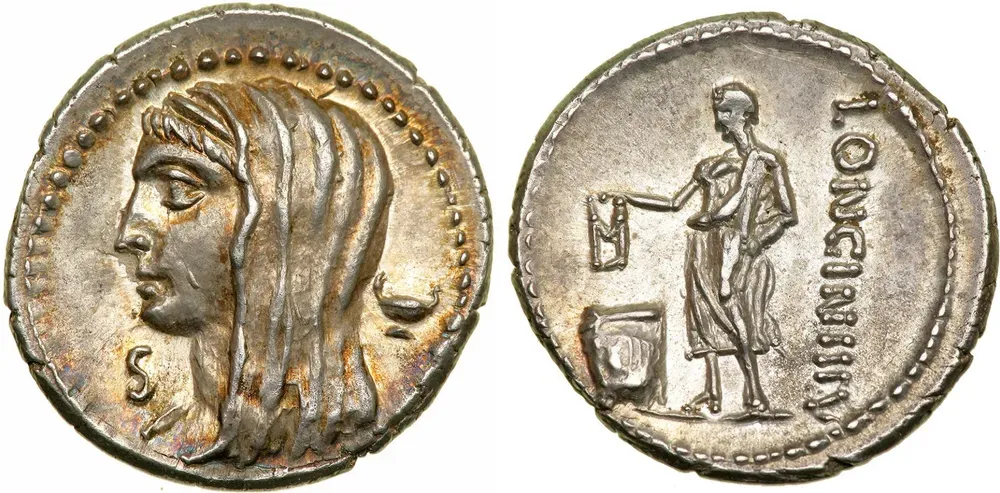
Crawford 413/1. Coined by Lucius Cassius Longinus in 63 BC.
Image courtesy of Ira & Larry Goldberg Coins
That year Rome was on the verge of internal collapse: Lucius Sergius Catilina attempted to overthrow the Senate through a conspiracy that was thwarted by the consul Cicero, who denounced the plot and executed the main people involved. In this climate of maximum political tension, the moneyer L. Cassius Longinus minted a denarius with a deeply republican message.
On the obverse appears Vesta, goddess and guarantor of the purity and cohesion of the state. On the reverse, three citizens are represented casting their vote with the inscription LONGIN III V, alluding to the lex tabellaria approved by a family ancestor, which introduced the secret ballot in Rome. The design vindicates the strength of Republican institutions and the role of the people in political life, in a year in which the city was saved from falling into the hands of the conspiracy.
Year 60 BC – The first Triumvirate is formed.
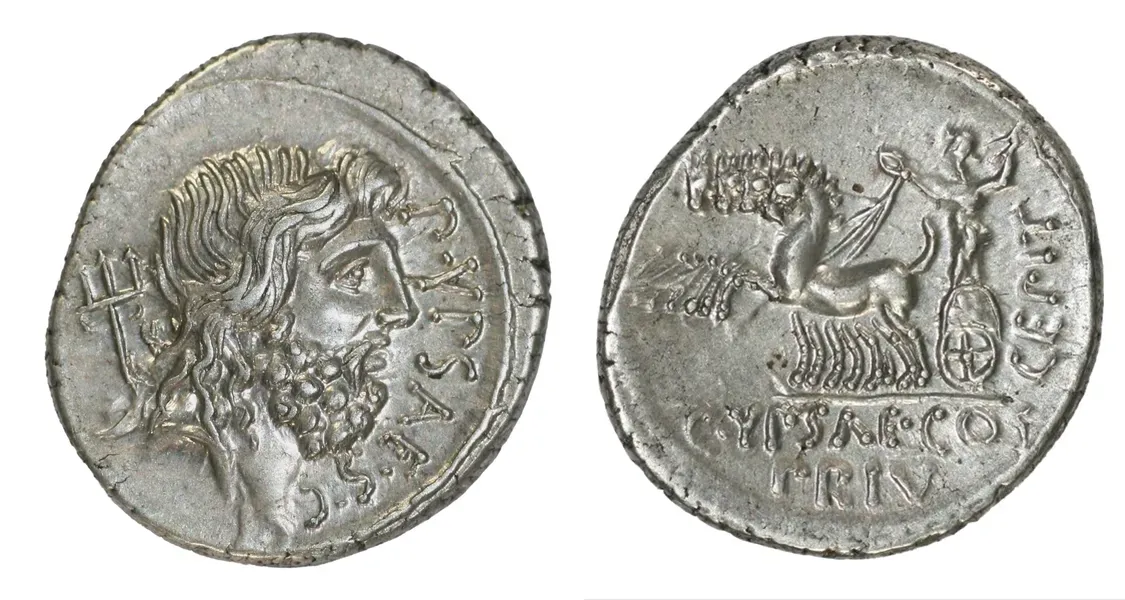
Crawford 420/1a. Denarius of P. Plautius Hypsaeus in the year 60 BC. (IOVIS Collection).
Image courtesy of Numismatica Ars Classica
Caesar, Pompey and Crassus sealed a private alliance known as the First Triumvirate, which allowed them to share power in Rome outside of traditional institutions. This informal pact marked the beginning of a new stage, in which the republican balance was subordinated to the interests of three strong men.
The denarius of P. Plautius Hypsaeus, minted that same year, is not directly related to the Triumvirate, but is a testimony to the political context. On the obverse, the laureate head of Jupiter appears, a symbol of supreme authority, while the reverse shows a triumphal chariot with Jupiter standing, evoking victory and divine favor. The iconography does not allude to Caesar, Pompey or Crassus, but it does reflect the climate of exaltation of personal power and religious legitimation that accompanied the politics of the time. In this sense, it is a contemporary piece that places us in the environment in which the agreement that would transform the Republic was forged.
Year 55 BC – Crassus prepares for the battle against Parthia.
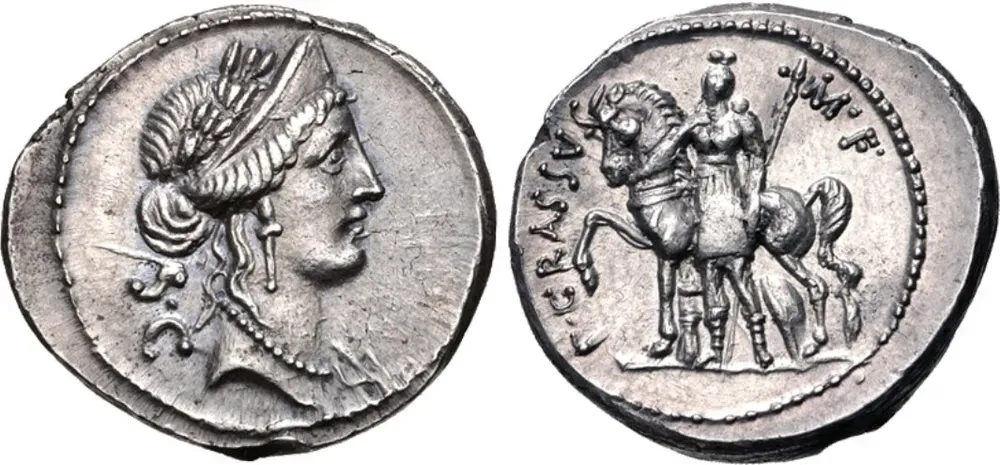
Crawford 430/1. Denarius of Publius Licinius Crassus from the year 55 BC.
Image courtesy of Classical Numismatic Group
This denarius was minted by the son of the triumvir Marcus Licinius Crassus during his father’s second consulship, at the time when the First Triumvirate (Caesar, Pompey and Crassus) was reaching its maximum power. On the obverse appears Venus, a symbol of prestige, lineage and divine favor, while on the reverse an armed figure leading a horse is represented, probably an allegory of Virtus or of Rome prepared for war, in allusion to the imminent eastern campaign.
It is the only denarius that makes direct reference to Crassus, the famous triumvir along with Caesar and Pompey. Father and son shared a common destiny, as both died in Sinnaca after the Roman defeat at the Battle of Carrhae (53 BC). Publius was married to Cornelia, daughter of Cornelius Scipio Nasica Serapion, who, after being widowed, became the fifth wife of Gnaeus Pompey. This coin reflects both the moment of greatest influence of the Crassus family and its tragic end, remaining a unique testimony of its numismatic and political legacy.
Year 54 BC – Issuance of a denarius with the bust of Sulla.
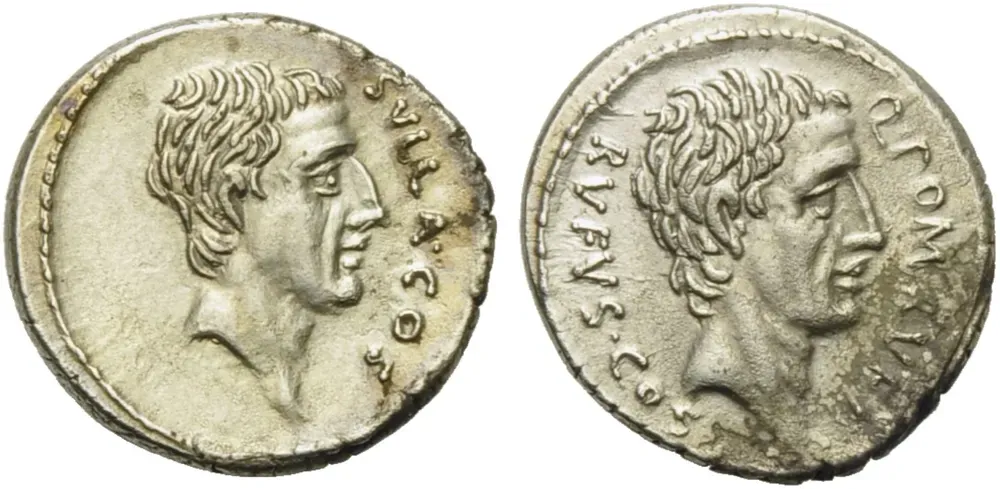
Crawford 434/1. Quintus Pompeius Rufus in 54 BC.
Image courtesy of Bertolami Fine Arts
Quintus Pompeius Rufus honors his grandfathers Sulla and Pompeius Rufus, consuls in 88 BC, and presents the only known portrait of Sulla on a coin. The issue coincides with a key moment: Julia, daughter of Julius Caesar and wife of Pompey, would die in 54 BC, ending the personal bond between the two men, which had already begun to grow complicated. In 53 BC, Crassus and his son would lose their lives in the Battle of Carrhae.
The choice to represent both grandparents on both sides of the denarius not only responds to a family tribute, but also reflects a political demand in times of instability. As Rome headed toward new civil wars, the figure of Sulla, a symbol of order imposed by force, served as a reminder of the power that the Senate and the republican tradition still aspired to preserve. A message that would undoubtedly not be comfortable for Caesar.
Year 49 BC – Julius Caesar crosses the Rubicon
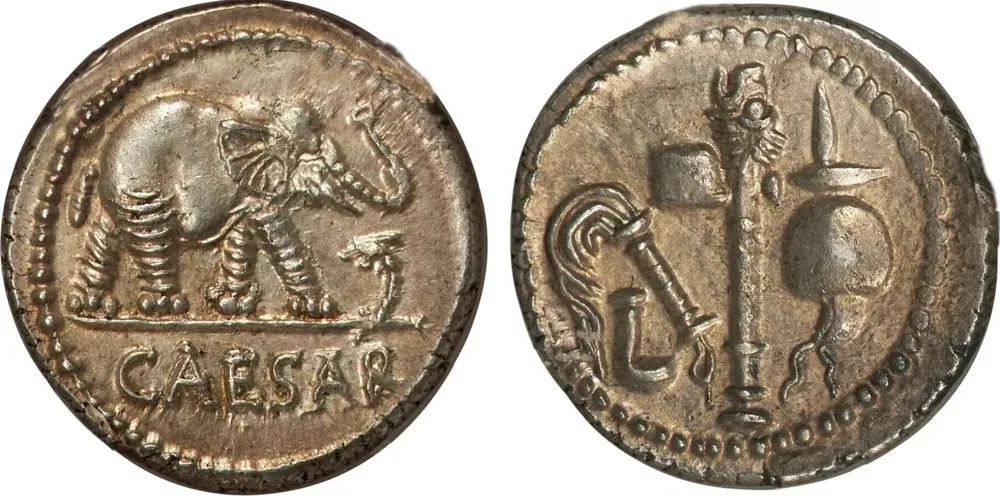
Crawford 443/1. Julius Caesar 49 BC
Image courtesy of Heritage Auctions
This denarius was the first that Julius Caesar minted to pay his troops. On the obverse, an elephant crushes a snake, an image that represents the victory of good (Caesar) over evil (his enemies). The elephant, a symbol of strength and power, alludes to Caesar’s military capabilities, while the snake could symbolize chaotic forces, senatorial resistance or even the Gauls. On the reverse, the pontifical emblems (simpulum, aspersorium, ax and apex) allude to the position of Pontifex Maximus that Caesar held since 63 BC.
When Caesar crossed the Rubicon and entered Italy with his troops, a new civil war began. The Senate and Pompey interpreted the act as a declaration of war and, given the speed of the Caesarian advance, they abandoned Rome and retreated to Brindisi, from where they reorganized their forces and transferred the conflict to Greece.
Year 49 BC – Pompey and the senate declare war.
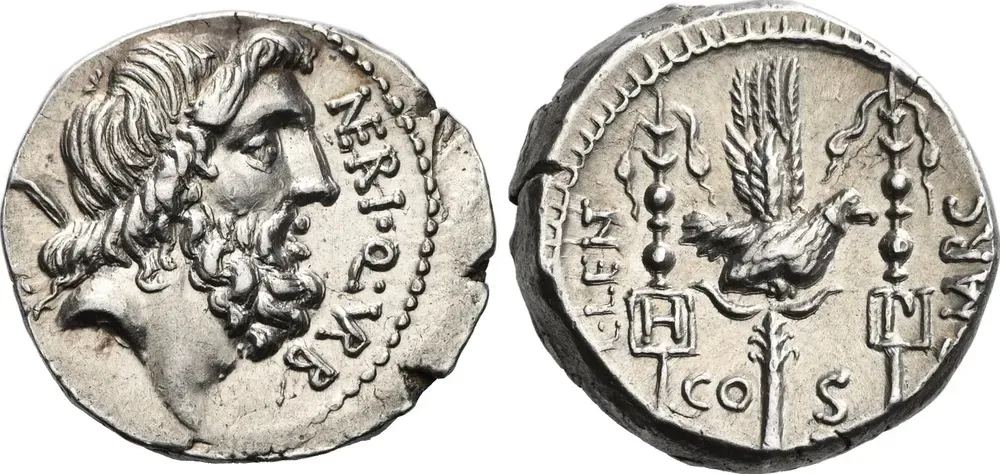
Crawford 441/1. Gnaeus Nerius 49 BC
Image courtesy of Numismatica Ars Classica
This denarius, with a clear military connotation due to the emblems on the reverse, was issued in the name of the consuls L. Cornelius Lentulus and C. Claudius Marcellus, together with the praetor Cn. Nerius, to whose gens it is attributed. All three were supporters of Pompey and, like the rest of the official apparatus, abandoned Rome when Caesar advanced towards the city with his legions.
On the obverse there is a bust of Saturn, with a harp on his shoulder. On the reverse, a legionary eagle flanked by military standards, a symbol of the authority and power of the Roman army.
Year 48 BC – Caesar’s coins remember Gaul.
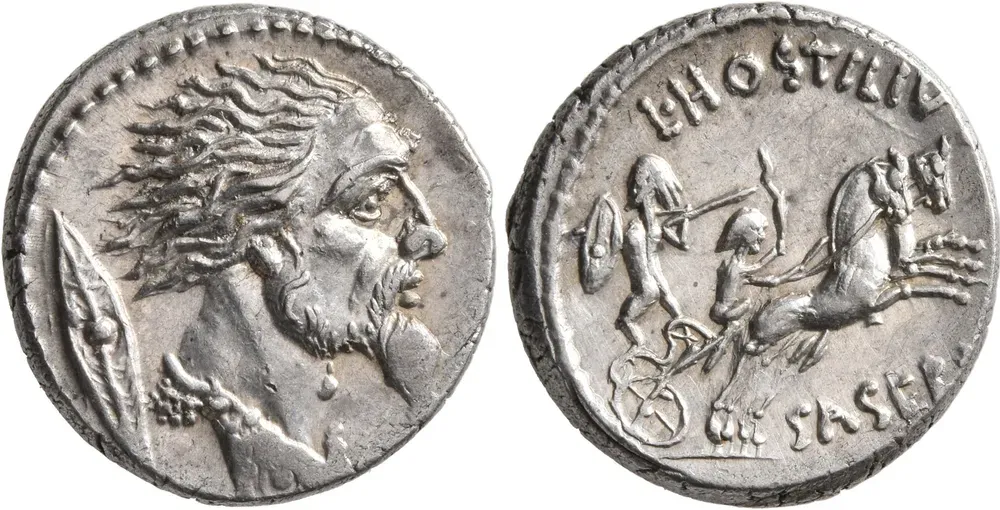
Crawford 448/2a Lucius Hostilius Saserna 48 BC
Image courtesy of Leu NumismatiK AG
In the midst of the civil war, the magistrate Lucius Hostilius Saserna evoked the successes in Gaul to praise Caesar’s triumphs and reinforce his legitimacy against Pompey. Just four years earlier, in 52 BC, the decisive battle of Alesia had been fought, where Caesar defeated and captured the Gallic leader Vercingetorix, almost concluding a campaign that began in 58 BC.
Once in power, Caesar displayed him in chains in his triumphal parade in Rome, after which the Gallic leader was executed.
This denarius shows precisely Vercingetorix, who became a symbol of that victory and an effective propaganda resource at Caesar’s service during the civil war.
Year 48 BC – Caesar’s victory at Pharsalia.
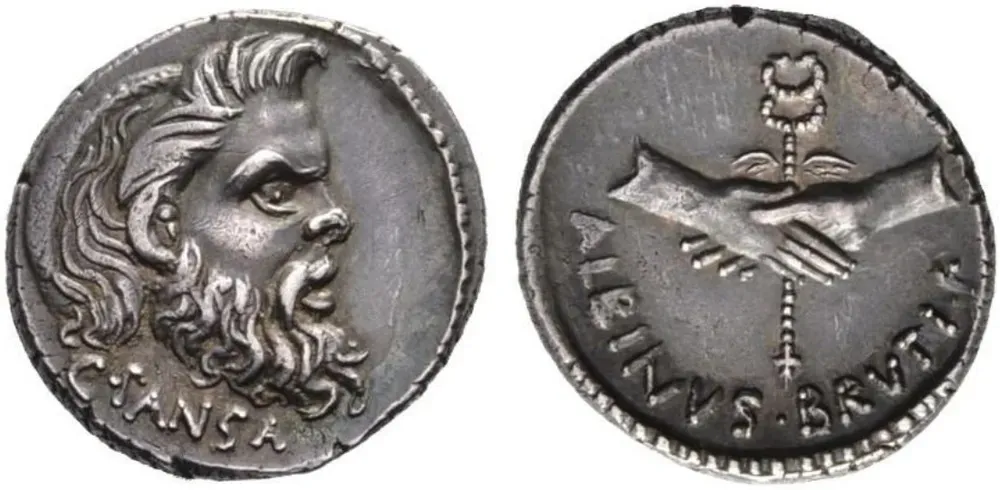
Crawford 451/1 - C. Vibius Pansa Caetronianus Postumius Albinus Bruti, 48 BC
Image courtesy of Numismatica Ars Classica
The Battle of Pharsalus and Pompey’s defeat took place in August 48 BC. Many experts interpret this denarius as reflecting the desire for peace after Caesar’s decisive victory over Pompey. According to historian Harold Grueber, the reverse, with a handshake under a caduceus, would symbolize an offer of alliance and reconciliation to the opposing side and to all Romans after that battle. On the obverse the god Pan appears, probably as a play on words with the name of the moneyer C. Vibius Pansa.
About the two moneyers and their evolution after this issue: Vibius Pansa was faithful to Caesar; after Caesar’s death he aligned himself first with Mark Antony and then with Octavian, dying in the campaign against Antony. Decimus Junius Brutus Albinus (Postumius Albinus Bruti f.) betrayed Caesar by participating in his assassination and supporting the “liberators.” He was eventually captured and executed by order of Mark Antony.
Year 47 BC – Scipio assumes command of the Pompeians.
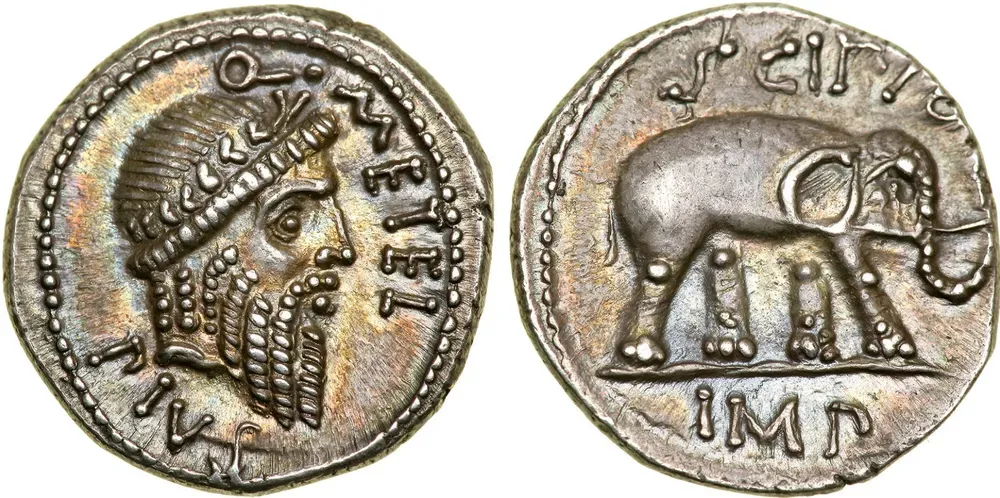
Crawford 459/1 Quintus Caecilius Metellus Pius Scipio, 47 BC
Image courtesy of Ira & Larry Goldberg Coins
In the final stretch of the civil war between Caesar and Pompey, after the Pompeian defeat at Pharsalia (48 BC), Publius Cornelius Scipio Nasica fled to Africa. There he took command of the remains of the Pompeian army. Scipio acted as supreme leader of the Pompeian side in Africa and established his headquarters in Utica. He faced Caesar in the African campaign of 47–46 BC. and was decisively defeated at the Battle of Thapsus (April 46 BC). After the defeat, he tried to flee by sea, but was captured and committed suicide to avoid falling into Caesar’s hands alive.
On the denarius we have an obverse with the laureate bust of Jupiter, a symbol of supreme authority and legitimacy, with the legend Q METEL PIVS, reinforcing the image that Scipio fought for the “true” Republic under divine protection. On the reverse, an elephant and the legend SCIPIO IMP, which proclaims Scipio as imperator. The elephant was a traditional emblem of the Caecilia gens, inherited from their ancestor Metellus Pius, famous for his victories in Africa. Due to his paternal lineage, Scipio also descended from the illustrious family of the Cornelians Scipios, to which Scipio Africanus belonged, victorious over Hannibal in the Second Punic War, thus linking the military glory of his ancestors with his own African campaign against Caesar.
Year 47 BC – Caesar finances his troops with new issues in Africa.
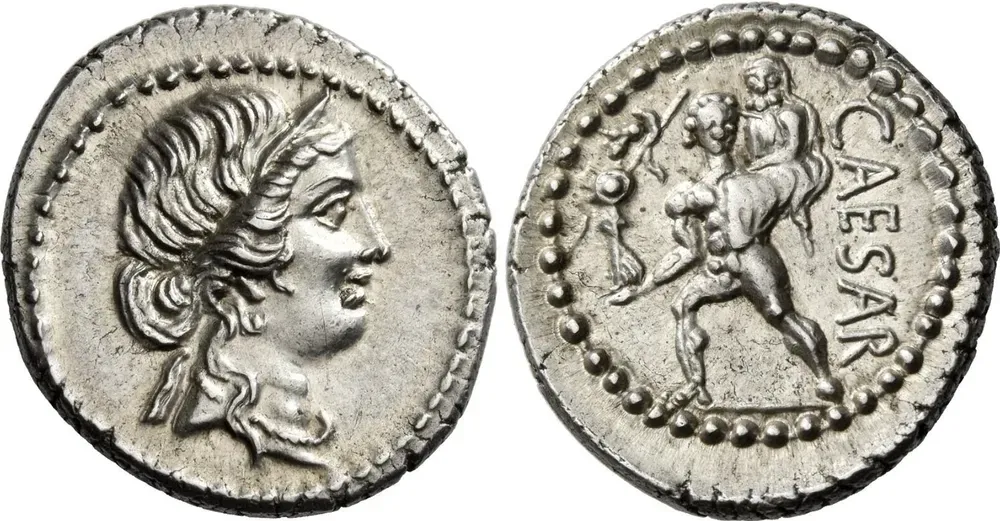
Crawford 458/1 Julius Caesar, 47 BC
Image courtesy of Numismatica Ars Classica
After settling affairs in Egypt and defeating Pharnaces of Pontus at Zela with his famous veni, vidi, vici, Caesar returned as the victor of the East and headed to Africa, where the Pompeians had reorganized their forces. To finance the expedition, he ordered the minting of new issues with a strong propaganda load.
On the obverse appears Venus, protective goddess of Caesar and mythical origin of the Julia gens, symbol of its divine legitimacy. On the reverse, Aeneas carrying his father Anchises and bearing the Palladium evokes the Trojan myth that linked his family to the origins of Rome. The message was clear: Caesar was not only a victorious general, but the heir to a founding destiny.
The African echo further reinforced this iconography. According to tradition, in his escape from Troy, Aeneas passed through Carthage and joined Queen Dido, a mythical episode that inaugurated the rivalry between Rome and Africa. By representing him in this issue, Caesar presented himself as a continuator of that epic: the Trojan hero who once again won in the lands of Carthage, now against the Pompeians.
Year 46 BC – Pompey’s sons resist in Hispania.
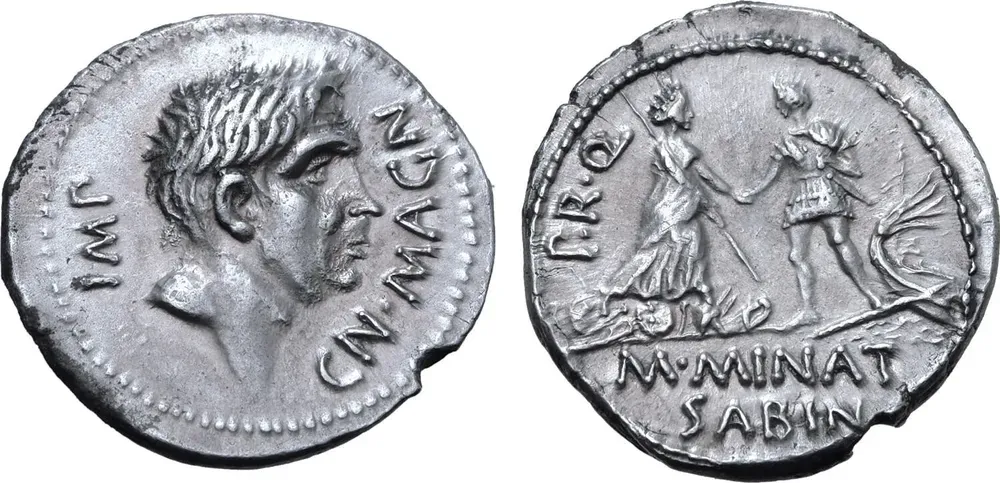
Crawford 470/1a Marcus Minatio Sabinus / Gnaeus Pompey the Younger, 46 BC
Image courtesy of Numismatica Ars Classica
After Scipio’s defeat at Thapsus (46 BC), the remains of his army—along with other Pompeian veterans and local troops—regrouped in Hispania under the command of Gnaeus and Sextus Pompey, sons of Pompey the Great. From bases like Corduba, they reinforced their forces and reorganized the resistance against Caesar, eventually gathering a very large army. This concentration of military power culminated in the battle of Munda (present-day Montilla in the province of Córdoba) on March 17, 45 BC, the last major confrontation of the civil war, in which Caesar obtained the definitive victory and the Pompeian side was annihilated.
On the obverse we have the portrait of Pompey the Great, to legitimize the command of his son and reinforce the loyalty of the troops by remembering the figure of his father. On the reverse, we have an allegory of Corduba (current Córdoba), Pompeian operations center in Hispania, receiving a soldier with a welcoming gesture.
Year 44 BC – Caesar achieves absolute power.
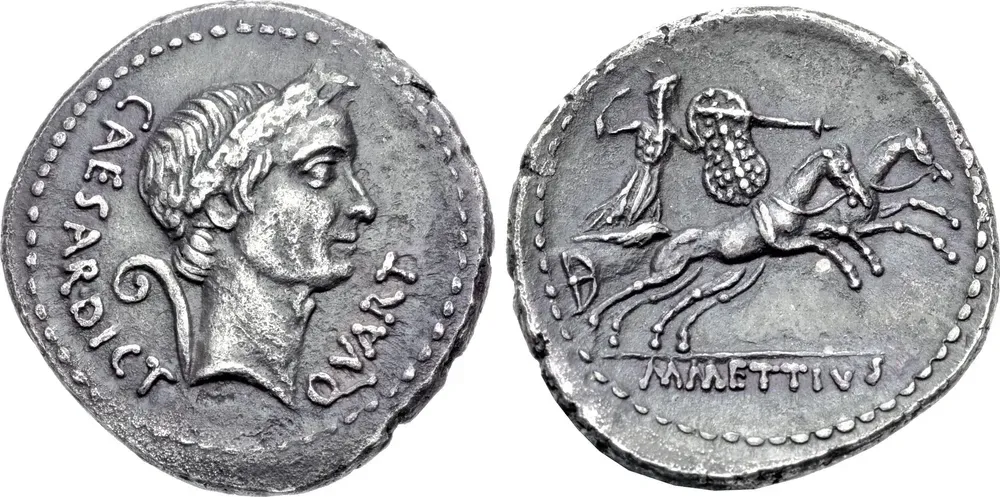
Crawford 480/2a Marco Mettio, 44 BC
Image courtesy of Classical Numismatic Group
Julius Caesar returned to Rome after definitively defeating the Pompeians, and the Senate named him dictator for the fourth time, shortly before granting him the title of dictator perpetuo. At this decisive moment, coins were minted that, for the first time in Republican history, showed the portrait of a living person. On the obverse Caesar appears with his bust facing right and crowned with laurel, a symbol of military triumph and personal glory, presenting him as the supreme victor and at the same time giving him an almost monarchical imprint, in the style of the Hellenistic kings. Behind the head the augural lituus can be seen, alluding to his dignity as Pontifex Maximus and reinforcing the accumulation in his person of the highest political, military and religious powers. The legend CAESAR DICT QVART refers to his office in those first months of 44 BC. The reverse shows Juno Sospita, a warrior goddess associated with Lanuvium, driving a biga to the right, armed with spear and shield, a symbol of divine protection and the martial virtues of Rome. The legend M METTIVS appears in the exergue, identifying the moneyer Marcus Mettius, a faithful follower of Caesar and responsible for the coinage.
Year 44 BC – Caesar falls on the Ides of March and Mark Antony emerges.
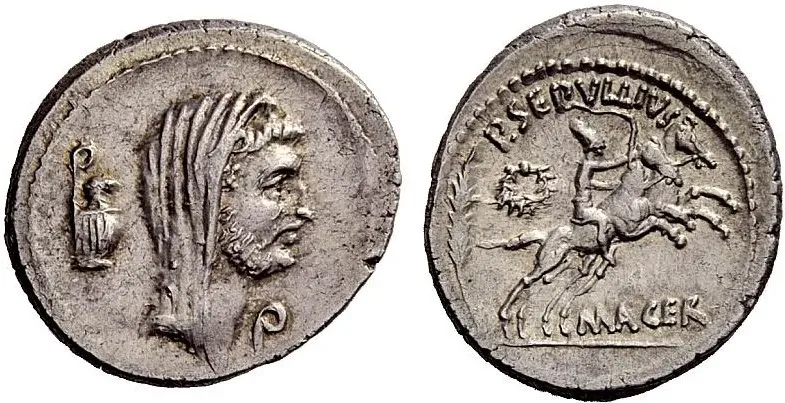
Crawford 480/22 Publius Sepullius Macer, 44 BC
Image courtesy of Numismatica Ars Classica
Julius Caesar is assassinated on March 15. Marcus Junius Brutus, whom Caesar had forgiven after Pharsalia, along with Gaius Cassius Longinus, led the tyrannicides. In the months immediately following the crime, the political climate in Rome was extremely tense: the Caesaricides claimed to have saved the Republic, while Caesar’s supporters, led by Mark Antony, demanded revenge.
It is in this context that this denarius issued by Publius Sepullius Macer appears, showing the portrait of Mark Antony on the obverse. The iconography is very revealing: he appears bearded and covered with a veil, a clear sign of mourning for Caesar’s death. The Romans used to grow their beards as a sign of mourning, and Antony would not shave until he consummated revenge against his general’s murderers. This detail turns the coin into a unique testimony of the political moment, loaded with symbolism. Furthermore, it is a milestone in numismatics: Mark Antony is the second living person to appear on a Roman denarius after Julius Caesar.
Year 43 BC – Resurgence of the Pompeian party
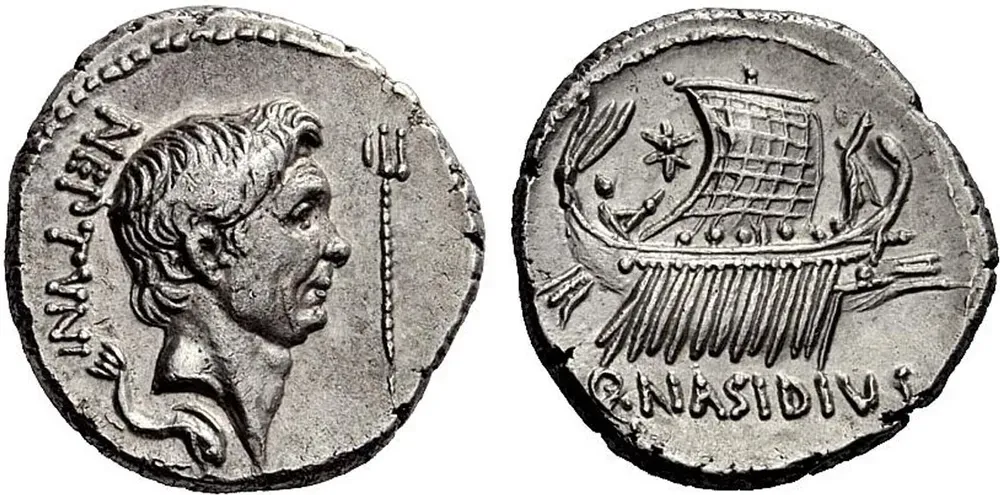
Crawford 483/2 Sextus Pompeius / Quintus Nasidius, 43 BC
Image courtesy of Numismatica Ars Classica
In the western Mediterranean, the figure of Sextus Pompey, the last surviving son of Pompey the Great, emerged. Heir to his father’s prestige, he assembled a powerful fleet with the help of faithful commanders, consolidating his maritime dominance and presenting himself as guarantor of the republican tradition against the Caesarians. This coin is part of that process of legitimation and propaganda.
On the obverse we have the bust of Pompey the Great along with a trident and a dolphin and with the legend NEPTVNI. The explicit mention of Neptune elevates him to an almost mythological level, granting Sextus a heroic and sacred lineage.
On the reverse, the galley represents the naval power of Sextus Pompey, his true base of political and military power. The star above the ship can be interpreted as a symbol of divine guidance and hope for victory. The inscription honors Quintus Nasidius, an admiral loyal to the Pompeian cause, consolidating the alliance between Pompey’s heir and his naval chief.
Year 43 BC – Octavian appears on a denarius.
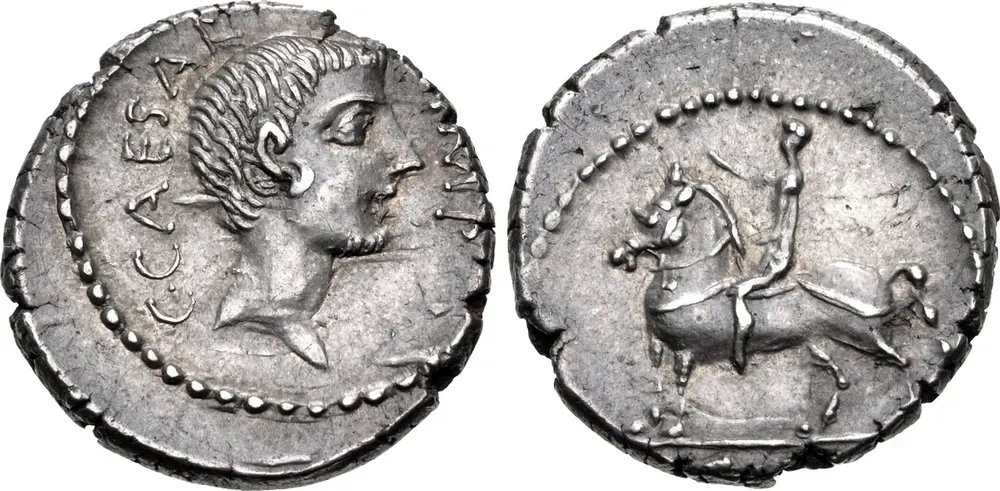
Crawford 490/1 Gaius Octavian, 43 BC
Image courtesy of Classical Numismatic Group
After the assassination of Julius Caesar, the young Octavian returned to Rome from Apollonia (Epirus), where he was studying. Caesar had adopted him in his will and Octavian immediately assumed the name of Gaius Julius Caesar Octavian, proclaiming himself political and religious heir of his uncle. In 43 BC, the Senate and the plebs officially recognized his position and he ended up being elected consul when he was only 19 years old. In those months of intense struggle with Mark Antony, Octavian used coinage as propaganda to legitimize his power and inheritance.
On the obverse we see his bearded bust, within the possibilities of a 19-year-old young man, as a sign of mourning. The legend CAESAR IMP emphasizes his identity as the new Caesar and military commander (imperator), although he had not yet demonstrated great military experience: it was an inherited legitimacy.
On the reverse appears the equestrian statue of Octavian that the Senate erected in Rome in 43 BC in recognition of his services and as Caesar’s heir. It was an exceptional honor for someone so young. The inclusion of S C in the legend, which does not appear in this image, indicates that this coinage had the formal approval of the Senate, underlining that Octavian did not act only as a military leader, but as an officially recognized figure in the structure of the state.
Year 43 BC – Formation of the Second Triumvirate, Lepidus appears in denarii.
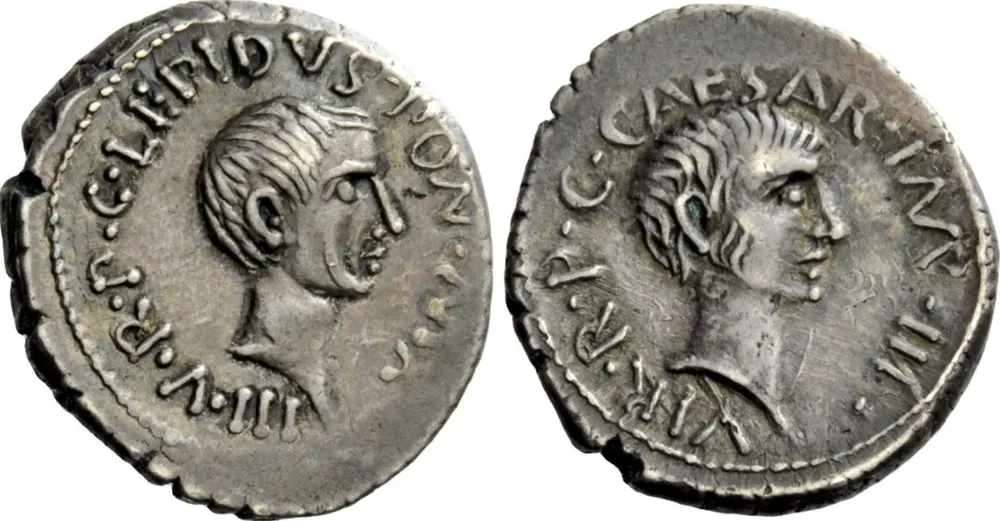
Crawford 495/2a Marcus Aemilius Lepidus, 42 BC
Image courtesy of Numismatica Ars Classica
Shortly after the Second Triumvirate was formed in November 43 BC between Octavian, Mark Antony and Lepidus, the latter minted his denarii to reinforce his political position. In them he recalls that he had been named Pontifex Maximus in 44 BC, after the death of Julius Caesar, and emphasizes that he holds this supreme religious office for life. At the same time, his status as triumvir for the reorganization of the state (III VIR R P C) stands out, placing him on an equal footing with the other two members of the pact.
In these issues, Lepidus appears on the obverse with his bust accompanied by the legend LEPIDVS PONT MAX III VIR R P C, while on the reverse there is the portrait of Octavian with the inscription CAESAR IMP III VIR R P C. The coin, therefore, not only legitimizes Lepidus as a religious leader, but also presents him associated with Gaius Julius Caesar Octavian, adopted son and political heir of the deified dictator.
Year 43 BC – The Caesaricides promote Cassius.
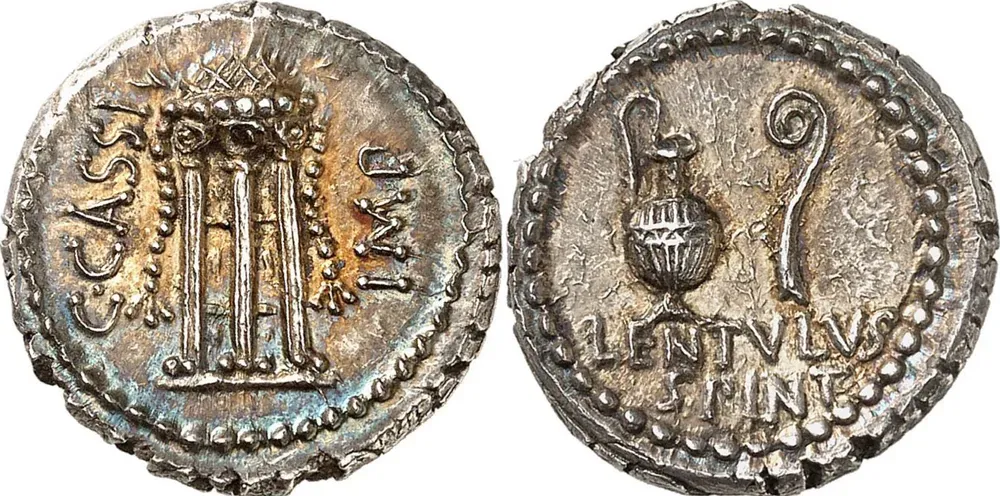
Crawford 508/3 Gaius Cassius Longinus / Marcus Junius Brutus / Cornelius Lentulus Espinter, 43 BC
Image courtesy of Maison Palombo
With this denarius, the Caesaricides sought to convey the religious and moral legitimacy of their cause, presenting Cassius as imperator under the protection of the gods. On the obverse, the tripod with a cauldron and laurel branches refers to the cult of Apollo and the purification rites, while on the reverse the jug and the lituus evoke the augural instruments of Rome, alluding to priestly authority and republican tradition. The presence of Lentulo Espinter in the legend reinforces the idea of a common front of magistrates and senatorial leaders. Altogether, the coin proclaims that the war against the triumvirs was not a rebellion, but a just fight protected by the gods to restore the republic.
Year 43 BC – Brutus spreads a clear message in his EID MAR denarius.
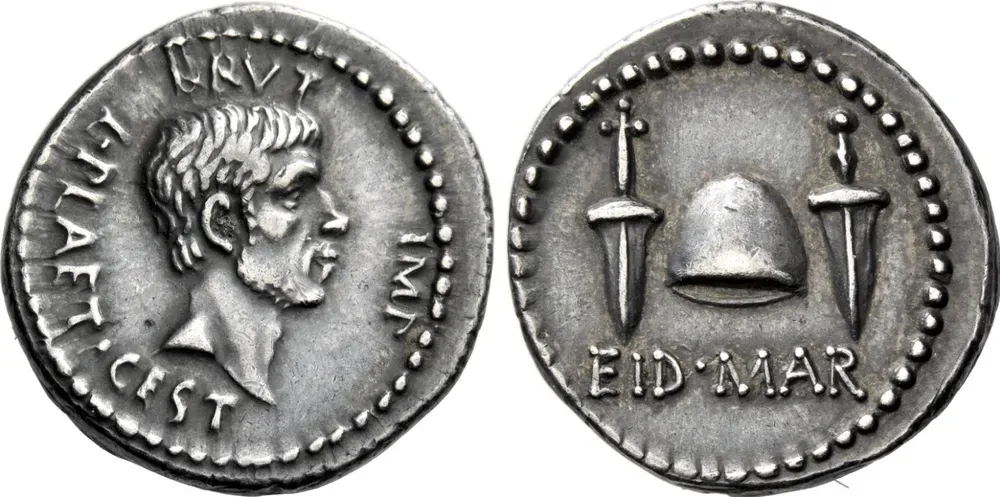
Crawford 508/3 Marcus Junius Brutus / Lucius Plaetorius Cestianus, 42 BC
Image courtesy of Numismatica Ars Classica
While the Second Triumvirate consolidated its power in Rome, the opposing side also resorted to coinage as propaganda. Led by Marcus Junius Brutus and Gaius Cassius Longinus, the Caesaricides minted denarii in the East that exalted their cause: the defense of republican freedom against what they considered the tyranny of Caesar and the ambition of his heirs. A supreme example of this strategy is the famous EID MAR denarius, attributed to Brutus and minted in 43/42 BC, probably in a traveling military mint in Macedonia or Thrace (possibly Amphipolis or Thessalonica).
On the obverse appears the bearded portrait of Marcus Junius Brutus, with the inscription BRVT IMP L·PLAET·CEST. Which consolidates the propaganda turn towards the personal portrait that Caesar had inaugurated. On the reverse the famous design of the pileus (cap of freedom) flanked by two daggers, with the inscription EID·MAR. The message is unmistakable: celebrate the Ides of March 44 BC, the day Caesar was eliminated in the name of republican freedom.
Year 42 BC – Quintus Cornificius rises in Africa as a third way.
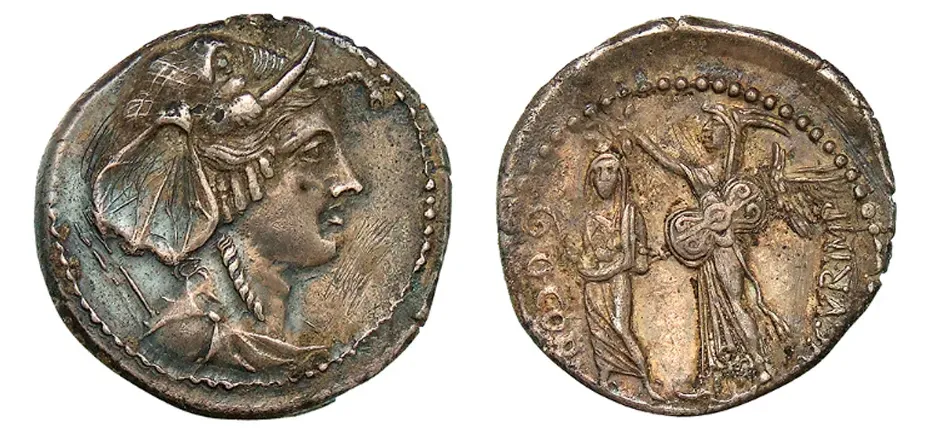
Crawford 509/4 Quintus Cornificius, 42 BC
Image courtesy of Münzkabinett Berlin.
Quintus Cornificius was a Roman senator and military man appointed by Caesar as governor of Africa, a key position for control of grain. After Caesar’s assassination in 44 BC, the Senate confirmed him in office and Cornificius remained faithful to senatorial authority, refusing to submit to Mark Antony or the Caesarians. In this way, he represented that intermediate line of the senatorial side that, without being Caesaricidal, opposed the absolute rule of Caesar’s heirs.
However, the triumvirs entrusted Africa to Titus Sextius, who defeated him shortly after. Cornificius died in combat in 43/42 BC, that is, before the battle of Philippi. His fall symbolized the rapid elimination of the last senatorial strongholds in the provinces, a prelude to the final clash between the Caesaricides and the Triumvirs in Macedonia.
His denarius from 42 B.C. It reflects the attempt to legitimize itself: on the obverse Africa appears with elephant skin and spears, while on the reverse Cornificius is presented as augur and imperator, crowned by Juno Sospita. The iconography unites military authority, religious legitimacy and African symbolism to reinforce its position against triumviral power.
Year 41 BC – Octavian and Mark Antony win at Philippi
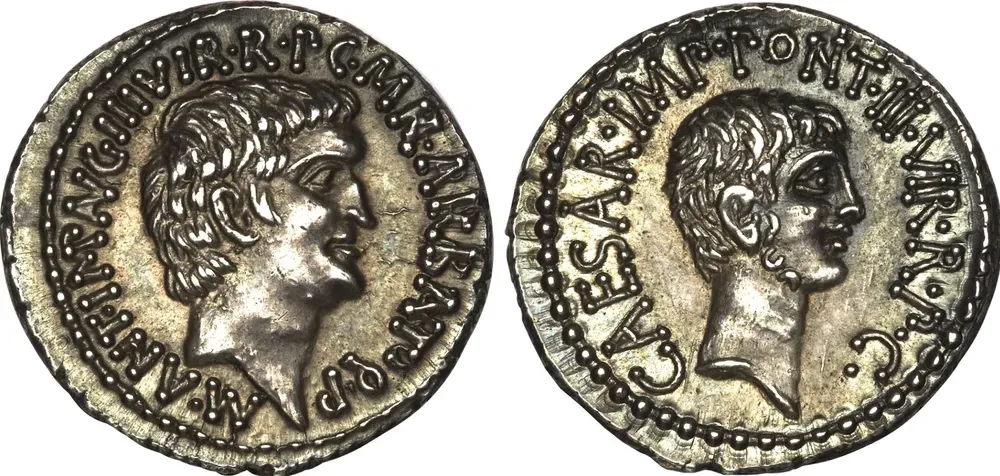
Crawford 517/2 Marcus Antonius / Marcus Barbatio Pollio, 41 BC
Image courtesy of Heritage Auctions.
In October 42 BC, Octavian and Mark Antony defeated the Caesaricides in the two battles of Philippi. Cassius committed suicide after the first, on October 3, and Brutus did the same after the second, on October 23. The victory at Philippi marked the end of the republican cause and left power in the hands of the Second Triumvirate: the East for Antony, the West for Octavian and Africa for Lepidus, who would soon lose political weight.
In the summer of 41 BC, already with Philippi as a backdrop, Mark Antony minted this denarius in Ephesus that projected the unity of the triumph. On the obverse appears Antony with his titles of Imperator, Augur and Triumvir; on the reverse, Octavian with those of Caesar, Imperator, Pontiff and Triumvir. The iconography shows a propaganda of harmony between Caesar’s two heirs, necessary to legitimize his power after the defeat of Brutus and Cassius, although under the surface the rivalry between the two was already beginning to grow.
Year 40 BC – Towards the Pact of Misenum with Sextus Pompey
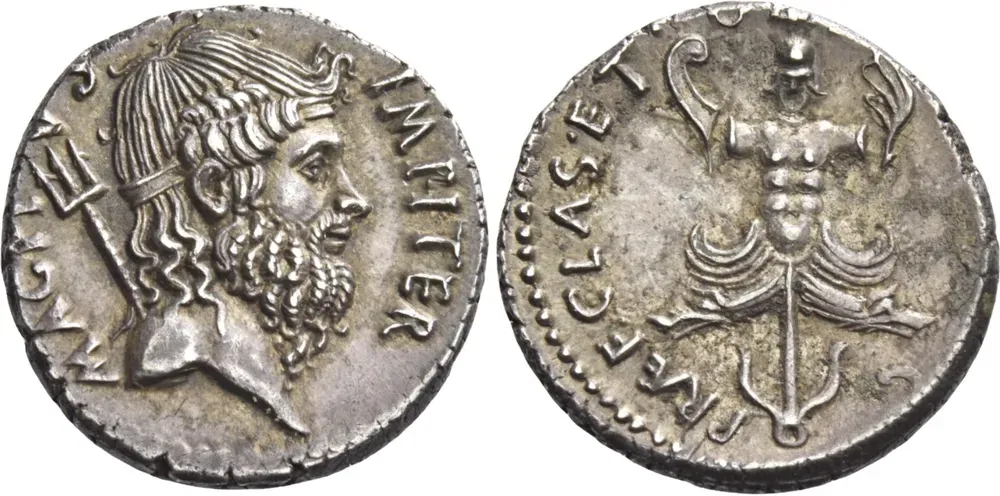
Crawford 511/2b Sextus Pompey, 40 BC
Image courtesy of Numismatica Ars Classica
This denarius of Sextus Pompey explicitly reflects his identity as lord of the seas. The obverse shows Neptune with the trident on his shoulder, alluding to the naval power inherited from his father Pompey the Great, which allowed him to control Sicily, Corsica and Sardinia. On the reverse there appears a naval trophy with a trident, anchor, prow, aplustre and figures of Scylla at the base, symbols of maritime supremacy and the victories achieved against their enemies. The legend PRAEF(ectus) CLAS(sis) ET ORAE MARIT(imae) EX S C recalls the title granted to his father by the Senate, and which Sextus adopted to legitimize his role as protector of the coasts and guarantor of the grain supply to Rome.
At the time of its issue, Sextus Pompey had consolidated his position in Sicily and dominated the western Mediterranean routes to the point of being able to cut off Rome’s wheat supply. That threat forced Octavian and Antony to formally recognize him in the Pact of Misenum (39 BC), which officially guaranteed him Sicily, Sardinia and Corsica in exchange for ensuring supplies to Italy. This denarius, therefore, does not commemorate a specific battle, but belongs to that context of tensions and negotiations, functioning as a piece of political and military propaganda that projected Sextus Pompey as the legitimate heir of the Pompeian cause and absolute master of the seas.
Year 41 BC – Lucius Antony rebels against Octavian
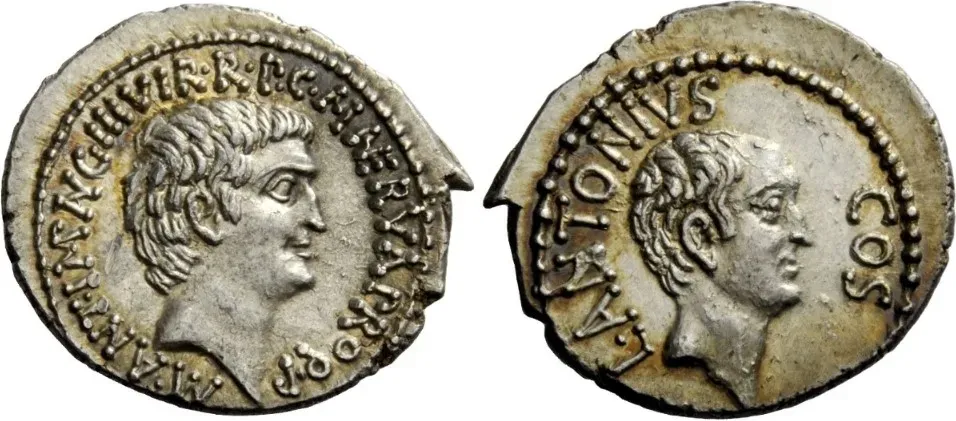
Crawford 517/5a Mark Antony / Marco Coceyo Nerva, 41 BC
Image courtesy of Numismatica Ars Classica
In the year 41 BC, while Mark Antony was in the East, his brother Lucius Antonius held the consulate in Rome. In this context, a very revealing denarius is minted, with Mark Antony on the obverse and Lucius on the reverse. The coin is a propaganda declaration of family unity: Antony, triumvir and political heir of Caesar, together with the acting consul, who provided institutional support for the Antonian cause.
Although the situation led to the so-called Perusine War (41–40 BC), when Lucius and Mark Antony’s wife, Fulvia, confronted Octavian in Italy to curb his power and denounce abuses in the distribution of land to veterans. Lucius entrenched himself in Perusia, where he was finally defeated and forced to surrender. Fulvia, a political figure of great character, died shortly afterwards in exile, paving the way for reconciliation between Antony and Octavian.
41 BC – Gnaeus Domitius Ahenobarbus, another power at sea.
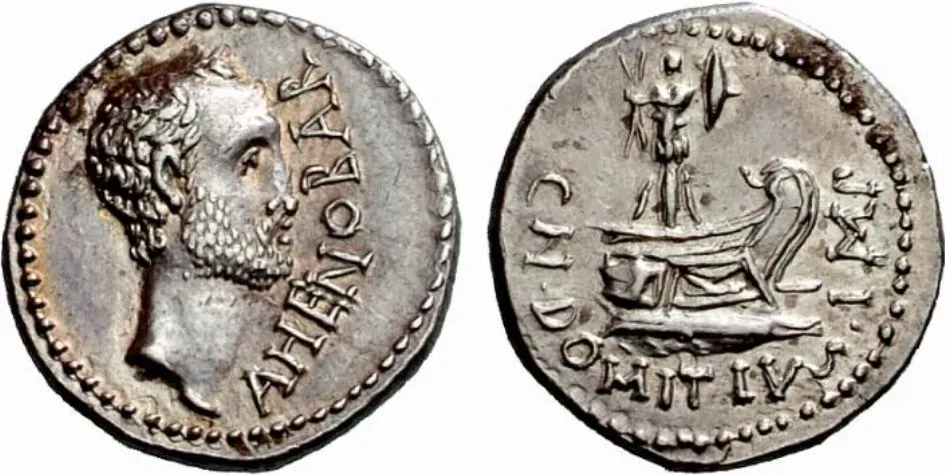
Crawford 519/2 Gnaeus Domitius Ahenobarbus, 41 BC
Image courtesy of Numismatica Ars Classica
Gnaeus Domitius Ahenobarbus, whose cognomen means “bronze beard” or “golden beard,” alluding to the characteristic reddish tone of his family, was one of the last senators faithful to the republican cause after the Ides of March. Although in 41 BC he presented himself as an independent naval chief, his career did not end there. Later he allied himself with Sextus Pompey to dominate part of the Adriatic and the supply routes of the triumvirs. His maritime power made him a key player in the years after Philippi, until, reconciled with Mark Antony, he achieved the consulship in 32 BC. On the eve of Actium he broke with Antony and shortly afterwards disappeared from the scene, just before Octavian’s definitive accession as Augustus.
The denarius issued in 41 BC (Crawford 519/2) reflects that stage of active resistance. The obverse shows his bearded bust with the inscription AHENOBAR, proudly affirming his family name and his status as a leader. The reverse, with the prow of a ship surmounted by a trophy of arms and the legend CN DOMITIVS IMP, underlines his role as a victorious naval commander. It is a typical piece of imperatorial coinage: a personal propaganda message, where legitimacy was based on military force and control of the sea.
Year 40 BC – Quintus Atius Labienus allies himself with the Parthians.
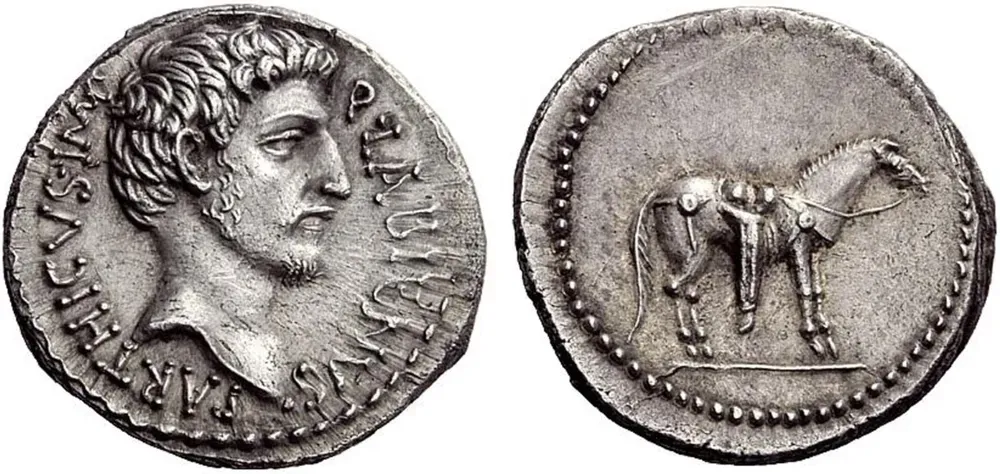
Crawford 524/2 Quintus Atius Labienus Parthicus, 40 BC
Image courtesy of Numismatica Ars Classica
Quintus Atius Labienus Parthicus, son of Caesar’s famous legate in the Gallic War who later joined Pompey’s side, was one of the last generals to support the Pompeian cause. After the defeat of Philippi, he initially entered the orbit of Mark Antony, but soon sought support from the Parthians to regain political and military prominence.
In 40 BC, with the support of the Parthian prince Pacorus I, he invaded Syria and Asia Minor, proclaimed himself imperator and minted coins with the legend Q. LABIENVS PARTHICVS IMP, in which he held the title of Parthicus as a symbol of his eastern alliance. However, his adventure was brief: in 39 BC he was defeated in Cilicia by Publius Ventidius Bassus, Antony’s lieutenant, who had him executed.
The figure of Labienus embodies a renegade Roman who, relying on a foreign power, tried to challenge the triumvirate in one of the most turbulent episodes of the transition towards Octavian’s absolute power. On the reverse of his denarii a Parthian horse appears with a bridle and saddle, accompanied by a bow case and quiver, characteristic attributes of Parthian cavalry.
Year 40 BC – Caesar returns to denarii.
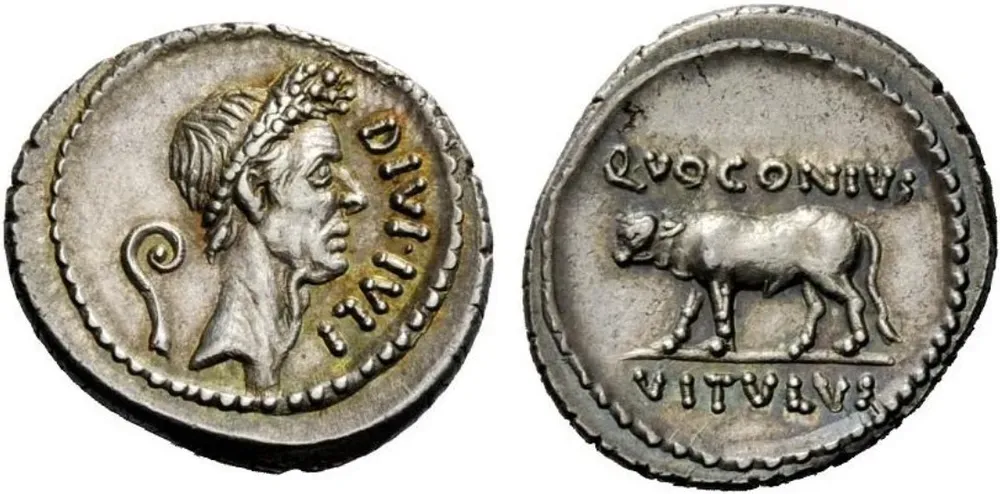
Crawford 526/4 Quintus Voconius Vitulus, 40 BC
Image courtesy of Nomos AG
Relations between the followers of Julius Caesar were turbulent and complicated. In this context, several coiners once again minted denarii with the bust of the dictator, now deified. This issue by Quintus Voconius Vitulus shows on the obverse the laureate portrait of Julius Caesar, accompanied behind by a lituus, symbol of his augural dignity, and the legend DIVI IVLI, a clear reference to the cult of the Divine Julius. This cult was promoted by Octavian to reinforce his legitimacy as Caesar’s heir (divi filius).
The reverse depicts a calf advancing to the left, with no meaning beyond a direct allusion to the magistrate’s cognomen, Vitulus (Latin for “calf”).
Year 39 BC – Antony and Octavian sign the Peace of Brundisiumum.
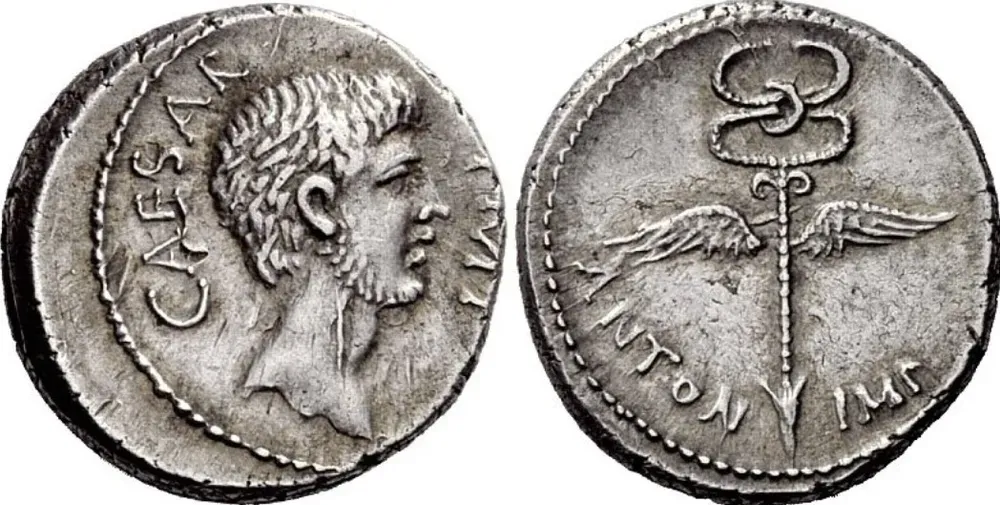
Crawford 529/2b Mark Antony / Gaius Octavian, 39 BC
Image courtesy of Numismatica Ars Classica
After the Perusine War and the growing confrontation between the sides of Mark Antony and Octavian, the tension threatened to definitively break the balance of the triumvirate. To avoid this, in September 40 B.C. The Peace of Brundisium was signed, by which the division of the Roman world was confirmed: Antony was in charge of the East, Octavian of the West and Lepidus of Africa. This agreement was sealed shortly after with the marriage of Antony and Octavia, Octavian’s sister, in an attempt to reinforce the reconciliation between the two.
This denarius, like another with the bust of Anthony, is issued as part of unity propaganda. The obverse features the bearded bust of Octavian with the legend CAESAR IMP, and the reverse a winged caduceus with the inscription ANTON IMP. The caduceus, a symbol of peace and harmony, underlines the message of reconciliation between both triumvirs, presented on an equal footing as imperatores.
Year 38 BC – Marcus Vipsanius Agrippa makes an appearance in the denarii.
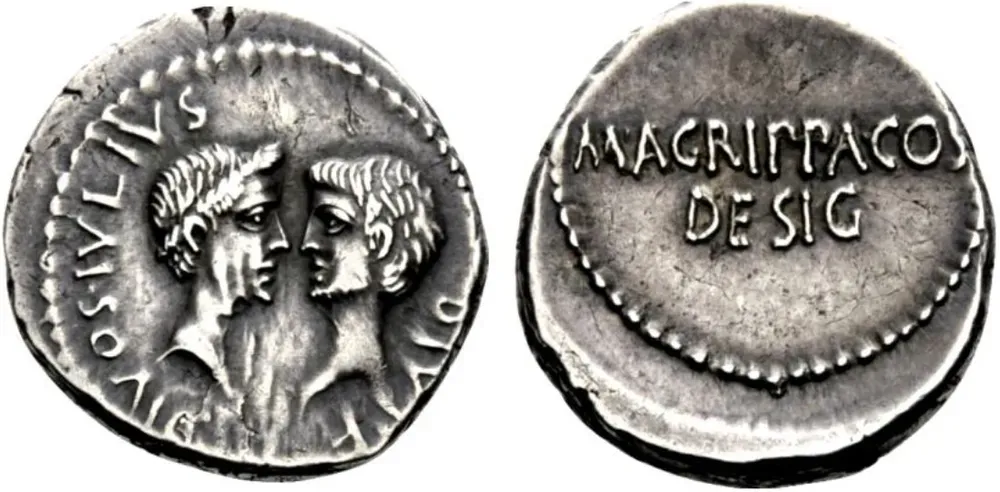
Crawford 534/2 Gaius Octavian / Marcus Vipsanius Agrippa, 38 BC
Image courtesy of Numismatica Ars Classica
Marcus Vipsanius Agrippa was the most faithful collaborator and friend of Octavian, the future Augustus. A skilled general and naval strategist, he played a decisive role in the civil wars, especially in the battle of Naulochus against Sextus Pompey and later at Actium against Mark Antony and Cleopatra. In addition to his military talent, he was a great builder and urban planner in Rome, responsible for works such as the Pantheon and the Aqua Virgo aqueduct, which reinforced the image of prosperity under Augustus.
In this denarius from the year 38 B.C. On the obverse, the bust of Julius Caesar is represented crowned in front of that of Octavian, underlining the divine filiation of the latter through the legend DIVOS IVLIVS DIVI F, which presents him as the adopted son of the deified dictator. The reverse, with the inscription M AGRIPPA COS / DESIG, honors the young Agrippa (25 years old) in his first appointed consulship, reflecting the political and personal alliance between the two, at a time when Octavian was beginning to consolidate his power after the assassination of Caesar.
Year 36 BC – Octavian pushes revenge against Sextus Pompey.
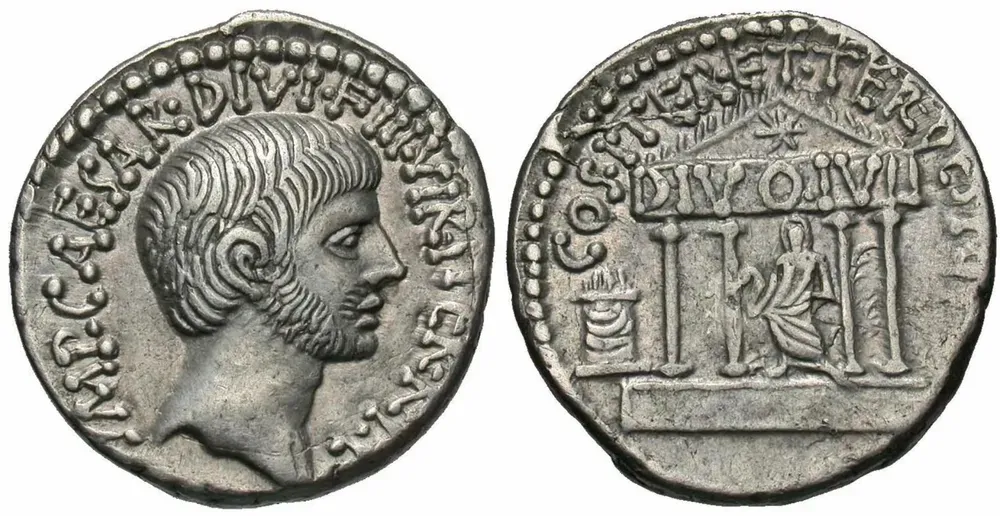
Crawford 540/2 Gaius Octavian, 36 BC
Image courtesy of VAuctions
This denarius, minted in 36 BC, shows on the reverse the temple of deified Caesar (DIVO IVL) in the Roman Forum, erected on the site of his cremation. The statue of Caesar veiled with lituus, the star of the Sidus Iulium on the pediment and the lit altar evoke his apotheosis and reinforce the cult that Octavian encouraged for his adoptive father. Although the temple was still under construction, its image on the coin had obvious propaganda value: it reminded that revenge for Caesar was still the driving force of his policy.
On the obverse, Octavian appears with a beard and the legend IMP CAESAR DIVI F III VIR ITER R P C. Although he had already shaved after the defeat of the Caesaricides, here he is still represented bearded with the barba pietatis, a symbol of mourning and his oath of revenge. The message is clear: there was still one enemy to eliminate, Sextus Pompey, son of Caesar’s great rival and master of the sea at that time.
The inscription on the reverse, COS ITER ET TER DESIG, indicates that Octavian was exercising his second consulship and was already appointed to a third, showing his political consolidation. This denarius was issued in the middle of the campaign against Sextus Pompey in Sicily, with the double objective of paying the legions and presenting the war as the culmination of revenge for Caesar. The decisive victory would come shortly after, at the Battle of Naulochus (September 3, 36 BC), when Agrippa’s fleet destroyed Sextus’s, forcing them to flee to the East. Captured the following year at Miletus and executed by order of Mark Antony, Sextus was the last obstacle in Octavian’s long revenge and path to absolute power.
Year 32 BC – Mark Antony chains fatal errors
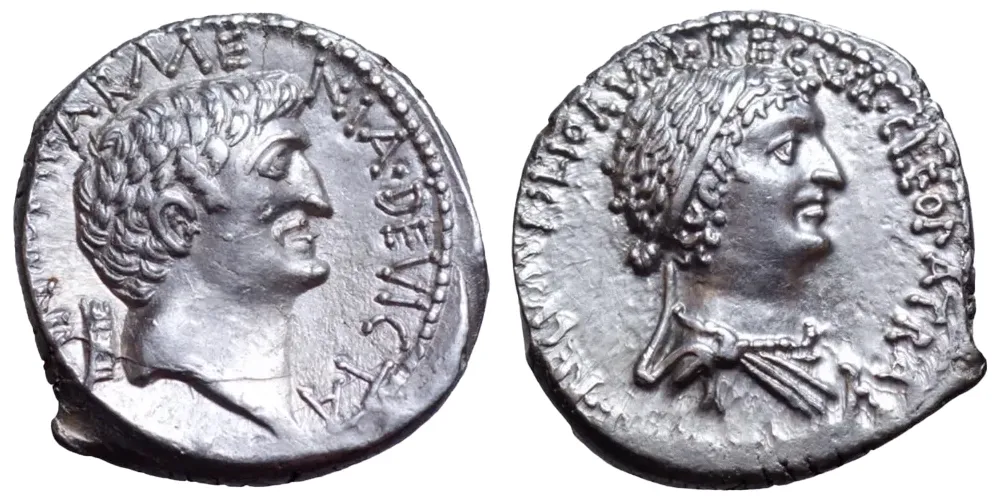
Crawford 540/2 Mark Antony, 36 BC
Image courtesy of Rome Numismatics
After the failure of his expedition against the Parthians in 36 BC, Mark Antony sought to regain prestige with a more accessible victory in Armenia in 34 BC. However, the celebration proved counterproductive: that same year, in Alexandria, he organized a Roman-style triumph and made the famous Donations of Alexandria (34 BC), dividing eastern territories between Cleopatra and her children. By publicly associating himself with the Egyptian queen and presenting her as “queen of kings,” Antony departed from Roman traditions and gave Octavian the perfect excuse to portray him as a traitor dominated by Cleopatra. Octavian’s propaganda exploited every mistake—the Parthian disaster, the Eastern pomp, the dynastic concessions—to convince the Senate and the people that the true enemy was no longer in the East, but within Rome itself. All this is reflected in the denarius issued in 32 BC, the only one that shows Mark Antony and Cleopatra together: on the obverse, Antony proclaims ARMENIA DEVICTA along with the tiara of the subject kingdom; On the reverse, the bust of Cleopatra with the legend that exalts her as “queen of kings and sons of kings”, a clear symbol of the personal and political alliance that would precipitate her ruin.
31 BC – The battle of Actium, the decline of Antony and Cleopatra
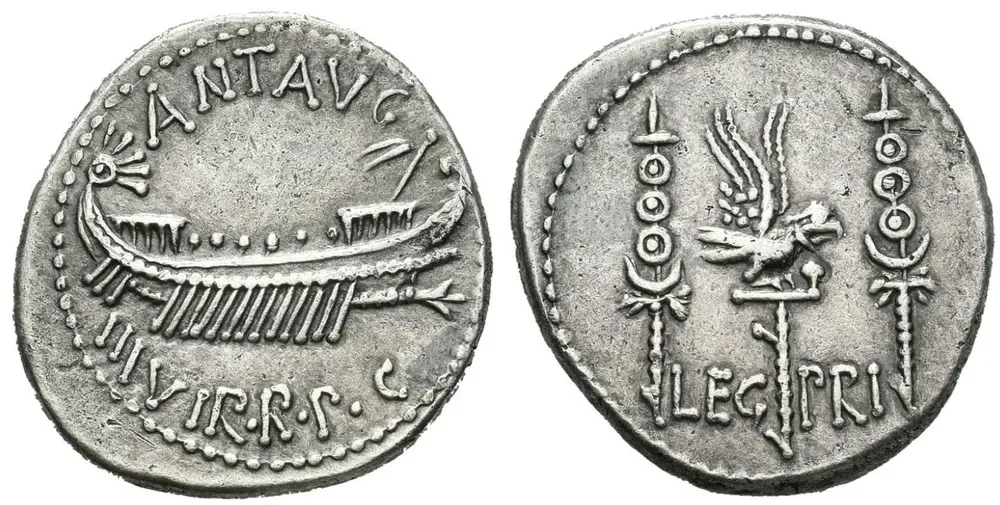
Crawford 544/13 Mark Antony, 31 BC
Image courtesy of Tauler & Fau
The decisive naval battle of Actium (31 BC) sealed the fate of Mark Antony and Cleopatra. In front of Octavian’s fleet, led by Agrippa, the Egyptian and Antonian ships were surrounded and, finally, Cleopatra chose to withdraw with her fleet, followed shortly after by Antony. The defeat was total and both fled to Egypt, where they ended up taking their own lives in 30 BC. After this outcome, Octavian emerged as the sole owner of Rome and would soon be proclaimed Augustus.
Antony’s “legionnaire” denarii, minted in the months prior to the confrontation, are one of the most iconic issues of the end of the Republic. We know thirty-two types cataloged by Crawford, each one with the numeral of a legion—some repeated with variants, such as LEG VIII and LEG IIX—in a clear attempt to reflect the breadth of his military power and exalt the fidelity of his troops. On the obverse appears a galley, a symbol of the naval force with which he intended to prevail in Actium, while the reverse shows a legionary eagle between two banners. Paradoxically, these coins, intended as propaganda for invincibility, ended up associated with one of the most famous defeats in Roman history.
Year 31 BC – Octavian on the way to Augustus
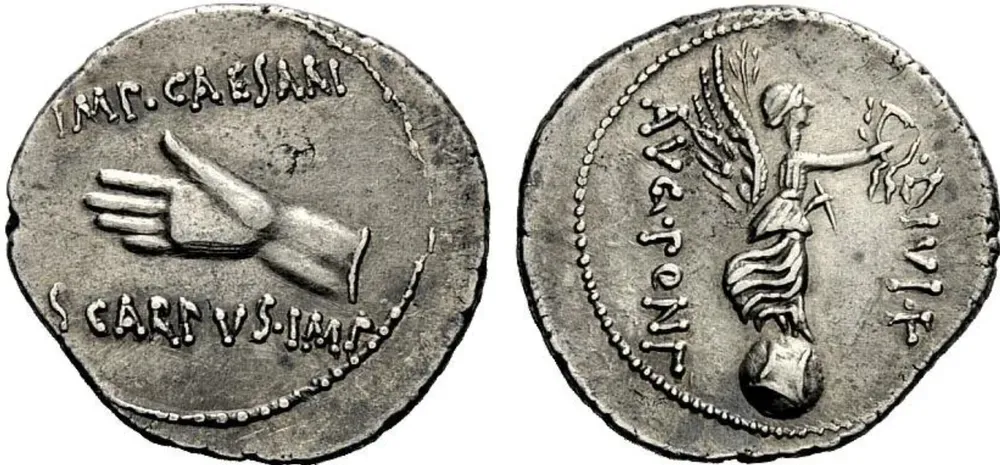
Crawford 546/7 Gaius Octavian / Lucio Pinario Escarpo, 31 BC
Image courtesy of Numismatica Ars Classica
Following Octavian’s victory at Actium, Egypt was incorporated as a Roman province under Octavian’s personal control. In 29 B.C. He returned to Rome as absolute owner, celebrating a triple triumph. Finally, in 27 B.C. He formally returned the administration of the provinces to the Senate, which in turn granted him the title of Augustus and an imperium for life. This act marked the end of the Roman Republic and the beginning of the Principate, the first stage of the Empire.
In this denarius, the last of the Republic collected in the Crawford RRC, an open hand is represented on the obverse with the legend SCARPVS IMP, a symbol of fides and concord that reflects the loyalty transferred to the new leader. On the reverse side Victory appears standing on a globe, holding a crown and a palm, with the legend CAESARI DIVI F (son of the divine Caesar). The scene alludes to the universal dominion of Rome after the victory of Actium, to the military triumph of Octavian and the lasting glory of his power, while the inscription underlines his legitimacy as adopted heir of Julius Caesar and continuator of his mission. With this coin, the history of the republican denarii symbolically closes and the long era of the Empire begins.
The closing of an era: from republican chaos to pax Romana
With Octavian’s victory at Actium (31 BC) and the conquest of Egypt (30 BC) his last rivals disappeared. In 28 B.C. He assumed the consulship alongside Agrippa and undertook the so-called “purification of the Senate”, a purge that reduced its number of members and reinforced the prestige of the institution, although in practice it remained under the absolute control of Octavian. The following year he staged the return of his extraordinary powers, and the Senate, without alternatives and under his influence, granted him the title of Augustus and an imperium superior to that of any other magistrate. That gesture, presented as a restoration of the Republic, actually marked the beginning of the Principate.
Although the Senate retained certain functions—administration of some pacified provinces, management of positions and religious prestige—it was subordinated to the new princeps. His survival was more a propaganda resource than a source of real power: Augustus presented himself as guarantor of traditional institutions, when in reality he concentrated control of the army, strategic provinces and political life in his person.
During the following years, what historians later called pax Romana was consolidated: a long period of stability and prosperity that ended a century of civil wars. The Republican denarii, loaded with symbols and messages of political urgency, gave way to imperial coinage, which now exalted peace, order and dynastic continuity.
Thus, those turbulent coins from the end of the Republic show us how Rome went from a system dominated by the rivalry of military leaders to a lasting empire, in which numismatic propaganda continued to be, for centuries, an essential tool of power.
Notes
About the term “imperatorial”
It is convenient to distinguish between the imperatorial period (the period of civil wars from Sulla to Augustus) and what in numismatics we call imperatorial denarii. This last term is used above all for the campaign coinage of the great generals—Caesar, Pompey, Brutus, Mark Antony, Octavian—although in Rome the triumviri monetales continued to issue “official” denarii with a strong political charge. That is, all the denarii from those years are from the imperatorial period, but not all of them fall into the imperatorial category.
About the end of the Republic
There is also no unanimity about the moment when the Roman Republic ceased to exist. Tradition usually points to Augustus as the first emperor and his rise as the beginning of the Empire. However, it was a more gradual process: many republican institutions were maintained, although subordinated to the figure of the princeps. More than a sudden break, it was a progressive transformation in which the Republic was emptied of political content.
Sources consulted and recommended readings
• M.H. Crawford, Roman Republican Coinage (Cambridge, 1974).
• Plutarch, Parallel Lives (Caesar, Pompey, Brutus, Antony).
• Appian, Civil Wars.
• Mary Beard, SPQR. A history of ancient Rome (Barcelona, 2016).
Furthermore, all images cite the auction houses and institutions that kindly allowed their use.
Register for free at Denarios.org, join our MEMBERS section and become part of the largest Spanish-language space dedicated to the Roman denarius.
Discover all the republican denarii collected at the Crawford RRC in our REPUBLIC section, and also explore the denarii of the Empire cataloged in the RIC in our EMPIRE section.