DR-245 | Crawford: 292/1
Publius Licinius Nerva
Publius Licinius Nerva
Gens: Licinia
Moneyer: Publius Licinius Nerva
Date and mint: 113 BC/112 BC - Rome
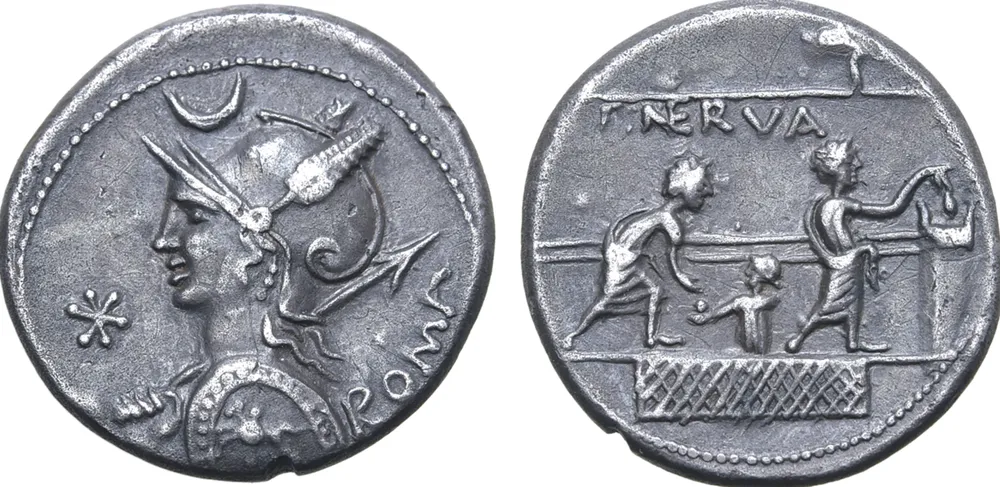
Obverse: Bust of Roma, left, wearing a helmet with a plume on each side and holding a shield in his left hand and a spear over his shoulder in his right hand. Dotted border.
Legend: ROMA
Symbols: Obverse above, Cross | Obverse before, x
Reverse: Voting scene. A figure to the left of the pons receives the ballot from the assistant below, another figure to the right of the pons places the ballot in the cist. At the top of the coin, a bar on which is a tablet with the letter P. Dotted border.
Legend: P NERVA
Comment: The Licinia gens was one of the most relevant plebeian families of the Republic. From the 4th century BC. He frequently held the consulate and other important positions, and his prestige was consolidated with figures such as Gaius Licinius Stolon, promoter of the Licinia-Sextia law that opened the consulate to plebeians. The cognomen Nerva identifies a branch within this gens, which would later give rise to the imperial family of the same name.
The moneyer man Publius Licinius Nerva is known mainly for this issue. There is no evidence of a distinguished political career, although it is possible that he held minor positions within the cursus honorum. As in so many other cases, access to the moneyer magistracy could have been the beginning of a public career that has not been documented in the sources.
The coin was minted in Rome between 113 and 112 BC, years marked by internal political tensions and external threats. In 113 BC, the Cimbri defeated a Roman army at Noreia, a prelude to a long conflict that would put the Republic in check. Internally, Roma continued to face pressure for social reforms and an increasingly decisive electorate, as the Tabellariae laws had introduced secret voting in assemblies at the end of the 2nd century BC. These transformations in the voting system expanded the plebs' margin of political maneuver and altered the traditional balances of senatorial power.
The message of the coin is clear in this context. On the obverse, Roma is depicted armed, a symbol of the city's strength and authority. The reverse, however, is the most unique element: it shows in detail the scene of a vote, with a citizen receiving his ballot, another depositing it in the urn (cista) and the pons through which the voters passed. At the top appears a tablet with the letter P, which could refer to populus or confirmation of the vote. We interpret this scene as a vindication of the role of the Roman people and the importance of the secret vote in assemblies, a recent innovation that reinforced the political power of the plebs. The choice of this motif seems linked to the prestige of the Licinia gens, traditionally associated with the defense of plebeian rights, and constitutes one of the most explicit representations of republican political life in all of Roman numismatics.
Provenance: Roma Numismatics (2022)
Price: 1,435 €
Other references
| Crawford: | 292/1 |
| DR: | 245 |
| BMCRR (Grueber): | Italia 526 |
| B (Babelon): | Licinia 7 |
| RSC (Seaby): | Licinia 7 |
| FFC (Fdez., Fdez., Calicó): | 802 |
| RC / RCV (D. Sear): | 169 |
| CRI (Sear Imperators) 49 - 27 BC: | |
| CRR (Sydenham): | 548 |
| Cal (Calicó): | 888 |
| RBW: | 1125 |
| Other authors: |
• Read the article about catalogues of Roman Republican coinage on our blog