Catalogues of Roman Republican Coinage
In this entry I have sought to make a brief reference to most of the coin catalogues from the time of the Roman Republic. My intention has been to mention and highlight those compendiums that, together, cover most of the essential references in the area. Although there are other more specialized catalogues that I have not integrated, I consider that the selected ones manage to bring together most of the available knowledge.
It should be noted that the REPUBLICAN DENARIES section of the website follows the same chronological order and references established in Crawford’s “Roman Republican Coinage”, and at the end of each file references to the other catalogues are included to offer a more complete vision and facilitate consultation for those interested.
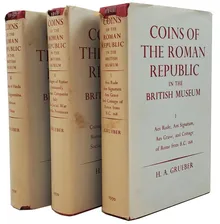
His work on Roman republican coins, focused exclusively on the British Museum collection, marked a before and after in cataloguing methodology. It can be considered the first systematic attempt at scientifically based classification. Regarding chronology, it differs from later studies and places the beginning of the denarius in the year 268 BC, following the historical references of Titus Livy. This work was published in London and Oxford in 1970.
In Forum Ancient Coins you can download the PDFs of the three volumes
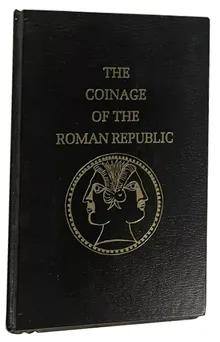
The Catalogue of Roman Republican Coins (CRR), published in 1952, proposed a chronological classification of denarii based on monetary families, styles, and issues. Contrary to Grueber’s traditional chronology, Sydenham places the first denarii around 187 BC, considering the previous didrachms as a previous stage.
Sydenham divides the coinage into seven periods and dedicates a broad introduction to explaining his method, although without elaborating on historical references, since he took Grueber’s work as a basis. Although its system was surpassed by Crawford’s in 1974, the CRR retains its value for its clarity of presentation and for continuing to be a common reference in catalogues of old auctions and historical collections.
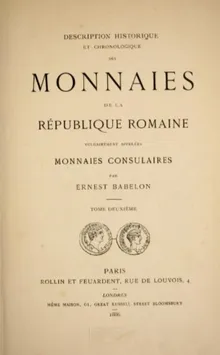
He is famous for his monumental work Description Historique et Chronologique des Monnaies de la République Romaine, published between 1885 and 1886 as part of the official catalog of the collection. This work, focused on the coin issues of the Roman Republic, became a fundamental reference for generations of researchers. For decades, it was the main starting point for the study of republican coins, and although it was later surpassed in some aspects by Michael Crawford’s catalog (1974), Babelon’s work continues to be consulted today for the richness of its historical analyses, iconographic descriptions and genealogical studies.
It can be consulted at Archive.org
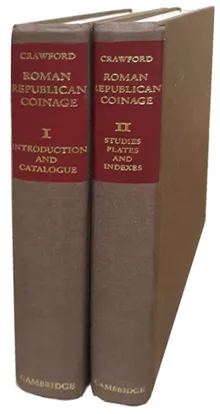
His work Roman Republican Coinage (1974) is considered an essential reference in the field of numismatics. This work presents an extensive analysis and cataloguing of the monetary issues of the Roman Republic, becoming a reference manual for researchers and collectors.
It dates the beginning of the minting of the denarius to the year 211 BC. and includes monetary production between 300 and 31 BC. The work was originally published by Cambridge University Press in 1974, with a reprint in 1983.
Its volume I and volume II can be consulted at Archive.org.
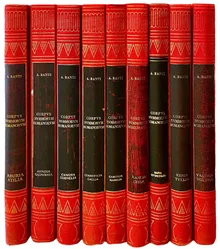
This bilingual (Italian/English) work focuses on coins minted by moneyers, grouping them according to families rather than chronologically.
It does not take into account early anonymous coins nor most of those issued in the late republican or imperatorial period. The work allows information to be cross-referenced with other important references (Babelon, Grueber, Sydenham and Crawford) and offers a detailed classification in which, in some cases, up to hundreds of minor variants in the control symbols of the minting dies are identified.
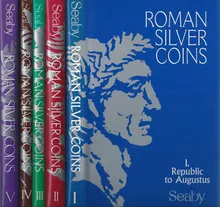
It is a very practical work, designed for collectors, with a clear classification by monetary families and with basic historical notes. Unlike Babelon or Crawford, it is much more accessible and functional to quickly consult a republican denarius.
Seaby was also the author of the Standard Catalogue of British Coins, a fundamental reference in the British sphere. His contribution to numismatics is still relevant today.
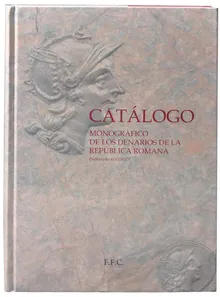
The work is the result of the work of three experts: José Fernández Molina, who carries out a detailed analysis of the emissions; Manuel Fernández Carrera, which coherently integrates historical and artistic aspects; and Xavier Calicó Estivill, specialist in iconography and typology.
Published in Madrid in 2002.
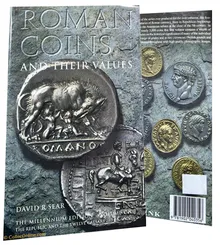
Sear manages to detect and correct existing errors in previous classifications, which makes it indispensable for collectors and numismatic experts.
The work, in English, is organized into several volumes that cover both Republican and imperial coinage. The first edition was published in 1964 and revised in 1988. The first volume covers a period of approximately 375 years, from the origins of coinage in the Republican period to the violent end of the second imperial dynasty, the Flavian, in 96 AD. Subsequently, four other volumes were published: the second covers until Nerva, the third until the death of Carinus, the fourth until the death of Constantine the Great and the fifth concludes the series covering until the year 491 AD.
Note that there is a website of David Sear himself
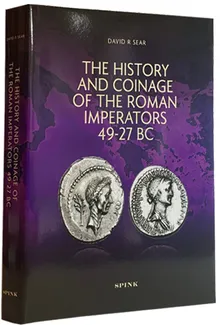
The book has six sections that are divided into: 1. Pharsalia: the civil war between Caesar and Pompey; 2. Thapsus and Munda: the final defeat of the Pompeians; 3. The Ides of March and Philippi: the death of Caesar and the fall of the republican cause; 4. From Philippi to the Parthian War: the rise of Antony and the growing dissension of the triumvirs; 5. From the Parthian War to the suicides of Antony and Cleopatra: the rise of Octavian and the final test of strength; 6. The preeminence of Octavian: prelude to the Empire, 30-27 BC.
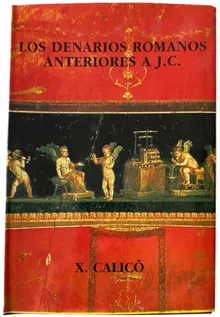
Unlike specialized works such as those of Crawford or Sydenham, the CAL catalogue does not adhere to a rigorous chronology nor does it delve into historical contexts or stylistic analysis.
Its strength lies in facilitating the valuation of coins through clear images and indicative price references based on the commercial market.
Written in Spanish, the catalogue’s visual and accessible format has made it an essential tool, especially for those who are new to republican numismatics or need a quick appraisal of common pieces.
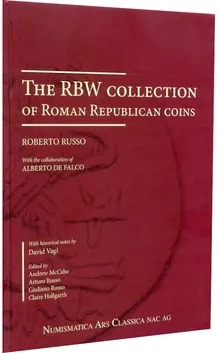
Considered the most complete collection of Republican coinage ever auctioned, each piece is illustrated in color, with detailed descriptions and references to Babelon, Sydenham, Crawford and Historia Numorum Italia. It also indicates their provenance, prices achieved and, in many cases, editorial comments and comments from RBW itself on chronology or attribution.
Witschonke, a key figure in American numismatics, stood out as a collector, researcher and businessman, devoting himself to the study and collecting of Roman coinage from his youth and throughout his life.