DR-861 | Crawford: 534/3
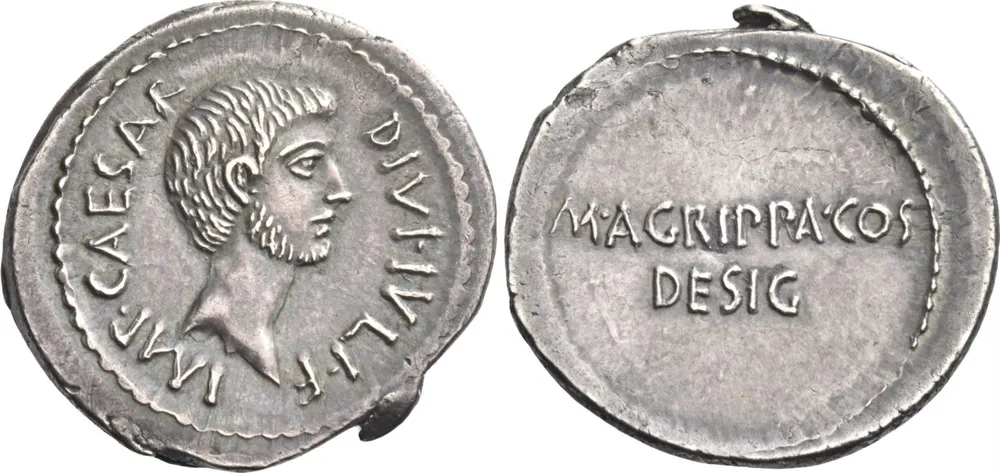
Gaius Octavius / Marcus Vipsanius Agrippa
Gaius Octavius / Marcus Vipsanio Agripa
Gens: Julia / Vipsania
Moneyer: Gaius Octavius / Marcus Vipsanius Agrippa
Date and mint: 38 BC - ?
Obverse: Bust of Octavian, right, with beard. Dotted border.
Legend: IMP CAESAR DIVI IVLI F
Reverse: Legend. Dotted border.
Legend: M AGRIPPA COS / DESIG
Comment: The gens Antonia was an influential plebeian family. In addition to Mark Antony, the famous triumvir, his grandfather Mark Antony the Orator also stood out for his rhetorical skill and military leadership, occupying the consulship in 99 BC. The family maintained a prominent position in the public life of Roma during the 1st century BC, although its power collapsed after the defeat of Mark Antony at Actium.
Mark Antony was one of Julius Caesar's main allies and, after his death, became one of the key figures of the Second Triumvirate. Antony had an extensive political and military career, standing out as a charismatic leader, although his ambitions in the East and his relationship with Cleopatra ended up undermining his power in Rome.
This denarius was minted in 32 BC, after Mark Antony's successful campaign in Armenia, whose victory is commemorated on the obverse with the title "Armenia Devicta". Antony distributed these denarii among his troops and the people, both as payment and to reinforce his image as a victorious military leader. This victory was crucial to strengthen his position before the civil war that would confront him with Octavian. The denarii also served as propaganda, highlighting their military successes at a key moment before the Battle of Actium.
On the obverse, the bust of Mark Antony with the Armenian tiara celebrates his recent military victory in Armenia. On the reverse, Cleopatra appears diademed and with a draped bust, underlining her status as queen of Egypt and mother of future kings. The bow before her image suggests the naval power that she controlled, key to subsequent events.
This denarius is the only one in which Mark Antony and Cleopatra appear associated. It is assumed that it was minted to celebrate the victory of Mark Antony in Armenia and that it was distributed among the soldiers and the people on the occasion of such celebration. This variant is also very rare because ARMENTA appears instead of Armenia on the reverse. This particular piece, according to Ars Classica, An extremely rare variety of a fascinating subject. Hit on large flan without the usual countermark.
Provenance: Numismatica Ars Classica (2020)
Price: 29,657 €
Other references
| Crawford: | 534/3 |
| DR: | 861 |
| BMCRR (Grueber): | Galia 103 |
| B (Babelon): | Julia 131 Vipsania 3 |
| RSC (Seaby): | Octavio y M. Agrippa 545 |
| FFC (Fdez., Fdez., Calicó): | Octavio y M. Agrippa 336 |
| RC / RCV (D. Sear): | 1543 |
| CRI (Sear Imperators) 49 - 27 BC: | 307 |
| CRR (Sydenham): | 1331 |
| Cal (Calicó): | 1388 |
| RBW: | |
| Other authors: | Cohen 545 |
• Read the article about catalogues of Roman Republican coinage on our blog