DR-860 | Crawford: 534/2
Gaius Octavius / Marcus Vipsanius Agrippa
Gaius Octavius / Marcus Vipsanio Agripa
Gens: Julia / Vipsania
Moneyer: Gaius Octavius / Marcus Vipsanius Agrippa
Date and mint: 38 BC - ?
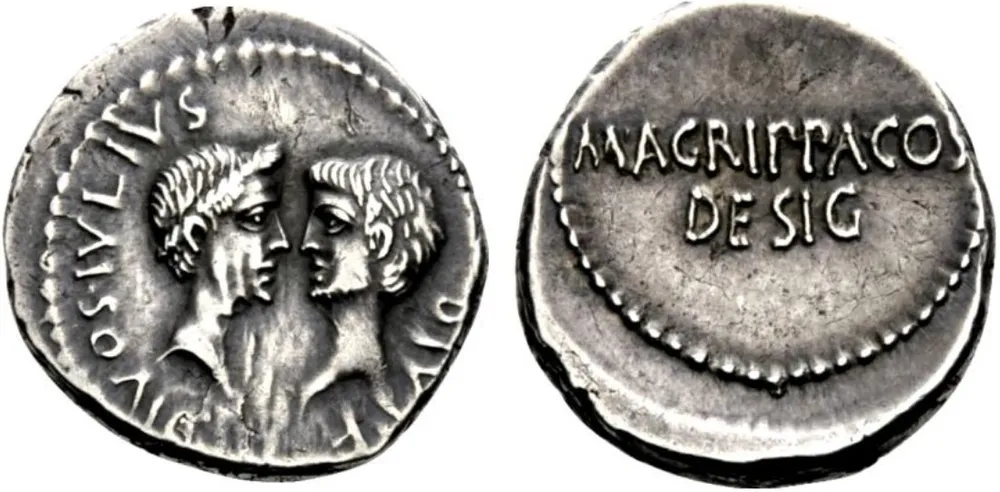
Obverse: Bust of Caesar crowned and Bust of Octavian facing each other. Dotted border.
Legend: DIVOS IVLIVS DIVI F
Reverse: Legend. Dotted border.
Legend: M AGRIPPA COS / DESIG
Comment: The gens Julia was one of the oldest patrician families in Rome, famous for attributing its lineage to Venus and Aeneas. Its most famous member, Julius Caesar, was adopted as a divine figure after his assassination in 44 BC, allowing his heir Gaius Octavius to legitimize himself as divi filius, son of the god. The gens Vipsania, on the other hand, was of plebeian origin and achieved notoriety thanks to Marcus Vipsanius Agrippa, a close friend and inseparable collaborator of Octavian, who rewarded him with extraordinary honors.
Agrippa stood out as a general and naval strategist, playing a decisive role in the victory of Naulochus (36 BC) over Sextus Pompey and, years later, in that of Actium (31 BC) against Mark Antony and Cleopatra. In addition to his military successes, he was a great promoter of public works in Rome, responsible for emblematic buildings such as the Pantheon and the Aqua Virgo aqueduct, contributing to the image of prosperity that accompanied the Augustan regime.
The denarius of 38 B.C. It is one of the most special pieces from this period due to its strong symbolic load. On the obverse appear the facing busts of crowned Julius Caesar and Octavian, with the legend DIVOS IVLIVS DIVI F, which underlines the divine filiation of the young heir: Octavian thus presented himself not only as a political successor, but as an adopted descendant of the already deified Caesar. The bust of Caesar with a crown is, furthermore, one of the first representations of his condition as divus, anticipating the later construction of the temple of the Divine Julius in the Roman Forum.
On the reverse, the inscription M AGRIPPA COS / DESIG honors a barely 25-year-old Agrippa, appointed to his first consulship. Its inclusion is extraordinary: rarely has a collaborator who did not belong to the ruling family been honored in life with such prominence on the coin. Octavian thus publicly showed the loyalty of his lieutenant and consolidated the political and personal alliance that supported his rise.
This coinage brilliantly brings together three protagonists from different “generations”: the deified dictator (Caesar), the political and religious heir (Octavian) and the military arm that ensured power (Agrippa). Together, they projected an image of continuity, divine legitimacy, and military strength. It was a novel propaganda formula that anticipated the imperial model: the prince as the son of the god and his collaborators as guarantors of the new order.
The choice of moment is also significant. In 38 B.C. Octavian continued to consolidate his position against Sextus Pompey and Mark Antony. By placing himself next to the deified Caesar and honoring Agrippa as designated consul, Octavian sent a message of unappealable authority: heir of the god and master of the armies. The place of issue has been located in a mint in southern Italy or in Gaul, key areas in the operations against Pompey, which gives full meaning to the insistence on Agrippa's dynastic legitimacy and naval strength.
This denarius not only commemorates a political appointment, but also constitutes a direct precedent of imperial iconography. In it the elements that will mark Augustus' propaganda already appear: divine filiation, the cult of the Divine Julius and the exaltation of his collaborators as pillars of the regime. For this reason, beyond its rarity, it is one of the most eloquent and anticipatory coins of the transition between Republic and Empire.
Provenance: Numismatica Ars Classica (2013)
Price: 80,688 €
Other references
| Crawford: | 534/2 |
| DR: | 860 |
| BMCRR (Grueber): | Galia 100 |
| B (Babelon): | Julia 129 Vipsania 1 |
| RSC (Seaby): | Julio Cesar y Octavio 5 |
| FFC (Fdez., Fdez., Calicó): | Julio Cesar y Octavio 2 |
| RC / RCV (D. Sear): | 1542 |
| CRI (Sear Imperators) 49 - 27 BC: | 306 |
| CRR (Sydenham): | 1330 |
| Cal (Calicó): | 1387 |
| RBW: | |
| Other authors: | Cohen 5 |
• Read the article about catalogues of Roman Republican coinage on our blog