DR-791 | Crawford: 500/7
Caius Cassius Longinus / Marcus Iunius Brutus / Cornelius Lentulus Spinther
Caius Cassius Longinus / Marcus Iunius Brutus / Cornelius Lentulus Spinther
Gens: Casia / Junia / Cornelia
Moneyer: Caius Cassius Longinus / Marcus Iunius Brutus / Cornelius Lentulus Spinther
Date and mint: 43 BC/42 BC - ?
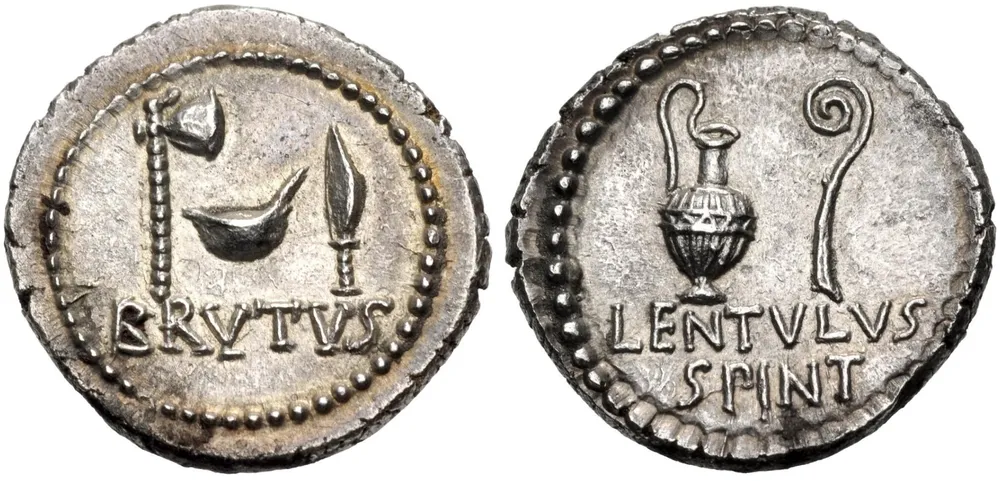
Obverse: Axe, cululus and knife. Dotted border.
Legend: BRVTVS
Reverse: Jug and lituo. Dotted border.
Legend: LENTVLVS / SPINT
Comment: Gens Casia, Junia and Cornelia: The gens Casia is a plebeian family that played an important role in Romen politics during the late Republic. Although not all its members reached high positions, some stood out at critical moments. The Junia gens also had a notable influence; Its most famous member, Marcus Junius Brutus, is known for his participation in the conspiracy against Julius Caesar. This gens is associated with courage and the fight for freedom, since an ancestor, Lucius Junius Brutus, was one of the founders of the Roman Republic and is remembered for overthrowing the last king of Roma, Tarquin the Proud, thus establishing a government based on the freedom and power of the people. The Cornelia gens was one of the oldest and most prominent, known for its numerous consuls and generals. The interaction between these gens in a period of political turbulence such as the civil war is crucial to understanding the conflict between the republicans and Caesar's supporters.
This denarius was issued between 43 and 42 BC. by Gaius Cassius Longinus, Marcus Junius Brutus and Cornelius Lentulus Spinther, who were involved in the conspiracy that led to the assassination of Julius Caesar in 44 BC.
- Gaius Cassius Longinus was quaestor in 49 BC. and is known as one of the leaders of the conspiracy against Caesar.
- Marcus Junius Brutus was quaestor in 44 BC. and became one of the most famous conspirators, considered a defender of the Republic.
- Cornelius Lentulus Spinther was praetor in 44 BC. and also actively participated in the conspiracy. The minting of this coin reflects their attempts to consolidate power and loyalty in a time of great instability. It was issued in a military context, where the conspirators sought to ensure the support of their troops in the face of political chaos.
After the assassination of Julius Caesar on March 15, 44 BC, Roma entered a phase of chaos and uncertainty. The conspiracy, carried out by Brutus, Cassius and others, sought to restore the Republic and eliminate what they considered the tyranny of Caesar. However, Caesar's death set off a series of chain reactions. Mark Antony, in his role as Caesar's colleague, took the lead in defending his interests, while Octavian, his adopted heir, returned to Rome to claim his legacy. In this context of instability, tension between the Republicans and the Caesarians intensified, leading to an open civil war. The Battle of Philippi in 42 BC, where the armies of Antony and Octavian defeated the forces of the conspirators, sealed the fate of Brutus, Cassius and Lentulus, and resulted in a consolidation of Caesar's power in the Roman government. This period marked the end of the Roman Republic and the rise to power of Octavian, who would become Augustus, the first emperor of Roma.
Obverse: The emblems of the pontiff, which include an axe, a cululus and a knife, underline the religious and sacrificial power of the Roman leaders. These symbols suggest a connection to the establishment of traditional order amid political turbulence.
Reverse: The augur's emblems, which include a jug and a lituo, highlight the importance of religion and omens in Romen politics. This may imply that the conspirators were acting under divine will, seeking to legitimize their action as a necessary act for the well-being of the Republic.
Provenance: Classical Numismatic group (2023)
Price: 8,000 €
Other references
| Crawford: | 500/7 |
| DR: | 791 |
| BMCRR (Grueber): | Este 80 |
| B (Babelon): | Junia 41 Cornelia 71 |
| RSC (Seaby): | Bruto 6 |
| FFC (Fdez., Fdez., Calicó): | Bruto 5 |
| RC / RCV (D. Sear): | 1431 |
| CRI (Sear Imperators) 49 - 27 BC: | 198 |
| CRR (Sydenham): | 1310 |
| Cal (Calicó): | 506 |
| RBW: | 1766 |
| Other authors: | Cohen 6 |
• Read the article about catalogues of Roman Republican coinage on our blog