The Tribute Denarius
“Render to Caesar what is Caesar’s, and to God what is God’s.”
The Tiberius Denarius: The Biblical Coin of Tribute to Caesar
The denarius of Tiberius, known as the “tribute denarius”, is one of the most emblematic coins of the Roman Empire. Minted between AD 14 and 37, mainly at the Lugdunum mint (present-day Lyon, France), this coin has become an object of fascination, both for its historical relevance and for its appearance in the Gospels of the New Testament.
Tiberius’s denarius is notable not only for its symbolic design, but also for the monetary policy it reflected. During his reign, Tiberius only authorized the minting of two types of denarii.
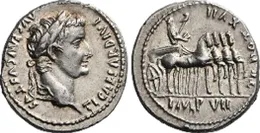
The first, extremely rare, shows the emperor in a quadriga (chariot drawn by four horses).
While the second, much more common, is known as the “tribute denarius.”
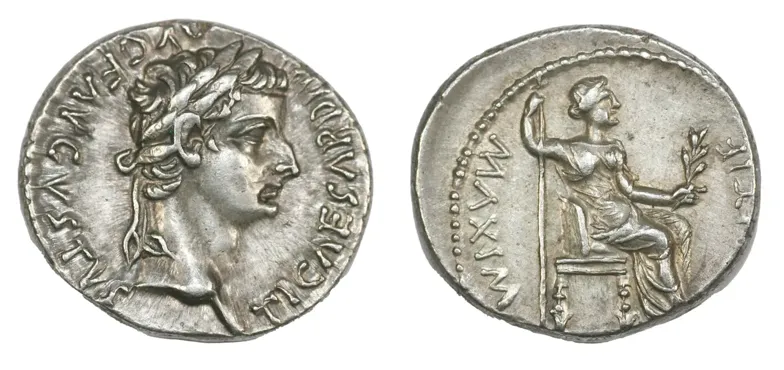
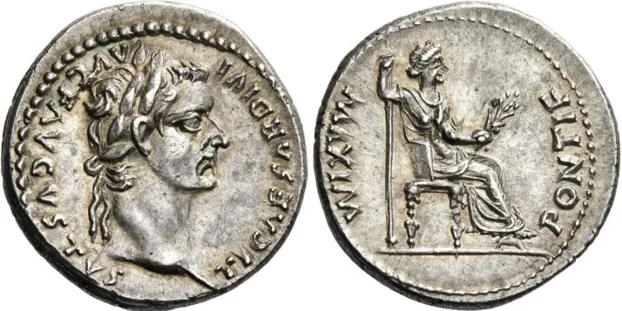
Tiberius Denarius from the IOVIS collection
This limited choice of designs reinforces the perception of Tiberius as a conservative ruler, who chose to maintain an austere economic and propaganda approach compared to his predecessor, Augustus.
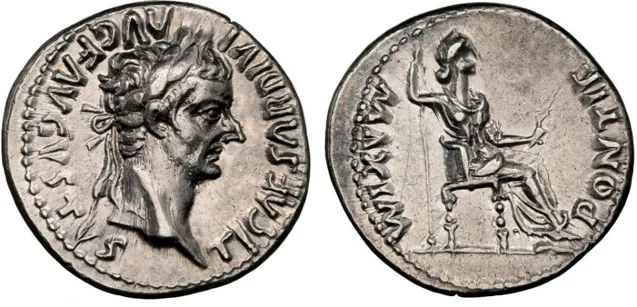
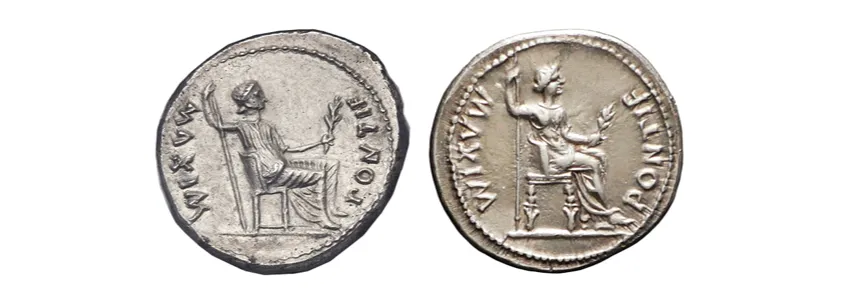
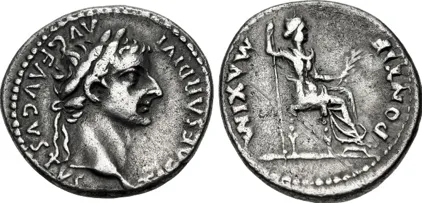
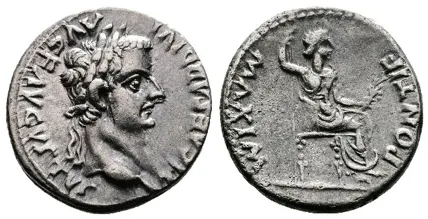
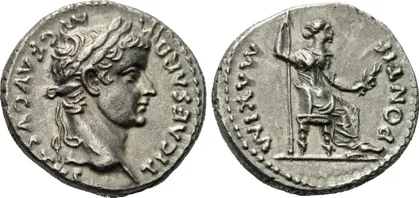
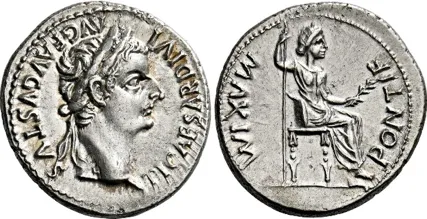
The design of the denarius is simple but loaded with symbolism. On the obverse is the laureate head of Tiberius facing to the right, accompanied by the inscription “TI CAESAR DIVI AVG F AVGVSTVS”, which means “Tiberius is Caesar, son of the divine Augustus, Augustus” which identifies Tiberius as the son of the divine Augustus and legitimate heir to imperial power. On the reverse, a seated female figure holds an olive branch and a scepter. Although some identify her with Livia, mother of the emperor, others believe she represents Pax, the goddess of peace. Probably, it would be an allegorical image of Peace represented by Livia. The inscription “PONTIF MAXIM” reaffirms Tiberius’s role as Supreme Pontiff, the highest religious leader of the Empire.
Thus, Tiberius’s denarius was not only a means of payment in the Roman economy, but also a propaganda tool that reflected the continuity and stability of the imperial government. Tiberius, as the second emperor of Rome, needed to convey a message of continuity.
What has truly immortalized this denarius is its connection with the biblical account of the tribute to Caesar in the gospels of Matthew, Luke and Mark. In the Gospel of Matthew, this denarius appears in the context of an attempt by the Pharisees to trap Jesus about the legitimacy of paying taxes to Caesar. The complete passage is the following:
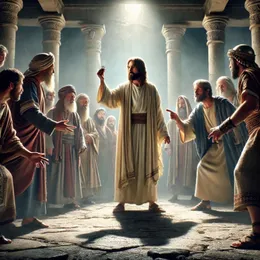
Matthew 22:15-21
15 Then the Pharisees went away and consulted how to surprise him in some word. 16 And they sent their disciples to him with the Herodians, saying: Teacher, we know that you are a lover of the truth and that you teach the way of God in truth, and that you do not care for anyone because you do not regard the appearance of men. 17 So tell us, what do you think? Is it lawful to give tribute to Caesar or not? 18 But Jesus, knowing their malice, said to them: Why do you tempt me, you hypocrites? 19 Show me the coin of the tribute. And they presented him with a denarius.20 Then he said to them, Whose image and inscription is this?21 They said to him, Caesar’s. And he said to them: Give therefore to Caesar what is Caesar’s, and to God what is God’s.
Although it is not explicitly specified which currency was used, the oldest known description of a New Testament manuscript makes a clear reference to the denarius. If at that time the emperor was Tiberius and there was a notable Roman presence in Judea, the deduction seems logical. However, today, some researchers question this theory, arguing that no denarii from before the reign of Nero have been found in the treasures of the time.
Regardless of this debate, the truth is that Judea had a mixed monetary system: local coins for everyday transactions, denarii and other Roman coins for tribute and trade, and shekalim used in the religious sphere. Among these, the Tyrian Shekel was the most common silver coin in the region, especially for the payment of the Temple tax. This monetary diversity reflected both Roman control and Jewish cultural resistance.
Variations and classifications of the Tiberius Denarius
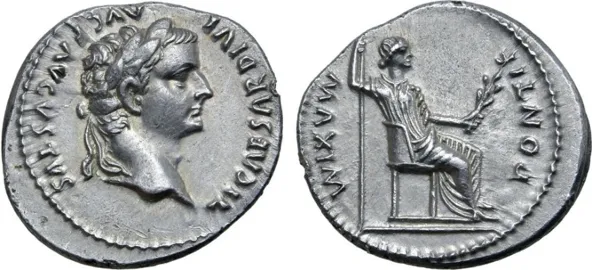
Jean-Baptiste Giard, a prominent French numismatist, made a detailed classification of the denarii issued during the reign of Emperor Tiberius (14-37 AD). According to his studies, Tiberius’s denarius experienced slight variations that have led experts to identify six main types. These differences reflect stylistic and technical changes that occurred during its long period of minting. The six types can be described as follows:- First phase (14-16 AD):At this early stage, the bust of Tiberius has a youthful appearance, and the throne on the reverse is simple, with smooth legs and no ornament.
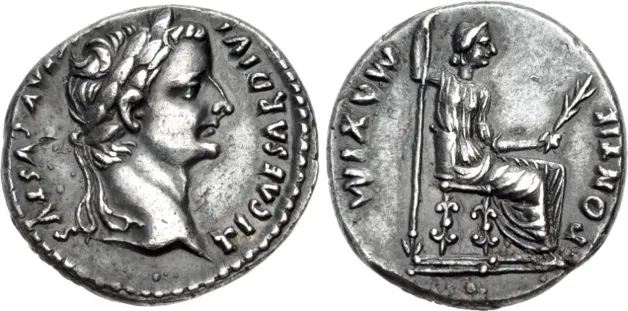
- Second phase (16-21 AD): The portrait of Tiberius begins to show more mature features, while the legs of the throne acquire ornamental details, reflecting greater attention to design.
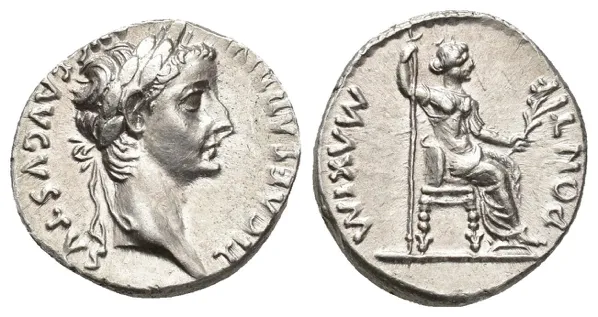
- Third phase (21-22 AD): A footstool or stool is introduced under the feet of the female figure on the reverse, and the throne retains its ornamentation, but in a more stylized manner.
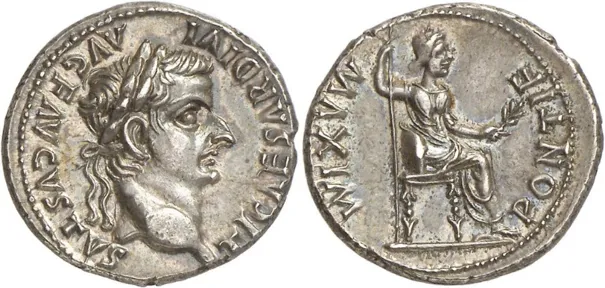
- Fourth phase (22-30 AD): The ribbons of the laurel wreath on the bust of Tiberius fall in a wavy manner, adding dynamism to the design. The throne on the reverse simplifies some of its decorative elements and returns to a single line.
- Fifth phase (30-34 AD): This type follows the general lines of the fourth phase, but with slight adjustments in the design of the throne and the arrangement of the elements on the reverse.
- Sixth phase (34-37 AD): The bust of Tiberius shows more aged features and a more rigid design on the ribbons of the laurel wreath. On the reverse, the throne maintains a similar design, although in some examples a rougher finish can be seen.
These variants not only reflect technical changes in coinage, but also possible adjustments in the perception and representation of imperial power as Tiberius’s reign progressed.
In the Roman Imperial Coinage (RIC), the fundamental reference work for the study of Roman imperial coins, three main types of Tiberius denarii are recognized, all having the same description on the obverse: Head of Tiberius, laureate, right and the legend TI CAESAR DIVI AVG F AVGVSTVS Instead, there are three different descriptions for the reverses:
RIC I (SE) Tiberius 26
Reverse: Female figure, draped, upright, seated, just above a chair with smooth legs, holding a branch and a long scepter; under the chair, a double line
Legend: PONTIF MAXIM
RIC I (SE) Tiberius 28
Reverse: Female figure, draped, right, seated, right holding branch and inverted spear, on chair with ornate legs; under the chair, a triple line
Legend: PONTIF MAXIM
RIC I (SE) Tiberius 30
Reverse: Female figure, draped, right, seated, right holding branch and long upright scepter, on chair with ornate legs; under the chair, a single line
Legend: PONTIF MAXIM

Although Giard limited himself to six groups or types, and only three types appeared in the RIC, in the “Corpvs Nvmmorvm Romanorvm” of Banti and Simonetti, 27 main types of coins are identified, each with several variants, making a total of 100 variants.
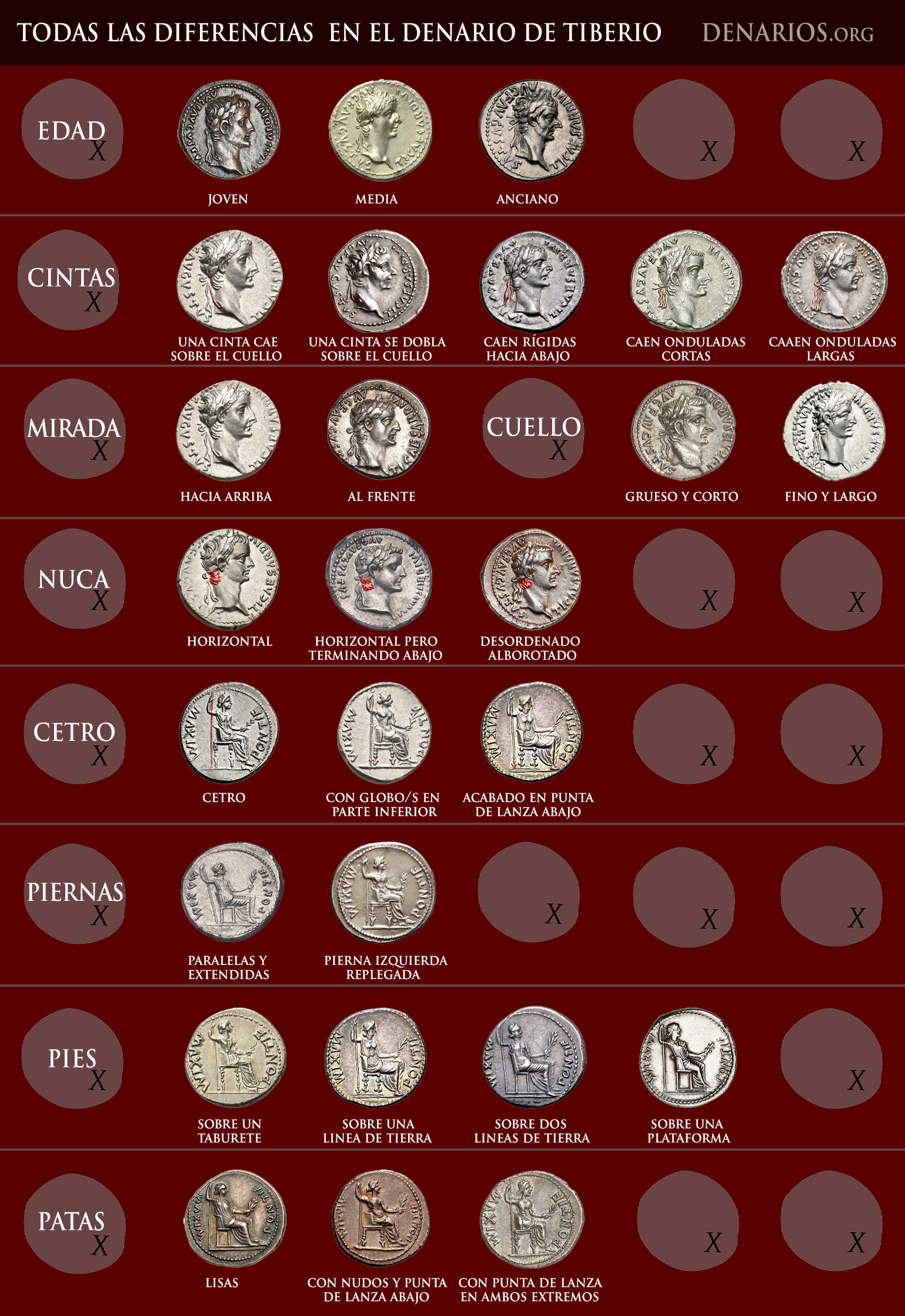
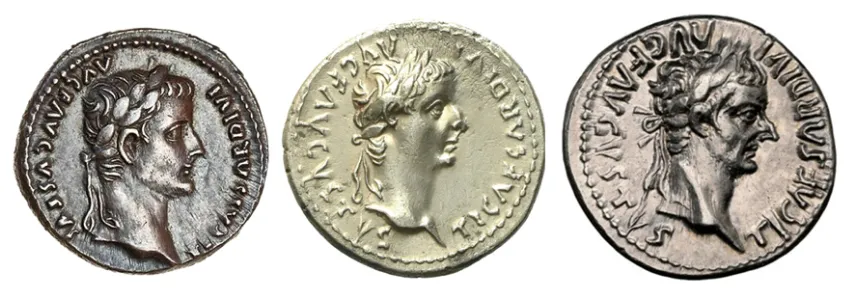
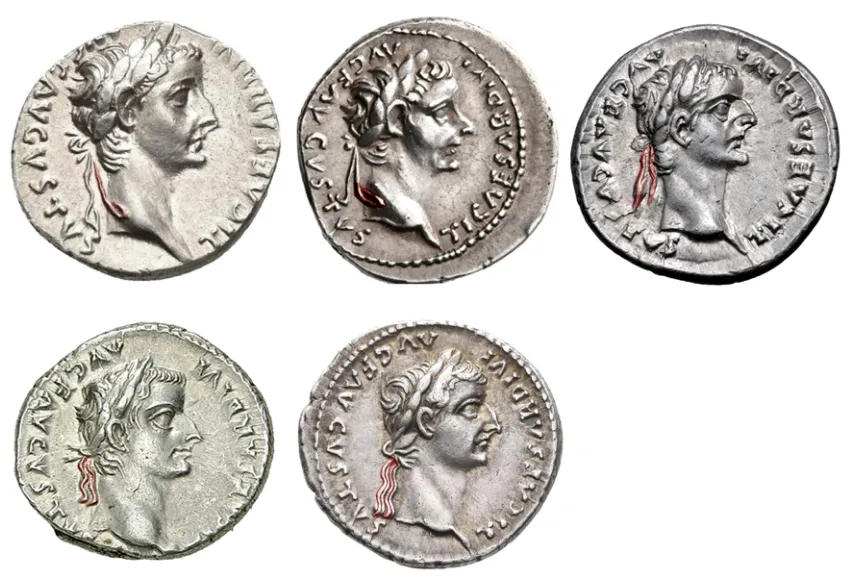
The differences that Banti and Simonetti define on the obverse are based on the following characteristics of the portrait, headband, gaze, neck and hair on the back of the neck:
About the portrait
Young, middle, old man portrait.
About the ribbons
A ribbon falls on the neck; A ribbon is folded over the neck; They fall down rigidly; They fall in short waves; They fall wavy and long.
About the gaze
Upward gaze; Forward gaze.
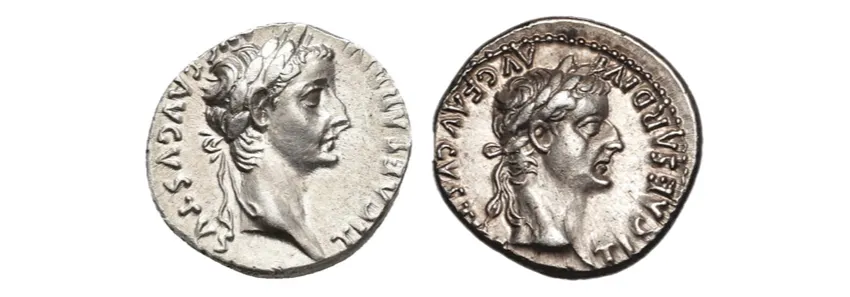
About the neck
It can be shorter/wider or longer/narrower
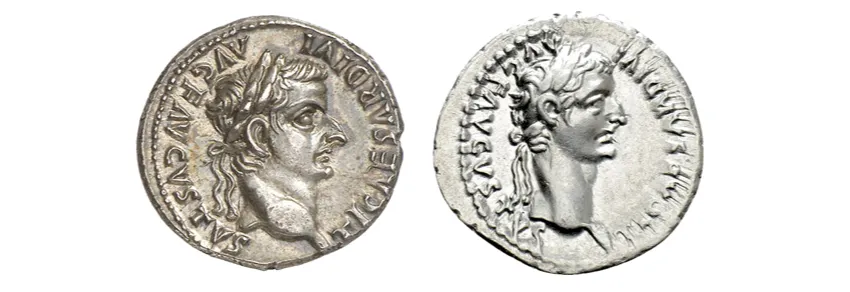
About the hair on the back of the neck
Horizontal nape hair; Horizontal, ending downward; Disordered or tousled.
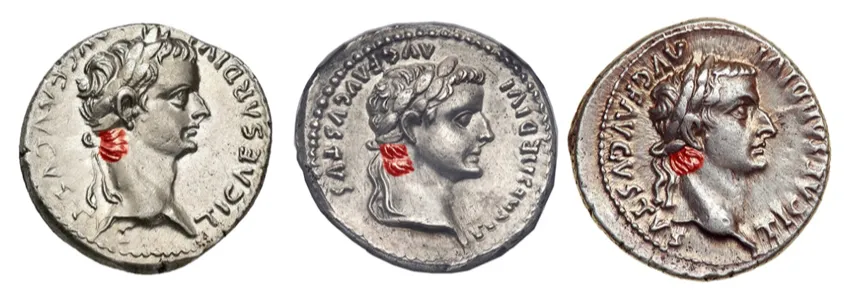
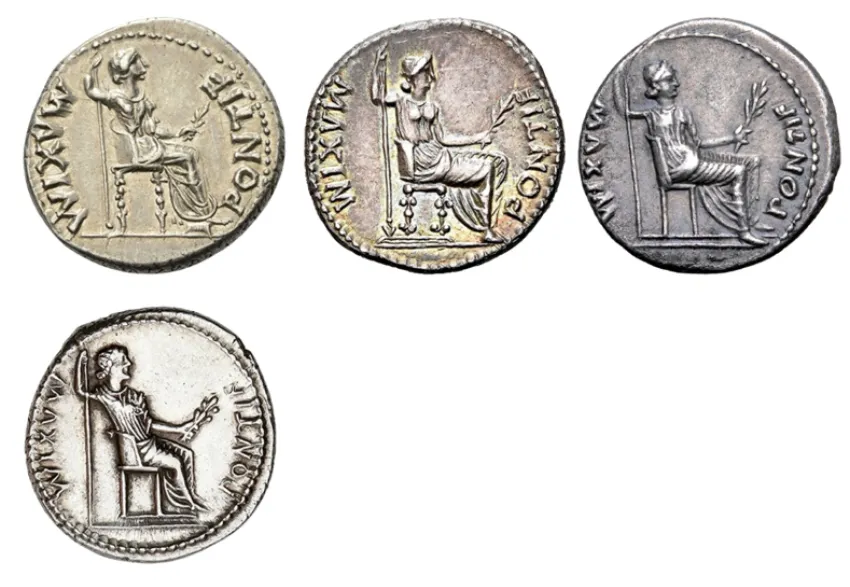
For the reverses, several characteristics are considered:
Scepter held by the figure
Scepter; Scepter with one or more globes at the bottom; Downward spear.
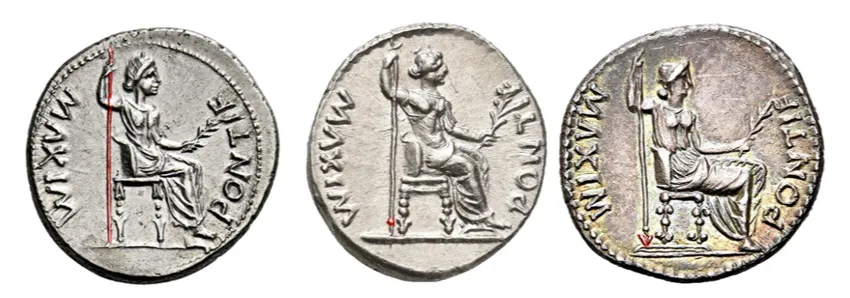
Leg position:
Parallel and extended; Left leg retracted.
Foot support:
On a stool; On a ground line; On two ground lines; On a platform (pedana).
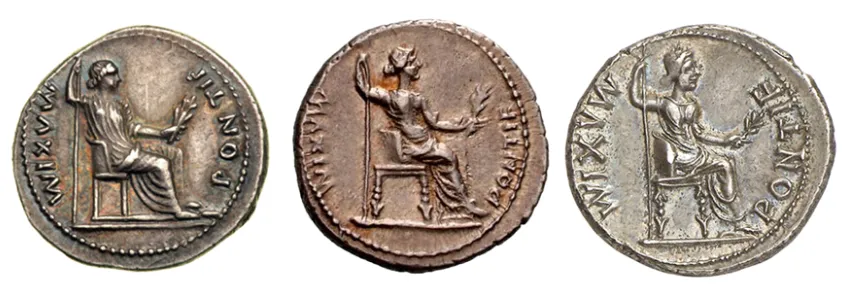
Chair legs design:
Smooth; With knots and spearhead below; With spear point at both ends.
About the current price of a Tiberius denarius
As we have seen on other occasions, the same denarius can cost very different prices. In general, everything depends on its degree of conservation. Below, we have some examples of the prices of the different tribute denarii: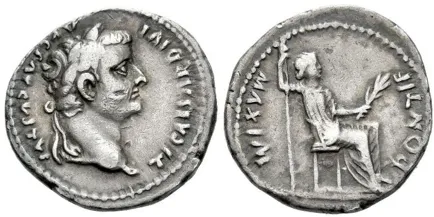
Auctioned for 170 euros in 2024.
Auctioned for 335 euros in 2025.
Auctioned for 600 euros in 2025.
Auctioned for 3500 euros in 2013.
Auctioned for 5000 euros in 2021.
As a curiosity, a die of the Tiberius denarius.
In 2009, the Stack’s auction house released a die that defined it as follows: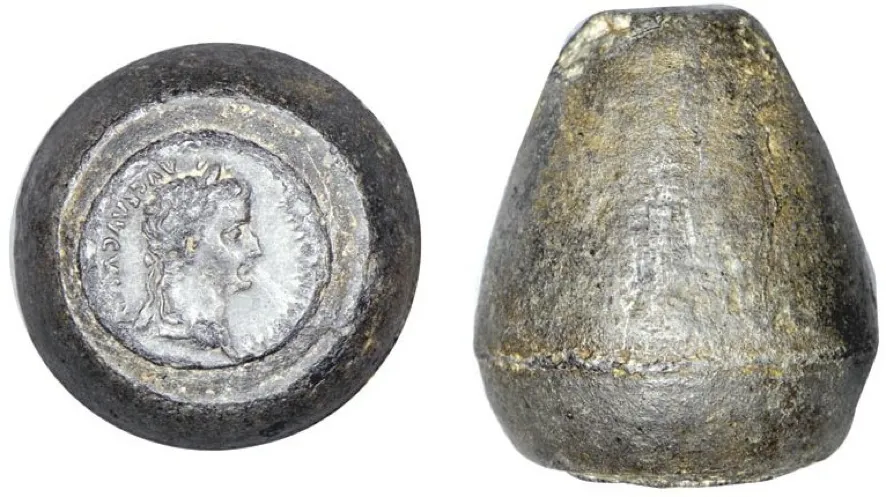
Unique die for a “penny tribute” denarius: denarius from the Lugdunum mint.
Official die with the obverse of a denarius embedded in the top.
- Obverse: Laureate head of Tiberius on the right; legend TI CAESAR DIVI AVG F AVGVSTVS.
- Weight: 161.16 grams.
- Dimensions: Height: 36.8mm; Circumference: 31.4 mm at its widest part.
In the Catalogue des Monnaies de l’Empire Romain, Tiberius-Nero (Paris, 1988), Jean-Baptiste Giard documented 12 known dies, of which 11 were found in the Lugdunum region (Lyon), within a radius of 200 km. - 1863: Four were found in Paray-le-Monial (Saône-et-Loire), currently in museums.
- 1799: Six were discovered at Auxerre (Yonne); four of them are kept in the Cabinet des Médailles of the BnF and the other two in the Musée Monétaire de la Monnaie de Paris.
- Another example was was found in Vertault (Côte-d’Or).
This die comes from an old collection in Poule-les-Echarmaux (Rhône), within the same geographical area. An analysis of the back of the die shows an identical composition to the other 12 known examples, confirming its authenticity as an official die.
The most plausible hypothesis regarding the presence of a denarius obverse embedded in the top is that, during the minting process, a denarius was accidentally trapped inside the die. Subsequently, the operators continued production without noticing the obstruction, which generated temporary errors in the coining.
When the mint worker tried to remove the trapped denarius, he was unable to extract it. The light scratch marks on Tiberius’s face show his failed attempts. Finally, failing to remove it, the operator discarded the defective die.
This find represents an exceptional vestige of the ancient coinage process in Rome and could be one of the first known evidence of errors in coin production in Antiquity.
Conservation status: Very good.
Estimate: 8,000 - 10,000.
Conclusion: The tribute denarius, between history and faith
The notable number of variants of this denarius is due to an exceptional fact in Roman numismatic history: Tiberius was the only emperor who, throughout his entire 23-year reign, minted mostly the same type of denarius. Unlike his predecessors and successors, who introduced multiple designs throughout their governments, Tiberius maintained a conservative monetary policy, resulting in multiple variations of the same model over time, but without substantial changes to its basic iconography. The only relevant change in the dies was the evolution of the portrait of Tiberius, which went from an image with more idealized features to an older representation as his reign progressed. The rest of the variations were generally due to the number of master engravers who made the dies over the years, introducing slight stylistic differences in the portraits and reverse details. This unprecedented continuity has made the tribute denarius one of the most studied and collected coins in Roman numismatics.However, beyond its numismatic importance, Tiberius’s denarius has transcended as a religious symbol due to its possible link with the evangelical story of the tribute to Caesar. Although not all experts agree that it was the exact coin mentioned in the Gospels, tradition has identified it as such for centuries. Its connection with this biblical episode has made it a piece that arouses the interest of collectors as well as historians and religious scholars.
“More than two thousand years later, this coin continues to tell the story of an empire and a religion. Was this the one that Jesus held in his hands? We do not know for sure, as not all experts agree. However, in the numismatic world, it is and will always be recognized as the tribute denarius.
JPG - THE TRIBUTE DENARIUS
Click on the image if you want to download it in higher resolution