Gods and Deities on the Denarii of the Roman Republic
The first denarii began to be issued in 211 BC. They all show the bust of Roma facing right on the obverse, and the Dioscuri, Castor and Pollux, riding right on the reverse. Some reverses include symbols such as stars, letters, ears of grain, anchors, dogs, and so on.
Around twenty years later, in 190 BC, the first anonymous denarius appeared with a different reverse: the goddess DIANA, or the Moon, driving a biga to the right (Crawford 136/1).
In 157 BC another anonymous issue replaced the Dioscuri with VICTORY in a biga (Crawford 197/1a), and this type seems to have become fashionable, appearing in fourteen of the next thirty issues.
In 144 BC, JUPITER in a quadriga appeared for the first time on a reverse (Crawford 221/1). From that point onward, gods began to appear on reverses with some regularity. In addition to Diana, Victory and Jupiter, Juno appears in 142 BC (Crawford 223/1), and Mars in 138 BC (Crawford 233/1).
It was not until 137 BC, after seventy-five years of issues, that a denarius appeared for the first time without Roma on the obverse. In her place was the god MARS, on an issue of Tiberius Veturius with a clearly military theme (Crawford 234/1). Around twenty years later, in 119 BC, Marcus Furius Philus issued a denarius with JANUS on the obverse (Crawford 281/1). In 114 BC, for the third time, a denarius appeared without ROMA on the obverse. In this case, Gaius Fonteius returned to an allusion to JANUS, but each face represents one of the Dioscuri (Crawford 290/1).
From then on, the classic denarii with Roma and the Dioscuri began to disappear. In fact, in 121 BC, Gaius Plautius issued the last denarius with Roma and the Dioscuri (Crawford 278/1).
Then came roughly sixty years in which the GODS became the real protagonists on the obverses of denarii.
Mars was the first to appear on an obverse.
Mars first appears in 137 BC, in an issue of the gens Veturia (Crawford 234/1). He continued to appear on a total of 29 denarii issued by 12 different moneyers.
Apollo is the god who appears most often.
Apollo first appeared in 112 BC (Crawford 298/1) and continued to appear on a total of 86 occasions until 43 BC. He was also the god claimed by the greatest number of moneyers: 36 in total.
Jupiter is in second place.
The king of the gods, who had already appeared on a reverse in 144 BC, first appeared on an obverse in 106 BC. The moneyer Lucius Cornelius Scipio Asiaticus, brother of Africanus, issued a fine denarius with Jupiter’s bust on the obverse and Jupiter in a quadriga on the reverse (Crawford 311/1a). Jupiter appeared in a total of 41 Crawford references and was “claimed” by 22 different moneyers. His last appearances were practically among the final Republican denarii, in 31 BC, as Jupiter/Ammon on denarii of Mark Antony (Crawford 546/3). Before that, he appeared in 43 BC on a denarius of the gens Petillia (Crawford 487/1).
The last denarius issued with a new god.
In 43 BC, at the same time as the famous denarius of BRUTUS, Lucius Plaetorius issued another denarius referring to BRUTUS. On the obverse it shows a female bust that appears to be ARTEMIS, the Greek goddess of hunting, wild nature and chastity (Crawford 508/2).
The last three denarii with gods on the obverse in the Republican period.
42 BC, Crawford 511/2 - Pompeia - the god Neptune.
41 BC, Crawford 512/2 - Claudia - the goddess Flora.
31 BC, Crawford 546/1 - Mark Antony - Jupiter/Ammon.
The Dii Consentes: the core of the Roman pantheon
Before entering the complete list of gods and deities that appear on Republican denarii, it is worth pausing over a fundamental group for understanding how the Romans conceived their relationship with the divine: the Dii Consentes, the twelve great gods of Rome.
The oldest literary source to transmit this list is the poet Quintus Ennius, in the second century BC, who refers to a group of twelve gods following the Greek model. Although the original passage has been lost, his testimony was preserved by later authors. Varro gave this group the name by which it has entered history, Dii Consentes, and Cicero confirms the tradition by explicitly quoting Ennius.
In Late Antiquity, between the fourth and fifth centuries AD, Macrobius presents the Dii Consentes in his Saturnalia as the traditional college of the twelve gods, and Saint Augustine, although he criticises them from a Christian perspective, recognises that this was an ancient and well-established belief within Roman paganism.
The term consentes comes from consentire, “to feel together” or “to act by common agreement”. It does not refer merely to passive coexistence between gods, but to an active harmony between different forces. For the Romans, that divine concord guaranteed the order, stability and prosperity of Rome.
The Dii Consentes were also conceived as six pairs, each formed by a god and a goddess, reflecting the balance between complementary forces that sustained the Roman world:
- Jupiter and Juno, the authority of the State and the order of the family.
- Mars and Venus, war and its justification.
- Apollo and Minerva, culture, reason and strategy.
- Neptune and Diana, the natural forces surrounding the human world.
- Vulcan and Vesta, fire in its two dimensions, destructive and domestic.
- Mercury and Ceres, the circulation of goods and sustenance.
This is not a decorative list, but a true map of the Roman world. The Romans believed that Rome prospered when the gods were in agreement.
To close this point, it is worth clarifying that consentes is not a modern English term. It can be rendered simply as “the twelve concordant gods”.
A possible collection: the twelve gods on Republican denarii
Although the Roman pantheon is much broader, the Dii Consentes offer an especially attractive concept for the collector of ancient coins. It is perfectly feasible, and relatively affordable, to assemble twelve denarii of the Roman Republic representing Jupiter, Juno, Mars, Venus, Apollo, Minerva, Neptune, Diana, Vulcan, Vesta, Mercury and Ceres.
Some divinities are more common than others, but all appear regularly both in specialised dealers’ inventories and in auction houses. None is unattainable through extreme rarity or price, as happens in other more demanding series.
It is therefore a collection within reach of almost any enthusiast, and one with powerful meaning. It also reflects a very specific moment in Republican coinage: after the anonymous issues and before the emergence of personal portraits, when the gods became a political and symbolic language in the service of Rome.
It is also a collection with a clear beginning and end: twelve pieces, twelve gods, a complete system that can be closed without becoming an endless pursuit. Each divinity can be represented by a different denarius, from different moneyers and years. The goal is not to gather every issue of the same god, but to choose a representative piece that completes the set.
We would not merely be collecting divine images, but the whole symbolic universe of Rome condensed into twelve coins: the idea that the success of the Republic, and later of the Empire, depended on maintaining balance and concord among the forces that sustained its world.
Quirinus: the great forgotten god
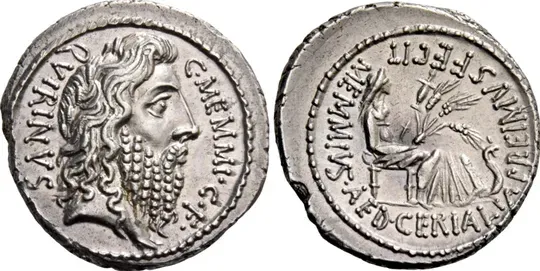
Alongside the great gods that dominated the monetary iconography of the Republic, there were also fundamental divinities of early Rome that gradually fell into the background. The most revealing case is Quirinus.
Quirinus was one of the oldest and most important gods of archaic Rome, long predating the appearance of the denarius. He formed part of the archaic triad, together with Jupiter and Mars, which gives a clear idea of his rank and relevance. He was by no means a minor god.
While Jupiter represented sovereignty and Mars war, Quirinus was linked to the Roman people as a community: the Quirites, the citizens. He did not embody battle, but Rome organised after war: the citizen who lays down his arms and returns to civic life.
Over time, the figure of Quirinus was identified with Romulus, the founder of Rome. According to tradition, after his disappearance Romulus was divinised and venerated under the name Quirinus as the eternal protector of the city. However, everything suggests that Quirinus was originally an independent god linked to the civic community, and that his identification with Romulus became consolidated later, especially at the end of the Republic. Authors such as Livy and Ovid already present both as the same figure, a sign that this fusion was then fully accepted.
And yet, despite his antiquity and rank, Quirinus barely appears on the Republican denarius. Only one clear issue is known, struck in 56 BC by Gaius Memmius. His absence does not seem accidental. In late Republican Rome, coinage increasingly became a language of power, victory and personal legitimacy. Quirinus, linked to an older and more collective idea of the Roman community, no longer fitted this new discourse.
He was not represented less because he was irrelevant, but because he represented an idea of Rome that was being left behind. Precisely for that reason, Quirinus is one of the most revealing gods in the whole series.
List of all gods on Republican denarii
According to the Crawford references, 368 different denarii were issued with a god on the obverse. In total, 36 different gods were represented, issued by 205 moneyers. Below is a table listing all the gods and deities found on denarii of the Roman Republic.
GODS AND REFERENCES / FIRST ISSUE
1# MARS, 137 BC
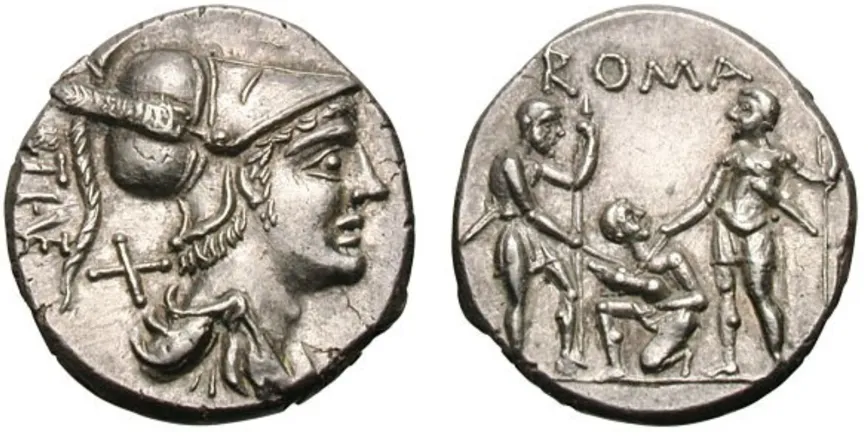
(Crawford 234/1 auctioned in 2011 at GEMINI with a hammer price of 3.500$)
The first god to appear on a denarius was MARS, god of war. In 137 BC the moneyer Tiberius Veturius issued what is now referenced as Crawford 234/1. On the obverse we have the bust of Mars wearing a helmet and facing right; behind, TI VET refers to the moneyer, and X refers to the value of the denarius as ten asses. On the reverse there is an oath-taking scene. Beneath the name ROMA, a kneeling youth holds a pig while two warriors touch it with their swords.
Mars appears on the obverse of 29 denarii, issued by 12 different moneyers, with the following Crawford references: 234/1; 296/1a; 296/1b; 296/1c; 296/1d; 296/1e; 296/1f; 296/1g; 296/1h; 296/1i; 296/1j; 296/1k; 296/1l; 319/1; 320/1; 335/3a; 335/3b; 335/3c; 335/3d; 335/3e; 335/3f; 335/3g; 345/1; 400/1a; 400/1b; 429/1; 450/1a; 450/1b; 497/3.
2# JANUS, 119 BC
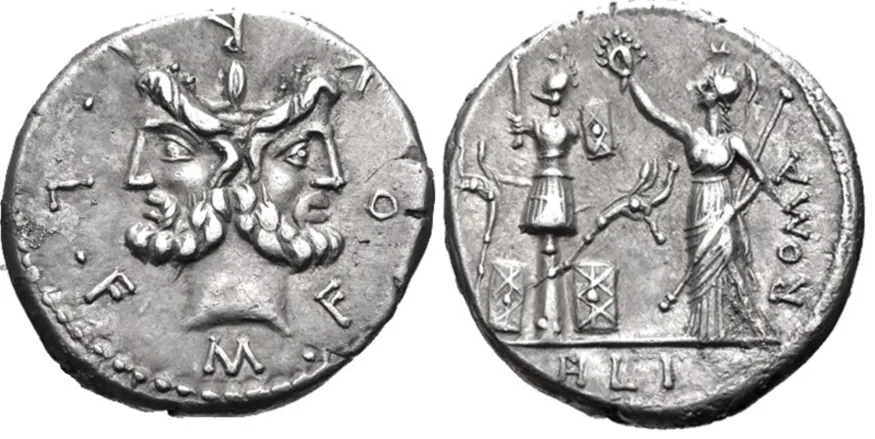
(Crawford 281/1 auctioned in 2012 at CNG with a hammer price of 1.100$)
The next to appear in the Olympus of the denarii was JANUS, god of beginnings and endings, and of doors and thresholds. War and peace were also connected with Janus: in his temple, the doors were closed in times of peace and open in times of war.
In 119 BC the moneyer M. Furius Philus issued Crawford 281/1. On the obverse we have the bust of Janus between M.FOVRI.L.F, a reference to the moneyer. On the reverse, Roma holds a sceptre and a wreath beside a trophy of Gallic arms, flanked by a carnyx and a shield on each side. It refers to the victory of Quintus Fabius Maximus over the Allobroges, which led to the annexation of Gallia Narbonensis as a Roman province.
Throughout the entire Republican period, this was the only denarius issued with the bust of JANUS.
3# HERCULES, 112 BC
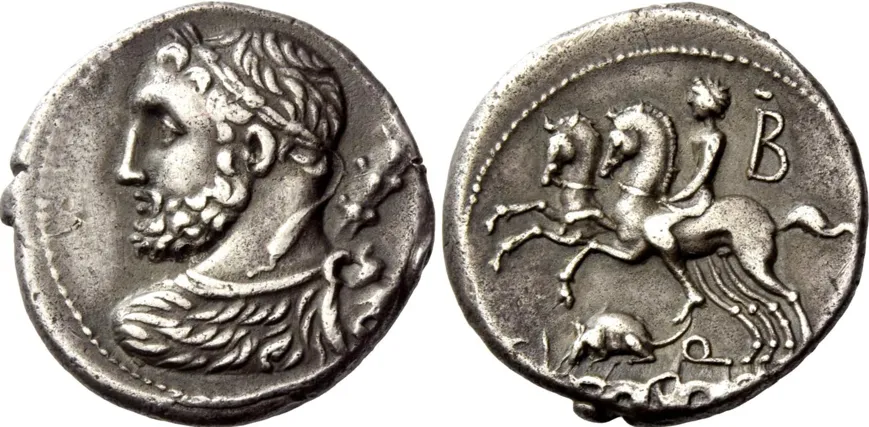
(Crawford 297/1a auctioned in 2016 at Ars Classica fine arts with a hammer price of 600€)
In 112 BC came the first denarius with the bust of HERCULES, a mortal son of Jupiter who was divinised after completing the so-called twelve labours of Hercules. His main characteristic was superhuman strength, but his unconditional love for humanity also stood out.
Ti. Quinctius was the moneyer who issued Crawford 297/1a. On the obverse we have the robust bust of Hercules, seen from behind, with a club over his right shoulder. On the reverse two horses gallop left, with a rider mounted on the nearer horse. Below appears a rat and the letter Q for Quinctius; above, a control mark.
The bust of Hercules appears in a total of 15 Crawford references and was issued by eleven moneyers, eight of them connected with the prominent gens Cornelia: 297/1a; 297/1b; 329/1a; 329/1b; 329/1c; 329/1d; 380/1; 385/2; 397/1; 426/2; 426/4a; 426/4b; 461/1; 494/37; 532/1.
4# APOLLO, 112 BC
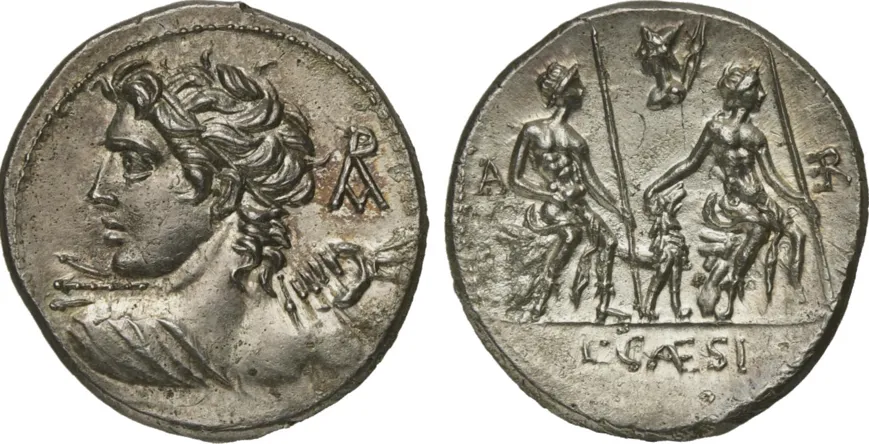
(Crawford 298/1 auctioned in 2018 at Bertolami fine arts with a hammer price of 6.270$
In 112 BC the first denarius with the bust of APOLLO also appeared. He was a many-sided god: god of archery, nature, truth, prophecy, medicine and healing, music, poetry and the arts.
Lucius Caesius issued Crawford 298/1. On the obverse we see Apollo from behind, with his right hand ready to hurl a thunderbolt. On the reverse two Lares are seated, each with a long staff resting on the ground, a dog between them, and the bust of the god VULCAN above with tongs behind. L.CAESI refers to the moneyer.
Apollo was the god who appeared on the most obverses of Republican denarii: specifically, on 86 denarii issued by 36 different moneyers: 298/1; 304/1; 334/1; 335/10a; 335/10b; 335/1a; 335/1b; 335/1c; 335/2; 340/1; 342/3a; 342/3b; 342/4a; 342/4b; 342/5a; 342/5b; 346/2; 346/2a; 346/2b; 346/2c; 350A/1a; 350A/1b; 350A/1c; 350A/1d; 350A/1e; 350A/2; 352/1a; 352/1b; 352/1c; 353/1a; 353/1b; 353/1c; 353/1d; 353/2; 354/1; 361/1a; 361/1b; 361/1c; 363/1; 363/1b; 363/1c; 363/1d; 369/1; 370/1a; 370/1b; 371/1; 385/5; 408/1a; 408/1b; 409/1; 410/1; 410/10a; 410/10b; 410/2a; 410/2b; 410/3; 410/4; 410/5; 410/6; 410/7a; 410/7b; 410/7c; 410/7d; 410/8; 410/9a; 410/9b; 410/9c; 444/1a; 444/1b; 444/1c; 445/2; 465/1a; 465/1b; 465/2a; 465/2b; 474/1a; 474/1b; 474/2a; 474/2b; 474/2c; 474/3a; 474/3b; 494/23; 503/1; 504/1; 506/2;
5# SOL, 109 BC
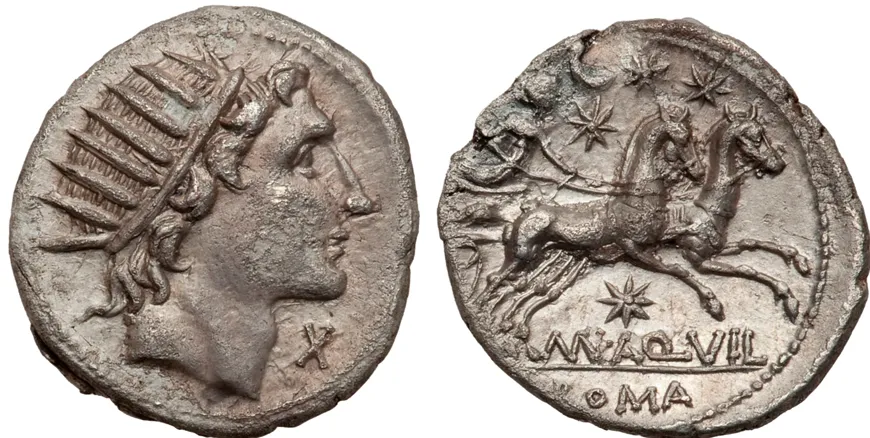
(Crawford 303/1 auctioned in 2012 at Heritage with a hammer price of 125€)
In 109 BC the moneyer Manlius Aquillius issued the next denarius, dedicated to the deity SOL, corresponding to the god Helios in ancient Greek mythology. On the obverse we have the radiate head of Sol, with X below the chin, indicating the value of the denarius as ten asses. On the reverse, Luna gallops in a biga, with a crescent moon and three stars above, another star below, and M.AQVIL referring to the moneyer.
Although not an especially prominent deity, we find 6 Crawford references issued by 5 different moneyers: 303/1; 390/1; 474/5; 494/21; 494/43a; 494/43b.
6# VICTORIA, 109 BC
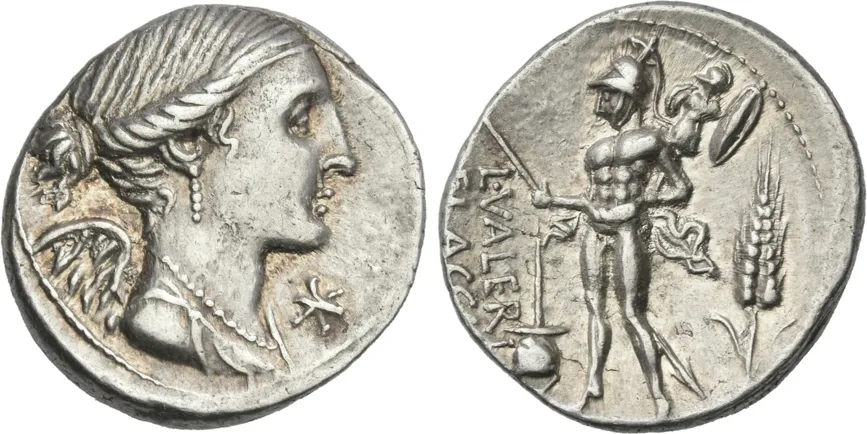
(Crawford 306/1 auctioned in 2020 at Ars Classica for 1.789€)
In 109 BC the moneyer L. Valerius Flaccus issued the first denarius with VICTORY, the goddess of triumph in war and in any competition. She was represented as a winged woman and identified with the goddess Nike in Greek mythology. On the denarius Crawford 306/1 we see her draped bust, with earrings and necklace, and her wings standing out on her back. On the reverse she is accompanied by the god Mars, who holds a trophy in his left hand and a spear in his right, pointing to a connection with some military victory.
Up to 22 denarii were issued with the bust of Victory, by a total of 12 different moneyers: 306/1; 337/1a; 337/1b; 365/1a; 365/1b; 365/1c; 366/1a; 366/1b; 366/1c; 366/2a; 366/2b; 366/3a; 366/3b; 366/3c; 366/4; 448/1a; 448/1b; 464/4; 464/5; 494/40; 546/6; 546/7.
7# JUPITER, 106 BC
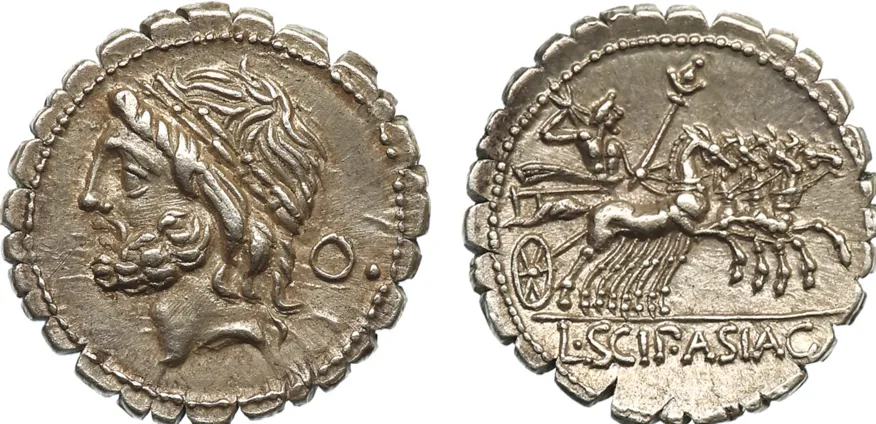
(Crawford 306/1 auctioned in 2014 at Ira and Larry Goldberg for 770€)
In seventh place, according to the order in which they appear on denarii, the first denarius of JUPITER appears in 106 BC. He was the most important god for the Romans: king of all gods, bearer of thunderbolts and lord of the heavens.
The moneyer L. Cornelius Scipio Asiaticus issued Crawford 311/1a. On the obverse we have the laureate bust of Jupiter facing left. On the reverse, Jupiter holds a sceptre and drives a galloping quadriga with his left hand, while hurling thunderbolts with his right. In the exergue: L SCIP ASIAG.
This denarius refers to the victory of the moneyer’s ancestors, the consul Lucius Cornelius Scipio and his brother, the general Scipio Africanus, over Antiochus III of Syria at the Battle of Magnesia in 190 BC. The victory expanded Rome’s dominions and marked another step toward control of the whole Mediterranean region.
Jupiter appeared on 41 denarii (Crawford references), including 10 as Jupiter/Ammon, issued by 22 different moneyers: 311/1a; 311/1b; 311/1c; 311/1d; 311/1e; 348/1; 358/1; 364/1a; 364/1b; 364/1c; 364/1d; 364/1e; 377/1; 379/1; 385/1; 398/1; 420/2a; 420/2b; 420/2c; 420/2d; 422/1; 422/1a; 422/1b; 445/3a; 445/3b; 447/1a; 447/1b; 459/1; 460/2; 474/4; 487/1; 509/2; 546/1; 546/2a; 546/2b; 546/2c; 546/2d; 546/3a; 546/3b; 546/3c; 546/4.
8# SATURN, 106 BC
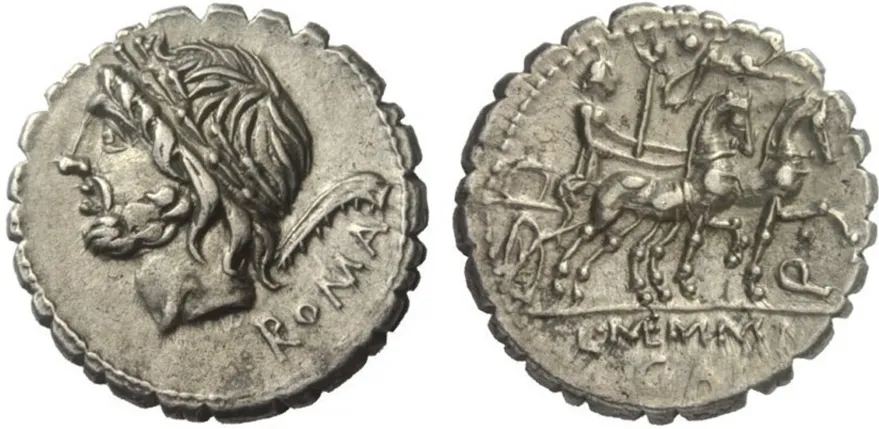
(Crawford 313/1a auctioned in 2014 at Numismatica Lanz for 300€)
SATURN corresponds to the Greek god Cronus, master of time, although in Roman mythology he represents the god of harvest and agriculture. The festival of the Saturnalia was celebrated in his honour, coinciding with the winter solstice.
He first appeared on a denarius in 106 BC, issued by the moneyer L. Memmius Galeria. On the obverse of the coin we see his laureate bust facing left and a harpa to the right. On the reverse, Venus drives a biga, and above appears Cupid holding a wreath. Below is the reference to the moneyer: L MEMMI GAL.
Saturn appears in 9 Crawford references struck by 6 different moneyers: 313/1a; 313/1b; 313/1c; 317/2; 330/1a; 330/1b; 349/1; 421/1; 441/1.
9# VULCAN, 105 BC
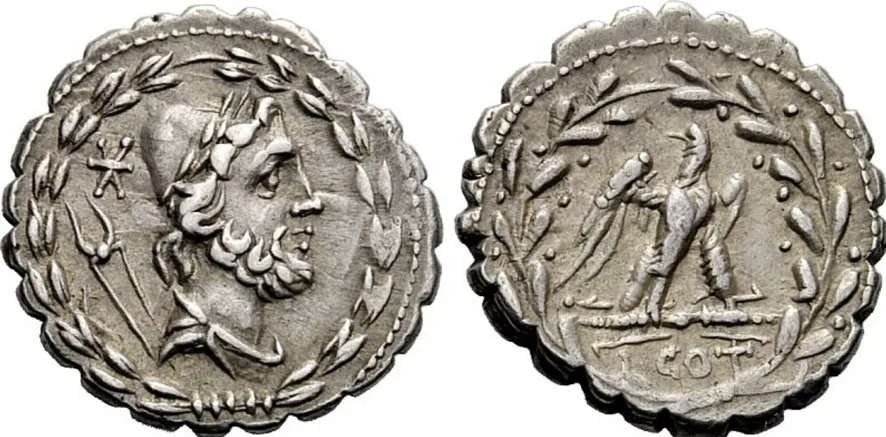
(Crawford 314/1 auctioned in 2023 at Ars Classica for 1.333€)
VULCAN, god of fire and patron of crafts connected with fire. Son of Jupiter and Juno, husband of Venus.
In 105 BC, L. Aurelius Cotta was the only moneyer to issue denarii, in four types, dedicated to this deity. On the obverse appears the draped bust of Vulcan wearing a close-fitting cap; behind are a star and tongs, all surrounded by a laurel wreath. On the reverse appears an eagle on thunderbolts, with L COT below, referring to the moneyer. Four Crawford references exist for this denarius: 314/1a; 314/1b; 314/1c; 314/1d.
10# JUNO SOSPITA, 105 BC
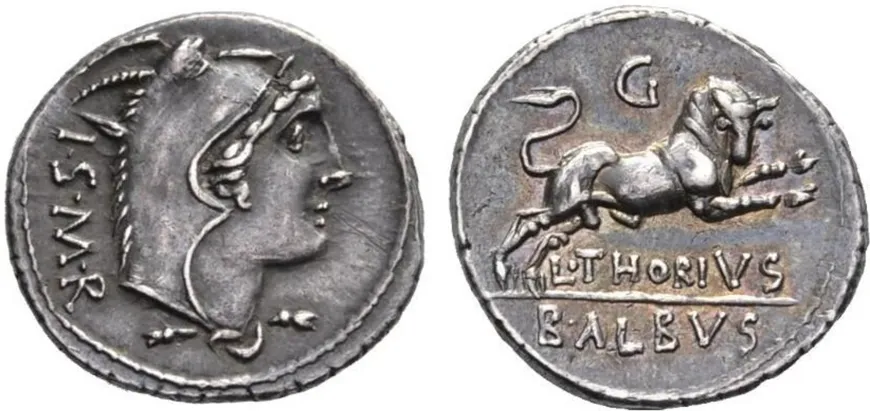
(Crawford 316/1 auctioned in 2015 at Ars Classica for 2.400€)
JUNO SOSPITA, Juno, the wife of Jupiter, is often represented as JUNO SOSPITA. She was a protector of those enclosed or confined, represented wearing a goatskin and carrying a shield and spear.
L. Thorius Balbus issued the first denarius with her bust as Juno Sospita in 105 BC. On the obverse appears her bust as Sospita, wearing a goatskin. On the reverse appears a bull and the moneyer’s reference, L THORIVS BALBVS.
Juno Sospita appears in 5 Crawford references, issued by 5 moneyers: 316/1; 379/2; 384/1; 412/1; 472/1.
11# CERES, 102 BC
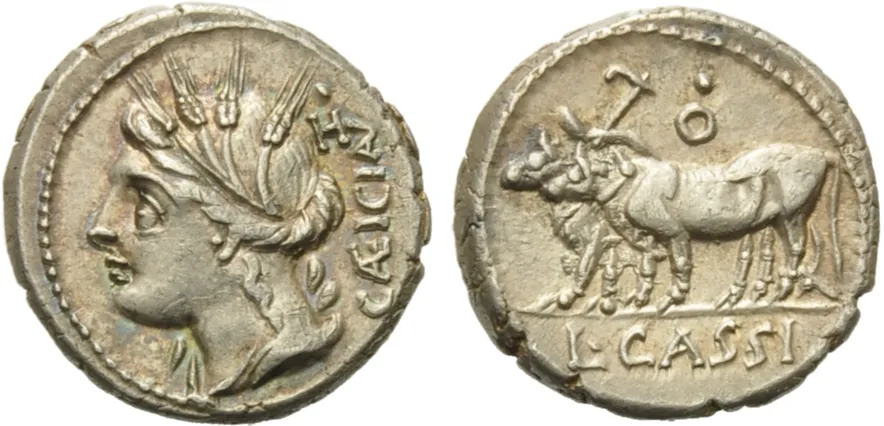
(Crawford 321/1 auctioned in 2018 at Bertolami for 3.200€)
CERES, goddess of agriculture and good harvests.
In 102 BC, the moneyer L. Cassius Caecianus was the first of seven moneyers to issue a denarius dedicated to Ceres. It is a coin highly representative of agriculture. On the obverse appears the bust of the goddess with a barley wreath, while on the reverse we have oxen pulling a plough.
There are 9 Crawford references for denarii of Ceres, issued by eight different moneyers: 321/1; 351/1; 378/1a; 378/1b; 378/1c; 414/1; 427/1; 467/1a; 467/1b.
12# CYBELE, 102 BC
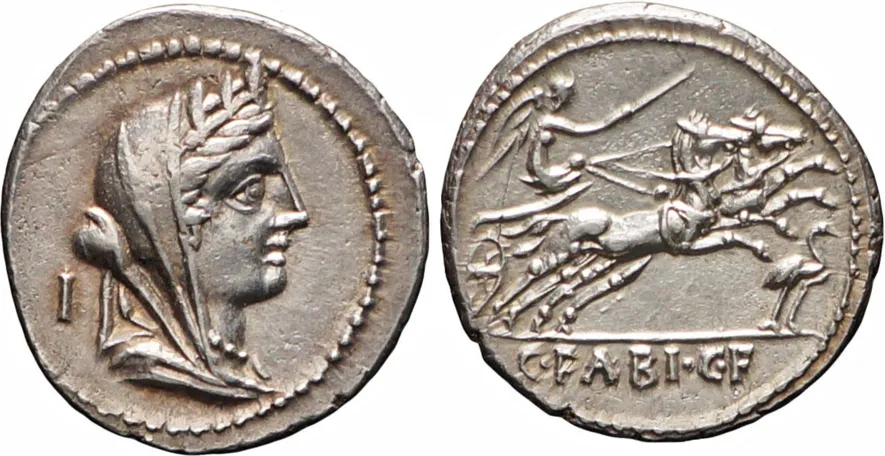
(Crawford 322/1a auctioned in 2018 at Numismatica Baresi for 510€)
CYBELE, a foreign goddess of Phrygian origin. She was associated with fortresses and also with wild nature, symbolised by the lions that accompany her. She was identified with the Roman MAGNA MATER.
She appears for the first time in 102 BC, issued by the moneyer C. Fabius. There are 9 references struck by five moneyers: 322/1a; 322/1b; 356/1a; 356/1b; 356/1c; 356/1d; 385/4; 409/2; 431/1.
13# MINERVA, 100 BC
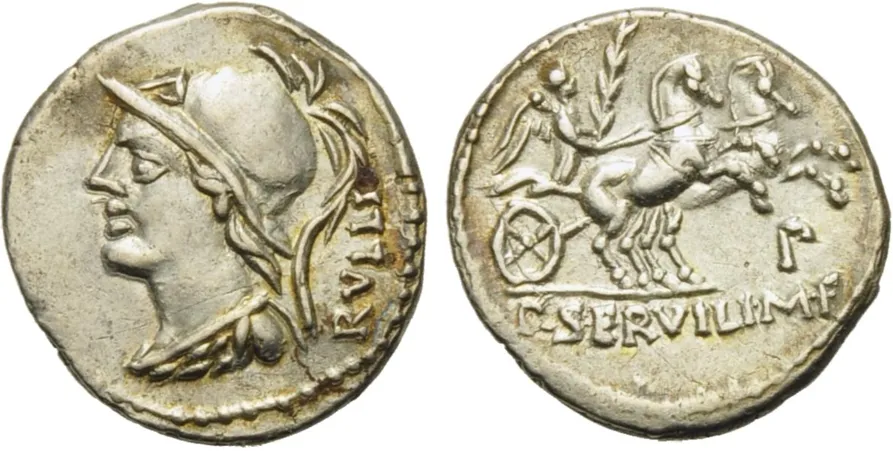
(Crawford 328/1 auctioned in 2018 at Bertolami for 1256€)
MINERVA, goddess of intelligence and just war, patroness of craftsmen.
In 100 BC she appears for the first time on a denarius issued by the moneyer P. Servilius Rullus.
She appears on 7 denarii struck by six different moneyers: 328/1; 342/6a; 342/6b; 348/3; 389/1; 465/5; 494/38.
14# DIANA, 95 BC
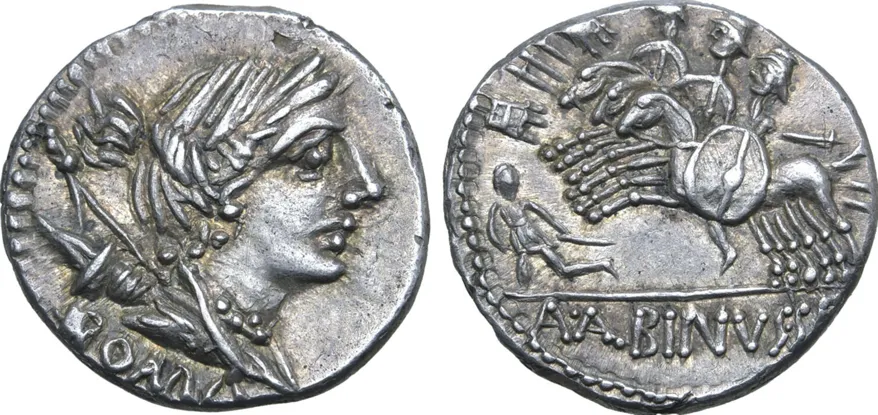
(Crawford 335/9 auctioned in 2022 at Roma Numismatics for 3.900€)
DIANA, goddess of hunting, childbirth and fertility, and patroness of wild animals. The deer is her sacred animal.
The first issue was struck in 95 BC by the moneyer A. Postumius Albinus. In the specimen shown, her bust appears on the obverse with a bow, quiver and arrows. On the reverse, three horsemen trample a fallen warrior.
She appears on 12 denarii struck by seven moneyers: 335/9; 336/1a; 336/1b; 336/1c; 372/1; 383/1; 394/1a; 394/1b; 407/1; 407/2; 426/1; 486/1.
15# SALUS, 91 BC
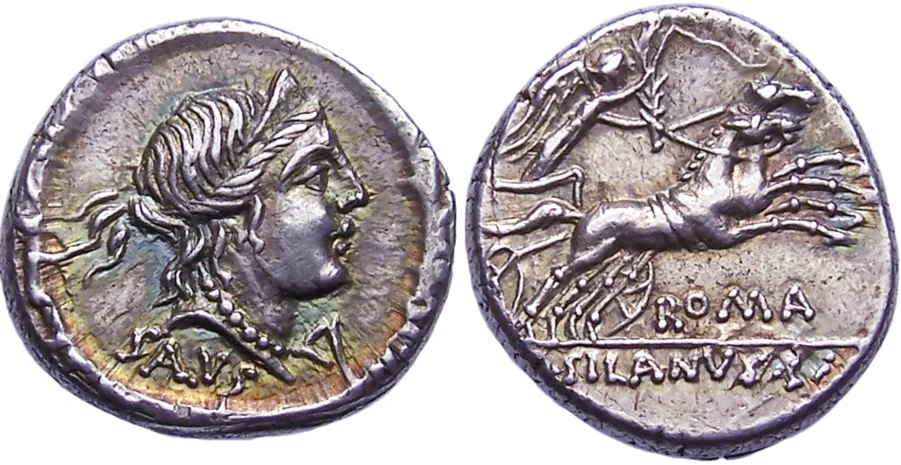
(Crawford 337/2c auctioned in 2011 at Roma Numismatics for 1.100€)
SALUS, goddess of safety, well-being, health and prosperity.
In 91 BC the moneyer D. Iunius Silanus issued the specimen shown. In total, 8 denarii were issued by two moneyers: 337/2a; 337/2b; 337/2c; 337/2d; 337/2e; 337/2f; 442/1a; 442/1b.
16# LIBER or BACCHUS, 90 BC
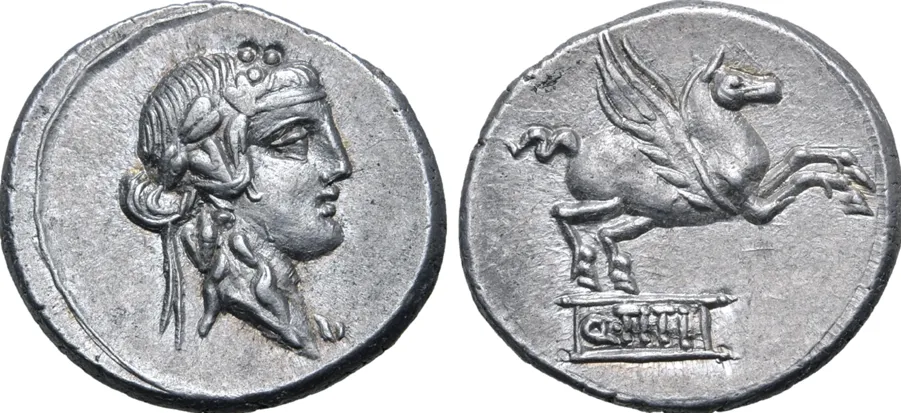
(Crawford 341/2 auction record not specified)
LIBER, Roman god of wine, generally associated with BACCHUS, also god of wine, festivity and revelry.
In 90 BC, Q. Titius struck the denarius shown. On the obverse appears Liber or Bacchus with a vine wreath. On the reverse we have Pegasus leaping over a tablet (Q.TITI), referring to the moneyer.
He appears on 7 denarii struck by five moneyers: 341/2; 385/3; 386/1; 449/2; 449/3a; 449/3b; 494/36.
17# JUNO, 87 BC
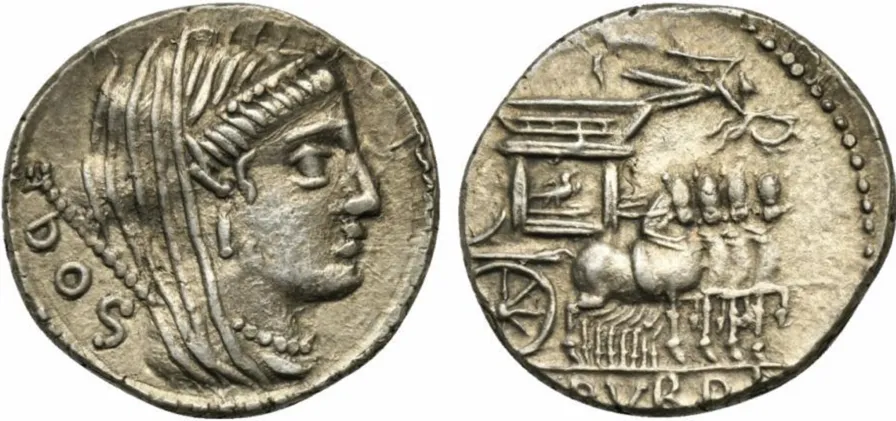
(Crawford 348/2 auctioned in 2022 at Bertolami for 190€)
JUNO, wife of Jupiter and queen of the gods and of heaven. Goddess of marriage, fertility and family. Together with Jupiter and Minerva she formed the Capitoline Triad, the most important gods of Rome.
In 87 BC, the moneyer L. Rubrius Dossenus was the only one to strike a denarius with the goddess Juno. In the image we see the veiled and diademed head of Juno, with a sceptre behind. On the reverse appears a triumphal quadriga with an eagle on a thunderbolt and, above, Victory holding a wreath.
18# CUPID, 75 BC
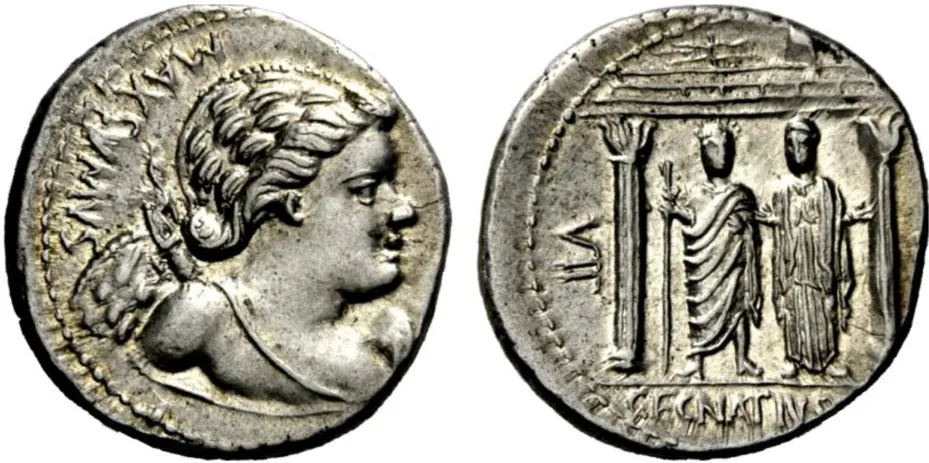
(Crawford 391/2, auctioned in 2013 at Ars Classica for 2.219€)
CUPID, god of love, son of Venus and Mars.
First issue in 84 BC by C. Egnatius Maximus. In total, 3 Crawford references by two moneyers: 391/2; 468/1; 468/2.
19# VENUS, 84 BC
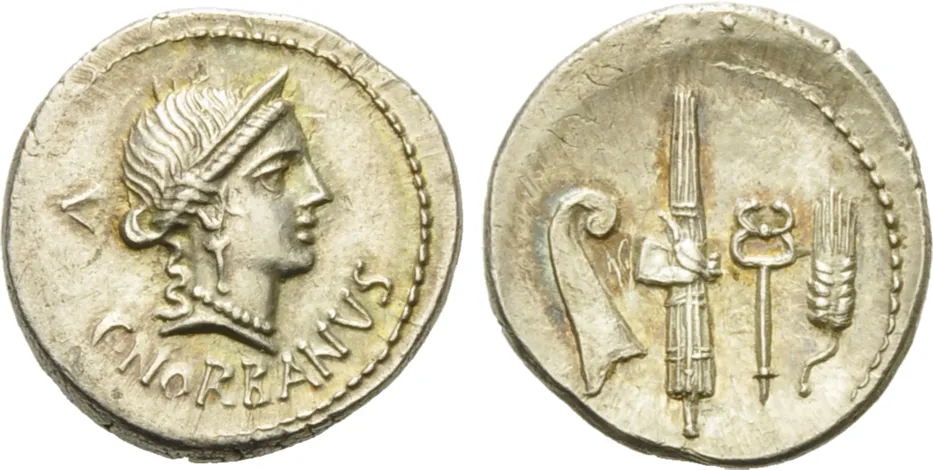
(Crawford 357/1a, auctioned in 2018 at Bertolami fine arts for 2.741€)
Goddess of love, fertility and beauty. Protector of gardens and nature.
First issue in 83 BC by C. Norbanus. In total, 22 Crawford references by sixteen moneyers: 357/1a; 357/1b; 359/2; 360/1a; 360/1b; 375/2; 376/1; 382/1a; 382/1b; 391/1a; 391/1b; 424/1; 426/3; 430/1; 457/1; 458/1; 463/3; 465/3; 465/4; 480/1; 482/1; 485/2.
20# MERCURY, 82 BC
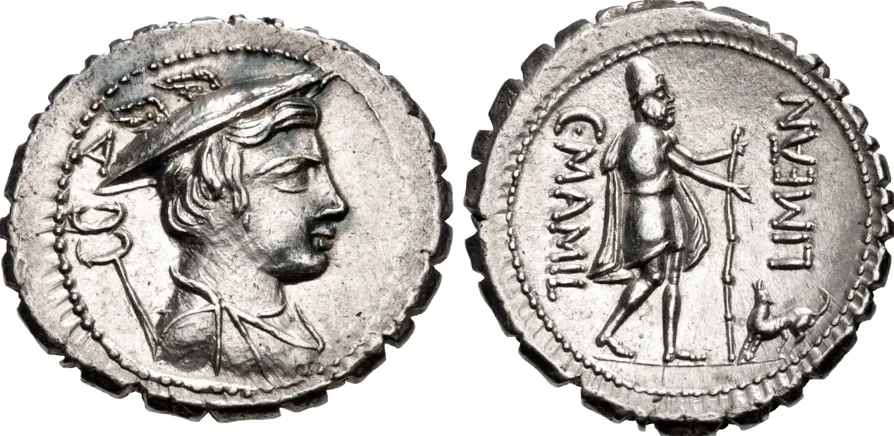
(Crawford 362/1, auctioned in 2021 at CNG for 2.752€)
God of commerce, messenger of the gods and protector of roads.
The reverse of this denarius shows Ulysses returning to his home on the island of Ithaca disguised as a beggar. No one recognises him except his old dog Argos, who runs toward his master, delighted to see him after twenty years.
First issue in 82 BC by C. Mamilius Limetanus. In total, 3 Crawford references by two moneyers: 362/1; 418/1; 418/2b.
21# NEPTUNE, 76 BC
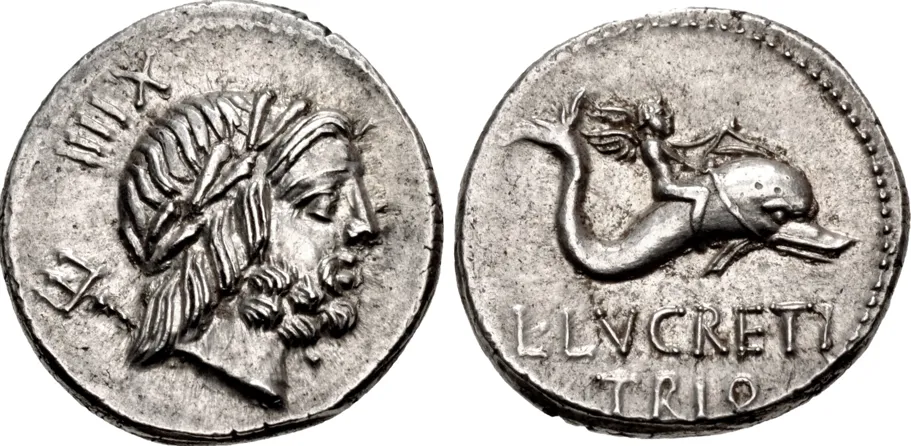
(Crawford 390/2, auctioned in 2020 at CNG for 1.568€)
God of the sea and brother of Jupiter.
First issue in 76 BC by L. Lucretius Trio. In total, 11 Crawford references by two moneyers: 390/2; 420/1a; 420/1b; 507/2; 510/1; 511/2b; 511/2c; 511/4a; 511/4b; 511/4c; 511/4d.
22# LIBERTAS, 75 BC
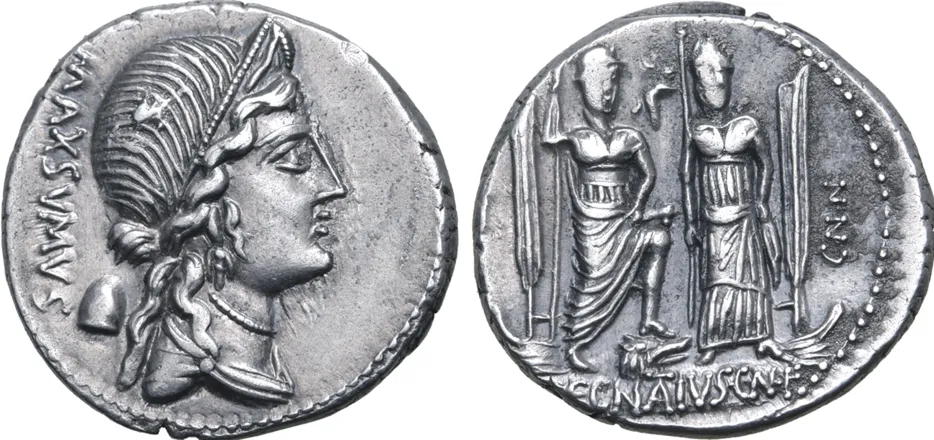
(Crawford 391/3, auctioned in 2022 at Roma Numismatics for 2.275€)
Goddess of freedom.
Diademed and draped bust of Libertas. The pileus stands out: a Roman cap with a special meaning, as it was the mark of freedmen, liberated slaves who ceased to be slaves.
The gens Egnatia was a plebeian family of equestrian rank in the Stellatina tribe, originally of Samnite origin. After the end of the Social War, a branch of the family moved to Rome, where two of its members were admitted to the Senate.
First issue in 75 BC by C. Egnatius Maximus. In total, 14 Crawford references by nine moneyers: 391/3; 392/1a; 392/1b; 428/2; 433/1; 449/4; 473/1; 500/3; 500/5; 501/1; 502/2; 505/2; 505/3; 505/5;
23# MONETA, 74 BC
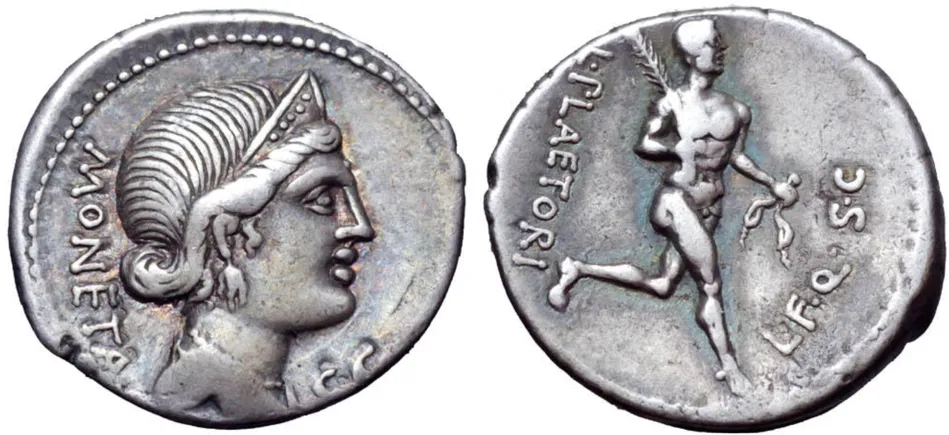
(Crawford 396/1a, auctioned in 2016 at Roma Numismatics for 1980€)
MONETA, an epithet or attribute of the goddess JUNO. Protector of Roman funds. Denarii were struck beside her temple. From her name came the word “money”.
Diademed and draped bust of Juno Moneta right; behind, MONETA; before, S C. Rev. Victorious boxer running right, holding a palm branch and caestus; behind, L PLAETORI; before, L.F.QS.C.
First issue in 74 BC by L. Plaetorius Cestianus. In total, 3 Crawford references by two moneyers:
24# AMPHITRITE, 72 BC
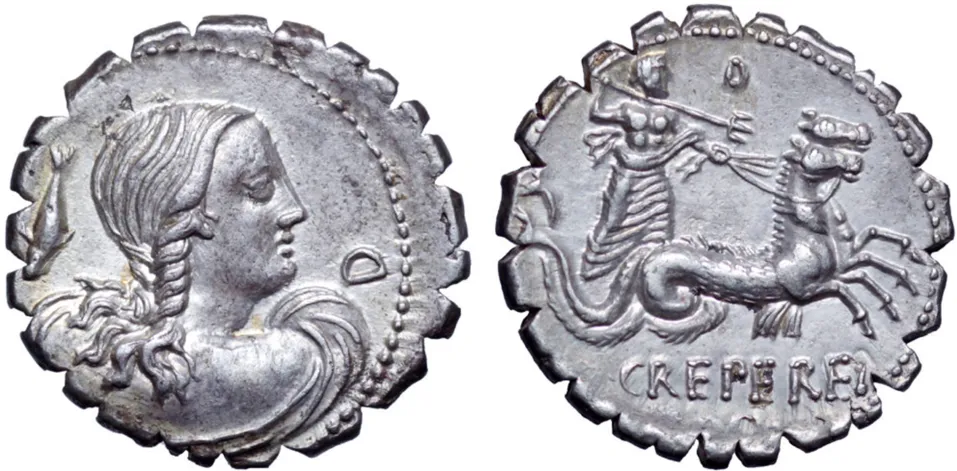
(Crawford 399/1a, auctioned in 2013 at Roma Numismatics for 4.925€)
Goddess of the sea, wife of Neptune.
Bust of Amphitrite, although some believe it could be Venus, seen from behind with a dolphin to the left. On the reverse, Neptune in a biga of hippocamps, brandishing a trident; D above, Q. CREPEREI [ROCVS]. A very difficult specimen to find, especially in this condition.
Tacitus indicates that Neptune was not favourable to a descendant of this moneyer. Crepereius Gallus died during an assassination attempt against Agrippina when he boarded the ship that Nero had arranged to sink by itself.
First issue in 72 BC by Q. Crepereius Rocus. In total, 2 Crawford references by a single moneyer:
25# VIRTUS, 71 BC
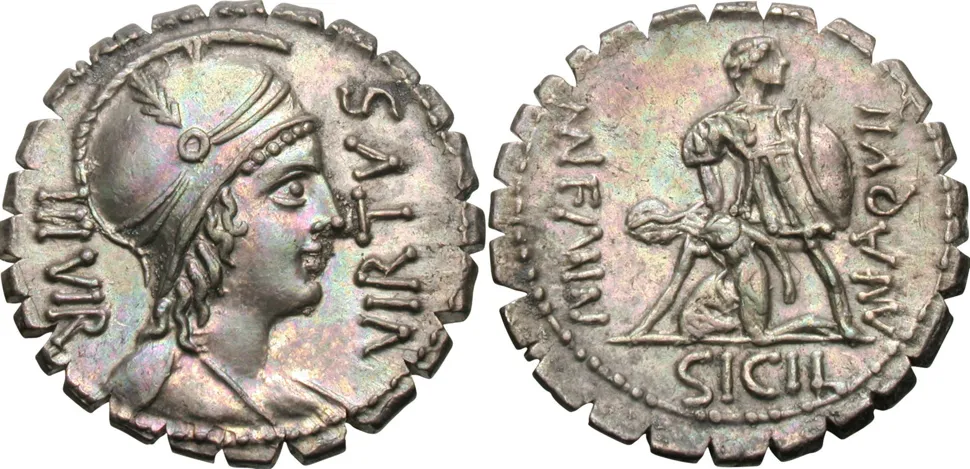
(Crawford 401/1, auctioned in 2011 at GEMINI LLC for 1936€)
Deity of courage and military strength.
On the obverse we see the helmeted bust of Virtus. On the reverse appears a warrior, possibly the consul Man. Aquillius, raising a fallen figure, possibly Sicily.
First issue in 71 BC by Mn. Aquillius. In total, 2 Crawford references by 3 moneyers:
26# FORTUNA, 69 BC
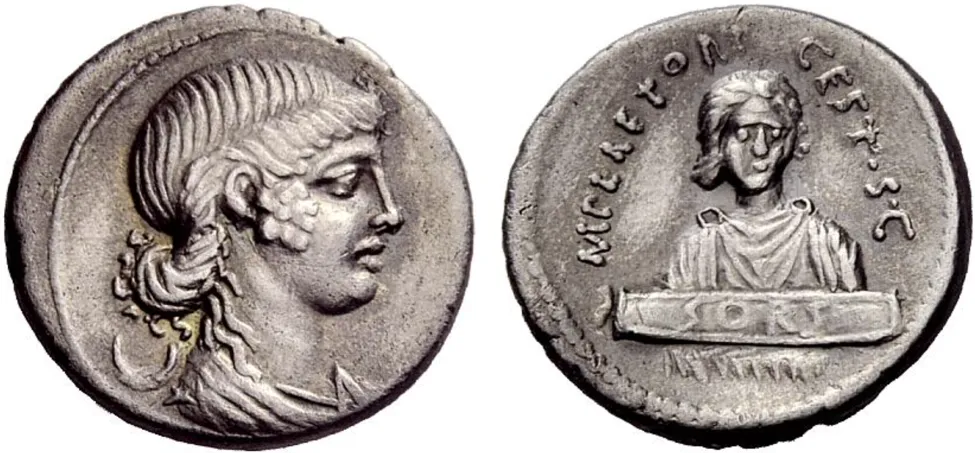
(Crawford 405/2, auctioned in 2010 at Ars Classica for 4.555€)
Roman goddess of fortune.
Draped bust of Fortuna right. On the reverse we see the personified bust of Sors, chance or lot, behind the inscription SORS.
SORS was the daughter of Saturn and carried a small box on her chest containing what was needed to cast lots. It was believed that, under the secret guidance of the goddess Fortuna, Sors cast these lots through the hand of a child.
First issue in 69 BC by M. Plaetorius Cestianus. In total, 2 Crawford references by two moneyers:
27# PROSERPINA, 69 BC
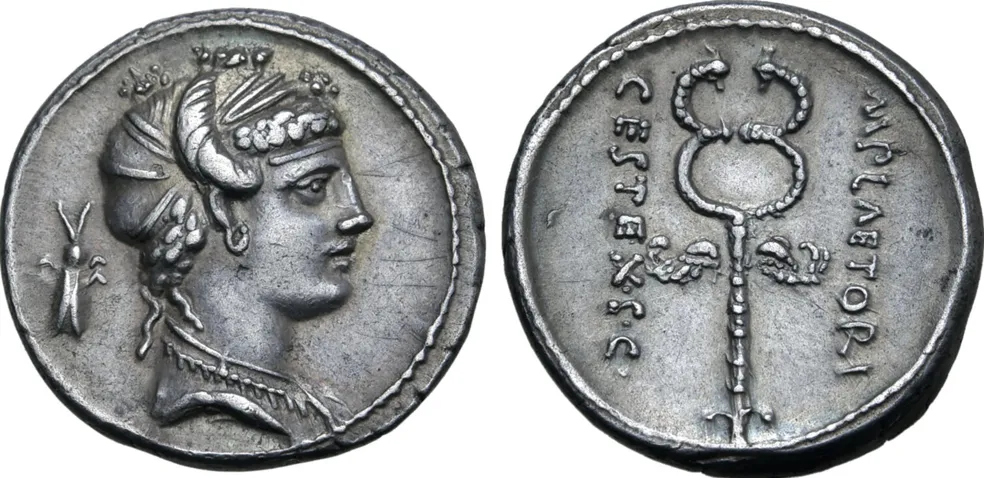
(Crawford 405/3b, auctioned in 2023 at Roma Numismatics for 2295€)
Daughter of Ceres and Jupiter, she was portrayed as a charming goddess. Goddess of life, death and resurrection. Pluto abducted her to make her his wife and live together in Hades, which also made her queen of the underworld.
On this piece, different identifications have been proposed for the bust. Some describe it simply as a woman, others as Ceres, and others as Proserpina. We believe the third identification is the most accurate.
First issue in 69 BC by M. Plaetorius Cestianus. In total, 6 Crawford references by a single moneyer:
28# VESTA, 69 BC
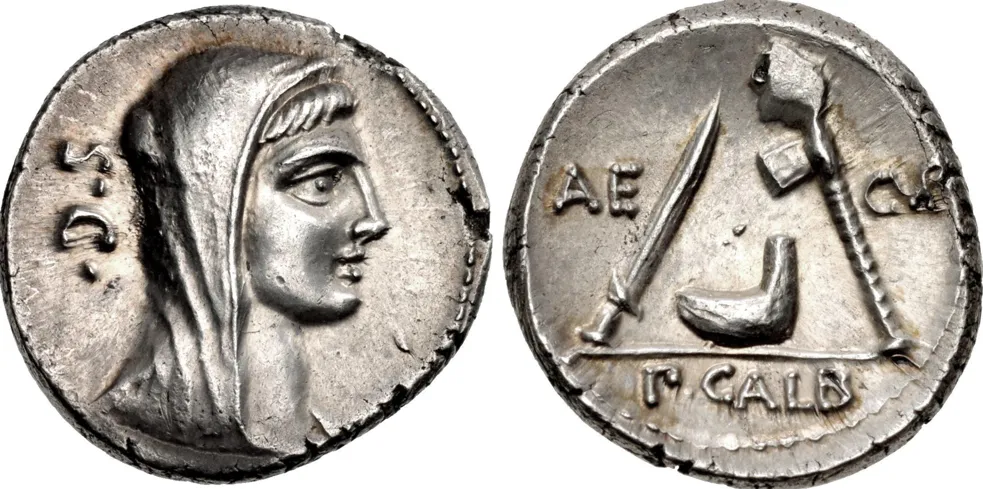
(Crawford 406/1, auctioned in 2017 at CNG for 1170€)
Goddess of the hearth and symbol of fidelity.
First issue in 69 BC by P. Sulpicius Galba. In total, 3 Crawford references by three moneyers:
29# CONCORDIA, 62 BC
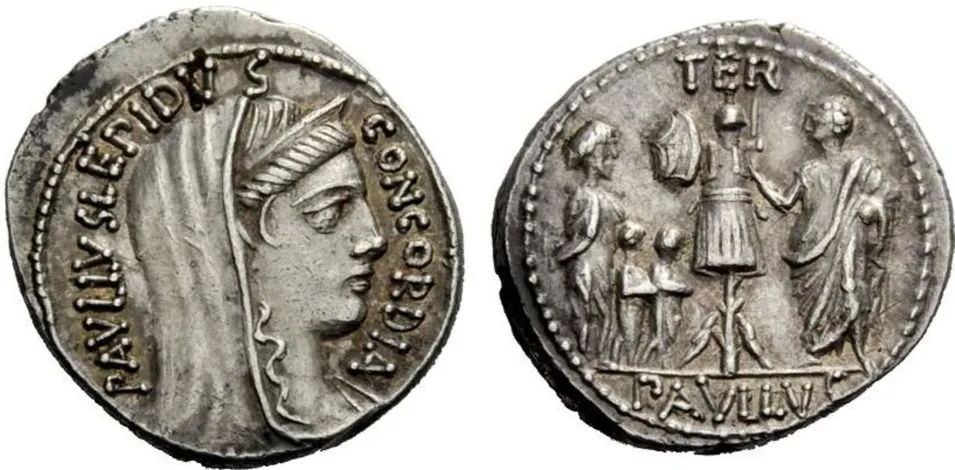
(Crawford 415/1, auctioned in 2016 at Ars Classica for 1.440€)
Goddess of agreement and harmony.
On the obverse we have the veiled and diademed bust of Concordia. On the reverse, a trophy stands in the centre, with three captives to the left, King Perseus of Macedon and his two sons, and Paullus to the right.
This coin commemorates the victories of the moneyer’s supposed ancestor, Lucius Aemilius Paullus, although in fact they were only distantly related. The word TER on the reverse refers to the three triumphs of Lucius Aemilius Paullus: in Spain in 190, in Liguria in 181, and at the famous Battle of Pydna in 168, when the Romans extinguished the independent kingdom of Macedon. *Nomos AG.
First issue in 62 BC by L. Aemilius Lepidus Paullus. In total, 10 Crawford references by six moneyers:
30# FLORA, 57 BC
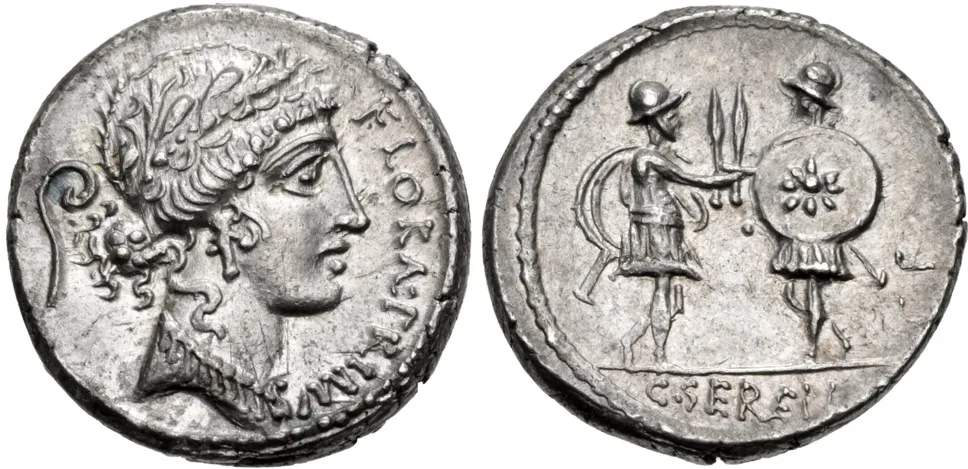
(Crawford 423/1, auctioned in 2021 at CNG TRITON XXIV for 4.123€)
Goddess of spring, gardens and flowers.
Bust of Flora right, with flower wreath, triple-drop earring and necklace with pendant; lituus to the left, FLORA PRIMVS to the right. On the reverse we see two warriors with helmet and shield facing each other, each holding a sword upright.
The obverse legend, FLORIAL(is) PRIMVS, suggests that a Servilian was the first flamen Floralis after the institution of the games in honour of the goddess Flora in 240 BC. The flamines were the high priests of Rome, and the fifteen flamines were responsible for the cults of various gods. *World Heritage.
First issue in 75 BC by C. Servilius. In total, 2 Crawford references by two moneyers:
31# QUIRINUS, 56 BC
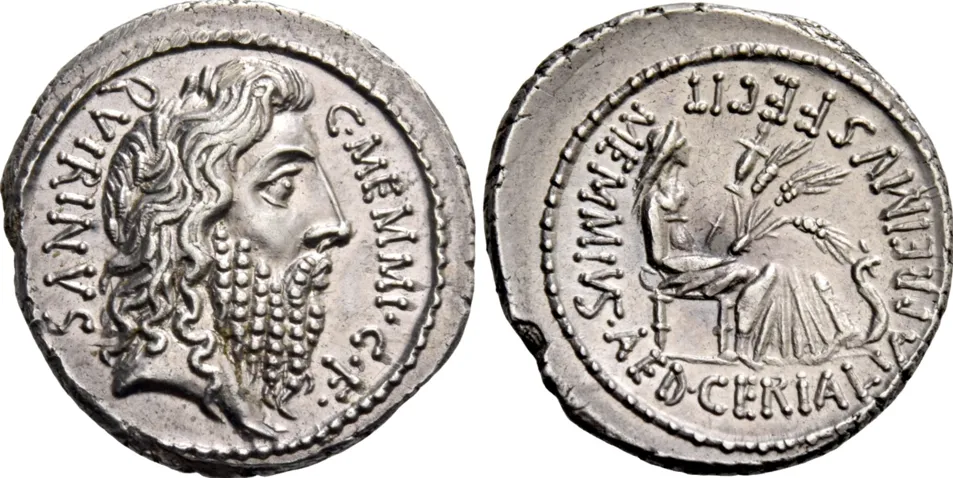
(Crawford 427/2, auctioned in 2019 at Ars Classica for 3.293€)
Quirinus is a Sabine warrior deity assimilated by the Romans. The Quirinal Hill bears his name. By the late first century BC, Quirinus was recognised as the deified form of Romulus.
Laureate head of Quirinus. On the reverse we see Ceres seated, holding a torch and a bundle of wheat behind a serpent; around, MEMMIVS AED CERIALIA PREIMVS FECIT.
Memmius seems to be referring to a Sabine family origin or claiming descent from Romulus. The obverse legend states that it was an ancestor of his who, in 202 BC, as aedile, celebrated the first festival in honour of the goddess Ceres, the Cerealia. *Larry Goldberg
First issue in 56 BC by C. Memmius. A single Crawford reference.
32# PAN, 81 BC
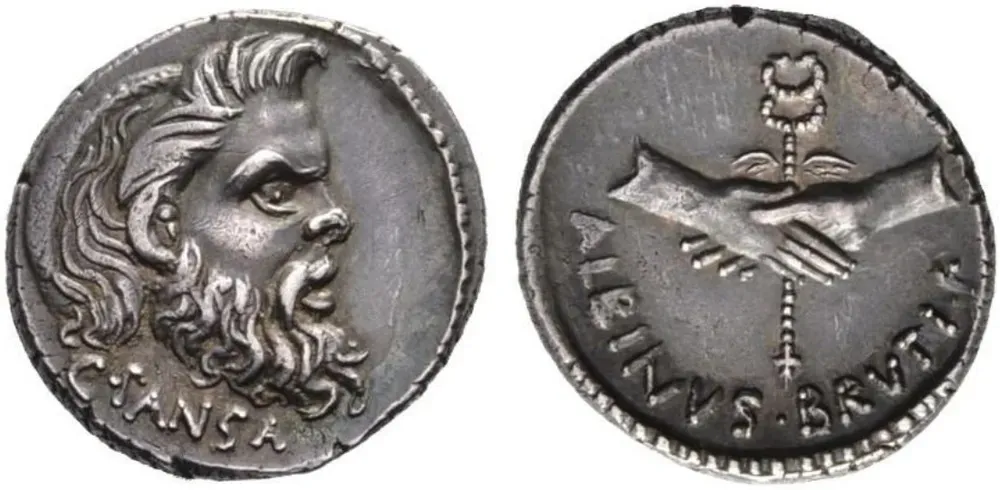
(Crawford 451/1, auctioned in 2015 at Ars Classica for 6.236€)
Gaius Vibius Pansa shows on the obverse the mask of the god Pan facing right, with beard, a numismatic allusion to the name Pansa (“Pan-sa”), a common device in the iconography of Roman coinage.
In classical mythology, Pan is a pastoral and rustic god, linked to flocks, shepherds, wild nature and rustic music. Although his usual iconography is hybrid, with goat legs and horns, on this denarius he is represented by his bearded mask.
The choice of Pan here does not necessarily reflect a deep religious function, but rather a play on the moneyer’s name and the Roman taste for inserting personal and symbolic references into coinage.
Three variants of the same type were issued: Crawford 449/1a; 449/1b; 449/1b; 449, plus another type with 451/1.
33# FIDES, 47 BC
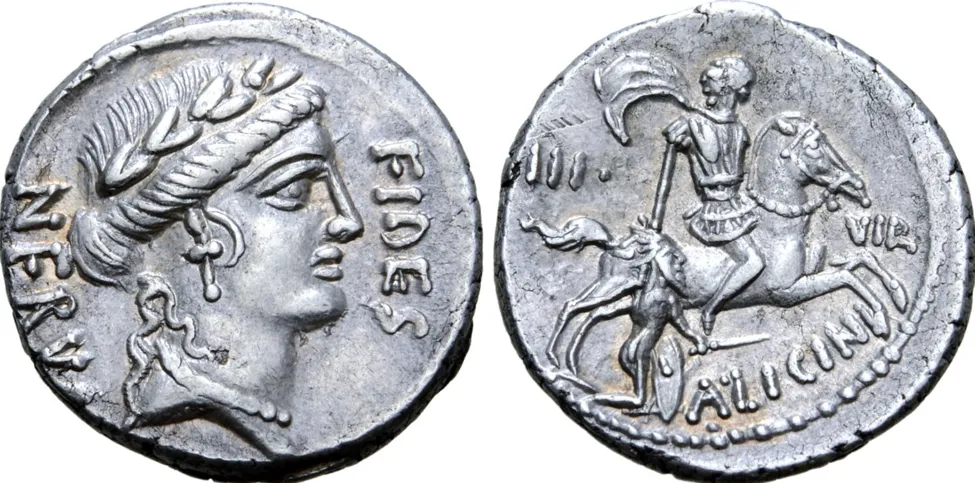
(Crawford 454/1, auctioned in 2020 at Roma Numismatics for 1.888€)
Goddess of trust, good faith and loyalty. Daughter of Saturn and Virtus. Treaties with foreign countries were kept in her temple.
Bust of Fides. On the reverse we have a horseman dragging a naked warrior by the hair; the warrior holds a shield in his left hand and a sword in his right.
First issue in 47 BC by A. Licinius Nerva. There are two Crawford references by the same moneyer:
34# PENATES, 47 BC
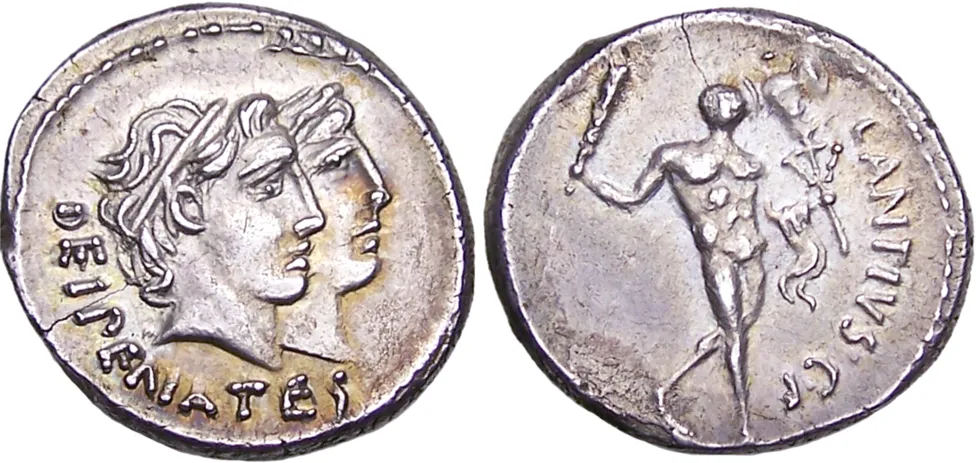
(Crawford 455/2a, auctioned in 2011 at Roma Numismatics for 1.277€)
The PENATES or LARES were gods protecting Roman households. According to Servius and Cicero, they were privately worshipped deities associated with the innermost and safest part of the family home. Roman religion allowed each individual to choose personal Penates, which could take the form of major heavenly deities such as Jupiter or Vesta, or could even be a person’s own ancestors or an emperor.
On the obverse we have two diademed busts of the Penates. On the reverse, Hercules holds a club and a trophy.
First issue in 47 BC by C. Antius Restio. There are 2 Crawford references by the same moneyer:
35# HONOS, 45 BC
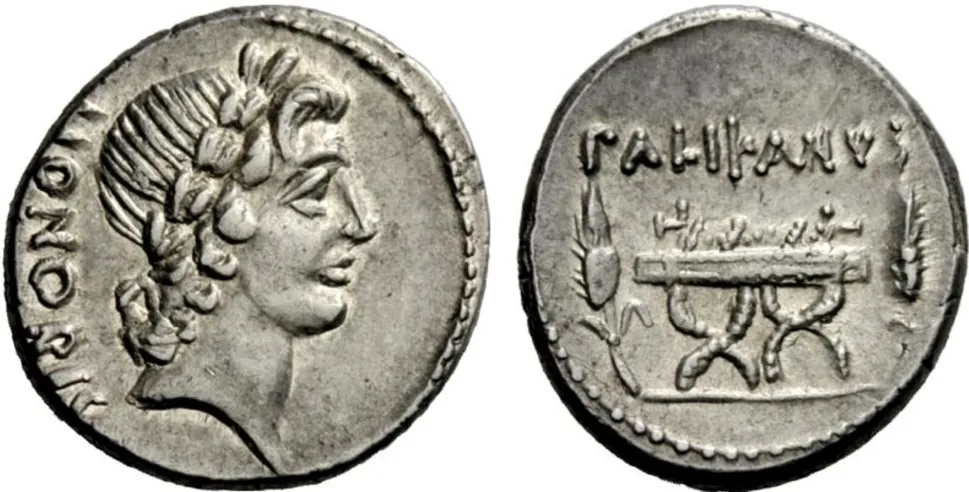
(Crawford 473/2a, auctioned in 2013 at Ars Classica for 1.130€)
God of honour, cavalry and justice, generally in the military sphere.
First issue in 45 BC by Lollius Palicanus. There are 4 Crawford references by the same moneyer:
36# ARTEMIS, 43 BC
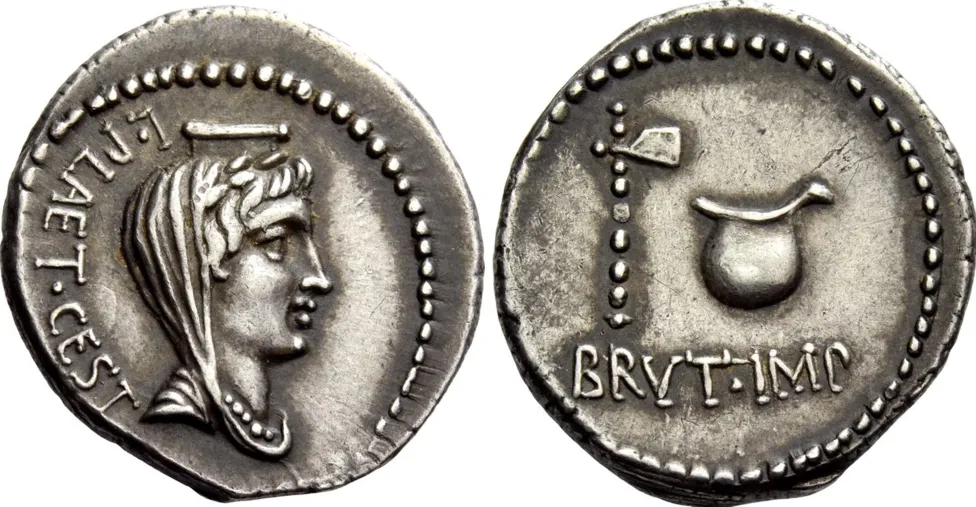
(Crawford 508/2, auctioned in 2016 at Ars Classica for 35.255€)
Greek goddess of hunting. Virgin goddess, protector of chastity and virtue. Diana in the Roman world.
Some specialists identify this bust with the goddess Ceres. Crawford favours the goddess Artemis. In any case, the last denarius with the bust of a goddess struck in the Republican period remains somewhat controversial.
Unique issue in 43 BC by Marcus Junius Brutus and L. Plaetorius Cestianus.