Origin of the Denarius
As in many places, commerce in ancient Rome was also carried out through barter and exchange, especially with small livestock. Over time, payments began to be made with weighed bronze pieces known as aes rude. Later, the standard of the bronze pound was established with the so-called aes grave, a large coin originally weighing 273 grams.
Then came the denarius, which became the Roman silver unit par excellence. Its importance survives in the word “dinero” in Spanish, used to designate any widely accepted good that serves as a means of payment, a unit of account, and a store of value.
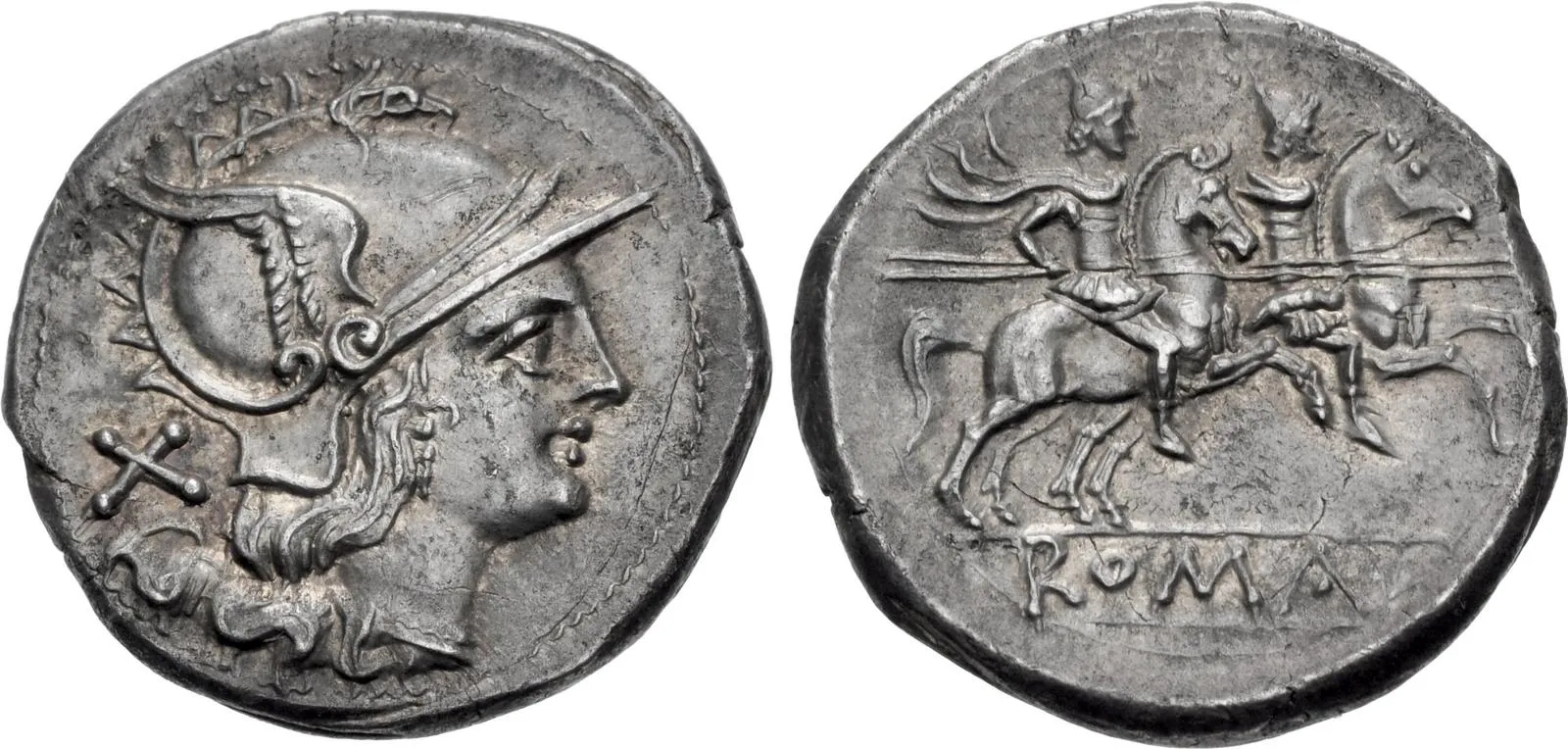
Denarius of the earliest period
It is generally understood that Rome began striking the denarius before or during the Second Punic War. Because of the financial difficulties caused by the war against Carthage, a new and lighter silver coin was created to finance the armies and to replace the quadrigatus. Its approximate theoretical weight was 4.5 grams, and its value was set at ten bronze asses, as indicated by its name, deni, “by tens”, and by the value mark X.
There is debate over whether the first Roman denarii were minted in southern Italy and, slightly later, in Sicily. At the same time, their fractional denominations were also created: the quinarius, a half-denarius marked V; and the silver sestertius, a quarter-denarius marked IIS.
Classical sources mention the ancient Sicilian city of Morgantina, which rebelled against Rome twice, in 214 and 211 BC. The city was destroyed in 211 BC; many buildings were ruined and definitively abandoned. Excavations of its remains uncovered denarii of the first issue together with quinarii, silver sestertii, coins of Syracuse, and coins from other Sicilian cities. This provided historical evidence that the denarius existed before 211 BC.
On the other hand, L. Villaronga published in 1976 an overstrike of a Carthaginian half shekel on a Roman denarius. Since the Carthaginians definitively abandoned the island in 210 BC, this also suggests that the denarius must have existed before that date.
Finally, according to Livy, Rome began striking denarii in 268 BC, with a weight of 4.54 grams.
In 217 BC, its weight was set at 3.90 grams, where it remained until Nero reduced it to 3.40 grams in AD 64. It remained at that standard until AD 161 and, from then on, its silver weight declined more steadily until the antoninianus appeared under Caracalla, a coin that eventually replaced the denarius completely.
The denarius was the reference coin of ancient Rome for a little over five hundred years, from 268 BC until AD 249/251 under Philip and his son. After that, some denarii may still have been struck as commemorative pieces or as copper coins with a silver wash.
At the well-known auction house CNG, a denarius of Magnia Urbica, wife of the emperor Carinus, was auctioned. It is dated to AD 284, with a diameter of 20 mm and a weight of 2.16 grams.
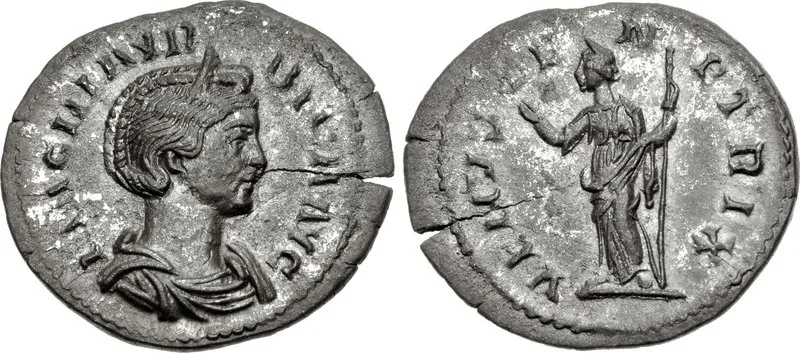
Denarius of the latest period