GENS VALERIA Crawford 306-1
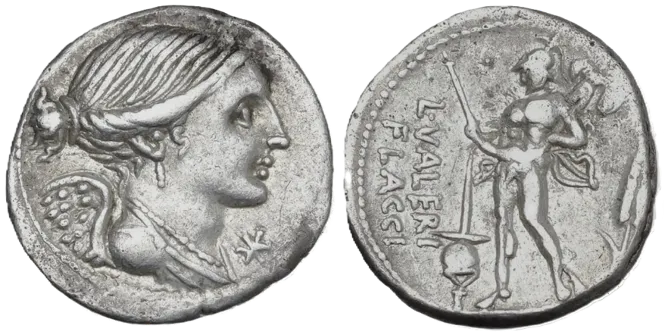
Legend ./L. VALERI. FLACCI
The Valeria gens was one of the oldest and most illustrious Roman families. Originally patrician gens that over time gave several plebeian branches. They were originally from the region of the Sabines, perhaps from Falerii. The nomen Valerio comes from the Latin praenomen Volusus or Volesus, which in turn derives from valere, which means strength, courage and also health, healing.
The ancestor of the gens, Volusus or Volesus arrived in Rome with Titus Tatius, king of the Sabines, who had established an alliance with Romulus. One of his descendants, Publius Valerius Publicola, took an active part in the overthrow of royalty and was consul alongside Brutus in the first year of the republic (509 BC). He defeated the Etruscans, whose king Porsenna wanted to restore Tarquin the proud to the throne, and returned triumphant to Rome. Afterwards, he again defeated the Sabines and was honored with the consulship four times.
Another prominent member of the gens was Marcus Valerius Corvo, who obtained the cognomen Corvo or Corvinus because during the war against the Gauls in 349 BC. C defeated a giant Gaul in single combat with the help of a crow. He was considered one of the greatest heroes of the republic and was dictator twice, consul six times and curul aedile twenty-one times, living to the age of one hundred.
The gens Valeria was divided into several branches under the republic, some of whose cognomina are Acísculus, Barbatus, Catullus, Corvus or Corvinus, Falton, Flaccus, Levinus, Maximus, Messala, Potito, Publicola, Tapon, Triarius and Voluso. The praenomina most used by the Valerians were Publius, Marcus, Manius, Gaius and Lucius [1,2].
Although several members of the gens shared names at that time, Crawford and Babelon identify our moneyer with Lucius Valerius Flaccus, son of Lucius Valerius Flaccus, consul in 131 BC and Flamen Martialis.
Lucio Valerio, like his father, held the priestly position of Flamen Martialis. This honorable position assured him from a young age an elevated position in society and security in the face of an increasingly bitter political struggle. Due to the position, he had to remain within the city limits of Rome and could not carry out any military activities. It was perhaps due to his flamen status that he reached the highest positions in the state. He was consul in 100 BC with Gaius Marius and censor in 97 BC. C. After the death of Marcus Emilio Escauro in 90 or 89 BC. C., became Princeps Senatus. Initially a supporter of Gaius Marius, his little involvement in the political life of those years guaranteed his safety in the face of the civil war. Valerio Flaco probably led a group of influential senatorial centrists who advocated a compromise between the popular and optimates. After Sulla’s victory in the civil war at the end of 82 BC. C., was elected interrex and presented a bill to grant the latter the powers of dictator. Sulla then appointed him magister equitum. He died sometime before 64 BC.
The chronology of this issue is problematic due to the fact that there are several members of the gens with the same name at that time. Crawford and Babelon identify the moneyer with Lucius Valerius Flaccus, consul in 100 BC. Grueber does not favor any of the candidates and indicates that it is an issue from an Italian mint. The fact that our moneyer held the position of Flamen Martialis rules out that it is an Italian issue and not from the city of Rome itself, since the flamen majors could not leave the pomerium.
If we listen to Crawford and Babelon and take into account the date of the consulate and the requirements of the lex Villia annalis, which established minimum time intervals between magistracies, Lucius Valerius should have held the office of praetor no later than the year 103 BC. C. It is unlikely that our moneyer obtained the magistracy of tresviri monetalis in 104 BC as indicated by Babelon and later the praetorship in 103 BC in accordance with the requirements of the aforementioned law. The date proposed by Crawford of 108-107 BC seems more appropriate considering the biography of Lucius Valerius Flaccus [3].
The elimination of Gaius Sempronius Gracchus ended the last attempt at agrarian reform in the state. A few relatively calm years in foreign policy and the economy, after the crisis years of the Gracchi, produced a false impression of calm and harmony in the leadership of the state. Three laws enacted during the 1910s would address the agrarian problem. The first, dated between 121 and 119 BC, eliminated the inalienability of the plots, opening the door for their sale. The second, from 119 or 118 BC, known as lex Thoria, guaranteed in perpetuity the lands of the ager publicus occupied up to that point, ending any possible agrarian distribution. Finally, in 111 BC, another law converted all the ager publicus distributed by the triumvirs into private property. Taken together, they meant an Italian land ownership law that guaranteed ownership of the land and its possible sale but that annulled any possibility of new land distributions in Italy for the future.
On the political scene, the approval by Gaius Gracchus of the Gracchani iudices through the lex iudiciaria resulted in the confrontation of a part of the nobilitas, gathered around the clan of the Caecilios Metellus with the equites, who controlled these courts that they could use for their own purposes. Under the shelter of the Metellus clan, a fundamental homo novus emerged in the history of Rome, Gaius Marius. Its origins are not clear, although it may have belonged to the equestrian order. His political career began in 119 BC as tribune of the plebs and in 115 BC he was praetor in Later Hispania. His career, supported by the Metellus clan, suffered ups and downs as a result of his contradictory policies for and against the plebs. However, at some point, he reconciled with the Metellus clan and was incorporated as a legate of Metellus’s African army.
In these years of the rise of Gaius Marius, there were a series of military defeats as a consequence of the incompetence and corruption of the Roman magistrates, Calpurnius Bestia and Albinus in Africa, M. Caton in Greece, Junius Silanus against the Cimbri, etc., which produced a wave of popular indignation that was taken advantage of by demagogue politicians to bring these disgraced former magistrates to trial.
Metellus began a war of attrition due to the harassment suffered by the Roman troops by Jugurtha. The impatience of the plebs, the long series of military failures and the promises of a quick victory, led to the elevation of Gaius Marius to the consulship in the year 107 BC and the leadership of the African war. Faced with the difficulties in forming the army that was to accompany him to Africa in the war against Jugurtha, Marius expanded the base for recruitment into the legions by accepting as volunteers not only citizens of the five classes of the centuriate order, but also capite censi, that is, citizens without the minimum economic resources to be counted. It would be the foundation of the new militia, from which the owners would gradually disappear, replaced by proletarians, for whom a long stay in the army in exchange for a salary and benefits once their military service had ended was no obstacle. It was the birth of the professional army.
The war that Marius had promised to win quickly was resisted for three long years, proving that Metellus had acted honestly and with the only possible tactic against an astute enemy knowledgeable about guerrillas. It was thanks to the negotiations carried out by Marius’s quaestor, Sulla, that they finally managed to catch Jugurtha and end the war. The victory opened the doors of the triumph that he celebrated on January 1, 104 BC.
The defeat of Arausius in 105 BC in which 80,000 men died due to the incompetence of their commanders cleared the way for Cimbri and Teutons to Italy. Upon Marius’s return from the war in Africa, he was invested as consul for the second time to confront the threat. For several years and being repeatedly ratified in the position of consul, he trained a powerful army that finally, in 102 BC, defeated the Teutons at Aqua-sextiae where around 100,000 Germans were killed or captured. In 101 BC with fresh troops he went to meet the other consul, Lutatio Catullus, to concentrate all the troops on the northern bank of the Po. In the Campi Raudii, near Vercellae, the decisive battle took place. No less than 65,000 Cimbri died in the battle, signifying the end of the German danger. Mario and Catullus celebrated a joint victory. Marius was proclaimed as the third founded of Rome, consul for the sixth time together with our moneyer Lucius Valerius Flaccus and pater patriae. It was the zenith of his career.
It was in this context of wars and military reforms when our moneyer minted its currency [4].
OBVERSE:Winged bust of Victory to the right, front: *
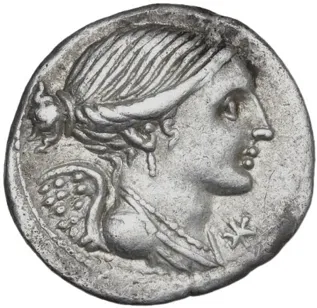
The Victory is one of the most common types, whether on the obverse or reverse, in Roman numismatics. Roman Victory is the Greek equivalent of the goddess Nike and was associated with the goddess Bellona, goddess of war, since Victory originally had an exclusively military meaning. Therefore, the obverse refers to military successes related to ancestors of the Valeria gens, since the moneyer did not have any military career when holding the position of Flamen Martialis.
Babelon indicates that the face of Victory is related to the biga driven by Victory found on the reverses of the coins of C. Valerius C. f. Flaccus, perhaps related to the triumphs of Valerius Publicola [1,2].
REVERSE:: Mars with trophy and spear standing left, in front: flamen cap (apex), behind: spike.
Legend ./L. VALERI. FLACCI
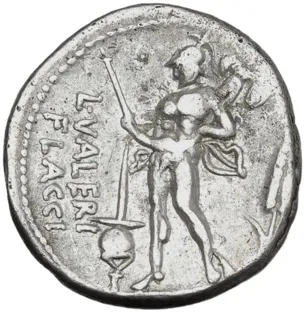
The reverse of the denarius alludes to several events related to the Valeria gens.
Babelon makes a vague description of the reverse, only indicating that the appearance of an ear of wheat would allude to some free distribution of wheat to the people of Rome, although without associating it with a historically known fact. For Babelon, the figure of the god Mars with a helmet and carrying a trophy is related to some military success of one of his ancestors. The apex or cap of the flamens recalls the functions of flamen that the father of the moneyer and himself performed.
Grueber indicates that both the motifs on the obverse and the reverse allude to three events related to members of the Valeria gens. Firstly, the successes of L. Valerius Flaccus in northern Italy against the Gauls in 194 BC, represented by Victory and Mars. The colonization of Placentia and Cremona by the same magistrate, represented by the ear of wheat and thirdly, the appointment of L. Valerius Flaccus, consul in 131 BC as Flamen Martialis, illustrated by the apex or cap of the flamines.
Therefore, the motifs on the obverse and reverse are a clear allusion to different military successes and positions held by former members of the Valeria gens as a way of extolling their lineage [2,3].
[1] Babelon E. Description Historique Et Chronologique Des Monnaies de la République Romaine. Vol 2. 1885.
[2] Grueber H. A. A Catalog of The Roman Coins in The British Museum. Vol 2. 1910.
[3] Crawford M. H. Roman Republican Coinage. Vol 1. 1974.
[4] Roldán J. M. History of Rome. The Roman Republic. 1982.