GENS SULPICIA Crawford 406-1
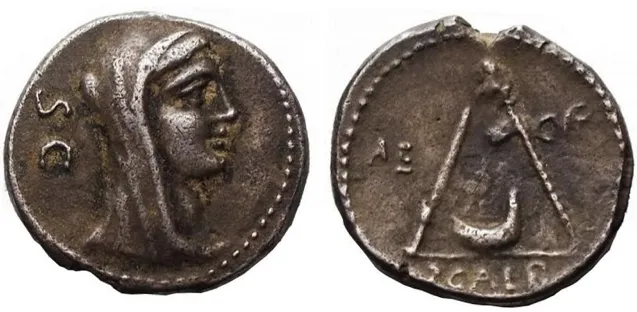
Legend ./ behind:S.C.
Legend ./in the field:AE-CVR.,(interlaced CVR),
Exergue: P. GALB
The gens Sulpicia is one of the most illustrious and ancient patrician families, originating from Lavinium. They settled in Rome in the time of the kings, and soon divided into different branches, some plebeians, among which the most famous bear the cognomen Camerinus, Cornutus, Galba, Rufus and Saverrio. They only used four praenomina, Publius, Quintus, Servius and Gaius.
At the beginning of the Roman Republic some patrician branches of the family had great relevance. The first member of the gens to obtain the consulship was Servius Sulpicius Camerinus Cornutus, in 500 BC, only nine years after the expulsion of the Tarquinians.
The patrician branch of the Sulpicius Galba to which the moneyer belonged also has among its members the Emperor Galba [1].
Publius Sulpicius Galba was appointed one of the judges in the trial against Gaius Verres in 70 BC, but was rejected by the latter due to his reputation for severity and incorruptibility. He was an unsuccessful candidate for the consulship in 63 BC in a struggle with Cicero. He is mentioned as pontifex in 57 and augur in 49 BC. According to the reasons represented on the coin, he must have held the position of curul aedile shortly after 70 BC. Cicero mentions him as one of the most honest citizens of his time [2,3].
The passage from the decade of 80-70 BC to 70-60 BC represents the transition to a more refined style of denarii with excellent workmanship that gives rise to very beautiful issues. The serrated or serrated denarii issued in previous times disappear.
Babelon, Mommsen, Grueber and Crawford agree in assigning this issue to 69 BC, when Publius Sulpicius Galba held the position of curul aedile. The reliefs of this series and the style resemble the coins issued by M. Plaetorius and L. Manlius Torquatus. The point is that, according to Grueber, who follows Mommsen in this case, the M. Plaetorius’s companion in office was C. Flaminius and, therefore, it would be implausible to think that there would be three curule aediles in 69 BC. Grueber solves the problem by assigning the emissions of L. Manlius and Sulpicus Galba to the year 69 and those of M. Plaetorius to 68 BC. Babelon assigns the positions of the year 69 to Sulpicius Galba and M. Plaetorius and Crawford delays the aedility of M. Plaetorius until 67 BC to square the college of aedilis.
Be that as it may, everyone agrees in assigning the Publius Sulpicius Galba series to the year 69 BC, although his companion in office is not known with certainty [2,3,4].
The Silane reform that affected all areas of the republic did not leave the administration of the provinces indifferent. The direct government of the provinces was in the hands of the provincial proconsuls and praetors elected from among the members of the senate. During the dictatorship of Sulla, the powers of the jurisdictional praetors of Rome and the provincial ones were unified and their number was increased from 6 to 8. Only after completing their position in Rome did they receive, as propraetors, the government of the provinces. Endowed with imperium militae when exercising their function outside Rome, they had unlimited power that included the direction of the army, coercitio and the administration of justice [5]. This power caused many governors to commit outrages and excesses for profit. One of the most notorious cases was that of Cayo Verres.
Unscrupulous man who obtained the praetura through bribery in 74 BC, abusing his authority. After his year in office, he obtained the province of Sicily, one of the richest in the republic. Under his government he committed all kinds of abuses, extortions and crimes. He stole statues and works of art from temples and public places, increased taxes on peasants, threatened property owners to pay him in exchange for his life, etc. Once his mandate had expired, the Sicilians asked Cicero, the best orator of his time, who had been quaestor in 75 BC on the island, to defend their interests. After several delays with different pretexts and changes in the jury, as was the case with our moneyer, due to his reputation for incorruptibility and an honest man, the trial took place in 70 BC. Although the accused was defended by the best lawyer from Rome, Quintus Hortensius, Cicero’s oratory made Verres decide to go into exile to Massilia even before knowing the outcome of the trial.
The disastrous government of Verres in Sicily generated a problem in the supply of grain to Rome, which largely came from the island, which could be the reason why Publius Sulpicius Galba had to exceptionally issue, senatus consultum, the series in question during his position as curul aedile in 69 BC [3,6].
OBVERSE:Veiled head of Vesta to the right.
Legend ./ behind:S.C.
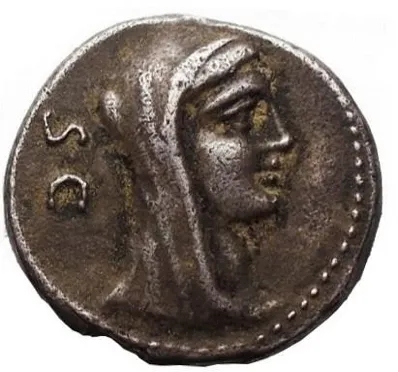
On the obverse appear the letters S C, senatus consultum, an official declaration from the senate to one or more magistrates. Although these decrees were not mandatory, in practice they were carried out by the magistrates. It was the first time under the Silan constitution that an aedile coined, since it was not his function. What was the reason that motivated the senatus consultum? The reason is not known with certainty, but it can be conjectured by looking at the coinages of previous aediles before Sulla, such as Marcus Fannius and Lucius Critonius. These aediles issued numerario to acquire grain due to the shortage in Rome, could it be the same reason that led the senate to dictate the senatus consultum in 69 BC? The lex Terentia and Cassia of 73 BC attempted to alleviate the lack of grain in Rome, which was bought in Sicily and paid in part with the state treasury. Verres’s embezzlement of these funds added to the problem. Titus Vettius Sabinus, quaestor in 71 BC in Sicily under Verres, he also issued a series under senatus consultum, due to lack of funds. If the coin of Publius Sulpicus Galba is dated 69 BC, it is in the time period after the trial of Verres in 70 and before the appointment of Pompey in the war against the Pirates in 67 BC. Grain still had to be purchased and the problem could have been brought under the control of the curule aediles of 69 BC [7].
In front of S.C, the bust of the goddess Vesta, one of the great Roman divinities, goddess of the hearth and sacred fire. She was considered the protector of the Roman state and, consequently, of the res publica. A retinue of priestesses known as Vestals took care of their temple and were in charge of keeping the sacred fire lit permanently. They were highly respected and presided over many of the state ceremonies and trials [8]. The head of Vesta on the obverse shows the close connection that the pontificate had with Vesta and the Vestal Virgins, which will be explained later along with the elements on the reverse.
The portrait of the goddess is extraordinary and, probably, was taken during the lifetime of a relative of the artist, his wife, his wife? [9].
REVERSE:Sacrificial knife, symbol and priestly ax decorated with a lion’s head.
Legend ./in the field:AE-CVR.,(interlaced CVR),
Exergue: P. GALB
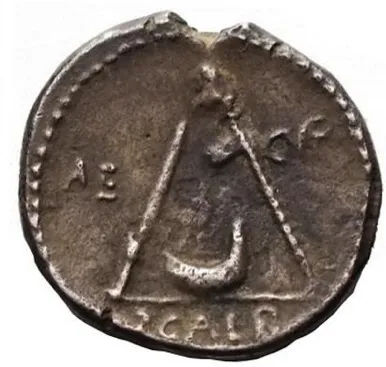
The reverse contains three priestly items: a ceremonial knife and ax used in sacrifice and a single-handled container called a simpulum, used in libations. Priestly symbols reflect political and religious authority.
The legend that appears in the field and exergue on the reverse indicate without a doubt that our moneyer held the position of curul aedile. Grueber mentions that the elements represented are related to the priestly functions of the curule aedile, but the aedility was not a priesthood. The aedility was a minor but very important magistracy made up of four members, two plebeian aediles and two curules or patricians with the same function. They had various tasks, mainly police in the interior of Rome, control of streets and buildings, responsibility for supplying the city with food and organizing the games, an extraordinary opportunity for electoral propaganda. They did not perform religious functions, therefore, the symbols on the currency refer to another office. The elements allude to the pontificate, a position that Publius Sulpicius Galba undoubtedly held. Cicero mentions that Galba belonged to the college of pontiffs in 57 BC but this issue indicates that the moneyer was already pontiff in 69 BC, when he coined curul aedile [3,5,7].
The elements represented relate obverse and reverse, since the college of pontiffs was closely related to the vestals. The pontiffs were in charge of judging them in case of crime and the Pontifex Maximus, the most important position in the Roman religion, was in charge of selecting and protecting them.
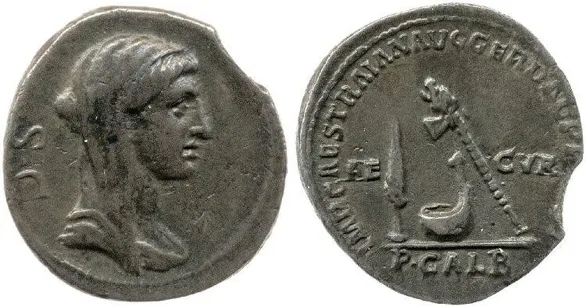
There are two variants of the reverse, the first with the legend AED CVR and the second with the legend AE CVR, more common. Trajan restored this denarius.
[1] Cohen H. Overview of the coins of the Roman Republic. 1857.
[2] Babelon E. Description Historique Et Chronologique Des Monnaies de la République Romaine. Vol 2. 1885.
[3] Grueber H. A. A Catalog of The Roman Coins in The British Museum. Vol 1. 1910.
[4] Crawford M. H. Roman Republican Coinage. Vol 1. 1974.
[5] Roldán J.M. Political institutions of the Roman Republic. 1990.
[6] Lomas Salmonte F. J. History of Rome. 2004.
[7] Harlan M. Roman Republican moneyers and their coins, 81-64 BC. 2012.
[8] https://www.forumancientcoins.com/numiswiki/view.asp?key=Vesta
[9] http://andrewmccabe.ancients.info/RRC405.html