GENS NAEVIA Crawford 382-1a
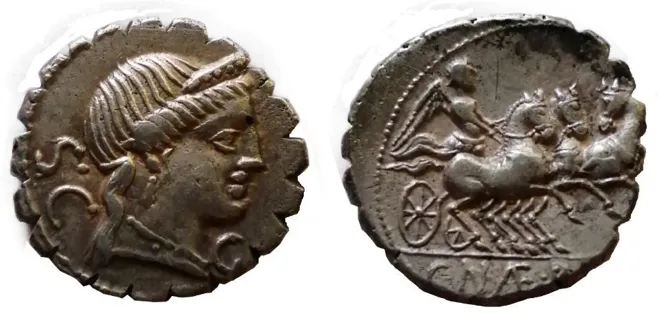
Legend ./in the exergue:C. NAE. BALB.,
(AE and AL intertwined).
The gens Naevia, occasionally written Navia, is a family of plebeian origin that holds secondary positions during the Roman Republic, since its first member to reach the consulship was Lucius Naevius Surdinus, in the year 30 AD, during the empire. Members of this gens are first mentioned during the Second Punic War when Q. Naevius Matho was praetor [1].
The nomen Naevius is generally considered to be a patronymic surname derived from the praenomen Gnaeus, indicating a birthmark. Gnaeus and Naevus, the usual form of the Latin word for a birthmark, were pronounced similarly.
There is hardly any information about our coiner, so it is foreseeable that his cursus honorum was limited to his position as triunviri monetalis during the dictatorship of Sulla. The main praenomina used during the republic were Quintus, Marcus, Lucius, Gaius, Sextus, Servius and Gnaeus. During the imperial era Lucius and Quintus and more occasionally Ennia were used.
The cognomina used under the Republic were Balbus, Matho, Crista, Pollio, Turpio, Capella and Surdinus, although the main cognomina of the Naevii were Balbus and Matho. Balbus, a common surname, originally meant he who babbles [2].
Babelon dates this coin to 74 BC but it is a late date for this series based on the treasures found and historical events. Based on these concealments, Grueber advances the emission to 81 BC together with C. Poblicio and relates it to other dentate series from the decade of 90-80 BC. Crawford, on the other hand, indicates that this series is adequately established by the findings that suggest a triumvirate and its belonging to 79 BC. Therefore, the three possible III VIRI Monetarii of the year 79 BC are C. Naevius Balbus, Ti. Claudius Ti.f. Ap.n. Nero and L. Papius [1,3,4]
The struggle between the optimate and popular factions in the senate crystallized brutally in the decade of 90-80 BC, when Sulla marched on Rome, laying the foundations for the personalisms that appeared later and that based their power on the army to achieve their ends. Although Sulla instituted a series of reforms that, in theory, returned power to the senate, the precedent he established by advancing on Rome caused the end of the republic several decades later. Once the reforms were made in Rome, Sulla headed to the East to confront Mithridates, king of Pontus, which meant the resurgence of the anti-Silanes and the establishment of the Cinna regime. He carried out proscriptions against his enemies and caused the exile of many prosilanos and opponents of Cinna, among them, Metellus Pius, who headed to Africa. After the defeat and capitulation of Mithridates in Dardanos, Sulla returned to Italy, where various figures joined him in his advance towards Rome, some convinced of Sulla and others who, although they did not share his ideas, knew that he was the winning side. At the end of 82 BC Sulla entered Rome and had himself appointed dictator, an ancient magistracy that had not been used for more than a century. The unlimited power of the magistracy that Sulla held was far from the old position, since he did not have a limited time. Shortly after, Sulla’s proscriptions began to eliminate anyone opposed to the regime, plunging Rome into an atmosphere of terror and insecurity. In 81 BC, the reform of the state apparatus began, known as the Silana constitution, with the aim of increasing the authority of the senate and restricting continuous attacks on the legal limitations imposed on the cursus honorum. In 79 BC Sulla renounced his powers and retired from public life as a simple privatus, a fact that causes debate even today. In this period there were still pockets of rebellion against the Silanian regime both in Cisalpine Gaul and in Hispania, which generated large expenses that had to be covered with profuse emissions like those in our moneyer [5].
OBVERSE:Diademed bust of Venus to the right, behindS.C., under the chin: letterC
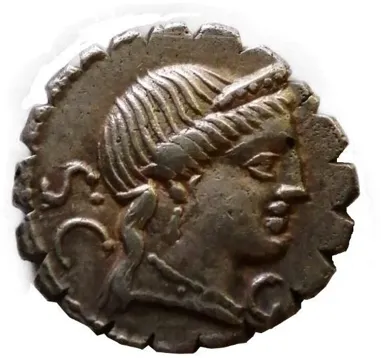
The bust on the obverse is according to Grueber the head of Juno Moneta, in whose temple in Rome the mint was located. But both Crawford and other authors consider that this figure represents Venus. [5]
Venus was an important Roman goddess mainly related to love, beauty and fertility, who played a crucial role in many Roman religious festivals and myths. From the 3rd century BC, the increasing Hellenization of the Roman upper classes identified her as the equivalent of the Greek goddess Aphrodite. In this way Venus was the wife of Vulcan and ancestor of the Roman people through its legendary founder Aeneas. Venus was often associated with the Greek goddess Aphrodite and the Etruscan Turan, borrowing aspects from both. However, according to Virgil’s Aeneid, as the Roman equivalent of Aphrodite, Venus did not have a personality as marked in its sensuality or cruelty as the Greek, although it retained its attributes and symbols, such as the golden apple of discord.
Sulla was devoted to Venus, and created the Ludi Victoriae in her honor probably around the year 81 BC. These Ludi received the epithet Sullana (Victoriae Sullanae). Harland, for his part, tells us that these Ludi Victoriae Sullanae were games instituted in honor of Sulla, predictably for his victory over the popular ones, and specifically for the victory of Sextus Nonius in the battle of Puerta Collina in 82 BC. This fact can be related to other series from prosilane and Sulla himself that present the head of Venus (see Craw-357 and 359). Therefore, the obverse and reverse types together perhaps refer to Venus’s position as patron deity of Sulla and the Sullan Victory.
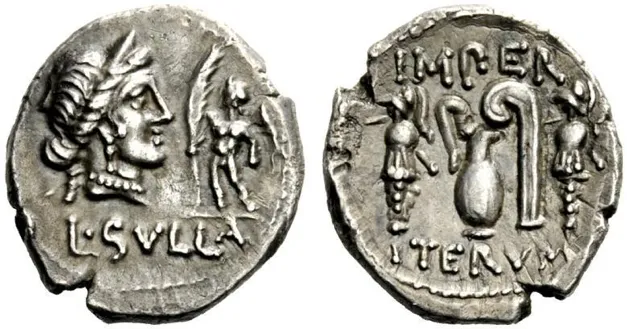
In these circumstances, it is difficult to avoid linking the name Epaphroditus with the link between Sulla and Venus, even if it is true that he was originally attached to Sulla simply because, as a Roman, he was supposed to have descended from Aeneas. Sulla used coinage as a political and ideological instrument, in no way dared to show his portrait, and limited himself to making the most explicit and coherent elements with skillful manipulation and reuse of pre-existing motifs. The key to his propaganda was his cognomen Felix and the image of Venus as his protective divinity. Sulla intends to present himself not only as filius Fortunae, or favorite of the gods, but also as “Epaphroditus”, that is, protected by Venus, in a new quasi-equivalence with Felix of undoubted political significance. The equivalence is not, however, unanimously accepted and a distinction has been proposed between Felix, a Western appellation, and Epaphroditus, an accepted nickname, and evidently at least unofficial, for relations with the East.
This denarius was, as the acronym S.C. indicates, minted by order of the Senate because of the large amount of money in circulation that was needed at that time to finance the Sertorian War that was taking place in Hispania.
REVERSE:Victory in triga to der
Legend ./in the exergue:C. NAE. BALB.,(AE and AL intertwined).
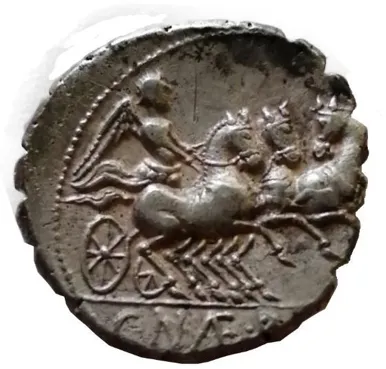
Victoria is in Roman mythology the goddess who personified triumph. She is the daughter of Styx and sister of Potestas, Vis and Invidia. She is represented as a winged woman, usually in the attitude of placing a laurel wreath on the victors and later on the Caesars, or driving a triumphal chariot, as is the case. Wheat was chosen as the motif on the reverse, a motif previously chosen by Claudius, Manlius and Urbinus on the denarius of Appius Claudius, consul in 79 BC, with wheat not appearing again during the Republic on the reverse of a denarius, which may be indicative of some meaning that we do not know.
The case of Victoria is just the opposite, it appears in a large number of coinages in which a chariot and, to a lesser extent, a biga are shown. In many other coinages Victoria is shown in the background, flying over with a laurel wreath and crowning another deity or character. The wheat was used by the Romans as a battle chariot and came from the Greek world.
The iconography of Victoria in the corn represents Sulla’s triumphal chariot, but without Sulla, as Marius and later Pompey also did before him.
There is a close relationship, even identity, between Venus and Victoria. Everything indicates that Venus, especially Venus Victrix, could be a goddess of victory, but with certain limitations. Venus never had wings and Victoria never appears without them. Also Venus and Victoria may appear together on the coin or Victoria may even be in a subordinate position, in the hand of Venus.
Thus, the obverse and reverse motifs, Venus Victrix and Victoria, are closely related, perhaps referring to the Venus of Sulla and the Victoria Sullana.
For this denarius Crawford mentions two known types (382/1a and 382/1b) and no variant. In type 1a, the control mark is on the obverse, under Venus’s chin, and in type 1b, the control mark is on the reverse, above the horses. The control marks are in 1a the letters of the Latin alphabet, and in 1b the letters of the Latin alphabet and the numerals from I to CCXXVI (1 to 226). Within the 1st, each control mark can have several stamps. Within 1b no control mark has more than one stamp.
[1] Babelon E. Description Historique Et Chronologique Des Monnaies de la République Romaine. Vol 2. 1885.
[2] http://foro.denarii.org/viewtopic.php?f=16&t=11020
[3] Grueber H. A. A Catalog of The Roman Coins in The British Museum. Vol 1. 1910.
[4] Crawford M. H. Roman Republican Coinage. Vol 1. 1974.
[5] Roldán J. M. History of Rome. The Roman Republic. 1982.