GENS IUNIA Crawford 337-3
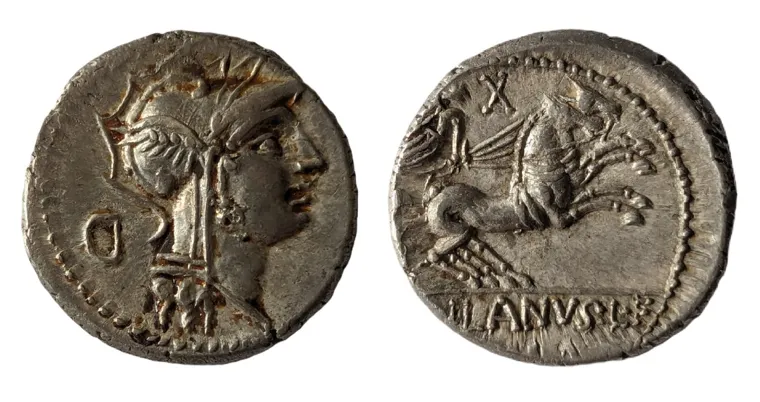
Legend ./in the exergue:LD. SILANVS. L.F./ ROME
The Junia or Iunia gens was one of the most famous families of Ancient Rome. It was originally of patrician origin, but lost its rank after Lucius Junius Brutus’s attack on Tarquin the Proud, thus being a plebeian gens since then. The family was prominent in the last days of the Roman monarchy. Lucius Junius Brutus was the nephew of Tarquin the Proud, the seventh and last king of Rome. After the expulsion of the Tarquins in 509 BC. C., he became founder of the Roman Republic and one of its first consuls.
There are doubts about the patrician or plebeian category of the gens, at least during the early days of the republic, since its prominence since the founding of the republic is combined with the fact that several consuls belonged to this gens, however, the plebeians could not access the consulate until the approval of the Liciniae-Sextiae laws in 367 BC.
The cognomen most used by this gens are Brutus, Bubulcus, Gracano, Norbanus, Pacioecus, Pera, Pullus and Silanus, although the cognomen Brutus is the most frequent and illustrious. Brutus means stupid, stupid in Latin, and comes from the fact that Lucius Junius Brutus pretended to be stupid to escape the persecution of Tarquin the proud.
Our moneyer is an unknown subject, we only know Decimus Junius Silanus Lucii Filius from the coins he issued since he is not mentioned by ancient historians and cannot be D. Silanus, praetor in 70 BC and consul in 62 BC because his father’s name was Marcus and not Lucius. Therefore, any information about this character is unknown apart from the fact that he obtained the position of tresviri monetalis during the time of the Allied war.
Iunius, the nomen of the gens, may be etymologically connected with the goddess Juno, from whom the month of June also derives [1,2].
Decimus Iunius Silanus (Lucii Filius) exercised the magistracy of tresviri monetalis during the period of the Bellum Marsicum or Allied War, hence the large size of its issue.
Babelon and Grueber think that he performed the functions of monetary official around the year 89-88 BC, as Borghesi inferred from the coins bearing E. L. P, which he translated as Ex lege Papiria. The Plautia Papiria law contained, among other things, provisions regarding coins. The ingots from the metal reserve of the public treasury had to be converted into money to meet the expenses of the war. It is to this circumstance that we owe the knowledge that this reserve, in 89 BC, amounted to 17,410 pounds of gold, 22,070 pounds of silver in ingots, and 6,135,400 sesterces (=18,230 pounds) in silver coins. These ingots were minted and Decimus Iunius Silanus was commissioned to manage this issue [1,2].
Crawford differs from this chronology based on several arguments. The author indicates that issues nº 337 and 340-44 appear together in the Fiesole treasure, a number of pieces of the finds help to establish their relative order. The Hoffmann treasure contains only the emissions of D. Silanus and L. Piso Frugi, the Fuscaldo treasure only contains the emissions of Q. Titius and C. Vibius Pansa; The Fiesole hoard only has two of the three types of L. Titurius Sabinus, suggesting that its issue is the last of the six. The absolute chronology is more complex. M. Cato’s issue is copied in an Italian issue of the social war with a Latin legend, therefore, from 89 BC or earlier.
Two organizations are theoretically possible:
| 91 | D. Silanus |
| 90 | L. Frugi Apartment |
| Q. Titius | |
| C. Vibius Pansa | |
| 89 | M. Cato |
| L. Titurius Sabinus |
either:
| 90 | D. Silanus |
| L. Frugi Apartment | |
| 89 | Q. Titius |
| C. Vibius Pansa | |
| M. Cato | |
| 88 | L. Titurius Sabinus (and others). |
On the other hand, Crawford does not consider it credible that the tribunate of M. Livius Drusus in the year 91 BC was not accompanied by a coinage.
One of the objectives of the Plautia Papiria law appears to have been to authorize the production of bronze series with a standard weight of half an ounce instead of one ounce. A second purpose seems to have been to revive the sesterce, which had not been issued for more than a century. All these provisions seem to influence the reduction of public treasury reserves as a consequence of the enormous expenses of the Allied war [3].
The administration and, above all, the tax system of the provinces was in the hands of the equestrian publicani. Their extortions were a scourge for the provincials, powerless against the actions of the knights. The senatorial governors could do little against the plunder carried out by the powerful companies, even less so when the equestrian order controlled criminal matters. Upon the return of an official legation from Asia, chaired by Scaurus, he denounced the situation and proposed sending a governor to establish the necessary reforms to end the abuses. The choice fell on Q. Mucius Scévola, linked as Scaurus, to the factio Metella, to whom the legate P was assigned. Rutilio Rufous. After the return of Rutilius in 92 BC, the legate was taken to court under the unfounded accusation of extortion of the provincials. He was condemned to exile, choosing as his destination the same province in which he had acted, Asia. Rutilio’s scandalous conviction put the spotlight on the equestrian Gracchani iudices. It was in this context, when M. entered the scene. Livio Drusus, young aristocrat supported by the factio Metella with the purpose of reforming the courts held by the knights. The tribune executed popular measures that were contested by the equestrian order and by the senate, but with the support of the factio Metella, he managed to maintain the viability of the project. At some point during his tribunate, Livy Drusus included in his program the granting of citizenship to the Italian allies. The tribune knew the problems and frustrations of the allies firsthand from the princeps italicorum Popedius
Sidon. The inclusion of the Italic socii in the Roman citizen body was one of the most urgent and difficult tasks faced by a reluctant state, which ended up withdrawing any possible support that Livy Drusus might have had. The Senate invalidated his laws and a few days later he was murdered. The elimination of the tribune represented the last opportunity for the allies for dialogue with the Roman state. The culmination of Roman clumsiness came from the hand of the praetor Q. Servilius, with his provocation to the inhabitants of Asculum, which led to the death of the ambassador and all the Romans in the city. The senate held the Italic communities responsible and, when a commission of them tried to present the old allied aspirations, it was realized that the positions were irreconcilable. The way to war was clear [4].
This confrontation is part of the various problems that affected Rome at the beginning of the 20th century. I BC Rome had gone from being a city-state to an empire without having hardly changed its laws and institutions. During this time, the Italic communities discovered to their regret that they were simply subjects of Rome, forced to maintain a state based on taxes and human capital that only benefited Roman citizens. These events had as a consequence the spread among the Italian allies of the idea of obtaining Roman citizenship to participate in the benefits of contributing to the state.
The shortsightedness of Roman politicians pushed the Allies into a civil war that claimed hundreds of thousands of lives and a large portion of Italy’s economic resources. Rome obtained the military victory, but only after recognizing its political defeat, that is, the recognition of the Italian allies’ right of Roman citizenship with the approval of the lex Plautia Papiria.
It was at this beginning of the Allied War, Bellum Marsicum or Italicum, when Decimus Iunius Silanus (Lucii Filius) coined the issue in question [5].
OBVERSE:Head of Rome to the right, behind letter:D.(inverted)
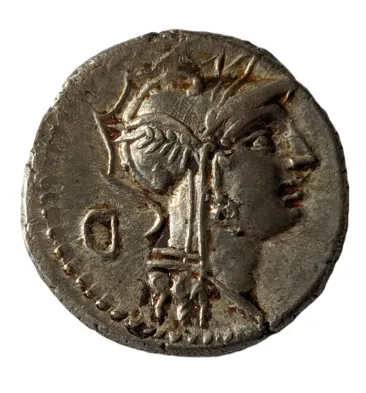
We only know Decimus Iunius Silanus from the extensive issue he made as tresviri monetalis around 91-90 BC. Decimus Iunius Silanus issued three series of denarii with different obverses, marking the first time that such a variety was produced from a single issuer. The first series contains the head of Rome, a very frequent representation in all republican coinage with a letter of the Latin alphabet, sometimes in reverse. In combination with all the die cuts on the reverse it indicates that this is a very extensive issue, much larger than the other two series that were issued.
The series with the obverse with the mask of Silenus alludes to his own cognomen and the other series contains the bust of Salus, which alludes to the dedication of a temple to that divinity due to the victory that the dictator Gaius Junius Bubulcus Brutus obtained over the Samnites near Bovianum, as a result of which he was granted a triumph [1,2].
REVERSE:Victory in biga to right, above number:X
Legend ./in the exergue:D. SILANVS. L.F./ ROME
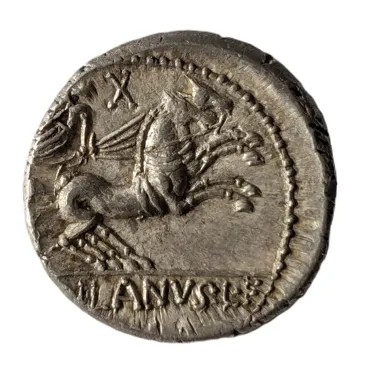
On the reverse of the three series of denarii issued by Decimus Iunius Silanus, the same motif is depicted, Victory on a biga. It has a numerical control mark that goes from I to XXX. The motif on the reverse may allude to two historical events. Grueber indicates that like the bust of Salus, the biga alludes to the victory of the dictator Gaius Junius Bubulcus Brutus over the Samnites in 302 BC for which he obtained a triumph. Babelon, on the other hand, is inclined because the reverse alludes to the successes of Marcus Junius Silanus during the Second Punic War [2,3]. In any case, the victory in biga alludes to the successes of the ancestors of the Iunia gens.
[1] Babelon E. Description Historique Et Chronologique Des Monnaies de la République Romaine. Vol 1. 1885.
[2] Grueber H. A. A Catalog of The Roman Coins in The British Museum. Vol 1. 1910.
[3] Crawford M. H. Roman Republican Coinage. Vol 1. 1974.
[4] Roldán J. M. History of Rome. The Roman Republic. 1982.
[5] Valverde L. A. The bull against the wolf. 2016.