GENS CORNELIA Crawford 329-1d
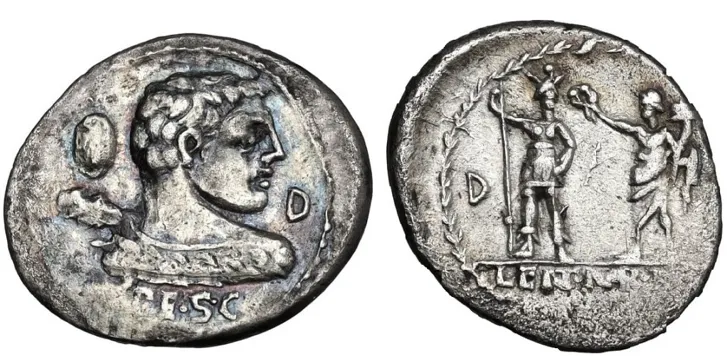
Legend ./below:P.E.S.C(Publice ex Senatus Consulto).
Legend ./in the exergue:P. LENT. MAR. F.,
(NT and MAR intertwined), all surrounded by a laurel wreath.
The Claudia gens was one of the oldest and most illustrious Roman families from the Sabine region. According to Suetonius, they settled in Rome in the time of Romulus, although the first known member of the gens was Appius Claudius Sabinus Regillensis (Appius Claudius Sabinus), who settled in Rome with his relatives and clients at the beginning of the Republic. The Claudian gens had a large number of illustrious representatives who were known, according to Livy, for their harshness towards the commoners. The patrician branches carry the cognomina Sabinus, Crassus, Caudex, Rufus, Pulcher, Centho and Nero. The plebeian branches carry the cognomina Asellus, Canina, Centumalus, Cicero, Flamen and Marcellus. The most famous member of the gens was Appius Claudius Coecus who, according to legend, was beaten and blinded by Hercules for a crime against divinity, distinguished himself in the wars against the Samnites, the Etruscans and for the creation of the Appian Way [1].
The moneyer is Publius Cornelius Lentulus Marcellinus who, like other monetary triumvirs, is practically unknown to us. He was the son of Marcus Claudius Marcellus who served under Gaius Marius in Gaul in 102 BC and had a prominent role against the Teutons in Aqua Sextiae. M. Claudius Marcellus had two sons, M. Claudius Aeserninus and our moneyer. The latter took the name Cornelius Lentulus because he was adopted by a member of this branch of the Cornelia gens. The context and year in which it was adopted is unknown. Publius Cornelius Lentulus Marcellinus married Cornelia, daughter of Publius Cornelius Scipio Nasica Serapion, with whom he had two sons who both Babelon and Grueber, guided both by the uncial weight standard and by historical sources, confuse with the father, Publius Cornelius Pf Lentulus Marcellinus, quaestor in 74 BC and Cnaeus Cornelius Lentulus Marcellinus , consul in 56 BC, attributing to him participation in the war against the pirates in 67 BC as Pompey’s legacy. Cicero considers our moneyer an orator of notable merit.
The nickname lentulus derives from lens, like cicero from cicer. For some, Lentulus would be an Etruscan name. For others, including Pliny the Elder, Lentulus would have been derived from nits (“lentils”) and would have been attributed to this branch because they excelled in the cultivation of this plant. It could also come from lentus which means “flexible”, “tenacious”, “indolent” or even “impassive”. It was carried by a numerous and powerful branch of the Cornelians; We find it from the 4th century BC with the patrician L. Cornelius Lentulus. Although the Cornelius Lentulos were patricians, our moneyer continued to retain its plebeian status after adoption.
Both Babelon and Grueber date this coin to 88 BC based on the uncial weight pattern of the bronzes minted at the time, but it is a late date for this series based on the relationship with other series and historical events. Sydenham estimates this series at 97 BC, approaching the date of 100 BC proposed by Crawford, which is quite plausible in light of the historical events of the time and the relationship it has with the denarius of L. Calpurnius Piso Caesoninus and Quintus Servilius Caepio. Therefore, the tresviri monetarii of the year 100 BC are M. Servilius C.F Vatia Isauricus, P. Servilius M.F Rullus and Publius Cornelius Lentulus Marcellinus.
Along with this regular issue, several special issues were minted by L. Calpurnius Piso Caesoninus and Quintus Servilius Caepio, Quaestor Ostiensis and Quaestor Urbanus respectively in the year 100 BC, along with the series of our moneyer with the legend PESC, much scarcer than the regular series, which implies that it was issued for a shorter period of time and that it was due to some special event.
A long series of military failures: Aulus Albinus in Africa, Julius Silanus against the Cimbri, Noreia, etc., led to the elevation of Gaius Marius to the consulship in 107 BC and the reform of the army that he carried out. Faced with the difficulties in forming the army that was to accompany him to Africa in the war against Jugurtha, Marius expanded the base for recruitment into the legions by accepting as volunteers not only citizens of the five classes of the centuriate order, but also capite censi, that is, citizens without the minimum economic resources to be counted. It would be the foundation of the new militia, from which the owners would gradually disappear, replaced by proletarians, for whom a long stay in the army in exchange for a salary and benefits once their military service had ended was no obstacle. It was the birth of the professional army.
The African war that Marius had promised to win quickly would hold out for three years, until, after intense negotiations carried out by Sulla, Marius’s quaestor, the king of Mauretania, Bocco, ended up betraying his son-in-law Jugurtha.
The defeat of Arausius in which 80,000 Romans died due to the fault of their commanders led Gaius Marius to be appointed consul without being present in Rome. After preparing an army during 103-102 BC, in which he was re-elected consul, they were ready for combat. In 102 BC the army of Teutons, Ambrones and Cimbri invaded Italy on several fronts. Gaius Marius entrusted the protection of northern Italy to his colleague Q. Lutatio Catullus, while he himself went to Gaul to contain the Teutons. Entrenched in the lower Isère, the consul allowed the Germans to continue along the Rhône towards the south, to fight, after overtaking them by another route, around Aquae Sextiae. Two successive encounters showed Roman superiority, in which around 100,000 Germans were killed or captured. Lutatio Catullus was not so lucky, he was forced by the Cimbri to retreat to the line of the Po, abandoning Gaul beyond the borders to be plundered. Mario from Rome, where he was elected consul for the fifth time, went in 101 BC with fresh troops to meet Catullus. In the Campi Raudii, near Vercellae, the decisive battle took place in which the Cimbri lost no less than 65,000 men. It was the zenith of Marius’s career that he was hailed as the third founder of Rome.
On the political scene, the end of the war in Africa brought to the fore the problem of land distribution among war veterans, which forced Marius to seek alliances with popular politicians such as Gaius Apuleius Saturninus. In 104 BC they agreed that the latter would obtain the tribunate of the plebs and Marius the consulship. A series of laws were approved such as the lex frumentaria, which lowered the price set for wheat by one eighth, the lex indiciaria and de maiestate to return to the iudices Gracchani full control of the criminal courts and the ability to judge crimes against the dignity of the Roman people, turning it into a weapon against the senate. A lex Appuleia agraria provided each veteran with a plot of 100 iugera (25 hectares) in Africa. This program led to the opposition of the senate and Mario’s enmity with the nobilitas. Even so, the end of the war against the Cimbri in 101 BC meant for Marius the continuation of this alliance due to the need for land for his veterans and the end of his consulship. Marius was in constant contradiction due to his alliance with Saturninus and, in turn, his aspiration as homus novus, to achieve integration into the nobilitas. The approval of the lex agraria presented by Saturninus was the end of the agreement between Marius and the tribune of the plebs. Saturninus attempted a second re-election of the tribunate and his colleague Glaucia presented his candidacy for the consulship, to which C. also aspired. Memmio. His murder by Glaucia’s henchmen changed the support of the plebs. The nobilitas took advantage of the opportunity, which put Marius before the difficult alternative of failing in his duties as consul, which required him to execute the senatusconsultum ultimum, to restore order, or charging against his former allies. Their decision, by agreeing to take charge of the repression, demonstrated their willingness to remain integrated into the oligarchy. The resistance that Saturninus and Glaucia presented at the Capitol was useless, so the besieged surrendered in exchange for protection. The consul took them to the curia to avoid their lynching, but a group scaled the roof of the building and stoned them from above.
It was in this context of revolts and confrontations between the popular and the nobles over the resources of the state, when the series of our moneyer was minted.
OBVERSE:Bust of Hercules to the right, seen from the back, behind the oval shield, in front:D.
Legend ./below:P.E.S.C(Publice ex Senatus Consulto).
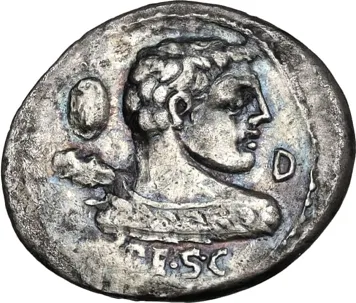
The unusual bust on the obverse of the denarius is identified with Hercules Respiciens, this word derives from the Latin respicio and means to look back. It is a representation attested in the city of Reate, current Rieti, one of the most important Sabine cities conquered at the beginning of the 3rd century BC by the Romans and which was considered in ancient times Umbiculus Italiae, the center of the peninsula. This city was founded by a companion of Hercules and perhaps reflects the Sabine origin of the Claudios. The demigod appears with the typical attributes that characterize him, the skin of the Nemean lion and a club at neck level.
From the legend of the exergue it is clear that he made two issues of denarii with the same typology: one as an ordinary issuer of the mint with the legend ROMA and the other as a special issuer with the legend PESC. There are several interpretations of this legend; P(ecunia) E(rogata) S(enatus) C(onsulto), that is, money disbursed by decree of the Senate and P(ublice) E(x) S(enatus) C(onsulto), which means that they were issued after a deliberation of the popular elections, with the authorization of the senate. The short issue of this series indicates that they were minted during a short period of time in the year 100 BC and because of some exceptional event that would require the extraordinary issue of numeraire.
REVERSE:Roma standing with helmet and spear is crowned by the Genius of the people, with horn of plenty, in the field, to the left:D
Legend ./in the exergue:P. LENT. MAR. F.,
(NT and MAR intertwined), all surrounded by a laurel wreath.
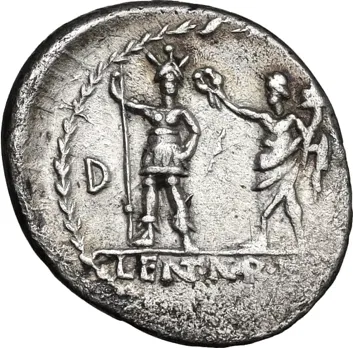
The reverse of this series depicts the spear-bearing goddess Rome being crowned by the genius of the Roman people. There are several interpretations for these reasons. Babelon explains that it represents the fact that the senate authorized the issuance of this special series, linking to the legend on the obverse, but this would not explain the fact of the regular series with the legend ROMA on the obverse.
The goddess Rome personifies the city or state of Rome, being one of the most represented divinities in republican coinage. She is generally represented with war attributes, carrying a spear and helmet. In Roman mythology the genii, from the Latin genius, plural genii, related to genitus, generator or father, are frequently confused with the Manes, Lares and Penates, for sharing a function with certain nuances, that of protecting mortals, but this also seems to be their main difference, since the genii are the powers that produce life (dii genitalia), a principle of fertility that accompanies the person throughout life. Genii were also usually represented as winged beings, and in Roman monuments they commonly appear as young men dressed in toga, with a patera or cornucopia in their hands and their heads covered. The geniuses were not only connected to man, but to any living being and place.
Grueber and other authors consider that the genius of the Roman people appears in several later coins minted by members of the Cornelia gens such as Publius Cornelius Lentulus Spinther in 74 BC, which also presents the bust of Hercules on the obverse and state that this gens especially favored the cult of the genius of the Roman people. Crawford does not share this thesis of the promotion of the cult of the genius of the Roman people by the Cornelia gens. He explains that the appearance of the genius of the Roman people in several series coincides with several war events. In 74 BC the war against Sertorius was taking place, therefore, its types must be considered purely public and as an affirmation of the claims of the Roman state against the rebellion. In the same way, the series issued by our moneyer would be linked to the victory over Cimbri and Teutons in which the father of the moneyer, Marcus Claudius Marcellus, participated, and which had taken place a few years before.
There are two series issued by the moneyer, one with the legend ROMA on the obverse and another with the legend PESC. Both series are presented with a Latin or Greek letter on the obverse and reverse, always being the same on both sides. Each letter can be accompanied by one, two and occasionally three dots. When the letter is behind the head of Hercules, the letter on the reverse is between the two figures, when the letter is in front of the bust, the letter on the reverse is in the left field.
[1] Babelon E. Description Historique Et Chronologique Des Monnaies de la République Romaine. Vol 1. 1885.
[2] http://foro.denarii.org/viewtopic.php?f=16&t=11020
[3] Grueber H. A. A Catalog of The Roman Coins in The British Museum. Vol 1. 1910.
[4] Crawford M. H. Roman Republican Coinage. Vol 1. 1974.
[5] Roldán J. M. History of Rome. The Roman Republic. 1982.