GENS CORDIA Crawford 463-1a
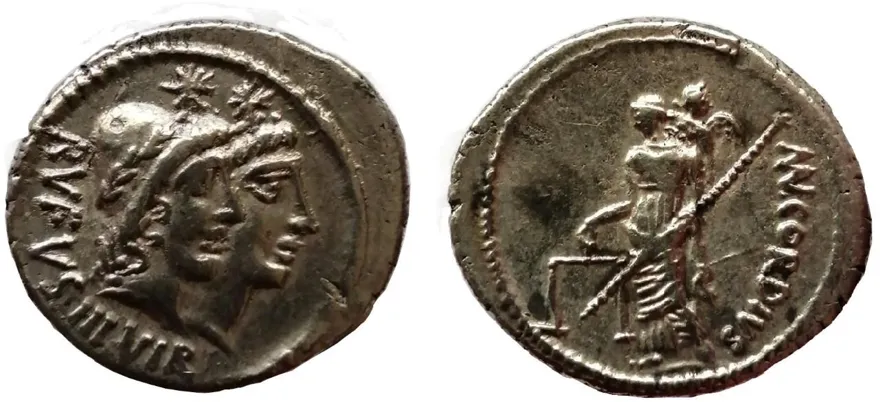
Legend ./behind:RUFVS III. VIR.
Legend ./in the field of der:MN. CORDIUS,(MN intertwined)
Family of plebeian origin practically unknown and not mentioned by ancient authors [1]. The only member of this gens is our moneyer, Manius Cordius Rufus, issuer at the end of the Roman Republic under the rule of Caesar.
Cavedoni claims that Manius Cordius Rufus was Pompey’s moneyer in the East because some of his denarii have elements similar to those found on coins from the cities of Pontus, such as Amisus, but authors such as Grueber reject this hypothesis and lean towards Borghesi’s theory [2]. Based on the motifs represented on the obverse of one of the denarii issued by the moneyer (Craw 463-heads of the Dioscuri), similar to some coins of the Sulpicia family, it suggests that this gens was originally from Tusculum, where the cult of these divinities was very popular. This author mentions an inscription found in said city with the name of Manius Cordius Rufus, son of another Manius, who held the positions of praetor, proconsul and aedile on the Sacred Mount and which probably corresponds to our moneyer [3].
Cavedoni suggests that as some of the types used by Manius Cordius are found on coins of the autonomous cities of Pontus, they were minted there, and more especially at Amisus, on whose coins the owl, aegis, and eagle with outstretched wings are found. He therefore concludes that Cordius was a coiner appointed by Pompey in 49 BC, who minted coins with types related to his own family in Rome, and that when his patron left, he followed him east [2].
This hypothesis has subsequently been discarded by other authors such as Grueber and Crawford. The series of T. Carisius, C. Considius Paetus and Mn. Cordius have been found in the Dracevica treasury along with other emissions from that period of the civil war. The Caesarian elements of their coins and of the contemporary triunviruses, and the large size of the issues, indicative of the need for currency, characteristic of these series
It seems to indicate with great probability that it is an issue from the year 47-46 BC. Crawford assigns them directly to 46 BC along with the other two mentioned purses, placing L. Plautius Plancus, A. Licinius Nerva and C. Restio in 47 BC, when Caesar was not yet in the city of Rome [3,4].
The death of Crassus at Carrhae in 53 BC and the increasingly distant interests of Caesar and Pompey made the break between the two individuals inevitable. Pompey’s progressive alignment with the factio optimate, contrary to Caesar, and the near return of the victorious Caesar from Gaul meant that the optimates’ program was fundamentally aimed at ending the latter. Caesar had to disband his army under penalty of being declared a public enemy and had to physically appear in the electoral campaign to be elected consul. The veto of the Caesarian tribunes of the plebs raised the tension to the maximum until finally the senate issued the senatus consultum ultimum, which granted Pompey and other magistrates unlimited powers for the protection of the state. Caesar’s loyal tribunes, Cassius and Mark Antony, abandoned the city and marched to Gaul to join their leader. Caesar had a legal pretext to justify his march on Italy; the optimates had forced the tribunes of the plebs to lift the veto on the bill, violating tribunician rights. On January 10, 49 BC, Caesar crossed the Rubicon, starting the civil war.
Appointed dictator and consul for five consecutive years, Caesar appointed like-minded people to occupy all the resources of the state. After the battle of Pharsalia in 48 BC, Mark Antony returned to Italy and obtained the position of magister equitum, lieutenant of the dictator, which, in Caesar’s absence, practically made him the supreme authority in Rome. But the despotic use that Antony made of these powers, in the atmosphere of unrest and violence caused by the economic crisis and in the midst of war, caused that, upon Caesar’s return to Rome, he removed Mark Antony from office, and M. Lepidus was elected consul alongside Caesar himself in 46 BC. The dictator’s stay was temporary since there were still pockets of war in Africa and Spain. It was in this context of war and social and economic crisis that M. Cordius Rufus issued the coin [5].
OBVERSE:Laureate heads of the Dioscuri to the right, surmounted by two stars.
Legend ./ behind:RUFVS III. VIR.
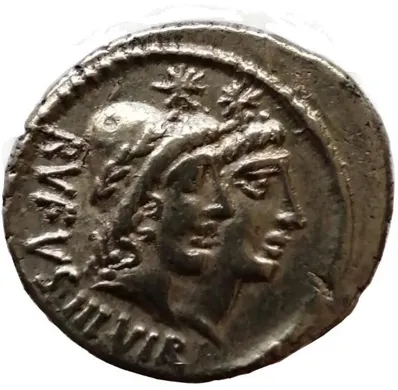
The obverse of the denarius issued by Manius Cordius Rufus alludes to his position, tresviri monetalis, and to the supposed origin of the coin family. Borghesi points out an inscription from the city of Tusculum that refers to Manius Cordius Rufus, son of another Manius, who held the positions of praetor, proconsul and aedile on the Sacred Mount, and who is probably our moneyer. This relationship is confirmed by the appearance of the Dioscuri, very popular divinities in said city.
Since the 5th century BC, the Gemini (twins) or dioscuros were venerated by the Romans, probably as a result of cultural transmission through the polis of Magna Graecia. The first temple was built in gratitude for the victory in the battle of Lake Regilus in 499 or 496 BC by the dictator Aulus Postumius Albinus. According to legend, the two brothers appeared in battle as horsemen contributing to the victory and for this reason a temple was built for them in the forum.
Children of Leda, wife of Tyndareus, king of Sparta, and Zeus. She turned out to be the object of the god’s desire, who transformed himself into a swan to lie with her and left her pregnant. According to one
version of the myth, that same night Leda lay with her husband and as a result the queen had multiple births. There are several versions of this event, two eggs, three, one, the most popular is that Pollux and Helen, children of Zeus, were born from one egg and Castor and Clytemnestra, children of Tyndareus, were born from the other. Despite this fact, the name dioscuros, from the Greek God Kouroi, means children of Zeus, which is why both were considered heroes. What the sources do agree on is that Castor was mortal and Pollux immortal. Castor was famous for his ability to break and ride horses and Pollux for his skill in hand-to-hand fighting.
They participated in the Argonauts’ expedition and rescued their sister Helen from Theseus. Later, Castor and Pollux kidnapped Leucippus’s daughters, promised to Idas and Lynceus, to marry them. Idas, offended, killed Castor, and Pollux, in revenge, killed the brother of his brother’s murderer, Lynceus. Pollux, separated from his brother, asked Zeus to either bring Castor back to life or deprive him of his immortality. Zeus gave Pollux the choice of spending his entire life on Mount Olympus or giving half of his immortality to his mortal brother. He opted for the second option, allowing the twins to alternate between Olympus and Hades. Later, Zeus placed them among the stars, in the constellation that we today call Gemini.
Castor and Pollux are associated with horses and are depicted as helmeted horsemen carrying spears. Sometimes with the stars that represent them in the sky above their heads.
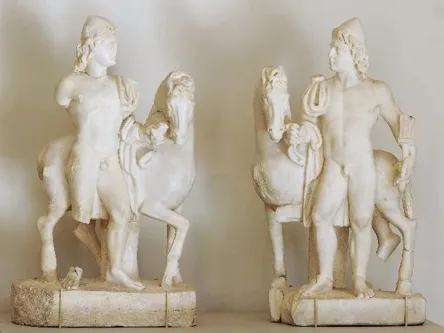
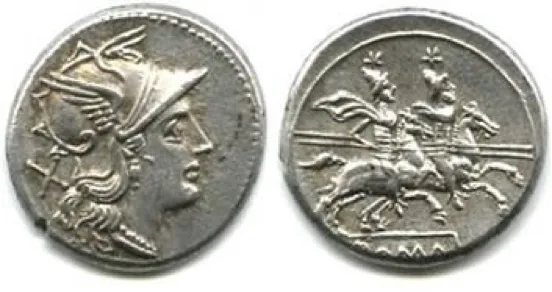
This theme is widely represented in Roman republican coinage, being the reverse of many anonymous denarii and, later, of denarii issued by various gens, especially those from Tusculum, where these divinities were very popular. Among them, the gens Cordia, to which our moneyer belonged [6,7].
There are two variants of the obverse, practically the same except for the laureate heads of the first variant, much scarcer, or diadems of the second variant.
REVERSE:Venus Verticordia to the left, with scales and scepter, Cupid behind her.
Legend ./in the field of der:MN. CORDIUS(MN intertwined).
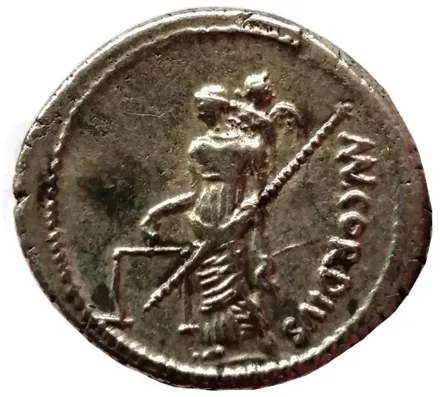
Grueber, following other authors such as Babelon, indicates that the figure represented on the reverse of the denarius is Venus Verticordia, the goddess who “converts the hearts of men”, to whom a temple was dedicated in Rome after an episode that occurred in the city. In 114 BC three Vestal virgins were sentenced to death for transgressing with three Roman knights the rigid law that forced them to chastity. To atone for the offense, a shrine was dedicated to Venus Verticordia in the hope that it would turn women’s hearts against debauchery and toward chastity. It may also refer to the Julia family, who claimed descent from Venus herself. Therefore, the image not only alludes to the name of the Cordia gens with a play on words, but this, and other representations of Venus, the Sun and the eagle on other coins of Cordius Rufus may have been selected in honor of Julius Caesar [3].
Crawford, on the other hand, does not share the opinion of Grueber and previous authors and suggests that the reverse refers to Venus or Venus Genetrix. The scale that holds the hand of the goddess perhaps suggests that the coin of Mn. Cordius Rufus is under the tutelage of Venus and is therefore an added compliment to Caesar. He does not believe that there is any reason to consider the Venus represented as Verticordia. The type as a whole, with Cupid perched on the shoulder of Venus, may derive from a statue placed in the temple of Venus Genetrix in 46 BC, the year of issue of this coin.
Caesar undertook to build a temple to Venus before the battle of Pharsalia. In fulfillment of his vow he erected the temple of Venus Genetrix (mother), in her role as ancestor of the Roman people, a goddess of motherhood and domestic life [8]. In 46 BC the statue of Venus Genetrix sculpted by Arkesilaos was installed in the unfinished temple of the same name. Therefore, the reverse would allude to the arrival of the statue of the goddess to her temple in fulfillment of Caesar’s promise and would be a reason to praise the figure of the dictator and make reference to the origin of the gens Julia and the Roman people [4].
The statue installed in the temple was lost so it is not known with certainty how Venus Genetrix was represented. It may be the figure depicted on several denarii of Julius Caesar and Augustus with an image of victory in his hand, in which case the representation on the reverse of the denarius would not be the same image [9].
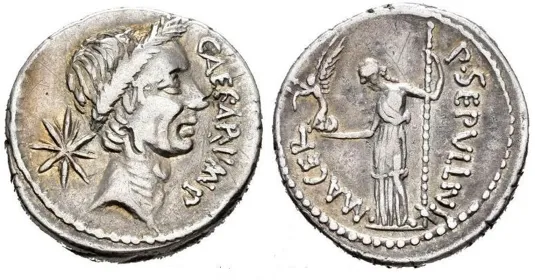
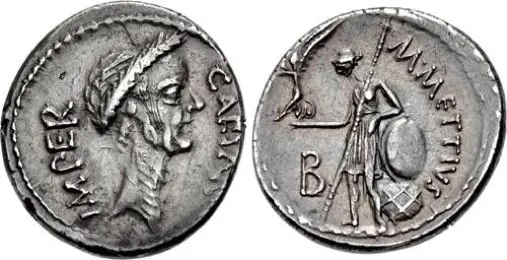
There are several variants of the reverse that consist of changes to the name of the moneyer, CORDIUS, CORDIU, CORDI and CORDIVI.
[1] Cohen H. Overview of the coins of the Roman Republic. 1857.
[2] Babelon E. Description Historique Et Chronologique Des Monnaies de la République Romaine. Vol 1. 1885.
[3] Grueber H. A. A Catalog of The Roman Coins in The British Museum. Vol 1. 1910.
[4] Crawford M. H. Roman Republican Coinage. Vol 1. 1974.
[5] Roldán J. M. History of Rome. The Roman Republic. 1982.
[6] https://mitologia.fandom.com/es/wiki/Dioscuros
[7] https://portalmitologia.com/castor-y-polux-los-hijos-de-zeus
[8] https://www.wikiwand.com/es/Venus_(mythology)
[9] http://mediterraneoantiguo.blogspot.com/2012/06/venus-genetrix-la-estatua-de-culto-del.html