GENS AEMILIA Crawford 415-1
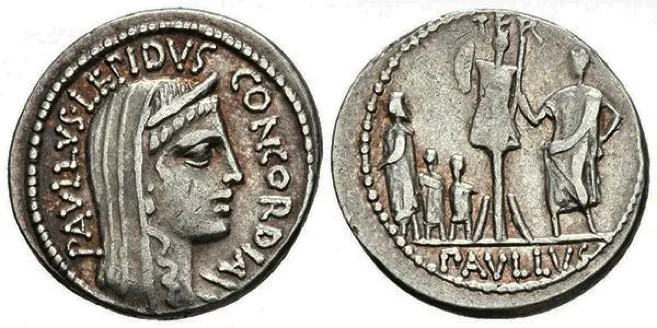
Legend ./PAVLLVS LEPIDVS CONCORDIA.
Legend ./above:TER.,
Exergue:PAVLLVS
The Aemilia family is one of the oldest and most illustrious patrician families of Rome, of Sabine origin. They claimed descent from Mamercus, son of Numa Pompilius, who would have received the name Aimilius because of his persuasive eloquence. Another tradition states that the Aemili descend from Aimylos, son of Ascanius, from whom Numitor and Amulius, kings of Alba longa at the time of the founding of Rome, descend. This gens was especially known from Aemili-Paullus, Scaurus, Mamercus and Lepidus [1].
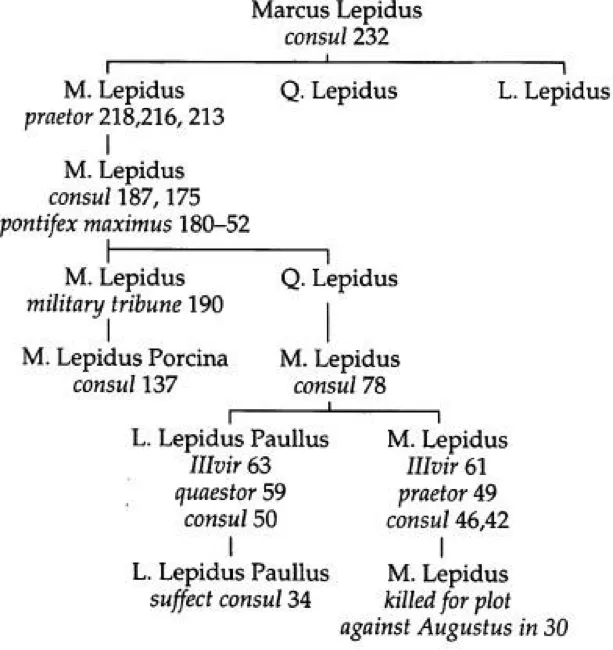
The moneyer is Lucius Aemilius Lepidus Paullus, quaestor in 59, aedile in 55, praetor in 53 and consul in 50 BC. He was the brother of the triumvir Marcus Aemilius Lepidus and son of Marcus Aemilius Lepidus, so he belonged to the Lepidus branch, a secondary line of the Aemilii. However, the monetali triumviri bears the agnomen and cognomen of Lucius Aemilius Paullus, victorious against the Ligurians, Hispanics and conqueror of Macedonia by defeating King Perseus in the battle of Pydna in 168 BC and rewarded with 3 triumphs. Why does this moneyer carry the agnomen and cognomen of another ancestor whose lineage had become extinct and of whom it obviously cannot descend?. Our monetary father himself had been consul with the support of Pompey in 78 BC, but it was at this point that the brilliance of the surname was tarnished. Marcus Lepidus’s candidacy for the consulship was personally unpleasant for Sulla who tried to prevent it. The newly elected consul was openly opposed to Silane policies and after his death, he tried to undo his work. He obtained Transalpine Gaul and probably Cisalpine Gaul as a proconsular government, raised troops, and refused to return to Rome to hold consular elections. The senate summoned him to Rome to account for his actions, but the year ended without his return or the election of new consuls. With the new year, Lepidus began to march towards Rome. The senate issued an emergency decree and sent Pompey north to Cisalpine Gaul to deal with Lepidus’s legate, Marcus Junius Brutus (father of Caesar’s murderer), while the other consul, Catulus, stayed in Rome to oppose Lepidus. He was camped outside Rome and had sent a demand to the senate for a second consulship when news arrived that Pompey had ended the war in Cisalpine Gaul and received Brutus’ surrender. Lepidus, now deprived of any possible reinforcements, was forced to fight for the capture of Rome. After initial success at Milvian Bridge, he pressed on to be defeated at Campus Martius. Lepidus became desperate and fled to Sardinia where his political hopes were shattered and he died shortly after.
This explains why our moneyer tried to distance himself from his father’s image and proclaim his support for the established order. The question is whether his father really gave him the name Paullus in memory of the famous Lucius Paullus or whether our moneyer appropriated that name to distance himself from recent events that recalled the name Lepidus [2].
Paullus assisted Cicero during the Catiline conspiracy and never supported Pompey. During his consulship Julius Caesar bribed him to obtain his favor in exchange for money that he used to rebuild the Basilica Aemilia in Rome. He opposed the second triumvirate of Octavian, Mark Antony and his own brother, supporting Cicero in condemning its members and declaring them public enemies. The triumvirs included him in their bans, however, according to Cassius Dion, his brother allowed him to escape. Paullus joined Marcus Junius Brutus the Younger and when he died in 42 BC, he was pardoned and lived out his remaining years in Miletus [3].
Babelon dates this coin as late as 54 BC [1] by mistaking the moneyer for his son. H. A. Grueber dates it to 71 BC [4] but recognizes that the dating is unlikely at such an early date. Both Crawford and Harlan date this issue to 63-62 BC [2,3] in the midst of Catiline’s conspiracy. The coins attributed to this year reveal a style of work similar to that of the previous year, but a change occurs with respect to this in the coins of C. Hosidius Geta, the flat structure with a serrated edge is suddenly abandoned for coins with types in high relief, smaller in size and with smooth edges. This new style will be found in later issues. There are three triumviri monetalis of that year: Paullus Aemilius Lepidus, Lucius Scribonius Libo and Gaius Hosidius Geta. [5]
The Silanian regime had withstood the test to which the father of the moneyer, Marcus Aemilius Lepidus, had subjected it, which was the most dangerous attempt to overthrow said order. But once the rebellion was averted, there was a gradual reform or evolution of the system established by Sulla a few years before, caused by the entry on the scene of new personalisms dissatisfied with the brakes imposed on their political promotion by the Silaan constitution. Ultimately, these individualities and the perversion of the system to their benefit would lead to the end of the Roman Republic a few decades later. It was in the years 70-60 BC where the personalisms of individuals such as Pompey, Crassus, Catiline, Caesar or Cicero crystallized.
Catiline, a protégé of Crassus, had failed three times to obtain the consulship, the last of them in favor of Cicero, representative of the traditional nobilitas. The hostile environment in Rome worsened with his prosecution for his part in Sulla’s proscriptions. Pushed by this situation and his ambition, he became the leader of the radical elements who did not expect to progress alongside the Senate or Pompey and who had hopes of violent surprise action. The first attempt at rebellion, known as Catiline’s first plot, ended quickly, but in 63 BC, together with other senators, he organized a plot to seize power that ended in failure and with the death of the conspirators without prior trial. It was in this hostile environment when our moneyer issued the coin in question [6].
OBVERSE:Veiled and diademed bust of Concordia to the right.
Legend ./PAVLLVS LEPIDVS CONCORDIA
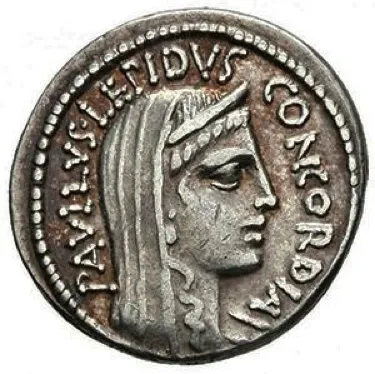
With the bust of the veiled goddess Concord that we see on the coins of Paullus Aemilius Lepidus, the purser attempted to distance himself from the dissensions of his father’s time and past and proclaim his preference for harmony and concord. Specifically, it would make reference to the concordia ordinum, the collaboration of the various classes for the maintenance of republican institutions that was fundamental for Cicero’s policy in 63 BC, of which the moneyer was a convinced supporter [2]. This was not going to be easy, taking into account the times in which he lived. It was probably another attempt to further distance himself from Catiline’s plot, which was too reminiscent of his father’s legacy, which led Paullus to indict him on charges of violence and rebellion. The revelation of the plot to Cicero forced Catiline to withdraw from Rome before facing the charges against him and led to the armed insurrection that ended with Catiline’s death [6]. Note that the legend highlights the name Paullus, in reference to his distant ancestor, with whom the moneyer is intended to connect.
The head of Concordia may also refer to the temple of the goddess located in the Roman forum where some meetings of the senate were held, especially in times of crisis. It was in this temple where Cicero delivered some of his Catilinarias. This fact would be indicated on the coin with the bust of the goddess, which would indicate support for Cicero and tradition against Catiline’s insurrection [7].
REVERSE:L. Aemilius Paullus standing on the right, leaning on a military trophy, in front, Perseus of Macedonia standing on the left, with his hands tied behind his back with his two sons.
Legend ./above:TER.,
Exergue:PAVLLVS
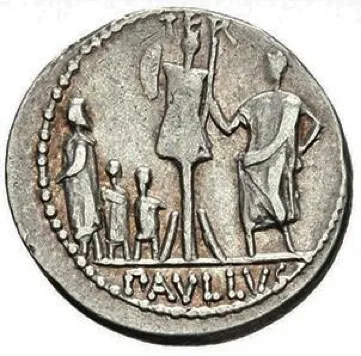
The reverse commemorates the defeat and capture by Lucius Aemilius Paullus Macedonicus of Perseus, king of Macedonia, and his two sons in 168 BC, whom he brought to Rome to adorn his triumph. The legend TER (Tertius) is undoubtedly related to the great victories obtained by L. Aemilius Paullus in Hispania in 190 BC, against the Ligurians in 181 BC; and the one referred to in Macedonia, for which the senate would have granted him three triumphs and he was acclaimed “Imperator” three times. It is not proven whether Emilio Paulo celebrated three triumphs, but the coin’s iconography leaves little doubt about which version of the tradition the moneyer wanted to convey [2].
Lucius Aemilius Paullus is represented as the largest figure on the coin which is located to the right of the trophy, while to the left there are three figures; The person with his hands tied behind his back is King Perseus and the two smaller ones represent his children. Perseus was the son of Philip V of Macedonia, who had been defeated by Flaminino in 197 BC, and inherited a kingdom belligerent with Rome. For a time, he was able to keep the pulse of the Roman state, defeating first the consul Publius Licinius in 171 and then the consul Aulus Hostilius in 170. On the diplomatic side, Perseus requested help from Epirus and the kingdom of Illyria. Faced with the defeats and the front that was forming in the east, Rome chose an effective man like Emilio Paulus to face this threat. He was elected consul and was entrusted with command of the war, even though he was already 60 years old.
After a rapid advance, the armies faced each other in the decisive battle of Pydna, where the Macedonian phalanxes were completely crushed, leaving more than 20,000 dead. It was the end of the kingdom of Macedonia as it was known. From that moment on, the Macedonian monarchy was eliminated and its territory was divided into 4 cantons. Rome did not directly annex the area until several decades later when it was demonstrated that the system implemented after Pydna in the region was unsustainable [6].
The triumph that followed the victory lasted three days, in which hundreds of statues, jewels, precious stones, silver and gold from the defeated territories were transported in hundreds of carts.
After the triumph, Perseus was imprisoned, but Emilio Paulus secured his release and exile to Alba longa, where he died four years later.
The splendor of the triumph masks a personal tragedy for the consul. Five days earlier he suffered the loss of his 14-year-old son, only to be followed by the death of another 12-year-old son three days after the triumph. These children were the result of a second marriage and although he had two other children with his first wife Papiria, these children had been adopted by Quintus Fabius Maximus and Publius Cornelius Scipio, so when Paullus died in 160 BC, he legally died childless and no heir could bear the surname Paullus. The Aemili-Paullus line became extinct. Our moneyer would recover the agnomen and cognomen to establish a relationship with such a distinguished character and free itself from the name of his father, who had dishonored the family with his actions [2]. There are 2 variants of this denarius with changes in the exergue on the reverse, PAVLVS instead of PAVLLVS, and another with the legend PAVLLS. Trajan restored this denarius.
[1] Babelon E. Description Historique Et Chronologique Des Monnaies de la République Romaine. Vol 1. 1885.
[2] Harlan M. Roman Republican moneyers and their coins, 63-49 BC. 1995.
[3] https://en.wikipedia.org/wiki/Lucius_Aemilius_Lepidus_Paullus.
[4] Grueber H. A. A Catalog of The Roman Coins in The British Museum. Vol 1. 1910.
[5] Crawford M. H. Roman Republican Coinage. Vol 1. 1974.
[6] Roldán J. M. History of Rome. The Roman Republic. 1982.
[7] http://augusto-imperator.blogspot.com/2015/11/el-templo-de-la-concordia.html.