The Denarii of Mark Antony's Legions
The formation of a triumvirate with Marcus Aemilius Lepidus, commander of the cavalry and Julius Caesar’s successor at the head of the Roman army deployed in Hispania and Gaul, only increased the hunger for glory and fame of Octavian and Mark Antony, both willing to concentrate all the powers of the state through a one-man form of government. The Peace of Brundisium in 40 BC redirected, though only very temporarily, the complex political situation that had developed after the death of the dictator, at a time when the clash of interests among the strongmen of the Republic was about to trigger a new episode of civil war, as indeed happened.
The talks held at Brundisium ended with a territorial division that defined the geographical spheres of influence of each triumvir. Mark Antony received the East, where he had already been active since the Battle of Philippi in Macedonia in 42 BC; the West came under Octavian’s control; and Africa was assigned to Lepidus.
From 36 BC onward, Antony began to consolidate his hegemonic position in the East, undertaking a series of territorial conquests and military expeditions that earned him great prestige as a commander. During one of these campaigns he met the woman who would mark his destiny: Cleopatra VII, queen and pharaoh of Egypt. From then on, Antony began an ideological transformation. After his sacred marriage to the Egyptian queen, whose unpopularity in Rome grew rapidly because of her involvement in the Republic’s eastern policy, he gradually adopted traits typical of Hellenistic rulers, presenting himself to his subjects, allies and enemies as a “living god”. Appealing to this divine status, the triumvir secured the submission of several eastern kings, with whom he formalized a series of vassalage agreements.
The growing power of his counterpart and rival in the East, who had begun to administer his domains as personal property, was seen by Octavian as a veiled threat to his own political position and to his ambitions for sole power.
Faced with Mark Antony’s ambitions, whose conquests at the expense of Roman resources seemed aimed less at Rome’s benefit than at personal exaltation and the creation of a parallel empire with its capital in Alexandria, the Senate decided to act, accusing him of treason and stripping him of his status as triumvir. In an attempt to avoid what would amount to another civil war, although this time with the appearance of a confrontation between East and West, Rome sent delegations to Patrae in Greece, where Antony, far from showing any willingness to settle the conflict peacefully, had concentrated the bulk of his army. At that time, the disparity of forces between Octavian and Antony suggested that, in the event of battle, victory would belong to Antony. The figures transmitted by ancient sources reflect this imbalance clearly. Commanded by Marcus Vipsanius Agrippa, the future emperor’s trusted man, Octavian had eighty thousand soldiers and four hundred ships, while the deposed triumvir had one hundred thousand men and eight hundred ships, including two hundred galleys supplied by Cleopatra. The eastern armies also surpassed the western forces in available resources. Octavian had one advantage: the discipline of his men, veterans determined in battle, and the experience of his officers, especially Agrippa.
 At the end of 32 BC, Mark Antony was preparing for the armed conflict that was approaching against Caesar Octavian. Legionaries were needed, and legionaries had to be paid. Moreover, because this was a war between Romans, they not only had to be paid, they also had to be kept loyal.
The silver, probably brought from Egypt, had to be turned into denarii, and the occasion was used to convey a political propaganda message that would inspire his soldiers and command respect from his opponents: Mark Antony and his powerful army of 23 legions.
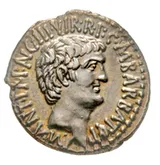
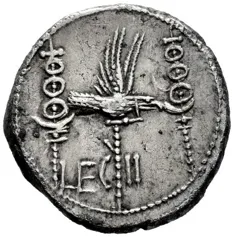
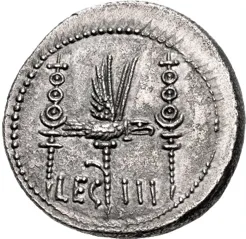
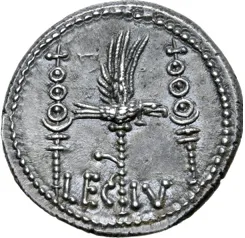
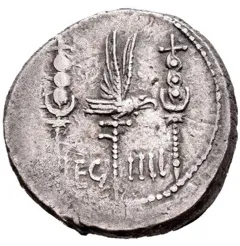
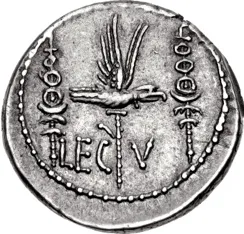
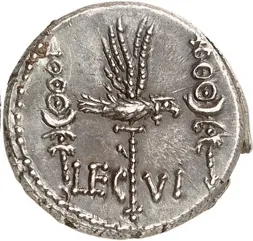
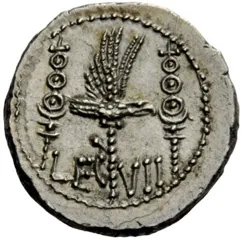
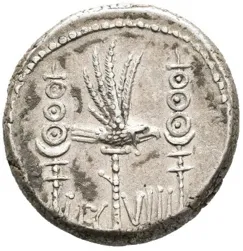
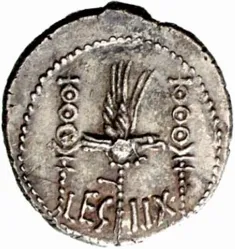
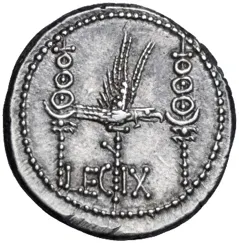
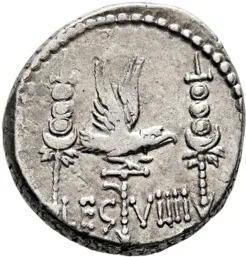
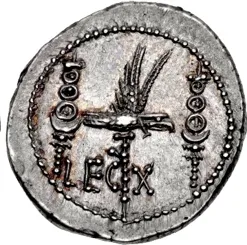
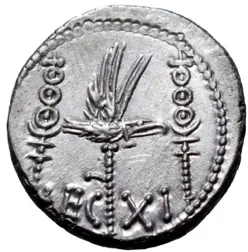
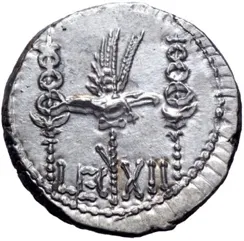
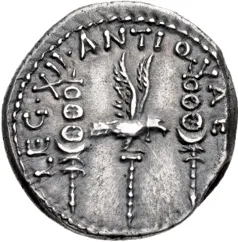
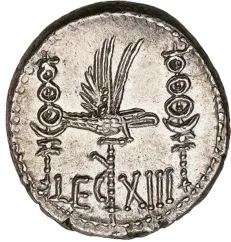
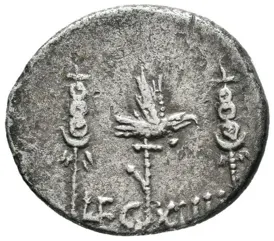
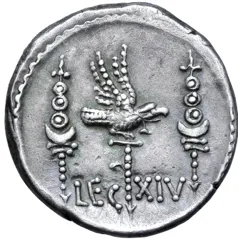
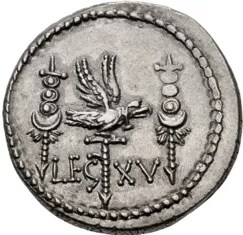
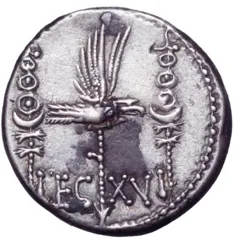
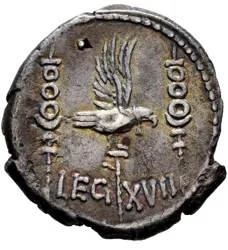
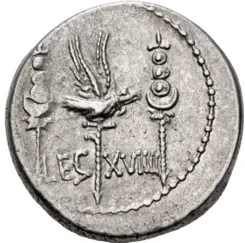
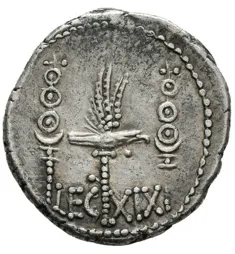
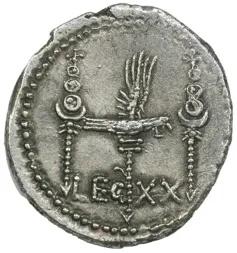
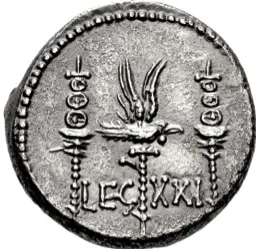
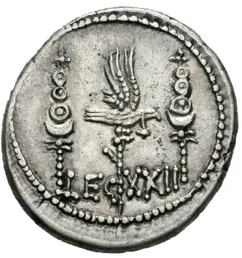
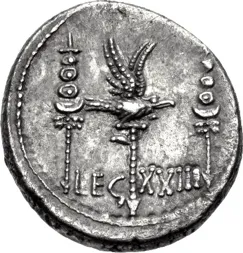
The obverse legend reads ANT AVG III VIR R P C, meaning “Antony, augur and triumvir for the restoration of the Republic”. On the reverse appears a legionary eagle between two standards, together with the legend LEG and the number of the legion.
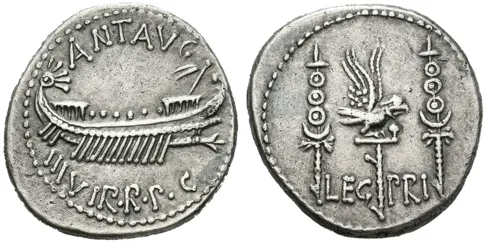
Auctioned by Tauler & Fau in 2018
In the spring of 31 BC, Agrippa struck a severe blow against the enemy in Greece, isolating Antony in the Peloponnese, whose army was highly heterogeneous and suffered from serious organizational weaknesses, while cutting his line of communication with Egypt.
Mark Antony preferred to take the fight to the sea, and on September 2 his fleet sailed out to meet Octavian. The initial clash favored Octavian. Gradually, the eastern forces were overwhelmed by the maneuverability of Agrippa’s ships, whose men proved lethal in close combat. These engagements showed the superiority of Octavian’s veteran soldiers, battle-hardened and relentless, over Mark Antony’s forces, many of them mercenaries and unfamiliar with the Roman system of warfare.
Antony judged victory to be unattainable and left behind the remains of his failed fleet, fleeing toward Egypt in the same direction as Cleopatra.
After Antony’s disaster at Actium, a large part of his army rebelled and went over to Octavian’s side. Mark Antony and Cleopatra took refuge in Alexandria with the eleven legions that still served him.
The suicide of Mark Antony, followed shortly afterward by that of Cleopatra, and the power vacuum created by their sudden disappearance, allowed Octavian to incorporate Egypt as a domain under Roman sovereignty and to restore the Republic, at least nominally.
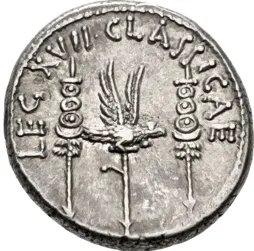
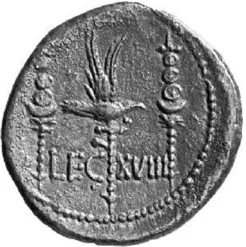
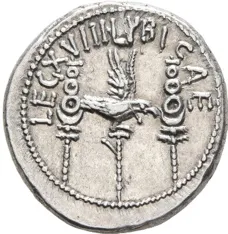
As for the denarii struck by Mark Antony to pay his legionaries, they all share the same obverse, with a galley moving forward and the usual legends of the triumvir. The reverse keeps the same general scheme, a legionary eagle flanked by two standards, and only the identifying numeral of each legion changes, together with a few specific legends.
Crawford catalogues 23 legionary numerals, from LEG I to LEG XXIII. In several cases, the same number appears with graphic variants typical of the epigraphy of the period:
- IV / IIII
- VIII / IIX
- IX / VIIII
- XIV / XIIII
- XVIII / XIIX
- XIX / XVIIII
There are also numerals “with a surname”, identifying legions with a long tradition or special functions within Mark Antony’s army:
- LEG XII ANTIQVAE
- LEG XVII CLASSICAE
- LEG XVIII LYBICAE
Added to these are two singular issues dedicated to non-legionary units:
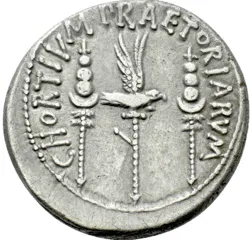
- CHORTIUM PRAETORIARUM, for the praetorian cohorts.
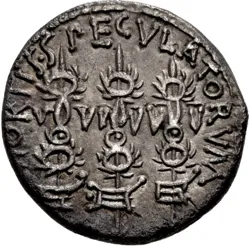
- CHORTIS SPECULATORUM, for the speculatores, reconnaissance and counterintelligence units of the Antonian army.
Alongside this well-structured group, rarities not included by Crawford are also known, either because of their extreme scarcity or because they were not documented at the time of his study. Among them are:
- A type without a legion number.
- An issue with the legend LEG I, formally doubtful because Crawford does not record an isolated I.
- LEG XIIX, a variant of XVIII, although some authors mention it as an independent type.
- LEG XXIIII, extremely rare.
- The surprising LEG XXXIII, of great numismatic and historical interest because of its apparent disconnection from the documented legions of Mark Antony.
A legion consisted of a little more than five thousand men. Every eight men formed a contubernium; every ten contubernia formed a century of 80 men; every two centuries formed a maniple of 160 men; every three maniples formed a cohort of 480 men; and every ten cohorts, numbered from I to X, formed a legion of 4,800 men. In addition, each legion had to be joined by its cavalry contingent, around 300 more men.
Taking the 23 numerals and calculating 5,000 men per legion, we obtain a total of 115,000 legionaries in Mark Antony’s army. This is somewhat higher than the 100,000 men mentioned by the classical sources. Most likely, some legions had fewer than 5,000 men.
At that time, a Roman legionary could earn around 240 denarii a year, about 20 denarii a month. Mark Antony would therefore have needed 27,600,000 denarii to maintain his army for one year.
As a documented fact, the weight of these denarii gradually decreased as the different types were struck, with differences of 0.2 g or even more between some issues and later ones. Another very significant point is that these denarii were struck in debased silver, with the silver concentration varying from one issue to another. If the denarii had been pure silver, and taking 3.56 g as an average weight, 98,256 kg would have been needed. However, if we assume an average silver content of 81%, about 80,000 kg of silver would have been required. In other words, to pay the salaries of the legionaries of these 23 legions for one year, around 28,000,000 denarii would have been struck and 80,000 kg of silver used.
According to Crawford, the total number of dies used for all these denarii is 864 obverse dies and 960 reverse dies, giving an average of 37 to 38 obverse dies and 42 reverse dies for each legion. We know that each die could produce around 30,000 coins. If we take the 960 reverse dies and multiply them by 30,000, we obtain 28,800,000 denarii, which agrees with the calculation above.
It is precisely estimated that in the city of Patrae, modern Patras in Greece, where Mark Antony’s headquarters were located, between twenty-five and forty million denarii of this type were struck, just enough to maintain the army and meet other expenses for one year.
With such a large issue, it is natural that today they are among the most abundant types of denarii. There is practically no Roman coin auction in which at least one of them does not appear.
Below are images of each of the legions catalogued by Crawford, accompanied by information on where each piece was acquired, the purchase date and its price.
High-quality specimens have been selected, which explains why the prices are high in many cases. It is worth remembering that the same issues, in more modest grades, can fall very significantly in price.
Below are these denarii not catalogued by Crawford.
In the first case there is no legion numeral after LEG. It is not known whether this was an error, a trial piece, or whether coins were ultimately struck in haste before the dies could be completed. One piece was auctioned by Numismatica Ars Classica in 2012 for a little over 9,000 euros.
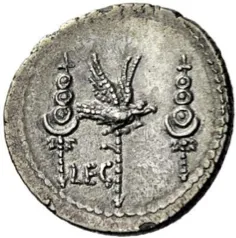
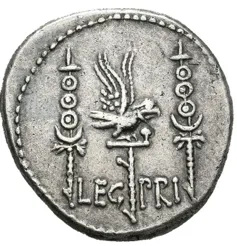
For the first legion, “PRI” is catalogued, but some specimen with “I” has also appeared. In this image we have a piece auctioned by Roma Numismatics.
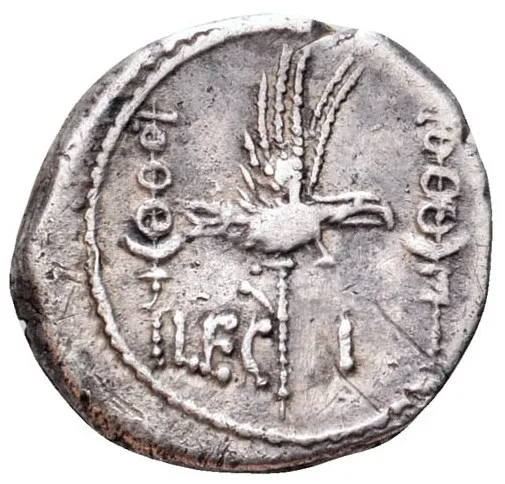
For legion XIIX it has been impossible for us to find images. Here we have a montage duplicating XI as IX.
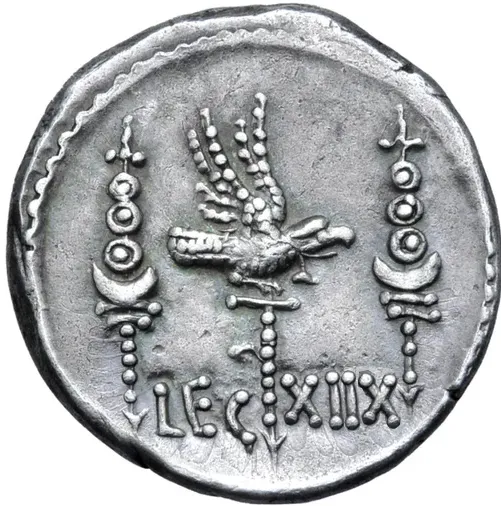
In 2019 a legion XXIIII appeared in a Bertolami Fine Arts auction.
In the numeral area there are strange details, and the numbers XXIIII look too different from the letters LEG. Could it be an authentic coin that was altered? Could it be real? A difficult question.
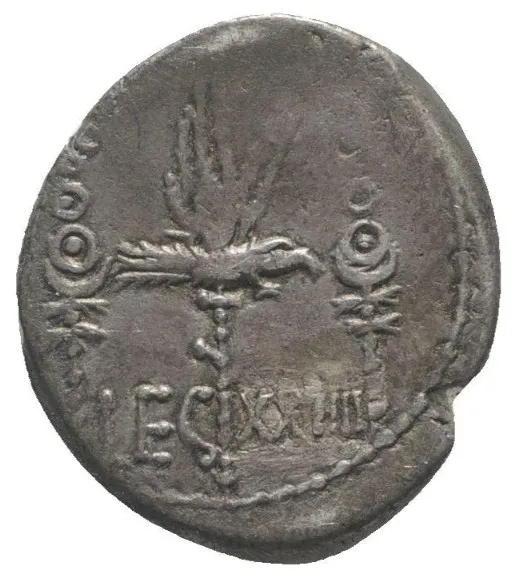
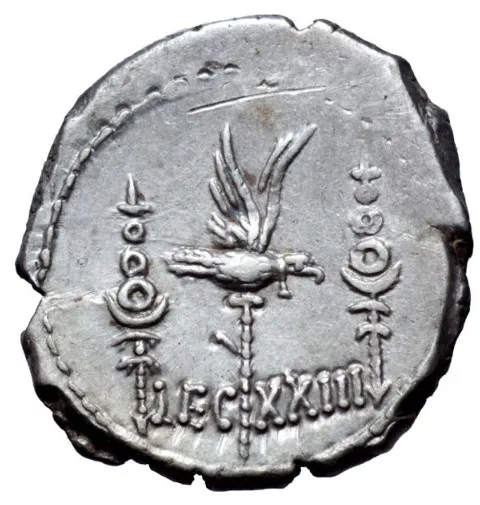
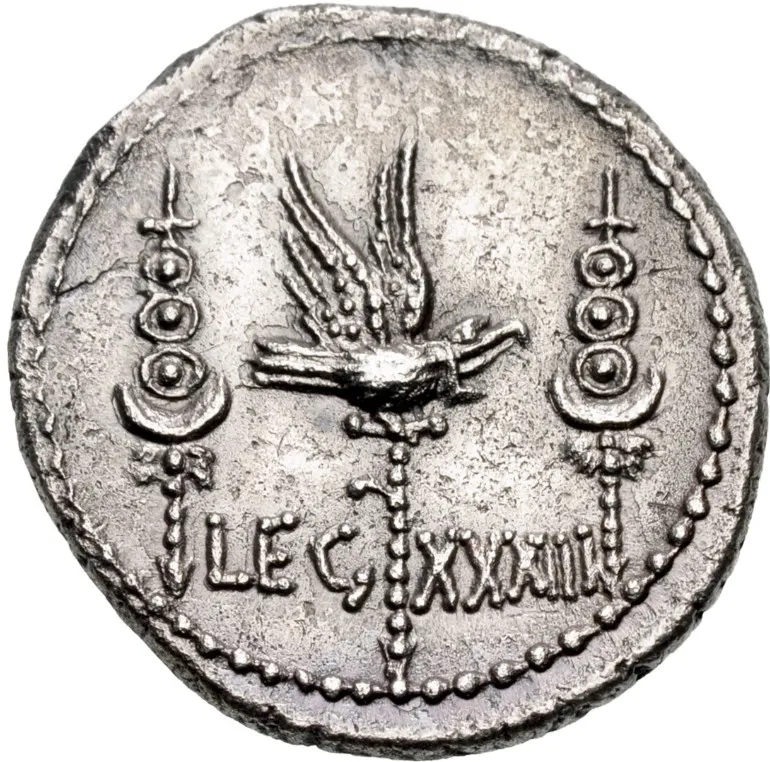
And the strangest of all: a legion XXXIII!
If XXXIII existed, did legions XXIIII to XXXII also exist? Very strange. In this case, two auctioned pieces have been found:
This one was auctioned in 2017 by Roma Numismatics for 5,109 euros.
This other one was auctioned in CNG Triton XXV in 2022 for 45,854 euros.
We know that Mark Antony had a Legio XXXV during the Mutina campaign thanks to an explicit reference preserved in the well-known letter from Servius Sulpicius Galba to Cicero (Ad familiares 10.30). In it he describes the events before the Battle of Forum Gallorum and states that, in the first clash, the cohorts of the legio Martia “put Antony’s thirty-fifth legion to flight”. This isolated mention is the only direct proof of the existence of that unit.
Therefore, if a Legio XXXV existed under Antony’s command, it is not unreasonable to think that there could also have been a Legio XXXIII, although for now we lack evidence confirming it beyond these two denarii auctioned in recent years.
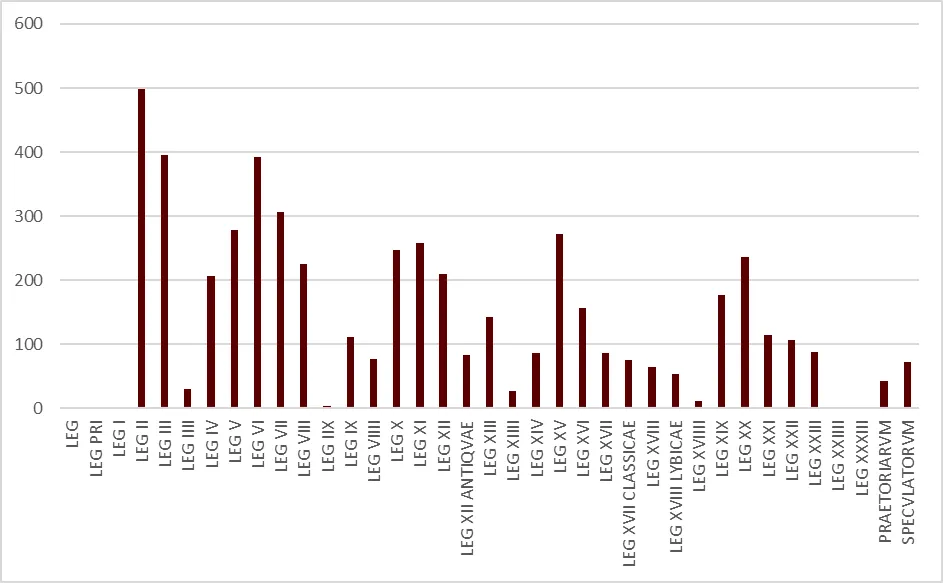
We have reviewed all auctions published on CoinArchives.com since 2004, identifying 5,141 legionary denarii of Mark Antony.
The table shows, for each legion type, how many specimens have been auctioned, as well as the minimum, average and maximum price and the percentage they represent of the total.
Several points stand out from this data set:
- Great inequality in the presence of each legion: some reach almost 500 specimens out of the 5,141 auctioned, while others appear only once or twice.
- LEGION II is the most common.
- The extremely rare numerals are LEG, LEG I, LEG PRI, the absent LEG XIIX, LEG XXIIII and the debated LEG XXXIII.
- Prices vary widely, with generally stable averages but maximum prices that, in the rarest types, easily exceed 10,000 euros.
- The appearance of two LEG XXXIII denarii reopens the possibility of undocumented numerations, in line with the historical case of Legio XXXV mentioned in the Mutina campaign.
The following chart seems to suggest that the higher the numeral, the fewer denarii were issued.