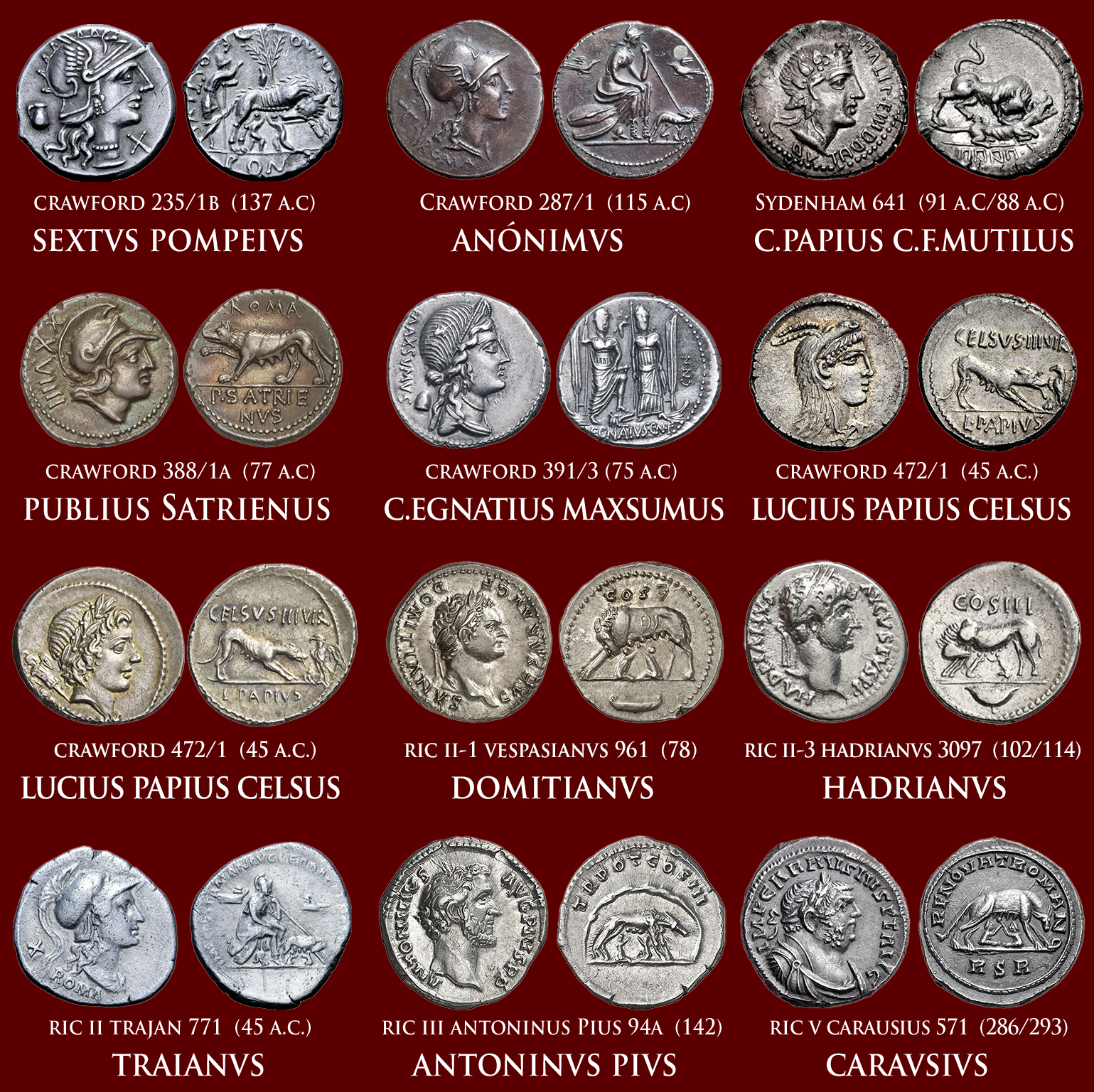
The Roman She-Wolf and Denarii
 “Denarius IOVIS collection”
Tenet fame cum fluitantem alveum, quo expositi erant pueri, tenuis in sicco aqua destituisset, lupam ex montibus, quae ad puerilem vagitum cursum flexisset, invenisse infantis expositos, mitem animum ostendisse; lingua lambentem pueros magister regii pecoris invenerit — Faustulus — ad stabula Larentiae uxori educandos dedit.
Titus Livy (Ab Urbe Condita, I, 4)
Tradition has it that, when the shallow water left dry the floating basket in which the children had been abandoned, a she-wolf came down from the mountains and, hearing the infants’ cries, turned aside, found the exposed children and showed a gentle nature. The master of the royal herd, Faustulus, found her licking the children with her tongue. He took them to his hut and gave them to his wife Larentia to raise.
Although there were already references to the myth of Romulus and Remus from the 4th century BC, the figure of the she-wolf was not consolidated as the main symbol of Rome until well into the Republican period. Livy mentions a statue as early as 295 BC, but it was not until 269 BC that it first appeared on a coin. It is a silver didrachm, weighing approximately 6.8 grams (6 scruples), following the Greek standard common in the mints of southern Italy.
The obverse shows the head of Hercules facing the right, with taenia (ribbon) in his hair, and carrying the club and the lion’s skin on his shoulder. On the reverse, the wolf appears standing to the right, turning her head to the left while nursing the twins Romulus and Remus. On the exergue, the inscription ROMANO clearly identifies the origin of the piece.
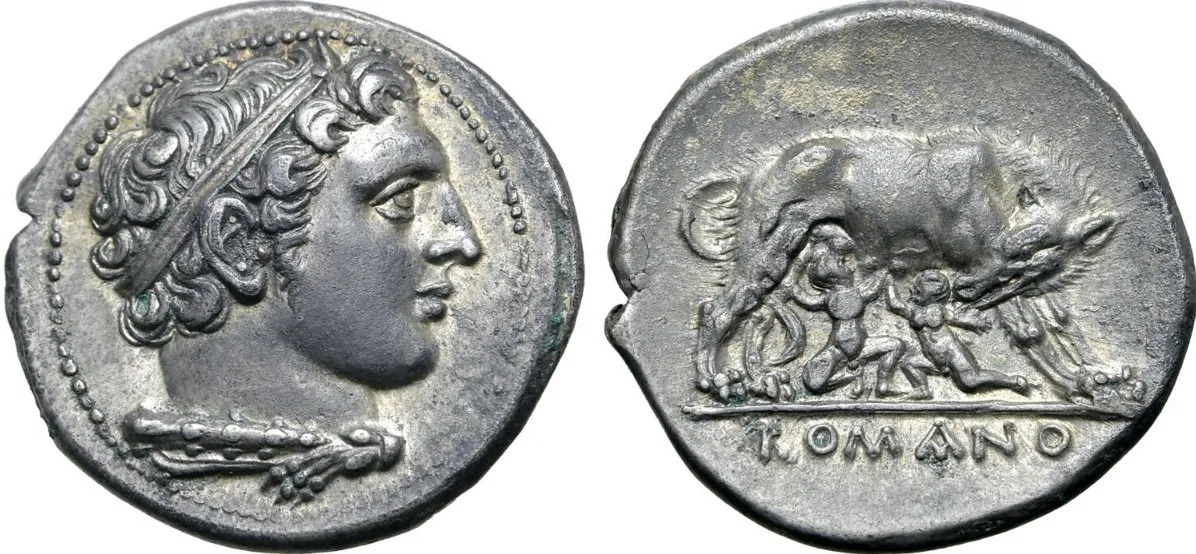
“Didrachm auctioned for 29,837 euros in 2022 at a Roma Numismatics auction”
The reverse shows Faustulus on the left, the she-wolf in the center nursing Romulus and Remus, and, behind them, the ficus Ruminalis, with a bird perched on the trunk and two others on the branches. The legend names the shepherd (FOSTLVS) and the moneyer (SEX POM ROMA), reinforcing the symbolic intention: linking his lineage with Faustulus, the first protector of Rome’s founders. According to myth, Faustulus found the twins by the Tiber and took them to his home, where his wife Larentia raised them. Some Roman authors recall that Larentia was called lupa, a term that could also mean “prostitute”, which gives the myth a dual traditional and symbolic reading.
The tree represented behind the she-wolf is, without a doubt, the ficus Ruminalis, the same one that ancient authors such as Livy and Plutarch placed next to the Lupercal cave, at the base of the Palatine Hill. The name of the tree evokes breastfeeding (ruma), reinforcing the maternal and protective character of the scene. Its inclusion allows us to visually locate the sacred place where Rome had its origin, a detail that the citizens of the time easily identified.
A bird appears on the trunk of the tree, usually interpreted as a woodpecker (picus), a sacred animal of the god Mars. Plutarch mentions that both the she-wolf and the woodpecker were sent by Mars, mythical father of the twins, to protect and feed them. This representation reinforces the sacred nature of the story, without the need for more speculative interpretations. As a whole, the scene projects a clear message: Sextus Pompeius presents himself as a symbolic heir to Rome’s origins.
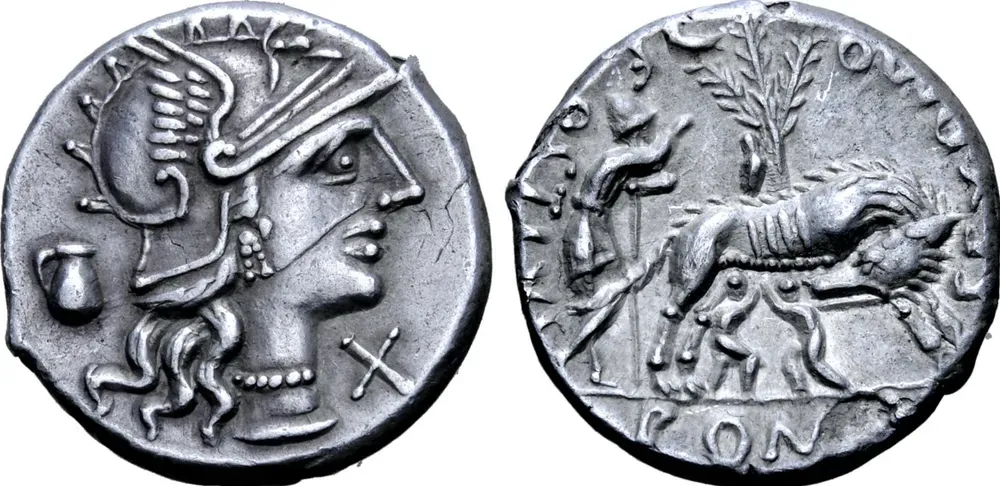
”Crawford 235/1b. Auctioned at Roma Numismatics in 2020 for 665 euros”
In the years 115 and 114 BC, Rome was going through a phase of apparent stability after the social outbreak caused by the Gracchus brothers. Although their reforms had been suppressed and the brothers themselves eliminated, tensions were still latent: the distribution of land, citizenship rights for the Italian allies and the conflict between optimates and populares were still present in the political debate. The Senate and the equestrian elite sought to restore balance by appealing to the traditional values of the Republic, but unrest persisted, especially among the popular classes and allies without full rights.
The obverse presents the head of Roma with a winged Corinthian helmet and a lock of hair falling over the left shoulder, accompanied by the inscription ROMA, which reaffirms her identity as the personification of the city. The reverse completes this message by showing Roma seated on a pile of shields, armed with spear and helmet, a symbol of her military power and her role as guarantor of peace. A helmet appears at her feet, and in the foreground the she-wolf nurses Romulus and Remus, a direct nod to the founding myth. Two birds in flight complete the scene, probably associated with the divine omens that accompanied the birth of Rome. Altogether, this coin projects an image of a strong, legitimate, god-protected and victorious Rome: a message perfectly aligned with the need for cohesion and institutional authority at a time of fragile political consensus.
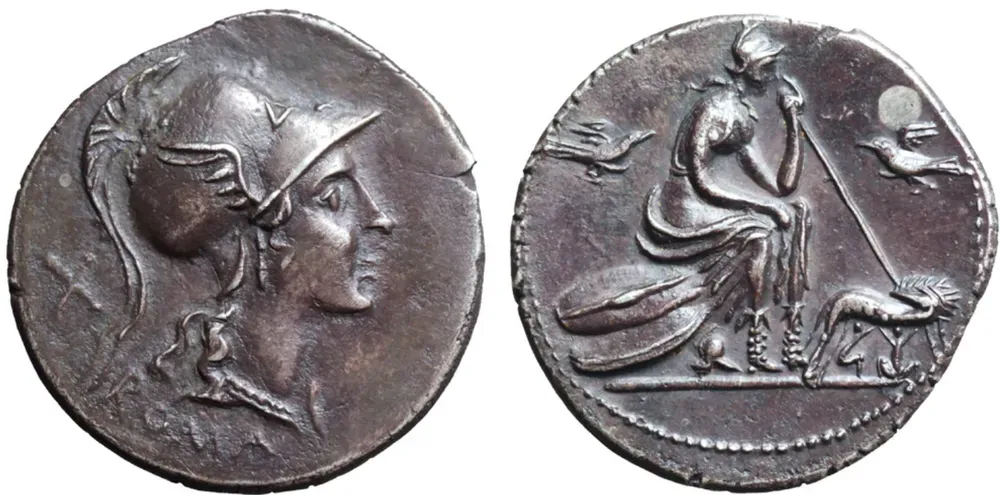
”Crawford 287/1. Auctioned at Roma Numismatics in 2014 for 3,200 euros”
It should be noted that, about 180 years later, Vespasian and Titus minted gold coins with their portrait on the obverse and this same reverse.
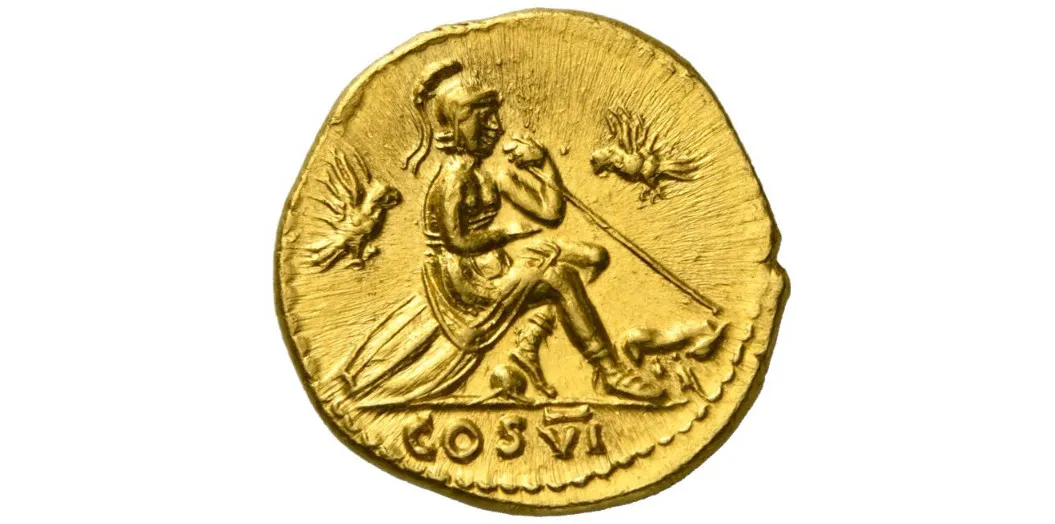
Then, as we will see later, under Trajan a restoration issue of this same Republican denarius was minted.
One of the best-known coinages of this iconography corresponds to the Marsic Confederation, dated between 90 and 88 BC, probably issued in Campania by a mobile mint under the authority of C. Papius C.f. Mutilus, one of the main leaders of the revolt. The obverse shows the laureate head of Bacchus to the right, with an ivy crown, accompanied by the legend MUTIL.EMBRATUR in Oscan, which identifies the rebel general as imperator. On the reverse, an Italic bull advances forcefully and gores a fallen she-wolf from behind, a visual allegory of the challenge to Rome, with the inscription C.PAAPI, also in Oscan, in the exergue. It is a scene with a direct political charge: it is not just a coin, but a declaration of sovereignty and identity against the metropolis.
Despite the harshness of the conflict, Rome managed to resolve the Social War by combining military repression with an unprecedented legal opening. With the Lex Iulia (90 BC), Rome offered citizenship to allies who had not rebelled; with the Lex Plautia Papiria (89 BC), it extended it even to those who had fought, on condition that they registered; and with the Lex Pompeia (89 BC), it granted the ius Latinum to communities in northern Italy. In this way, Rome politically defused the revolt while restoring territorial control through military means. Curiously, the symbol of the she-wolf, far from disappearing after these iconographic attacks, emerged strengthened: Rome not only won the war, but also reappropriated its own myth.
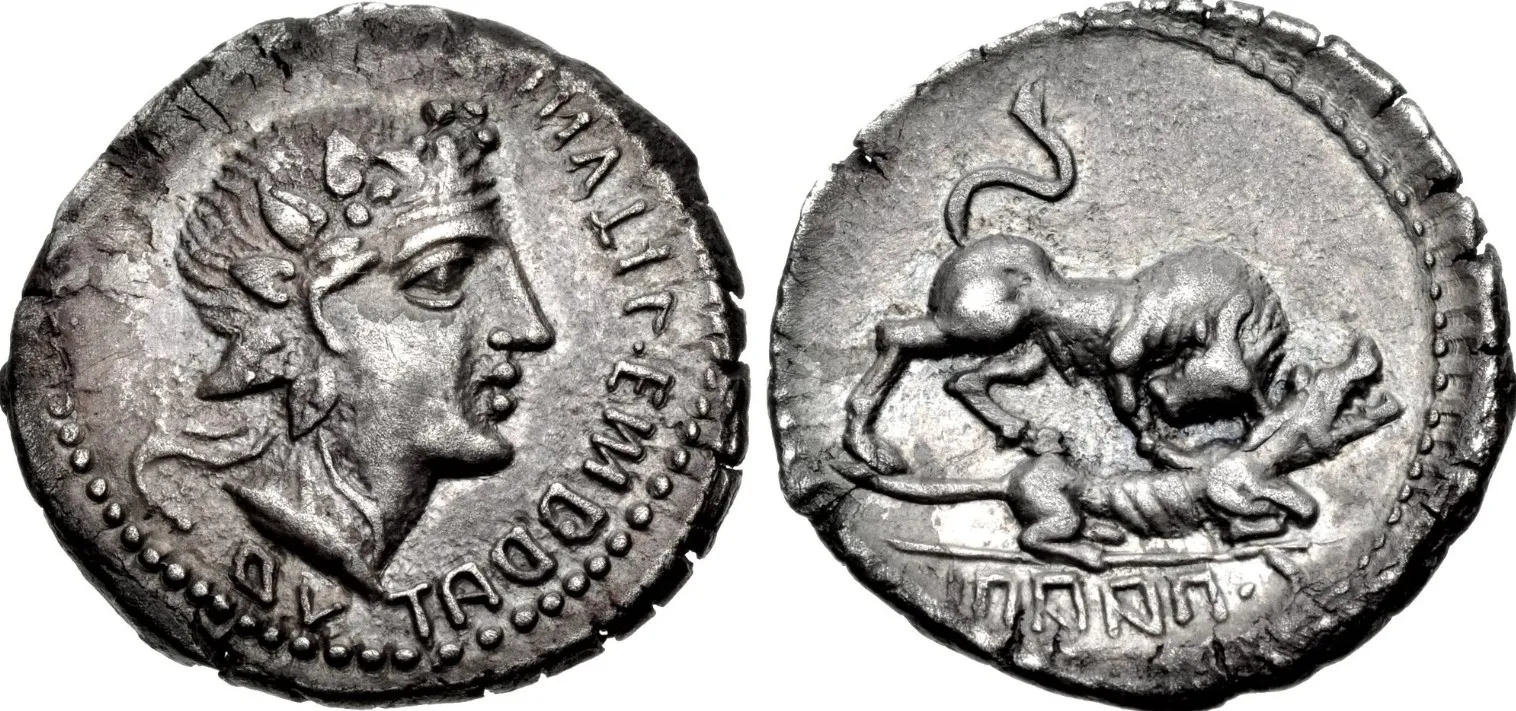
”Fewer than 22 coins of this type are known. The specimen in the photo was auctioned in 2016 at CNG’s Triton XIX. It reached $20,000 and went unsold”
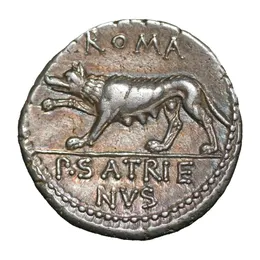
That year, Rome was experiencing a delicate situation after the recent dictatorship of Sulla. The revolt of Marcus Aemilius Lepidus had just been put down, but the war against Sertorius continued in Hispania. The Republic was trying to reassert its authority in a time of uncertainty and division. In this context, Satrienus minted his denarii, using coinage as a means of symbolic expression in defense of the Republican order.
On the obverse appears a bust with a Corinthian helmet, traditionally interpreted as Roma, but today mostly attributed to a young Mars. This figure reinforces the message of strength and legitimacy, linking the protection of Rome with its tutelary god. The reverse depicts the Capitoline she-wolf advancing alone, with her udders clearly visible and the inscription ROMA along the spine. The absence of the twins is not coincidental: it can be interpreted as a victorious Rome after appeasing internal threats, but also as a protective mother who reserves her care for the faithful, not the rebels. A direct message at a stage in which the stability of the Republic was at stake.
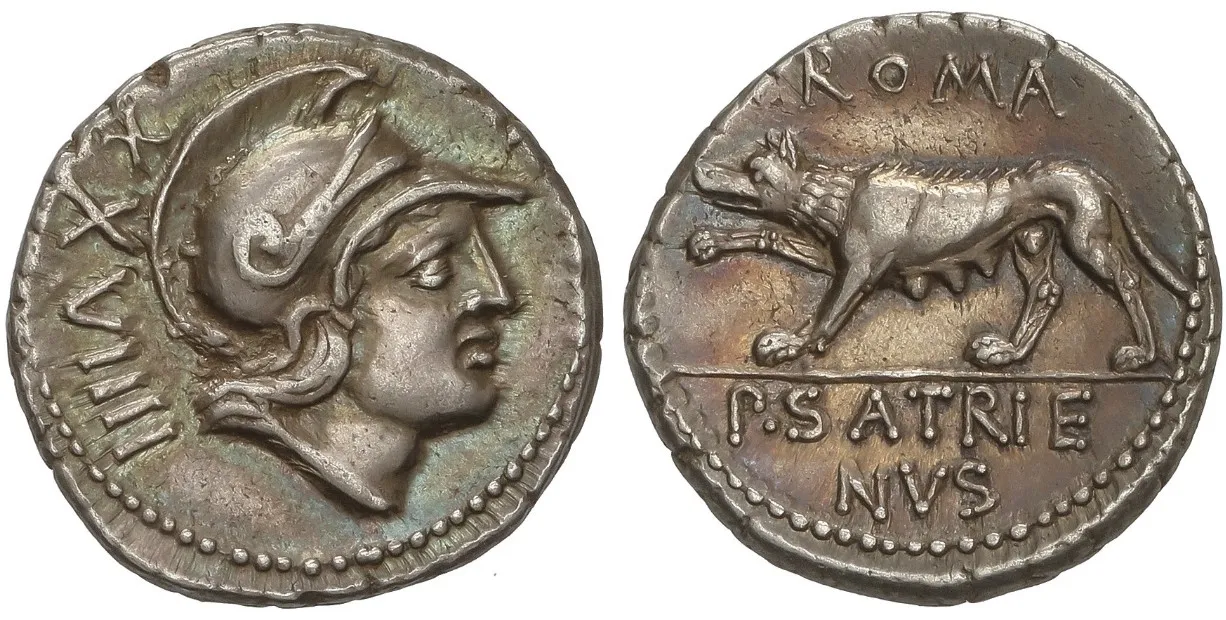
“Crawford 388/1a. Denarius IOVIS Collection”
In 74 BC, two major conflicts broke out: the Third Mithridatic War in Asia Minor, led by the consul Lucullus, and the slave revolt led by Spartacus in Italy. Both fronts put the Republic under pressure.
On the obverse of the denarius of Gaius Egnatius Maxsumus (75 BC) appears the bust of Libertas, goddess of freedom, represented with a diadem and drapery, with a pileus (cap of freedmen) behind. This figure alludes to one of the most important values of the Republic and reflects the political aspirations of the moment, after the abuses of the Sullan regime.
On the reverse, a symbolic scene is represented with the goddesses Roma and Venus, brought together to recall the mythical origin of the city. Venus represents Rome’s Trojan root through her son Aeneas, while Roma personifies the city founded by Romulus, a descendant of that lineage. Together they evoke the double heritage of the Republic: Troy and Latium.
A singular detail is the head of a she-wolf under the foot of the goddess Roma. Although the full scene with the twins is not depicted, its inclusion functions as a direct symbol of the founding myth: the she-wolf who suckled Romulus and Remus. Far from showing weakness, the she-wolf appears here as the foundation of Roman greatness. Rome rests on its legendary origins, transmitting a message of continuity, strength and divine protection.
Taken together, this iconography affirms that Rome is great because its roots are sacred. The presence of Libertas on the obverse completes the message: a free Rome, protected by Venus, and founded on its eternal myth.
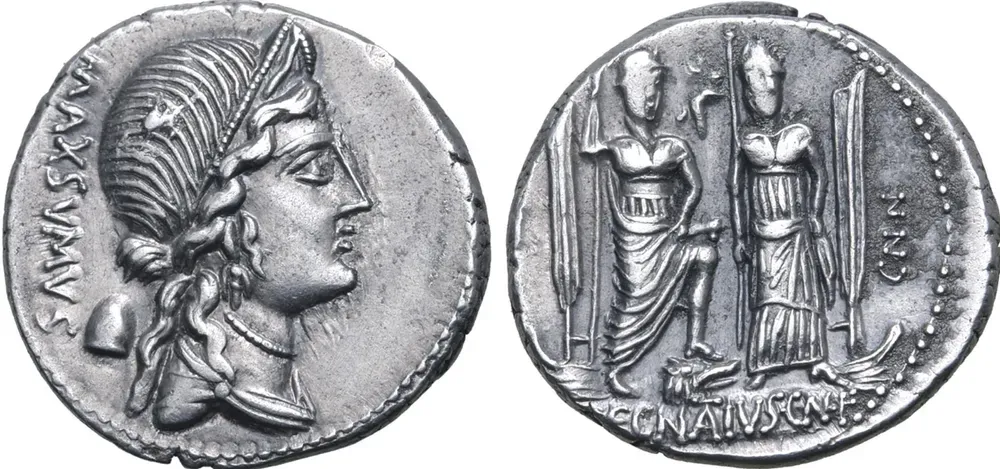
“Crawford 391/3. Roma Numismatics (2012) €2,278”
Papius Celsus served as tresvir monetalis at a key moment: the end of the civil war between Caesar and Pompey. Rome began a process of pacification and institutional reorganization under Caesar’s growing power, and monetary iconography became an effective propaganda tool. This denarius fits perfectly into that context.
The reverse shows a unique scene: a wolf placing a log on a bonfire, while an eagle fans the flames. The image comes from an ancient omen collected by Dionysius of Halicarnassus, possibly of local origin in Lanuvium. It symbolizes the founding of a city protected by divine forces against external threats. In the context of the year 45 BC, it can be read as an allegory of the rebirth of Rome after the civil war, kept alive by the protection of its tutelary symbols: the she-wolf and the eagle.
Papius Celsus minted two types with this reverse: the most common, with the obverse of Juno Sospita (Crawford 472/1), exalting her link with Lanuvium, and a rarer type with the personification of Triumph (Crawford 472/2), which directly alludes to Caesar’s victories. The first is considered the main type due to its frequency and its coherence with the family’s monetary tradition.
On the obverse of the first type appears Juno Sospita with a goatskin and a severe expression, without inscription. The reverse shows the scene of the she-wolf and the eagle lighting the fire, with the inscription L PAPIVS CELSVS III VIR in the exergue. This issue combines founding myth, local identity and political message in one of the most original compositions in the Republican repertoire.
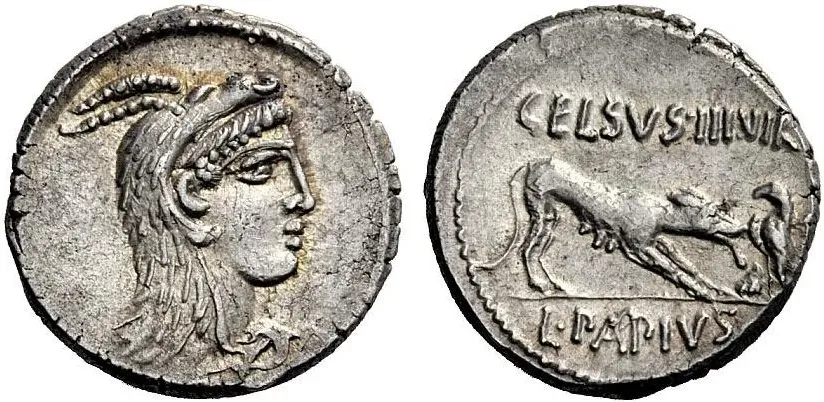
”Crawford 472/1. Numismatica Ars Classica. Auctioned in 2012 for €2,915”
On the obverse of the second type appears the male personification of Triumph (TRIVMPVS), laureate and with a solemn expression, representing the official celebration of Caesar’s victory in 45 BC. The figure conveys military glory and political legitimation. This variant, much rarer, combines an allegorical founding scene with an explicit political message: the triumph of Rome and Caesar appears as the fulfillment of a destiny announced by the gods since ancient times.
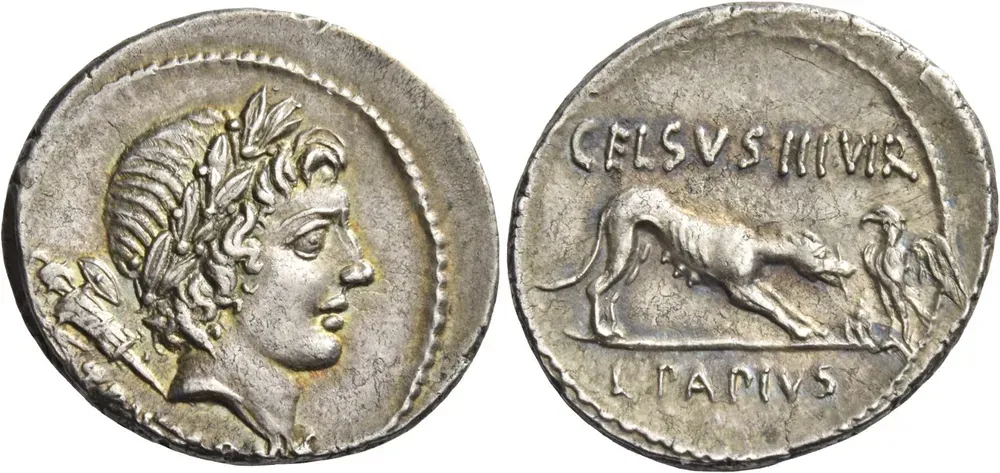
”Crawford 472/2. Numismatica Ars Classica. Auctioned in 2020 for €6,025”
And the Republic ends without further references to the she-wolf on denarii. In the time of Augustus, the she-wolf was consolidated as an urban and political symbol of Rome, appearing in monuments such as the Ara Pacis and on numerous artistic supports. From then on, her image represented not only a founding myth, but Rome itself, undefeated and eternal.
On the obverse, laureate Domitian appears as an imperial prince who had not yet acceded to the throne, while the reverse presents the Capitoline she-wolf nursing Romulus and Remus, symbol of the founding of Rome, and a ship’s prow in the exergue. The legend COS V refers to Vespasian’s fifth consulship, precisely fixing the date of issue. This coin is a clear example of how Vespasian used coinage not only to exalt the mythical origins of Rome, but also to promote the image of his son Domitian as guarantor of dynastic continuity.
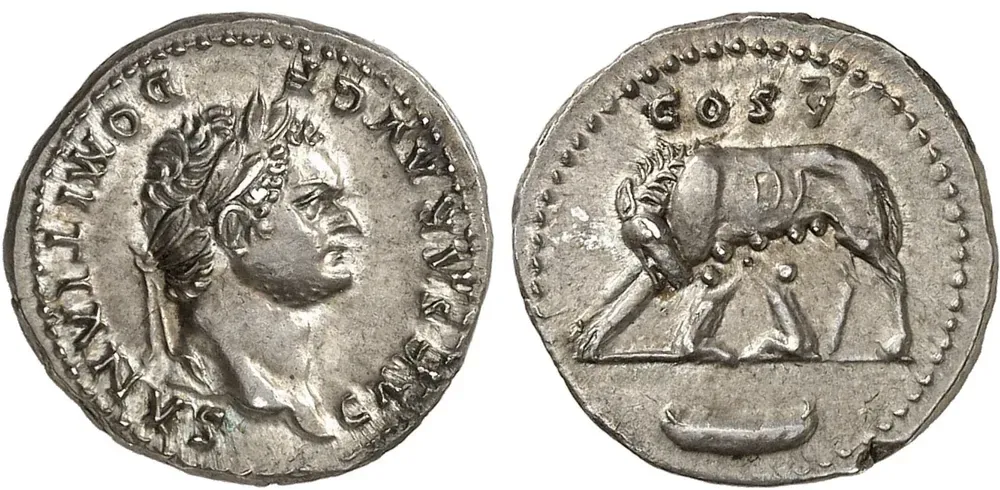
RIC II, Part 1 (SE) Vespasian 961. Auctioned at Rudolf Künker in 2020 for €4,200
On the obverse appears the laureate bust of Hadrian looking to the right, accompanied by the legend HADRIANVS AVGVSTVS P P, which presents him as Emperor Augustus and father of the fatherland. The reverse depicts the Capitoline she-wolf standing to the left, with the twins Romulus and Remus below, in a composition that directly evokes the founding myth of Rome. An unusual detail in this variant is the inclusion of a bowl or dish under the she-wolf, an element interpreted as part of the ritual context of the myth. The COS III legend indicates that the coin was minted during his third consulship, placing it chronologically between 128 and 130 AD.
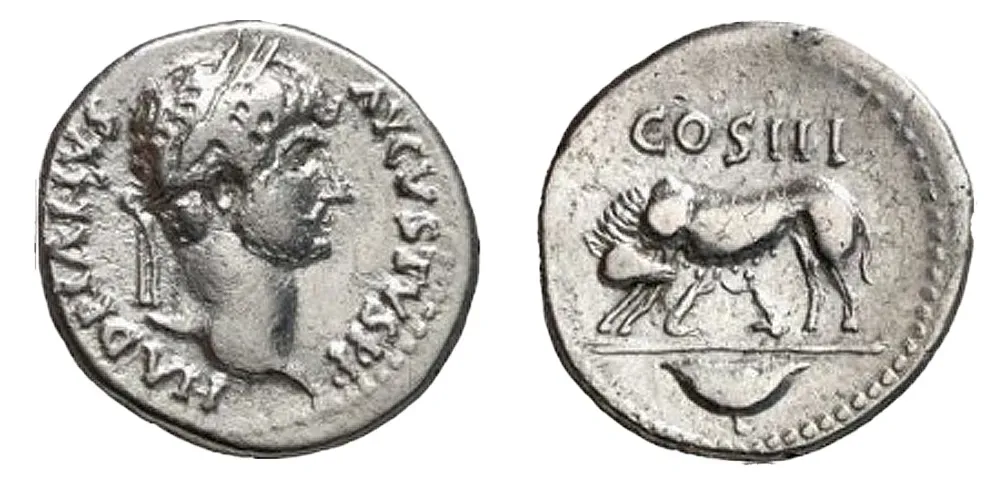
RIC II, Part 3, 3097. Auctioned at Gorny & Mosch (2006) for 360 euros
Between 102 and 114 AD, Rome experienced a period of intense military activity and imperial consolidation. After the two Dacian Wars (101-102 and 105-106), Trajan celebrated a great triumph and financed monuments such as Trajan’s Column. At the same time, he promoted a legislative and institutional restoration campaign that included the issuance of restored coins from the Republican period, as a way to connect his regime with the traditional values of Rome and to project an image of renewal guided by the authority of the past.
This denarius of Trajan (RIC II 771) belongs to an interesting series of restored coins that the emperor had minted between 102 and 114 AD. It faithfully reproduces an ancient Republican type, with the head of Roma on the obverse and Roma seated next to the she-wolf and the twins on the reverse, all accompanied by the legend REST, which indicates its restored character. This is not a modern copy or a forgery, but rather an official issue with a clear ideological purpose: Trajan wanted to reinforce the legitimacy of his government by linking it to the founding values of the Republic. These coins without an imperial portrait recovered traditional images with an enormous symbolic load, projecting continuity between Rome’s heroic past and the new imperial order.
This piece reproduces the earlier type seen in the ANONYMOUS REPUBLICAN section, although on the reverse ship prows appear instead of the birds and the legend reads IMP CAES TRAIAN AVG GER DAC P P REST: “The emperor Caesar Trajan Augustus, [victor over] the Germans and Dacians, father of the fatherland, restored [this coin].”
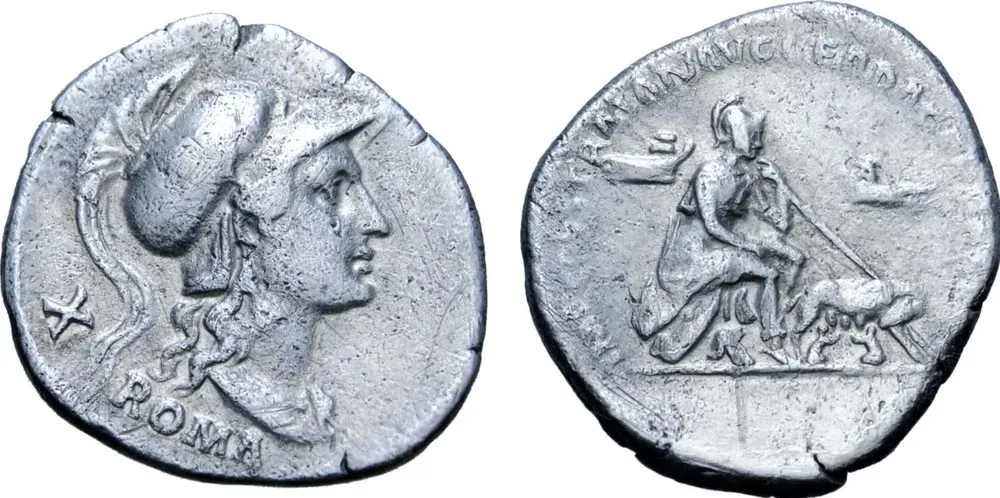
“RIC II Trajan 771. Auctioned at Roma Numismatics in 2020 for €1,003”
Between 140 and 143 AD, the period in which this denarius was minted, Rome was experiencing a period of internal tranquility and institutional consolidation. The first years of his reign were celebrated, in which Antoninus reinforced the image of continuity with Hadrian and promoted public works, legal improvements and tributes to tradition. In this context, coin issues sought to reaffirm Roman identity and its legacy, using classic symbols such as the Capitoline she-wolf.
This denarius shows on the obverse the bare head of the emperor with the legend ANTONINVS AVG PIVS P P, which identifies him as Augustus, pious and father of the fatherland. On the reverse appears the emblematic image of the Capitoline she-wolf nursing Romulus and Remus, a symbol of the founding myth of Rome, accompanied by the legend TR POT COS III, which indicates his tribunician power and his third consulship. In this case, it is notable that the image appears in front of or inside a cave.
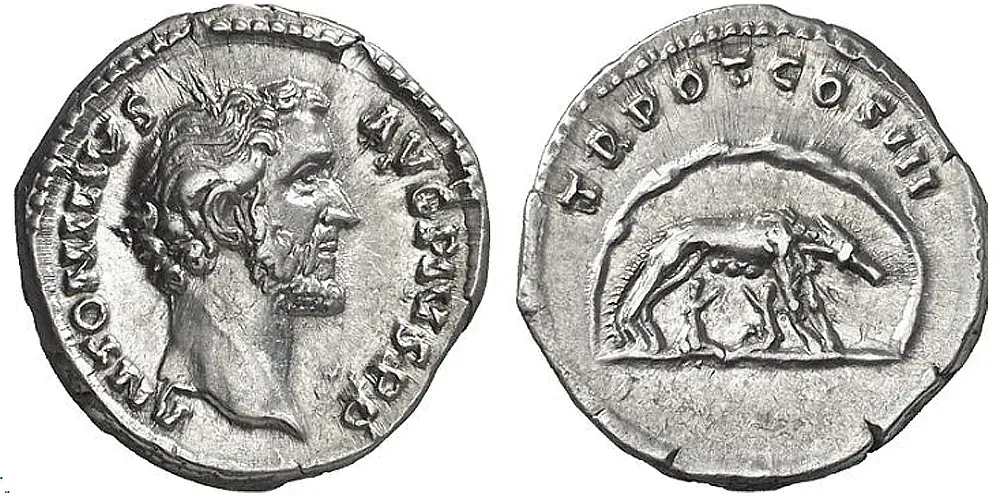
“RIC III Antoninus Pius 94a. Auctioned by Lanz München in 2007 for €220”
He issued coinage of notable quality and strong symbolic content, seeking to legitimize his authority and attract the favor of the provincial population and the army.
Although it is often known as the Carausian denarius, it is not actually a regular denarius, but rather a rare symbolic issue in silver, minted outside the normal monetary system of the Empire.
Carausius deliberately wanted to recreate the ancient Roman denarius as a gesture of legitimacy and continuity with Rome, restoring its form and its message with a clearly propagandistic purpose.
The DI-6655 specimen | RIC V 571, minted during his usurpation, is an extraordinary piece both for its iconography and its political content.
On the obverse, Carausius appears laureate, draped and with a cuirass, with the legend IMP CARAVSIVS P F AVG, which presents him as a legitimate, pious and happy emperor.
On the reverse, the Capitoline she-wolf nursing Romulus and Remus is accompanied by the legend RENOVAT ROMA (and variants), which can be translated as “Rome is renewed” or “He renews Rome.”
This scene, typical of the republican and imperial repertoire, is loaded with meaning: Carausius is not shown as a usurper, but as a renewer of Rome, someone who restores its founding glory from the margins of the Empire.
The use of this mythical symbol, together with such an eloquent inscription, turns this coin into an act of conscious propaganda, which evokes eternity and the divine origins of the City.
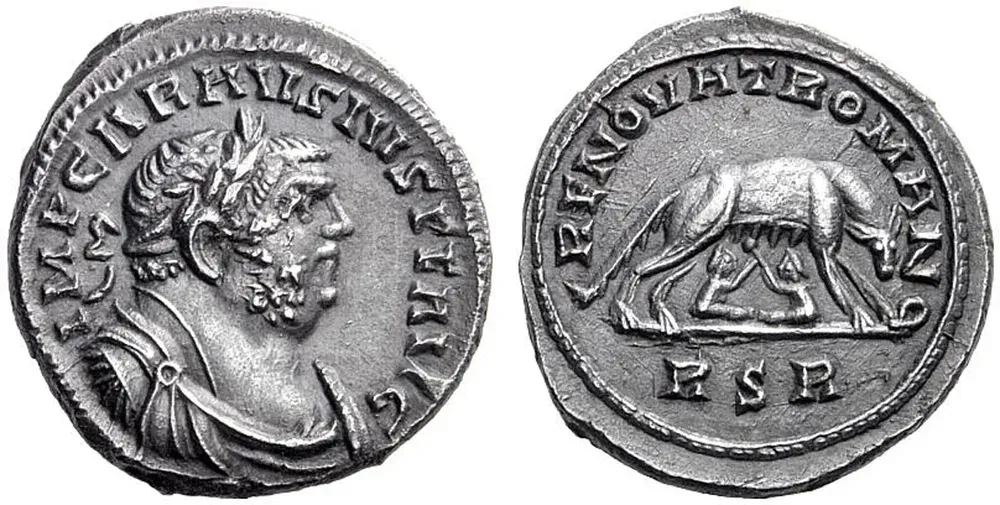
“RIC V Carausius 571. Auctioned at Ars Classica in 2011 for 48,647 euros”
Throughout Roman history, the image of the she-wolf appeared on twelve denarii as a symbol of the city’s mythical origins. From the first didrachms to imperial denarii, its presence served to reinforce ideas of identity, continuity and power.
In some cases it is used to recall the legendary birth of Rome; in others, to give legitimacy to emperors or even enemies of the city who wanted to appropriate that symbol. But in all cases, the she-wolf represents something more than a simple mythological scene: it is an emblem of Rome itself.
With this review of different issues, it is clear that the Capitoline she-wolf not only fed Romulus and Remus, but also centuries of history, propaganda and collective memory.
JPG - THE ROMAN SHE-WOLF AND DENARII
Click on the image if you want to download it in higher resolution