The Princes of Youth: Gaius and Lucius on the Denarius of Augustus
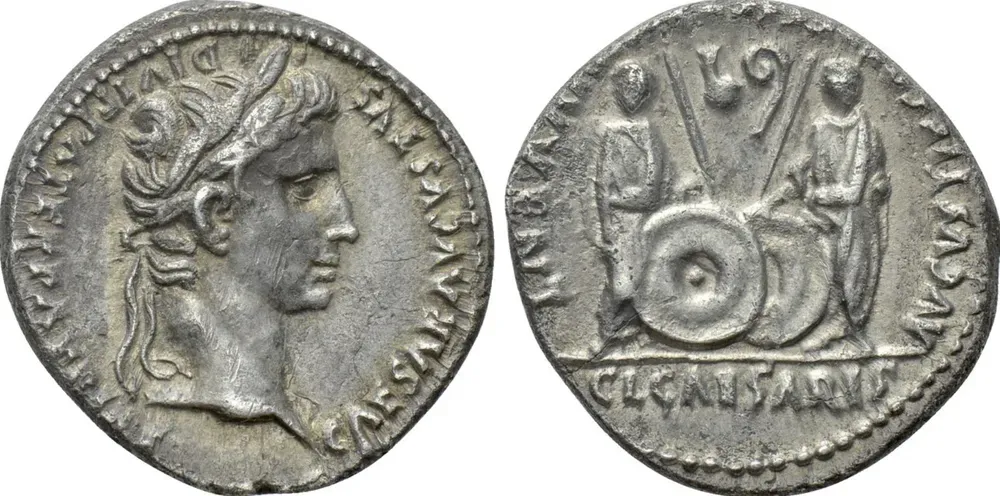
As you know, this denarius depicts Gaius and Lucius Caesars on its reverse: the grandsons, adoptive sons and heirs of Augustus. Gaius and Lucius were the sons of Agrippa, Augustus’ closest friend and admiral of his fleet at the Battle of Actium, the battle that, we could say, made Octavian, the future Augustus, master of the Roman world.
Augustus married his only daughter, Julia, to Agrippa, and from them were born, among other children, Gaius and Lucius. Augustus was sickly by nature and was always convinced that he would die young; for that reason he named Agrippa as his heir. However, Agrippa died long before Augustus, in 12 BC, and Augustus then decided to adopt his grandsons Gaius and Lucius and name them Caesares, that is, heirs.
These denarii were minted at the mint of Lugdunum, present-day Lyon, France, which at that time was the central imperial mint. Unlike Rome, whose mint was controlled by the triumvirs and the Senate, in Gaul Augustus exercised proconsular power; the mint of Lugdunum was subject to the imperium maius, and therefore the emperor had direct control over the coinage, allowing him to produce the gold and silver coins used to pay the legions.
On the obverse we read the titulature CAESAR AVGVSTVS DIVI F PATER PATRIAE, and see the laureate head of the emperor. On the reverse, the legend begins in the exergue: C L CAESARES, and continues around: AVGVSTI F COS DESIG PRINC IVVENT. We see the young Caesars, Gaius and Lucius, standing facing, dressed in the toga virilis, holding spears and silver shields.
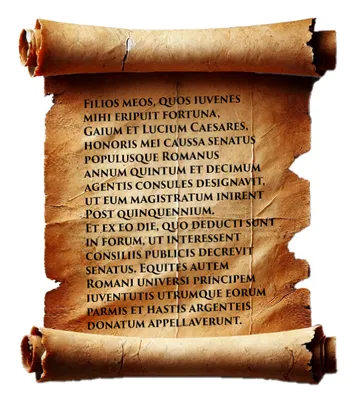
Surprisingly, this reverse seems to illustrate perfectly a paragraph from a famous inscription, the Res Gestae Divi Augusti, a kind of political autobiography in which Augustus recounts the main events of his reign in the first person. In this document, we read:
“My sons Gaius and Lucius Caesars, whom Fortune took from me in their youth, were named consuls designate in my honor by the Senate and the Roman people at the age of fifteen, with permission to enter that magistracy after five years. The Senate also decreed that from the day on which they were led into the Forum they should attend public debates. In addition, the Roman equites, unanimously, gave each of them silver shields and spears and hailed them as princes of youth.”
This ceremony took place when his grandsons and adoptive sons, Gaius and Lucius, assumed the toga virilis, that is, when they became Roman citizens by wearing the toga, the Roman national dress, for the first time upon reaching the legal age: in this case, 15 years old (it could be earlier, from 13, or as late as 17, depending on the young man’s maturity). In addition, Gaius was named pontifex (pontiff), and Lucius was named augur.
However, the scene we see, exactly the one Augustus describes, is impossible, because although both did in fact receive the honors described, this happened on different occasions. Gaius (born in 20 BC) assumed the toga virilis in 6 BC, and Lucius (born in 17 BC) did so four years later than his older brother, in 2 BC. In other words, the reverse image of these denarii is like one of those pictures made from cuttings from different periods.
Fortune, as Augustus tells us, was cruel to his young heirs. Lucius, the younger, sent to Hispania to complete his military training, died in Massilia without ever reaching his destination, in AD 2. For his part, Gaius, sent to Syria to suppress an uprising in 1 BC, would assume the consulship in absentia the following year together with his brother-in-law; he intervened in Armenia, placing Ariobarzanes II of Media Atropatene on the throne, but this triggered a rebellion encouraged by the Parthians. When the rebel leader, Abaddon, invited him to parley, he set an ambush in which Gaius Caesar was wounded; and although he survived and managed to crush the rebels, he was left gravely injured and his health deteriorated, dying in February AD 4. Both were commemorated throughout the empire in inscriptions such as this one, discovered in Pisa, and in monuments, the most famous of which is the “Maison Carrée” (Nimes), which is a cenotaph.
These denarii, as many already know, are the most common silver coins minted in the name of Augustus, and the most likely date for their introduction is 2 BC, the year in which Lucius received the same honors as his older brother, Gaius. But they are so common that everything suggests they continued to be minted even after the death of both, because there is great stylistic variety and even several variants, mostly distinguishable by the orientation and placement of the simpulum and the lituus (a reference to the religious offices these princes also received: pontifex and augur), which may appear facing outward, inward or also transposed.

The scarcer variants bear the value mark X (denarius), even though by 136 BC the denarius was already worth 16 asses. Denarii of this type must have been minted until AD 10, when Tiberius began to appear regularly on the coinage as Caesar (heir).
But the greatest mystery of these coins is who does NOT appear on the reverse. Gaius and Lucius had a younger brother who was also adopted by his grandfather Augustus and received some of the honors granted to his brothers. This was an obscure figure named Agrippa Postumus. He was so called because he was born in 12 BC, shortly after the death of his father. However, Agrippa was a somewhat sinister character. Mentally unstable, violent, the sources portray him as a taciturn young man, addicted to angling and prone to fits of rage. Roman historians apply adjectives to him such as ferox (fierce) and trux (savage).
Augustus had planned for Agrippa Postumus to continue the line of his late and beloved friend Agrippa; but after the death of his older brothers, he decided to adopt this last grandson, and Agrippa received the same honors his brothers had received (princeps iuventutis and consul designatus) when he assumed the toga virilis, in AD 5. That is why we say that a third prince could have appeared on this denarius… but things were different with him.
Augustus distrusted Agrippa Postumus, kept him under surveillance and soon discarded the idea of naming him heir to his power, although not to his lineage and part of his property.
Matthew 22:15-21
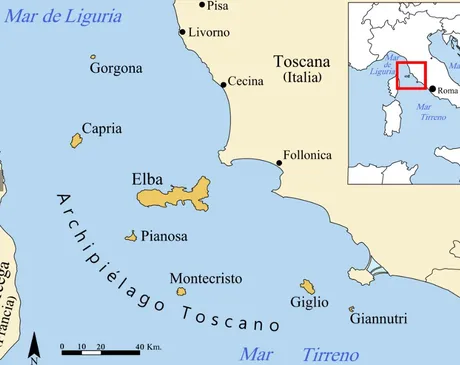
But Agrippa Postumus’ ferocity soon led Augustus to confine him to a villa in Sorrento barely a year later, in AD 6; and the following year he deported him to Planasia (Pianosa), an island between Italy and Corsica, where the troublesome young man was forgotten, surely fishing as much as he pleased. Yet the mystery does not end there.
In May AD 14, Augustus decided to visit his only surviving male grandson in secret, setting out for the remote island together with a trusted senator: Paullus Fabius Maximus, none other than the founder of Lucus Augusti, the present-day city of Lugo. However, Maximus apparently broke the silence agreed with Augustus, telling his wife of the mysterious visit before departing. It is believed that for this reason Augustus ordered his execution.
On his return from Planasia, on August 19, Augustus died at Nola, never reaching the capital. Shortly before or shortly after, Agrippa Postumus was executed, under mysterious orders, by the centurion Gaius Sallustius Crispus, great-nephew and adoptive son of the historian Sallust.
When Tiberius was informed that “his orders had been carried out”, he categorically denied having given them. He then said that he knew Augustus had ordered that Agrippa Postumus should not survive him. Whether the order to kill Agrippa was given by Tiberius, Augustus himself or, perhaps more probably, his grandmother Livia, is something we will never know.