DR-880 | Crawford: 544/13
Marcus Antonius
Marcus Antonius
Gens: Antonia
Moneyer: Marcus Antonius
Date and mint: 32 BC/31 BC - ?
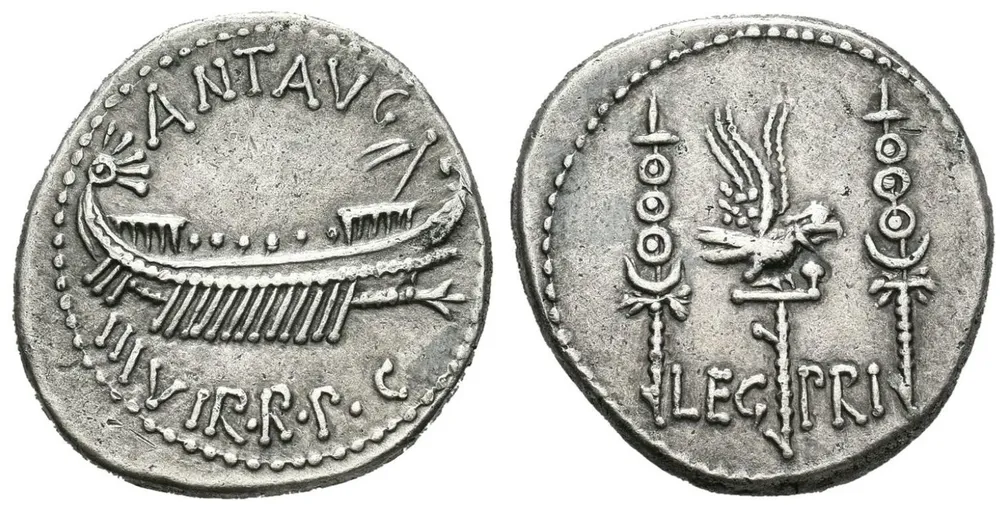
Obverse: Galley to the right. Dotted border.
Legend: ANT AVG III VIR R P C
Reverse: Eagle between two banners. dotted border
Legend: LEG PRI
Comment: The gens Antonia was an influential plebeian family with prominent figures in the public life of Roma. Among them, Mark Antony the Orator stands out, grandfather of the triumvir, famous for his rhetorical skill and his political career, who reached the consulship in 99 BC. His grandson, Mark Antony, was the most famous member of the family: he fought in the Gallic War under Caesar, shone as a commander in the civil wars—especially at Pharsalia (48 BC)—and as tribune of the plebs in 49 BC. He defended the interests of the dictator before the Senate. After Caesar's death, Antony became one of the three strong men of the Second Triumvirate, until his confrontation with Octavian culminated in the decisive war that would seal the fate of the Republic.
Between 32 and 31 BC, in the months prior to the battle of Actium, Antony minted in Patras (Greece) a large series of denarii known as “legionaries”, intended to pay his troops and, at the same time, to exalt the loyalty and power of his army. On the obverse there is a galley, a symbol of the naval dominance in which he relied to prevail over Octavian. On the reverse, a legionary eagle between two banners, with the inscription of the corresponding legion (from I to XXIII). In the case of this specimen, the LEG PRI legend honors the first of its units. Each type paid tribute to a specific legion, in a clear propaganda effort to reinforce the morale of its soldiers and underline the breadth of its forces.
Thirty-two types cataloged by Crawford are known, including variants such as LEG VIII / LEG IIX, which shows the magnitude of the issue. These coins circulated in large numbers, which explains their wide preservation until today, but at the time they served as royal payment in a desperate campaign for supremacy in Rome.
The outcome was the battle of Actium (31 BC), where the fleet of Antony and Cleopatra, cornered by Agrippa, ended in defeat. The retreat of Cleopatra with her squadron, followed by Antony, marked the collapse of her cause. They both fled to Egypt, where they committed suicide in 30 BC. The defeat left Octavian as the sole master of Roma and paved the way for his proclamation as Augustus, first emperor.
Paradoxically, the legionary denarii that were supposed to celebrate the loyalty of their troops and their invincibility became associated with one of the most famous defeats in Romen history. Today they are one of the most iconic broadcasts of the end of the Republic, a reflection of Antonio's military propaganda and the moment when the Republic definitively collapsed before the birth of the Empire.
Provenance: Tauler & Fau (2018)
Price: 8,800 €
Other references
| Crawford: | 544/13 |
| DR: | 880 |
| BMCRR (Grueber): | Este 189 |
| B (Babelon): | Antonia 104 |
| RSC (Seaby): | Marco Antonio 26 |
| FFC (Fdez., Fdez., Calicó): | Marco Antonio 31 |
| RC / RCV (D. Sear): | 1479 |
| CRI (Sear Imperators) 49 - 27 BC: | |
| CRR (Sydenham): | 1215 |
| Cal (Calicó): | 178 |
| RBW: | |
| Other authors: | Cohen 26 |
• Read the article about catalogues of Roman Republican coinage on our blog