DR-874 | Crawford: 543/1
Marcus Antonius
Marcus Antonius
Gens: Antonia
Moneyer: Marcus Antonius
Date and mint: 32 BC - ?
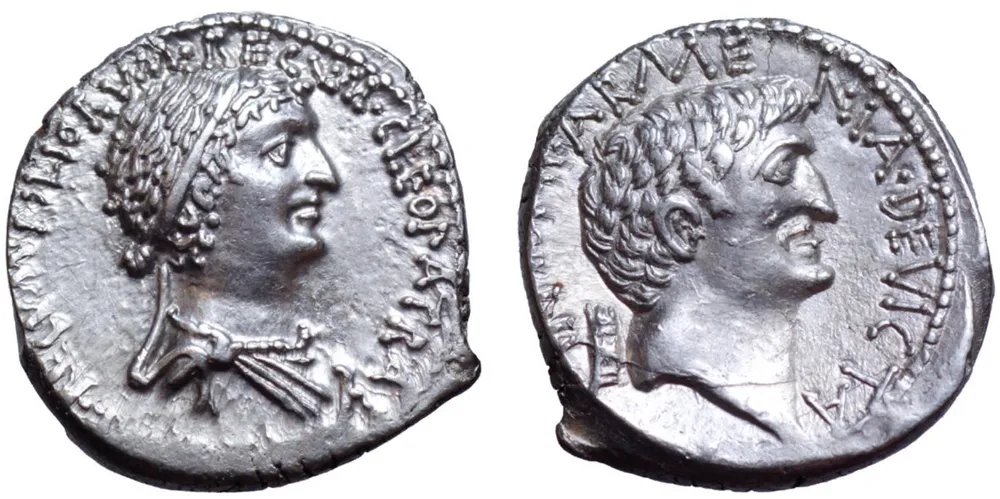
Obverse: Bust of Mark Antony, right. Dotted border.
Legend: ANTONI ARMENIA DEVICTA
Symbols: Obverse behind, Armenian tiara
Reverse: Bust of Cleopatra, right, draped and diademed; before, Proa. Dotted border.
Legend: CLEOPATRAE REGINAE REGVM FILIORVM REGVM
Comment: The Antonia gens, of plebeian origin, achieved great projection in the 1st century BC. thanks to Mark Antony, Caesar's lieutenant and later member of the Second Triumvirate. After his break with Octavian, he became a protagonist in the great final confrontation of the civil wars, closely linked to Cleopatra VII of Egypt.
After the failure of his expedition against the Parthians in 36 BC, Antony sought to regain prestige with a campaign in Armenia (34 BC). Although he was proclaimed the winner, the celebration was controversial: instead of celebrating a triumph in Rome, he did so in Alexandria, organizing a Roman-style spectacle and carrying out the famous Donations of Alexandria, by which he divided eastern territories between Cleopatra and her children. He proclaimed her “queen of kings” and linked her descendants to kingdoms not yet conquered, departing from Romen tradition and offering Octavian the perfect excuse to present him as a traitor dominated by the Egyptian queen.
The denarius minted in 32 BC. directly reflects this policy. On the obverse appears the bust of Mark Antony, accompanied by the inscription ARMENIA DEVICTA and the Armenian tiara, symbol of the subject kingdom. The reverse shows the bust of Cleopatra, exalted as “queen of kings and sons of kings.” It is the only Roman denarius that represents Cleopatra, which makes the piece an unparalleled iconographic testimony. There is also a very rare variant with the legend ARMENTA instead of ARMENIA, an error that multiplies the interest of the issue.
Antony's intention was clear: to reward his soldiers and reinforce the image of his victory in the East, linking it to the dynastic legitimacy of Cleopatra and her children. For the troops, the coin was a symbol of reward and new conquests; For his enemies in Rome, it was tangible proof that Antony had broken with republican customs.
The use of the formula ARMENIA DEVICTA imitated the triumphs celebrated in Rome, but transferred to a strange context: Alexandria, with Cleopatra as co-star. This contrast between Roman tradition and Eastern ceremonial was the perfect weapon for Octavian's propaganda, which presented him not as a political rival, but as a Roman corrupted by a foreign queen. Thus, the denarius that was supposed to celebrate Antony's power became, after his defeat, a symbol of his fall.
Its rarity and exceptionality make it one of the most famous pieces of Republican numismatics. Beyond its material value, this denarius is a unique historical document: it shows the moment when Antony crossed the line between Roman politics and Alexandrian orientalism, embodying the alliance that would precipitate his ruin and open the way to Octavian's triumph.
Provenance: Roma Numismatics (2017)
Price: 104,510 €
Other references
| Crawford: | 543/1 |
| DR: | 874 |
| BMCRR (Grueber): | Este 179, 182 |
| B (Babelon): | Antonia 95, 95 var |
| RSC (Seaby): | Marco Antonio y Cleopatra 1-1e |
| FFC (Fdez., Fdez., Calicó): | Marco Antonio y Cleopatra 1 a 6 |
| RC / RCV (D. Sear): | 1515 |
| CRI (Sear Imperators) 49 - 27 BC: | 345 |
| CRR (Sydenham): | 1210, 1210a,b |
| Cal (Calicó): | 218 a 223 |
| RBW: | 1832 |
| Other authors: | Cohen 1 |
• Read the article about catalogues of Roman Republican coinage on our blog