DR-841 | Crawford: 524/2
Quintus Atius Labienus Parthicus
Quintus Atius Labienus Parthicus
Gens: Atia
Moneyer: Quintus Atius Labienus Parthicus
Date and mint: 40 BC - ?
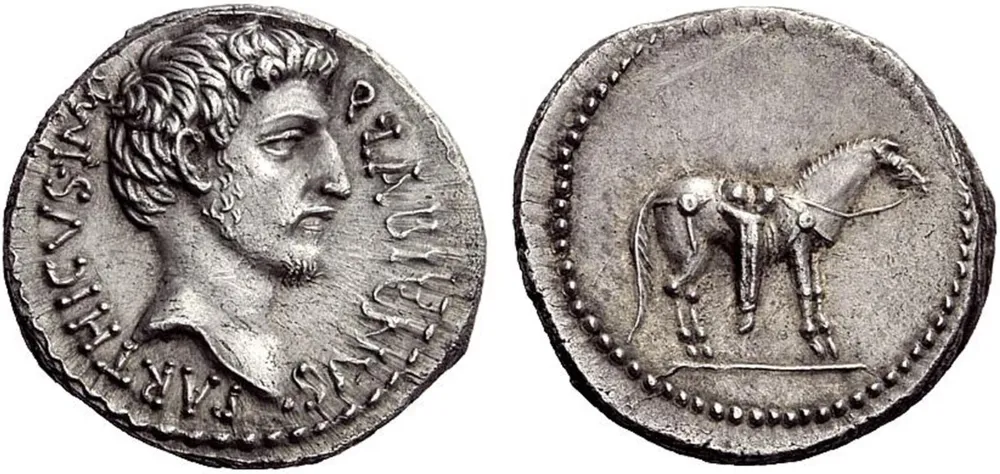
Obverse: Bust of Q. Labienus, right. Dotted border.
Legend: Q LABIENVS PARTHICVS IMP
Reverse: Parthian horse, straight, with bridle and saddle, to which the bow case and quiver are attached. Dotted border.
Legend:
Comment: The Atia gens was a plebeian family of some relevance in Republican Roma, remembered above all for its connection with Caesar's family: Atia, mother of Octavian Augustus, came from her. Within this gens is Quintus Atius Labienus Partico, son of the famous Titus Labienus, Caesar's lieutenant in the Gallic War who, after the break with the dictator, joined Pompey's side.
Quintus Labienus continued that political trajectory: after the republican defeat at Philippi (42 BC), he momentarily passed into the orbit of Mark Antony, but soon sought support from the Parthians, the great eastern power that had inflicted the defeat of Carrassus on Crassus. With the support of Prince Pacorus I and King Orodes II, Labienus proclaimed himself imperator and undertook in 40 BC. an ambitious campaign that led him to conquer Antioch, Palestine, Phenicia, Cilicia and Caria. For these victories he adopted the nickname Parthicus, an unusual title for a Roman, with which he reinforced his legitimacy as the allied military leader of the East. His career, however, was brief: in 39 B.C. He was defeated in Cilicia by Publius Ventidius Basus, Antony's lieutenant, and executed shortly afterwards.
The denarius minted then—probably in Antioch—is one of the most unique and appreciated in republican numismatics. On the obverse there is the portrait of Labienus, following the tradition inaugurated by Caesar and continued by Brutus, Octavian and Antony. With this he affirmed his rank as legitimate leader and presented himself as a direct rival of the triumvirs. The legend Q LABIENVS PARTHICVS IMP proclaimed both his title of imperator and his alliance with the Parthians. On the reverse appears a Parthian horse with bridle and saddle, along with the bow case and quiver, emblems of the famous Parthian chivalry that sustained their power.
This broadcast perfectly encapsulates the paradox of Labienus: a renegade Roman who, relying on a foreign army, attempted to challenge the triumvirate. Its failure sealed the fate of the last Pompeians and reinforced Mark Antony's supremacy in the East. Even so, his denarius has remained a testimony to one of the most audacious and disconcerting episodes of the agony of the Republic.
Provenance: Numismatica Ars Classica (2011)
Price: 154,048 €
Other references
| Crawford: | 524/2 |
| DR: | 841 |
| BMCRR (Grueber): | Este 132 |
| B (Babelon): | Atia 3 |
| RSC (Seaby): | Labieno 2 |
| FFC (Fdez., Fdez., Calicó): | Labieno 1 |
| RC / RCV (D. Sear): | 1458 |
| CRI (Sear Imperators) 49 - 27 BC: | 341 |
| CRR (Sydenham): | 1357 |
| Cal (Calicó): | 241 |
| RBW: | 1809 |
| Other authors: | Cohen 2 |
• Read the article about catalogues of Roman Republican coinage on our blog