DR-808 | Crawford: 511/2b
Sextus Pompeius
Sextus Pompeius
Gens: Pompeia
Moneyer: Sextus Pompeius
Date and mint: 42 BC/40 BC - ?
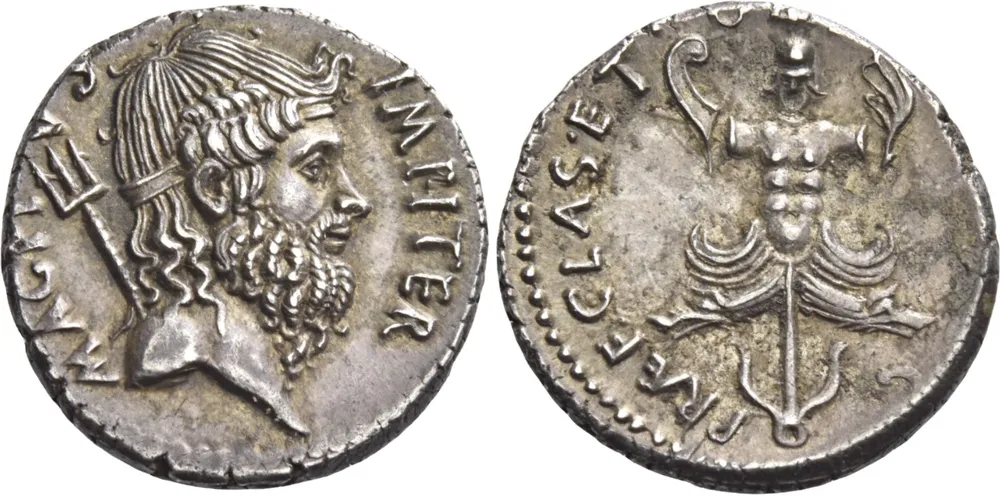
Obverse: Head of Neptune, right, hair tied up with a band, with trident on the shoulder. Dotted border.
Legend: MAG PIVS IMP ITER.
Reverse: Trophy with trident above and anchor below, bow to the left and aplustre to the right, two heads of Scylla at the base. Dotted border.
Legend: PRAEF CLAS ET ORAE MARIT EX S C oPRAEF CLAS ET ORAE MARI TEX S C
Comment: The Pompeia gens reached its greatest splendor in the 1st century BC. thanks to Gnaeus Pompey the Great, one of the most influential generals of the Republic. His youngest son, Sextus Pompey, became the last great leader of the Pompeian cause, presenting himself as his father's heir and as guarantor of the republican tradition against the power of the Second Triumvirate.
This denarius is one of the most representative pieces of their propaganda. On the obverse Neptune appears with the trident on his shoulder, an unequivocal symbol of naval dominance and a direct allusion to the power that Sextus had inherited from Pompey the Great. The reverse shows a naval trophy, composed of a trident, anchor, prow, aplustre and the figures of Scylla at the base, an iconographic display that proclaims maritime supremacy and the victories achieved over their enemies. The legend PRAEF CLAS ET ORAE MARIT EX S C recovers the title granted to his father by the Senate, “prefect of the fleet and maritime coasts”, which Sextus adopted as an element of legitimation.
At the time of its broadcast, Sextus Pompey had consolidated his position in Sicily, from where he dominated the western Mediterranean routes and could block the supply of wheat to Rome. This ability to pressure forced Octavian and Antony to negotiate the Pact of Misenum in 39 BC, which officially recognized their control over Sicily, Sardinia and Corsica in exchange for guaranteeing supplies to Italy.
Thus, rather than commemorating a specific victory, this denarius should be understood as a piece of political and military propaganda. It projects Sextus Pompey as the legitimate heir of the Pompeian cause, absolute lord of the seas and essential actor in the fragile balance of power that marked the last years of the Republic.
Provenance: Numismatica Ars Classica (2020)
Price: 15,755 €
Other references
| Crawford: | 511/2b |
| DR: | 808 |
| BMCRR (Grueber): | Sicilia 16, 15 |
| B (Babelon): | Pompeia 21 |
| RSC (Seaby): | Sexto Pompeyo 1, 1a |
| FFC (Fdez., Fdez., Calicó): | Sexto Pompeyo 1, 2 |
| RC / RCV (D. Sear): | 1391 |
| CRI (Sear Imperators) 49 - 27 BC: | 333 |
| CRR (Sydenham): | 1347 |
| Cal (Calicó): | 1169a, 1170 |
| RBW: | |
| Other authors: | Cohen 1 |
• Read the article about catalogues of Roman Republican coinage on our blog