DR-802 | Crawford: 508/3
Marcus Iunius Brutus / Lucius Plaetorius Cestianus
Marcus Iunius Brutus / Lucius Plaetorius Cestianus
Gens: Junia / Plaetoria
Moneyer: Marcus Iunius Brutus / Lucius Plaetorius Cestianus
Date and mint: 43 BC/42 BC - ?
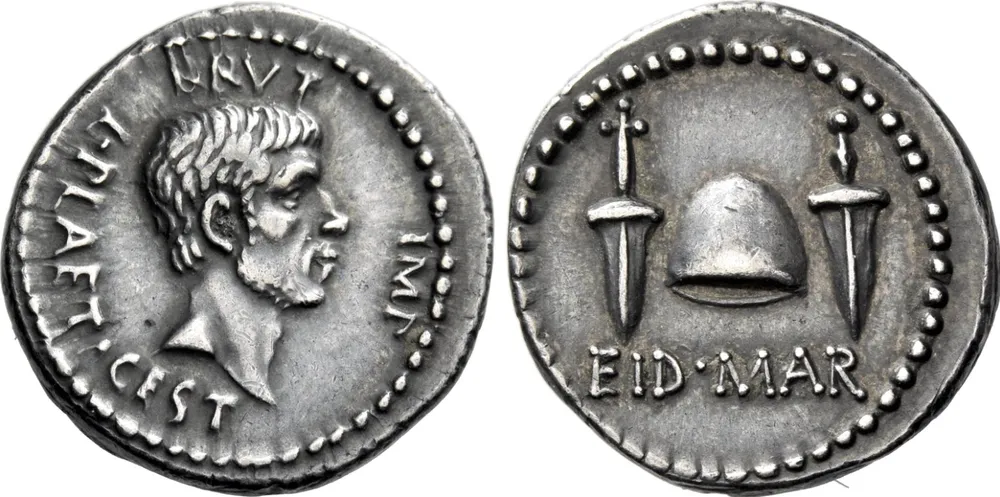
Obverse: Bust of L. Junius Brutus, right, with beard. Dotted border.
Legend: BRVT IMP L PLAET CEST
Reverse: Pileus between two daggers. Dotted border.
Legend: EID MAR
Comment: The EID MAR denarius of Marcus Junius Brutus is one of the most famous coins of Antiquity and perhaps the most symbolic of the Roman Republic. It was minted in 43-42 BC, shortly before the Battle of Philippi, when Brutus and Cassius were facing the Second Triumvirate in Greece. It was a campaign broadcast, produced by a traveling mint at the service of the army, with which Brutus paid his soldiers and, at the same time, spread an unequivocal political message.
The coin openly commemorates the assassination of Julius Caesar on March 15, 44 BC, the Ides of March. On the obverse appears the portrait of Brutus with the legend BRVT IMP, which breaks with the republican tradition of not representing living people. Caesar had inaugurated this practice during his lifetime and Brutus, despite proclaiming that he had eliminated a tyrant, repeated the formula to legitimize himself as imperator and as leader of the republican cause. Behind the head appears the abbreviation L·PLAET·CEST, in reference to the moneyer magistrate Lucio Plaetorio Cestiano.
The reverse is one of the most direct and powerful designs in all of Roman numismatics: a pileus, the cap of freedom given to manumitted slaves, flanked by two daggers with the inscription EID·MAR. The message is transparent: Caesar's death was a violent but necessary act to free Roma from tyranny. The two daggers are interpreted as an allusion to Brutus and Cassius, the leaders of the conspiracy, while the pileus turns its action into a symbol of freedom. This is the only case on Roman coinage in which a specific date appears, proof of the undisguised propaganda intention.
The context of the broadcast is crucial. After Pharsalia and Thapsus, the Pompeians had been defeated, but in the East Brutus and Cassius managed to gather a large army. The denarius served to pay those troops and remind them why they were fighting: for the freedom of the Republic. The circulation of these coins was also an open challenge to the power of Antony and Octavian, who claimed the memory of Caesar as divus.
Archaeological finds point above all to Macedonia and Thrace, where Brutus set up his headquarters, although some specimens have appeared as far away as France or Britain, proof that they circulated for decades. Today there are around a hundred denarii and only three examples in gold. The latter are unique treasures: one is kept in the British Museum, another in the Bundesbank in Germany and the third was auctioned in 2020 for more than four million dollars before being returned to Greece for being looted.
The current value of Brutus' denarii reflects their importance: pieces in average conservation exceed 200,000 euros and the best preserved reach record prices, such as the almost one million euros of the coin in this token. The aureus, due to its extreme rarity, occupies a separate place as the most coveted Roman coin.
In modern historiography the EID MAR is seen as the political manifesto of the Caesaricides: a portable poster that proudly proclaimed the death of Caesar. At the same time, it contains an obvious paradox: Brutus justified his action as defense of the Republic, but he did not hesitate to place his own face on the coins, imitating the gesture of the one he called a tyrant. After the defeat at Philippi, many of these pieces were removed and melted down by the winning side, which explains their extreme rarity.
Today the EID MAR is much more than a currency. It is the material symbol of a decisive moment: the end of the Republic and the beginning of the path towards the Empire. It represents the tension between freedom and personal power, and reminds us that in Rome even coins could become weapons in the fight for control of the State.
Provenance: Numismatica Ars Classica (2024)
Price: 973,225 €
Other references
| Crawford: | 508/3 |
| DR: | 802 |
| BMCRR (Grueber): | Este 68 |
| B (Babelon): | Junia 52 Plaetoria 13 |
| RSC (Seaby): | Bruto 15 |
| FFC (Fdez., Fdez., Calicó): | Bruto 10 |
| RC / RCV (D. Sear): | 1439 |
| CRI (Sear Imperators) 49 - 27 BC: | 216 |
| CRR (Sydenham): | 1301 |
| Cal (Calicó): | 881 |
| RBW: | |
| Other authors: | Cohen 15 |
• Read the article about catalogues of Roman Republican coinage on our blog