DR-746 | Crawford: 490/1
Gaius Octavius
Gaius Octavius
Gens: Julia
Moneyer: Gaius Octavius
Date and mint: 43 BC - ?
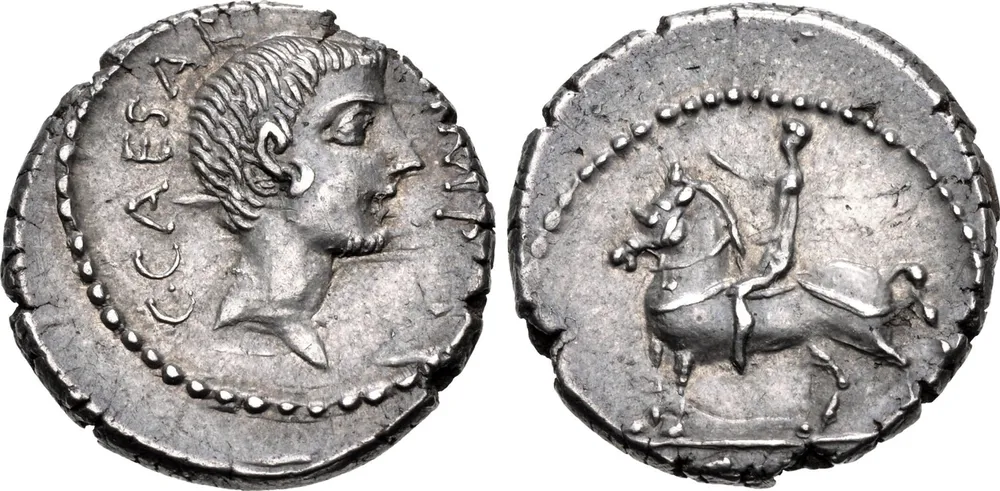
Obverse: Bust of Octavian, right, with beard. Dotted border.
Legend: C CAESAR IMP
Reverse: Equestrian statue, left, with right hand raised. Dotted border.
Legend: S C
Comment: The gens Julia was one of the oldest and most influential patrician families in Rome, claiming descent from Aeneas and the goddess Venus. Its most famous member was Julius Caesar, whose political, religious and military inheritance passed, after his assassination in 44 BC, to his adopted son and great-nephew, Gaius Octavius, later known as Augustus.
Octavian was only 19 years old when he returned from Apollonia (Epirus), where he was studying, to claim his uncle's inheritance. He immediately adopted the name Gaius Julius Caesar Octavian and presented himself as his legitimate successor. In 43 BC, in a climate of intense disputes with Mark Antony, the Senate and the people officially recognized him as heir, even being elected consul at an extraordinarily young age.
In this context of propaganda and legitimation, the denarius was minted. On the obverse appears the bearded bust of Octavian, within the possibilities of a 19-year-old young man. The beard was not a sign of maturity, but of mourning for Caesar, reinforcing the idea of dynastic continuity. The legend CAESAR IMP proclaimed his status as the new Caesar and imperator, a title that evoked military command even though he had not yet demonstrated experience on the battlefield: it was an inherited legitimacy.
The equestrian statue of Octavian is depicted on the reverse, erected in Rome by decision of the Senate in 43 BC. as a tribute to his services and as official recognition of his role as Caesar's heir. This honor was exceptional for someone so young and, on the coin, is reinforced by the initials S C (senatus consulto), which indicated the formal approval of the Senate. Thus, the broadcast emphasized that Octavian was not acting only as a military leader, but as a figure endorsed by the institutions of the Republic.
This denarius therefore reflects the moment when Octavian was beginning to forge his public image: a legitimate heir, anointed by both Caesar's memory and senatorial backing, who was preparing to become the new arbiter of Roman politics.
Provenance: Classical Numismatic group (2021)
Price: 2,455 €
Other references
| Crawford: | 490/1 |
| DR: | 746 |
| BMCRR (Grueber): | Galia 81 |
| B (Babelon): | Julia 63 |
| RSC (Seaby): | Octavio 246 |
| FFC (Fdez., Fdez., Calicó): | Octavio 170 |
| RC / RCV (D. Sear): | 1534 |
| CRI (Sear Imperators) 49 - 27 BC: | 131 |
| CRR (Sydenham): | 1318 |
| Cal (Calicó): | 655 |
| RBW: | |
| Other authors: | Cohen 246 |
• Read the article about catalogues of Roman Republican coinage on our blog