DR-733 | Crawford: 483/2
Sextus Pompeius / Quintus Nasidius
Sextus Pompeius / Quintus Nasidius
Gens: Nasidia / Pompeia
Moneyer: Sextus Pompeius / Quintus Nasidius
Date and mint: 44 BC/43 BC - ?
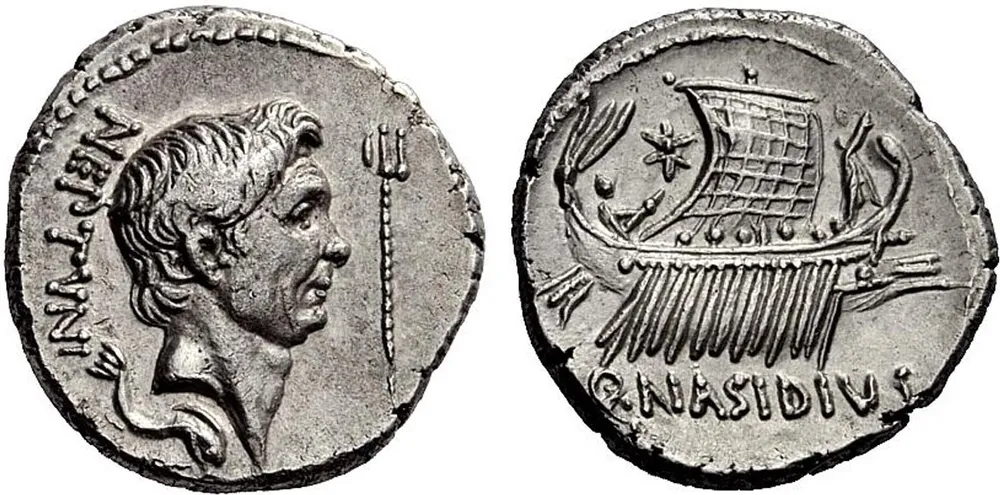
Obverse: Bust of Pompey the Great, right; before, Trident; Down, Dolphin. Dotted border.
Legend: NEPTVNI
Reverse: Galley sailing to the right; up, star. Dotted border.
Legend: Q NASIDIVS oQ NASIDIV
Comment: The Nasidia gens is a family barely known in the history of Roma, remembered mainly thanks to the figure of Quintus Nasidius, a Pompeian admiral and responsible for this coinage. The gens Pompeia, on the other hand, achieved great notoriety with Gnaeus Pompey the Great, one of the most influential generals of the Republic. After his death, the Pompeian cause was continued by his youngest son, Sextus Pompey, who became the last great republican leader.
Sextus Pompey, heir to his paternal prestige, emerged in the western Mediterranean after the Pompeian defeat in Africa (46 BC). He gathered a powerful fleet and consolidated his maritime dominance, presenting himself as guarantor of the republican tradition before Caesar and later before Octavian. In this context of propaganda and legitimation is the joint broadcast with Q. Nasidius, one of its most loyal naval commanders.
The obverse shows the bust of Pompey the Great accompanied by a trident and a dolphin, with the legend NEPTVNI. The reference to Neptune elevates the general to an almost mythological level, linking Sextus Pompey with a sacred and heroic lineage under the protection of the sea god. The reverse represents a galley, a direct symbol of the naval power that supported the authority of Sextus, with a star that can be interpreted as divine guidance and hope for victory. The inscription honors Q. Nasidius, thus cementing the alliance between Pompey's heir and his admiral.
Nasidius himself had an outstanding career: he received command of a fleet from Pompey to liberate Massalia, but was defeated by Caesar's troops and took refuge in Africa before moving on to Hispania. He later abandoned the Pompeian side and joined Mark Antony, who appointed him chief of his fleet. He was finally defeated by Agrippa at Patras, shortly before the decisive battle of Actium (31 BC).
This denarius is, therefore, a testimony of Pompeian propaganda in its final phase: it exalted the memory of Pompey the Great deified as Neptune, legitimized Sextus as his natural heir at sea and, at the same time, recognized the fidelity of Nasidius as a key piece of the republican resistance.
Provenance: Numismatica Ars Classica (2011)
Price: 25,945 €
Other references
| Crawford: | 483/2 |
| DR: | 733 |
| BMCRR (Grueber): | Sicilia 21 |
| B (Babelon): | Nassidia 1, 2 Pompeia 28, 29 |
| RSC (Seaby): | Pompeyo Magno 20, 20a |
| FFC (Fdez., Fdez., Calicó): | Pompeyo Magno 29, 30 |
| RC / RCV (D. Sear): | 1390 |
| CRI (Sear Imperators) 49 - 27 BC: | 235 |
| CRR (Sydenham): | 1350 |
| Cal (Calicó): | 1044, 1045 |
| RBW: | 1698 |
| Other authors: | Cohen 20 |
• Read the article about catalogues of Roman Republican coinage on our blog