DR-706 | Crawford: 480/2a
Marcus Mettius
Marcus Mettius
Gens: Mettia
Moneyer: Marcus Mettius
Date and mint: 44 BC - Rome
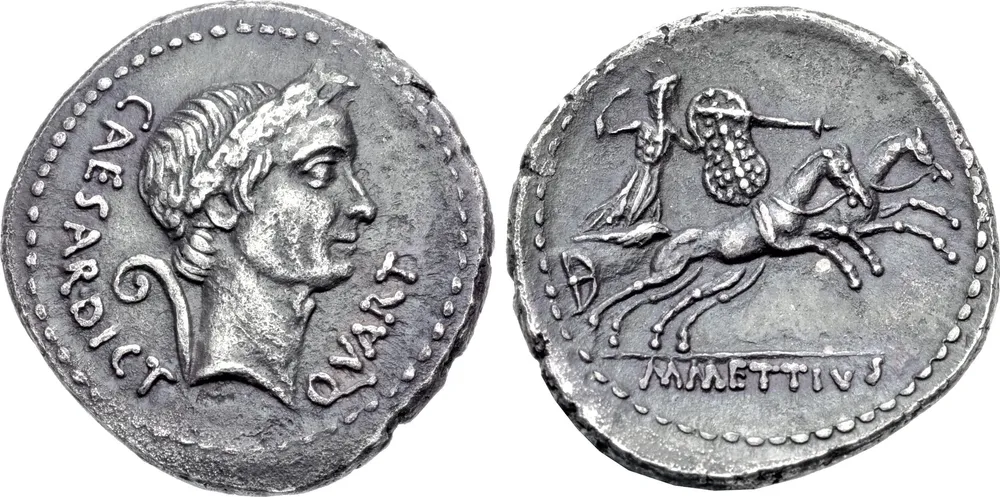
Obverse: Bust of crowned Caesar, right. Dotted border.
Legend: CAESAR DICT QVART
Symbols: Obverse behind, Lituus curved to the left
Reverse: Juno Sospita in biga, right, holding reins and Shield in left and Lance in right. Dotted border.
Legend: M METTIVS (in Exergo)
Comment: The Mettia gens was a plebeian family known, almost exclusively, for the coins minted by Marco Mettio. This coin, a faithful supporter of Julius Caesar, went down in posterity for being responsible for one of the most significant issues of the end of the Republic: the first to represent the portrait of a living Roman on the obverse.
The broadcast corresponds to the first months of 44 BC, when Caesar, after his definitive victory over the Pompeians, returned to Rome and was named dictator for the fourth time, shortly before receiving the title of perpetual dictator. It was a decisive moment, in which the currency became a powerful propaganda instrument.
On the obverse appears the laureate bust of Caesar looking to the right, an image loaded with symbolism: the laurel wreath exalted his military glory and his character as supreme victor, but at the same time evoked the iconography of the Hellenistic kings, with an almost monarchical nuance that broke with the republican tradition. Behind the head we can see the augural lituo, which alludes to his status as Pontifex Maximus, underlining the concentration in his person of the highest political, military and religious powers. The legend CAESAR DICT QVART confirms his position at that precise moment.
The reverse represents Juno Sospita, a warrior goddess linked to Lanuvium, driving a biga to the right and armed with a spear and shield. The image evoked both divine protection over Roma and the warrior virtues that supported it. The inscription M METTIVS appears on the exergue, identifying the moneyer unit.
In this way, Marco Mettio left testimony to a transcendental change in Romen history: the transition from a republican tradition without portraits of living people to the open representation of Caesar as a central figure of power, at a time when the Republic was already on the verge of its transformation into an Empire.
Provenance: Classical Numismatic group (2012)
Price: 42,135 €
Other references
| Crawford: | 480/2a |
| DR: | 706 |
| BMCRR (Grueber): | Roma 4135 |
| B (Babelon): | Julia 31 Mettia 3 |
| RSC (Seaby): | Julio Cesar 36 |
| FFC (Fdez., Fdez., Calicó): | Julio Cesar 27 |
| RC / RCV (D. Sear): | 1406 |
| CRI (Sear Imperators) 49 - 27 BC: | 98 |
| CRR (Sydenham): | 1057 |
| Cal (Calicó): | 1006 |
| RBW: | |
| Other authors: | Cohen 36 |
• Read the article about catalogues of Roman Republican coinage on our blog