DR-682 | Crawford: 470/1c
Marcus Minatius Sabinus / Gnaeus Pompeius filius
Marcus Minatius Sabinus / Cneo Pompeius filius
Gens: Minatia / Pompeia
Moneyer: Marcus Minatius Sabinus / Gnaeus Pompeius filius
Date and mint: 46 BC/45 BC - ?
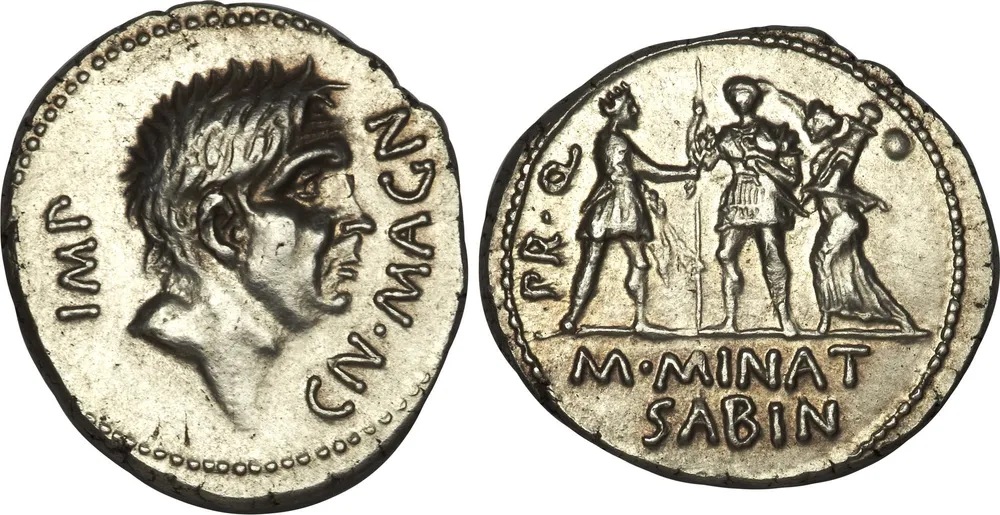
Obverse: Bust of Pompey the Great, right. Dotted border.
Legend: CN MAGNVS IMP (o variación)
Reverse: Spanish city standing on the right, with a turreted crown, holding a caduceus in the left hand and with the right offering a branch to the Pompeian soldier who is in front, leaning on a spear with his right hand; On the right, another Spanish city, walking to the left, wearing a turret-shaped crown, holding the trophy in the left hand over the left shoulder and with the right hand crowning the soldier. Dotted border.
Legend: M MINAT / SABIN PR Q
Comment: The gens Minatia is one of the little-known Roman families, barely documented in history and practically linked to the figure of Marcus Minatio Sabinus, the magistrate responsible for this issue. The gens Pompeia, on the other hand, achieved great notoriety thanks to Gnaeus Pompey the Great, one of the undisputed protagonists of politics and war in the 1st century BC. His lineage and prestige were inherited by his sons, Gnaeus and Sextus Pompey, who continued the fight against Caesar after their father's death.
The denarius was minted in Hispania after the Pompeian defeat at Thapso (46 BC). The remnants of the army, along with veterans of other campaigns and local troops, regrouped under the command of Gnaeus and Sextus Pompey around bases such as Corduba. From there they reorganized the resistance and managed to concentrate a very large army that faced Caesar in the decisive battle of Munda (March 17, 45 BC), the last major clash of the civil war, where the Pompeian side was finally annihilated.
The coin has a clear propaganda intention. On the obverse appears the portrait of Pompey the Great, reminding the troops of the figure of his father and thus legitimizing the leadership of his son Gnaeus Pompey the Younger.
Reverse (variant without kneeling figure): The scene presents two standing Hispanic personifications, both with a mural crown. One gives a palm or shakes the hand of the Pompeian soldier (depending on subtype), while the other girds him with a laurel wreath and holds a trophy (tropaion). The absence of the gesture of submission (the knee on the ground of the other subtype) shifts the message from “surrender” to “adhesion and recognition of command”: the urban/provincial communities hail and formalize the transfer of command to Gnaeus within the framework of the Hispanic revolt of 46 BC. This reading—documented for subtypes RRC 470/1c (palm and coronation) and RRC 470/1d (shaking hands)—fits with the academic interpretation of the series as a visual commentary on the transfer of leadership of the revolt in Hispania Ulterior to Gnaeus Pompey, rather than as a representation of specific cities.
Academia.edu
warwick.ac.uk
In this way, the denarius links the memory of the father with the action of his children, vindicating the political and military heritage of Pompey in the Hispanic scenario that preceded the final outcome of the civil war.
Provenance: Heritage Auctions (2011)
Price: 39,190 €
Other references
| Crawford: | 470/1c |
| DR: | 682 |
| BMCRR (Grueber): | Hispania 83, 82 p. 367 nt. |
| B (Babelon): | Minatia 5 Pompeia 14 |
| RSC (Seaby): | Pompeyo Magno 11-11c |
| FFC (Fdez., Fdez., Calicó): | Pompeyo Magno 14 a 17 |
| RC / RCV (D. Sear): | |
| CRI (Sear Imperators) 49 - 27 BC: | 50 |
| CRR (Sydenham): | 1038, 1038a-c |
| Cal (Calicó): | 1017 a 1020 |
| RBW: | 1644 |
| Other authors: | Cohen 11 |
• Read the article about catalogues of Roman Republican coinage on our blog