DR-644 | Crawford: 458/1
Gaius Iulius Caesar
Gaius Iulius Caesar
Gens: Julia
Moneyer: Gaius Iulius Caesar
Date and mint: 47 BC/46 BC - ?
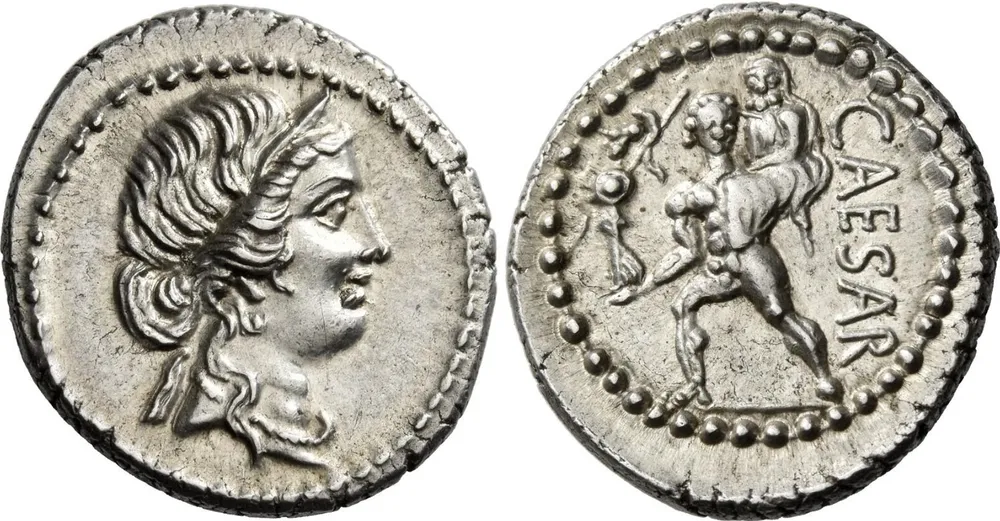
Obverse: Bust of Venus, right, diadem. Dotted border.
Legend:
Reverse: Aeneas, left, carrying palladium in his right hand and Anchises on his left shoulder. Dotted border.
Legend: CAESAR
Comment: The gens Julia was one of the oldest and most prestigious patrician families in Rome. Their lineage was traced, according to tradition, to the Trojan hero Aeneas, son of Venus and Anchises, allowing the Julius to claim direct descent from the goddess of love. This mythical genealogy gave the family an aura of divine legitimacy and placed it among the most respected houses in the Republic.
The currency was Julius Caesar himself, who minted this coin in Africa between 47 and 46 BC, during his campaign against the Pompeians after the victory at Pharsalia. This was Caesar's third issuance of denarii, intended to fund his troops at a key moment in the civil war. After putting down Egypt and defeating Pharnaces of Pontus at Zela—where he uttered his famous veni, vidi, vici—Caesar marched to Africa, where the Pompeians had reorganized their forces. The campaign culminated in the decisive Battle of Thapsus (46 BC), which assured his control over the western Mediterranean and Roma itself.
On the obverse appears the diademed bust of Venus, protective goddess of Caesar and mythical mother of the Julius, a symbol of legitimacy and divine favor. On the reverse, Aeneas is depicted carrying his father Anchises and carrying the Palladium, the sacred image of Troy, directly evoking the founding myth of the Julia gens. The message was unmistakable: Caesar was not just a victorious military leader, but the heir to an epic destiny and founder.
The African echo further reinforced this iconography. According to tradition, in his escape from Troy, Aeneas ended up in Carthage, where he joined Queen Dido, a mythical episode that inaugurated the rivalry between Roma and Africa. By choosing this scene for a broadcast carried out in Africa, Caesar presented himself as the continuator of that epic: the Trojan hero who returned to conquer the lands of Carthage, now embodied in his Pompeian enemies.
Thus, this denarius combines military propaganda, mythical memory and divine legitimation, presenting Caesar as the undefeated general and, at the same time, as the descendant of the founders of Roma called to protect and guide the city in a new stage of its history.
Provenance: Numismatica Ars Classica (2022)
Price: 5,367 €
Other references
| Crawford: | 458/1 |
| DR: | 644 |
| BMCRR (Grueber): | Este 31 |
| B (Babelon): | Julia 10 |
| RSC (Seaby): | Julio Cesar 12 |
| FFC (Fdez., Fdez., Calicó): | Julio Cesar 10 |
| RC / RCV (D. Sear): | 1402 |
| CRI (Sear Imperators) 49 - 27 BC: | 55 |
| CRR (Sydenham): | 1013 |
| Cal (Calicó): | 644 |
| RBW: | 1600 |
| Other authors: | Cohen 12 |
• Read the article about catalogues of Roman Republican coinage on our blog