DR-568 | Crawford: 427/2
Caius Memmius
Caius Memmius
Gens: Memmia
Moneyer: Caius Memmius
Date and mint: 56 BC - Rome
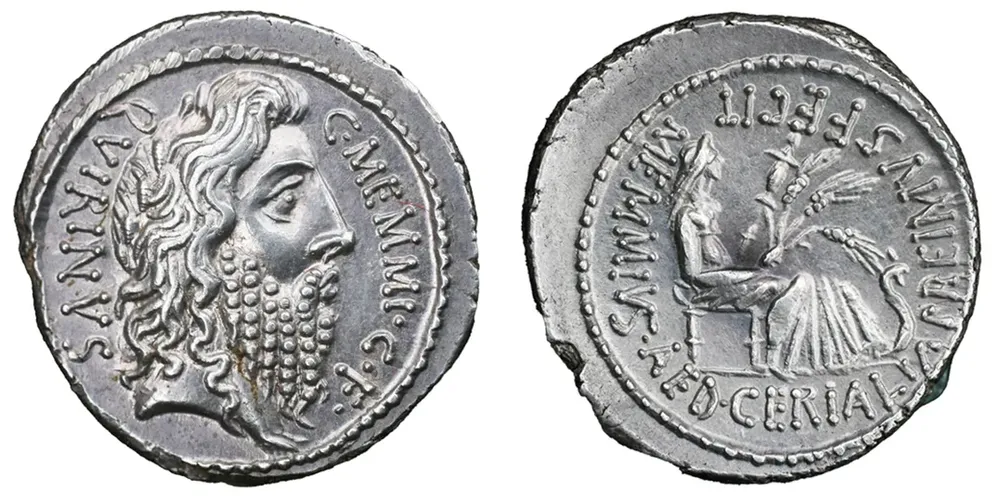
Obverse: Laureate bust of Quirinus, right. Dotted border.
Legend: QVIRINVS C MEMMI C F
Reverse: Ceres sitting right, holding Torch on left and Ear of wheat on right; before, snake. Dotted border.
Legend: MEMMIVS AED CERIALIA PREIMVS FECIT
Comment: The Memmia gens was a Roman plebeian family with a modest reputation in republican politics. One of its best-known members was Gaius Memmius, tribune of the plebs in 66 BC. and later aedile. The Memmios took advantage of their political career to stand out, especially through festivities and public shows, like the Cerialia, which allowed them to gain some popular favor. Although it was not a dominant family in Republican history, some of its members made an impact through their contributions to public life.
Gaius Memmius, son of Gaius Memmius (C. Memmius C. F.), was responsible for the issuance of this denarius in the year 56 BC. The legend on the reverse indicates that one of his ancestors was the first aedile to organize the Cerialia, a festival dedicated to the goddess Ceres. Although legend suggests that this ancestor of C. Memmio was the founder of the games, it is believed that what he actually did was add ludi scaenici (theatrical performances) to the already existing games. This suggests that, although he embellished the story, Gaius Memmius was not guilty of complete fabrication, but of political embellishment to elevate the glory of his family.
In 56 BC, Roma was a hotbed of political tension. The First Triumvirate, composed of Julius Caesar, Pompey and Crassus, reaffirmed their alliance at the Conference of Luca, while struggles for control of the magistracies and the loyalty of the people intensified. Public spectacles, such as the Cerialia, were a key tool for magistrates seeking to consolidate their power and popular influence in a politically unstable Roma.
On the obverse, the bearded head of Quirinus, a Sabine warrior deity who was assimilated by the early Romans, appears decorated, highlighting his importance. Quirinus was later identified as the deified form of Romulus, the founder of Roma. The name Quirinus comes from the Sabine word quires ("spear") or from the city of Cures. Its inclusion on this coin underscores Roma's connection to its warrior origins and divine foundation.
On the reverse, Ceres, goddess of agriculture, appears seated holding a torch and an ear of wheat, symbols of fertility and prosperity. The snake that appears next to him is a symbol of regeneration and protection. The legend on the reverse celebrates the relationship of the Memmia gens with the Cerialia, a festival in honor of Ceres, which was celebrated each year from April 12 to 18. This festival included three main types of games: the ludi Cerialis (women's races with torches), the ludi circenses (horse races and other events in the circus), and the ludi scaenici (theatrical performances), which, according to legend, were added by an ancestor of C. Memmio.
Provenance: Numismatica Ars Classica (2024)
Price: 11,000 €
Other references
| Crawford: | 427/2 |
| DR: | 568 |
| BMCRR (Grueber): | Roma 3940 |
| B (Babelon): | Memmia 9 |
| RSC (Seaby): | Memmia 9, 9a, 9b |
| FFC (Fdez., Fdez., Calicó): | 916 a 919 |
| RC / RCV (D. Sear): | 388 |
| CRI (Sear Imperators) 49 - 27 BC: | |
| CRR (Sydenham): | 921 |
| Cal (Calicó): | 988, 989, 989a, 990 |
| RBW: | 1532 |
| Other authors: |
• Read the article about catalogues of Roman Republican coinage on our blog