DR-510 | Crawford: 409/1
Marcus Plaetorius Cestianus
Marcus Plaetorius Cestianus
Gens: Plaetoria
Moneyer: Marcus Plaetorius Cestianus
Date and mint: 67 BC - Rome
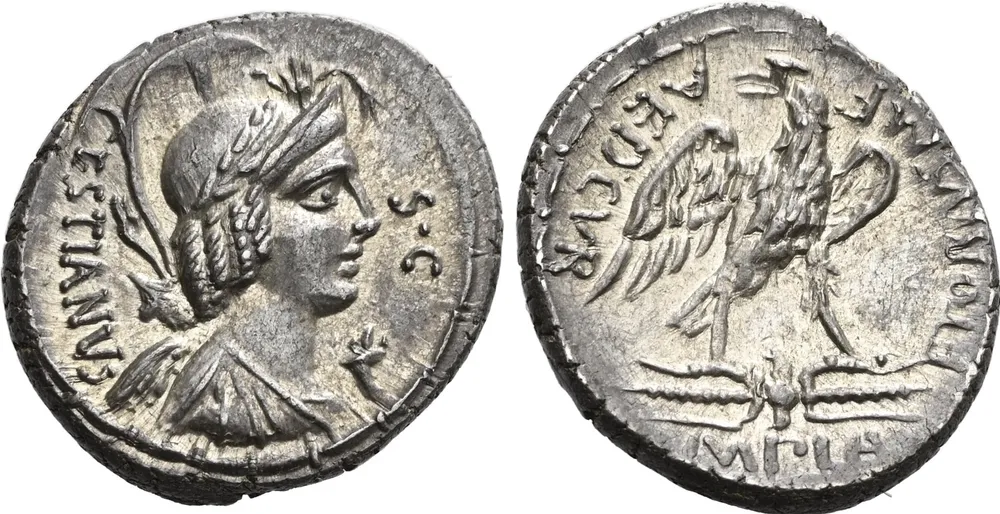
Obverse: Bust, right, draped and with attributes of Isis, Minerva, Apollo, Diana and Victoria. Bead and spool border.
Legend: CESTIANVS S C
Symbols: Obverse before, Cornucopia
Reverse: Eagle on lightning. Contour of beads and spools.
Legend: M PLAETORIVS M F AED CVR
Comment: The gens Plaetoria was a relatively unprominent Roman plebeian family, although some of its members held positions of some importance in the Republic. M. Plaetorius Cestianus was one of its most notable members as a moneyer. There is not much information about Cestianus's political life outside of his work in minting coins, but his activity as a coiner indicates that he had an important role in the public affairs of Roma.
M. Plaetorius Cestianus minted this denarius in 67 BC, a period in which Roma faced great challenges, mainly the threat of Cilician pirates, who attacked the trade routes and coasts of the Mediterranean, disrupting trade in grain and other essential supplies. This context led the Senate to grant Gnaeus Pompey extraordinary powers to combat this threat, and these events were a crucial part of the political scenario of the time.
On the obverse of the coin appears the figure of Ceres, the Roman goddess of agriculture, grain and fertility, represented with a crown of ears. The choice of Ceres on this denarius underscores the importance of agriculture and the security of food supplies, especially at a time when pirates threatened trade routes bringing grain to Rome.
The reverse depicts an eagle perched on a lightning bolt, one of the most powerful symbols of Jupiter, the king of the gods. The eagle and lightning bolt symbolize both the supreme power of Roma and its ability to exert divine strength and justice. This emblem is a clear expression of Roma's military dominance and the invocation of its strength in times of crisis, such as the fight against pirates.
This denarius may reflect Roma's concern for restoring order and security in the Mediterranean, and the choice of Ceres and Jupiter as central figures highlights both the importance of economic stability (food and trade) and the military strength necessary to protect the Republic in difficult times.
_
The goddess Vaccine is of Sabine origin. She combined the attributes of several goddesses such as Ceres, Minerva, Diana, Victoria and Venus, and became highly revered.
Provenance: Numismatica Ars Classica (2024)
Price: 1,115 €
Other references
| Crawford: | 409/1 |
| DR: | 510 |
| BMCRR (Grueber): | Roma 3596 |
| B (Babelon): | Plaetoria 4 |
| RSC (Seaby): | Plaetoria 4 |
| FFC (Fdez., Fdez., Calicó): | 969 a 971 |
| RC / RCV (D. Sear): | 349 |
| CRI (Sear Imperators) 49 - 27 BC: | |
| CRR (Sydenham): | 809 |
| Cal (Calicó): | 1106 |
| RBW: | 1482 |
| Other authors: |
• Read the article about catalogues of Roman Republican coinage on our blog