DR-416 | Crawford: 363/1a
Lucius Marcius Censorinus
Lucius Marcius Censorinus
Gens: Marcia
Moneyer: Lucius Marcius Censorinus
Date and mint: 82 BC - Rome
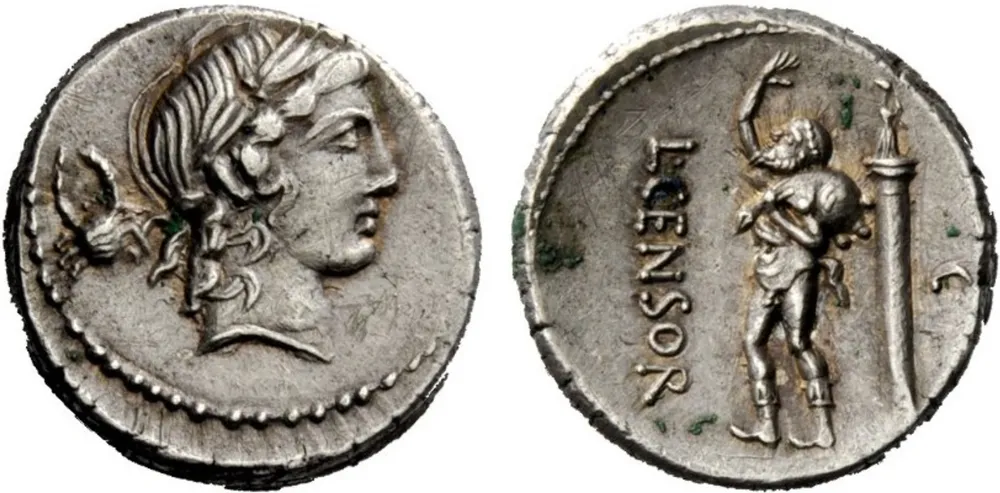
Obverse: Marsyas, bald, walking to the left, with his right arm raised and holding a wineskin over his left shoulder; behind, column with the statue of Victoria. Dotted border.
Legend:
Reverse: Marsyas, bald, walking to the left, with his right arm raised and holding a wineskin over his left shoulder; behind, column with the statue of Victoria. Dotted border.
Legend: L CENSoVI | L.CENSOR
Comment: The Marcia gens was one of the oldest and most prestigious families in Rome. Of patrician origin, she considered herself a descendant of Anco Marcius, fourth king of Roma, which linked her directly to the origins of the city. During the Republic, several Marcii held consulships and censorship, consolidating a long-standing political tradition. The branch of the Censorini, to which this currency belongs, stood out precisely for having given several censors to the city.
The moneyer man Lucio Marcio Censorino minted his denarii in the year 82 BC, one of the most turbulent times of the Republic. That year Sulla returned to Italy after the war against Mithridates and defeated the Marianists, entering Roma as dictator and beginning the bloody proscriptions. The moneyer issues of this period are loaded with symbolic messages and family affirmation.
The obverse and reverse present the same image: the satyr Marsyas, bald and naked, walking to the left, with his right arm raised in an expressive gesture and a wineskin resting on his shoulder. Behind it rises a column crowned by a statue of Victoria. The legend L CENSOR identifies the magistrate.
The choice of Marsyas as the absolute protagonist is very striking. According to mythology, Marsyas challenged Apollo in a musical contest and was brutally punished for his daring. However, in Rome he was also considered a symbol of freedom of speech and popular expression: his statue was in the Forum and was associated with frankness (libertas). By placing this figure on his coin, Censorino seems to vindicate that tradition linked to the people and freedom, while the column with Victoria adds a nuance of triumph and civic glory.
The message of this coin is clear and unique in republican numismatics: the family memory of the Marcii, with its long political tradition, is linked to the figure of Marsyas, emblem of the popular voice and freedom, under the gaze of Victoria. A bold combination that fit a year of deep political tensions and power struggles, where the freedom of the people and the legitimacy of victory were at stake.
Provenance: Numismatica Ars Classica (2016)
Price: 1,265 €
Other references
| Crawford: | 363/1a |
| DR: | 416 |
| BMCRR (Grueber): | Roma 2661 a 2663 |
| B (Babelon): | Marcia 24 |
| RSC (Seaby): | Marcia 24b, 24c |
| FFC (Fdez., Fdez., Calicó): | 890, 891 |
| RC / RCV (D. Sear): | 281 |
| CRI (Sear Imperators) 49 - 27 BC: | |
| CRR (Sydenham): | 737c,737f; 737d, 737e |
| Cal (Calicó): | 959, 960 |
| RBW: | |
| Other authors: |
• Read the article about catalogues of Roman Republican coinage on our blog