DR-366 | Crawford: 344/2b
Lucius Titurius Sabinus
Lucius Titurius Sabinus
Gens: Tituria
Moneyer: Lucius Titurius Sabinus
Date and mint: 89 BC - Rome
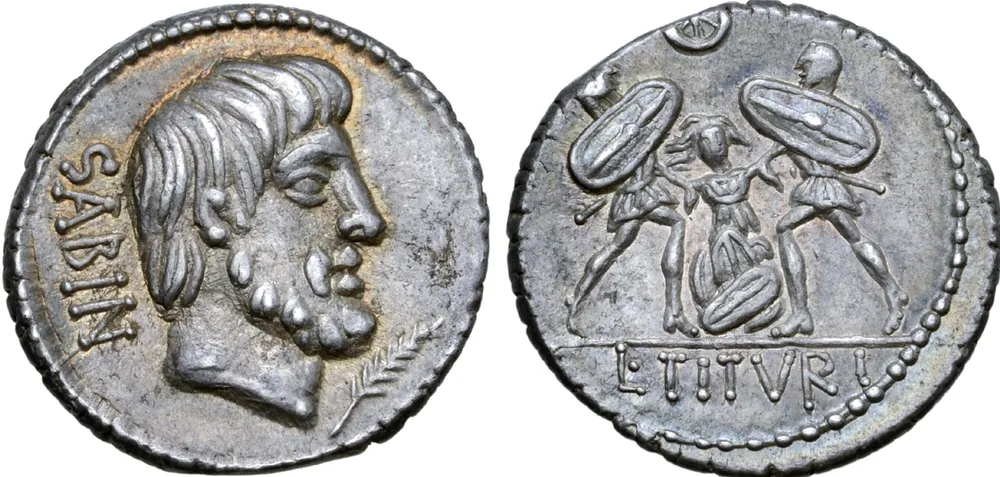
Obverse: Bearded head of King Tatius, right. Dotted border.
Legend: SABIN
Symbols: Obverse before, palm branch
Reverse: Two soldiers with shields killing Tarpeia, in the middle; above, star in crescent. Dotted border.
Legend: L TITVRI
Comment: The Tituria gens, of Sabine origin, did not have great political prominence in Rome, but stood out for linking its name to legendary episodes of the Sabines and their integration into the city. Its best-known member, Lucius Titurius Sabinus, was moneyer in 89 BC. and used its broadcasts to claim that ancestral lineage. Centuries later, another descendant, Quintus Titurius Sabinus, would be Caesar's legate in Gaul and would die in the ambush of Ambiorix in 54 BC.
The year 89 B.C. It was marked by the Social War, in which Roma fought against its former Italian allies. That same year, the Lex Plautia Papiria was promulgated, which granted Roman citizenship to Italics who agreed to lay down their arms. In this context of integration and conflict, the insistence on the Sabine heritage was a highly topical political message: what were once enemies could become an essential part of Roma.
The denarius shows on the obverse the bearded head of Titus Tatius, Sabine king, identifiable by the legend SABIN TA. It was about reclaiming a past in which the Sabines had not only fought against Roma, but had ended up joining it. The reverse presents the dramatic scene of the death of Tarpeia, the vestal virgin who, according to tradition, betrayed the citadel of the Capitol to the Sabines in exchange for what they carried in their arms. Deceived in her greed, she was crushed under his shields and buried in the place that would later be known as the Tarpeian Rock, from where traitors were thrown as an exemplary punishment. The star in a crescent above the scene adds a mythical and divine air to the story.
The legend of Tarpeia was a permanent moral reminder: in Rome, betrayal never went unpunished. The propaganda message of this denarius is powerful: while the abduction of the Sabine women (in the other type of Sabinus) alludes to reconciliation and the union of peoples, the story of Tarpeia represents the eternal condemnation of disloyalty. In the midst of the Social War, both images functioned as a warning and at the same time as a promise of integration: Roma would welcome the loyal Italics, but would harshly punish the traitors.
Provenance: Roma Numismatics (2020)
Price: 3,745 €
Other references
| Crawford: | 344/2b |
| DR: | 366 |
| BMCRR (Grueber): | Roma 2328 |
| B (Babelon): | Tituria 4 |
| RSC (Seaby): | Tituria 4 |
| FFC (Fdez., Fdez., Calicó): | 1156 |
| RC / RCV (D. Sear): | 251 |
| CRI (Sear Imperators) 49 - 27 BC: | |
| CRR (Sydenham): | 699 |
| Cal (Calicó): | 1312 |
| RBW: | |
| Other authors: |
• Read the article about catalogues of Roman Republican coinage on our blog