DR-363 | Crawford: 344/1b
Lucius Titurius Sabinus
Lucius Titurius Sabinus
Gens: Tituria
Moneyer: Lucius Titurius Sabinus
Date and mint: 89 BC - Rome
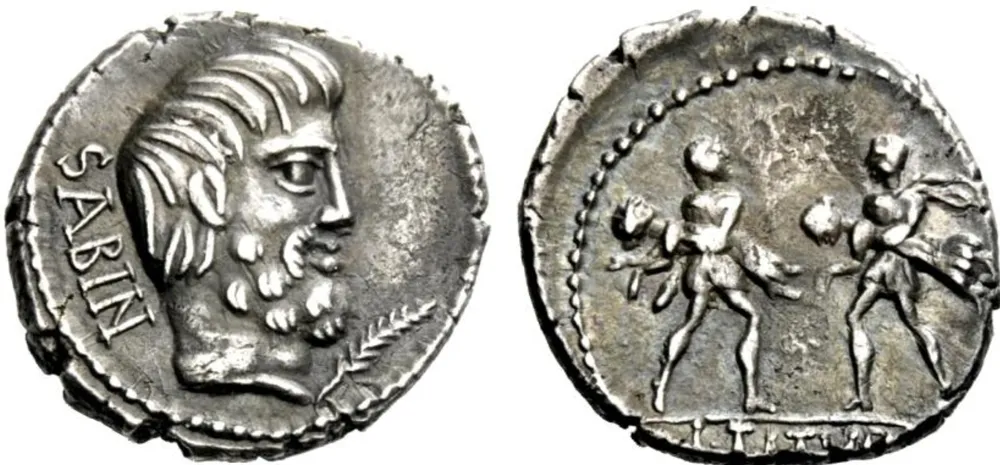
Obverse: Bearded head of King Tatius, right. Dotted border.
Legend: SABIN
Symbols: Obverse before, palm branch
Reverse: Two soldiers left and right, with Sabine women. Dotted border.
Legend: L TITVRI
Comment: The Tituria gens was of Sabine origin and little known in the history of Roma. Its greatest relevance comes with Lucio Titurio Sabino, the moneyer magistrate of this issue. The name “Sabinus” within the family underlines that link with the Sabines, a people integrated into Rome after the wars of the monarchic period. The myth of the abduction of the Sabine women and the subsequent alliance with Roma were part of their cultural identity. The gens did not have great figures on the political scene, but they left their mark through these coins loaded with references to the Sabine origins of Roma.
Lucius Titurio Sabino, as moneyer, took advantage of his position to remember the ancestral ties of his family with the Sabine king Titus Tacio and with the famous episode of the Sabine Women. The moneyer magistrates of the Republic often used the coinage as propaganda for their lineage, and in this case Sabinus claimed an ancient and noble origin. This family message was kept alive for generations: centuries later, another member of the family, Quintus Titurius Sabinus, was Caesar's legate in Gaul and was killed in an ambush by Ambiorix in 54 BC.
The year 89 B.C. It was decisive in the Social War (91-88 BC), the conflict between Roma and its Italian allies who claimed citizenship. In that year, Roma approved the Lex Plautia Papiria, which granted Roman citizenship to Italics who laid down their arms, marking the beginning of the end of the war. It was a time of political and military tensions, and the message of Sabine integration that appears on this coin fit perfectly into that context: the Sabines had been enemies in the past, but had finally become an essential part of Roma.
The denarius presents on the obverse the bearded head of Titus Tatius, Sabine king, identifiable by the legend SABIN. The palm in front is a symbol of victory or harmony. The portrait of a Sabine king on a republican coin is not coincidental: it vindicates the memory of the fusion between Sabines and Romans. On the back appears the scene of the abduction of the Sabine women, where two soldiers lead the women, recalling the founding story in which the initial violence is transformed into union and the creation of a new community. The inscription L TITVRI signs the authorship of the moneyer.
The legend of the abduction of the Sabine women tells that, after founding Roma, Romulus lacked women to ensure the descendants of the city. He organized games in honor of Neptune and, during the celebration, the Romans kidnapped the daughters of the Sabines. This event caused a war between both towns, which ended when the Sabine women themselves intervened between their fathers and husbands, asking for peace. Thanks to them, the reconciliation and union of Romans and Sabines was achieved, the origin of the future greatness of Roma.
Provenance: Numismatica Ars Classica (2013)
Price: 383 €
Other references
| Crawford: | 344/1b |
| DR: | 363 |
| BMCRR (Grueber): | Roma 2325 |
| B (Babelon): | Tituria 2 |
| RSC (Seaby): | Tituria 2 |
| FFC (Fdez., Fdez., Calicó): | 1154 |
| RC / RCV (D. Sear): | 249 |
| CRI (Sear Imperators) 49 - 27 BC: | |
| CRR (Sydenham): | 698a |
| Cal (Calicó): | 1310 |
| RBW: | |
| Other authors: |
• Read the article about catalogues of Roman Republican coinage on our blog