DR-358 | Crawford: 342/6b
Caius Vibius Pansa
Caius Vibius Pansa
Gens: Vibia
Moneyer: Caius Vibius Pansa
Date and mint: 90 BC - Rome
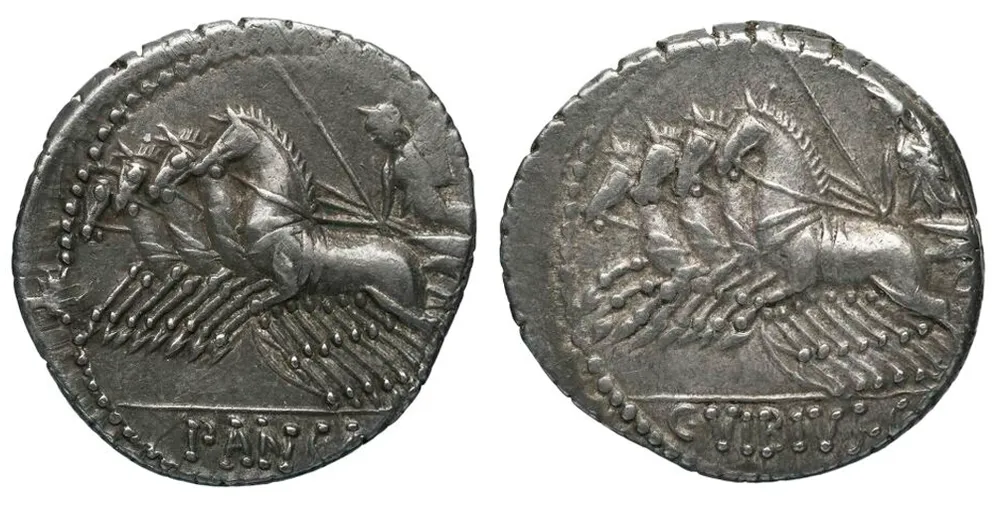
Obverse: Minerva on chariot, left, holding spear and reins in right hand and trophy in left hand. Dotted border.
Legend: PANSA
Reverse: Minerva on chariot, left, holding spear and reins on right and trophy on left. Dotted border.
Legend: C VIBIVS C F
Comment: The Vibia gens was a very ancient plebeian family, with a presence in Romen politics since the Republic. One of its branches was established in Baetica and, centuries later, two emperors would descend from it: Trebonianus Gallus and his son Volusianus. This continuity shows how a family of modest origins was able to project itself for generations until reaching the pinnacle of imperial power.
In 90 BC, in the midst of the Social War, Roma needed enormous amounts of currency to finance the conflict against the rebellious Italian allies. Cayo Vibio Pansa, one of the moneyers of that year, was responsible for one of the largest and most varied issues of the Republic.
Their denarii show on the obverse the laureate head of Apollo, a symbol of protection and prophecy, and on the reverse Minerva on a chariot carrying a trophy, sometimes crowned by Victoria, a clear allusion to Rome's military victory. Crawford distinguishes several variants: 342/4a and 4b (quadrigue on the left), 342/5a and 5b (quadrigue on the right) and the very rare 342/6a and 6b, where coins appear with Minerva in a quadriga on both sides. The latter do not seem to respond to a deliberate design, but are probably minting errors, as a reverse die was used inadvertently instead of the obverse. Crawford classifies them as R^5, which confirms their extreme rarity and supports the interpretation that they were accidental issues, the result of the enormous productive pressure of the mint in that war year.
The reason for such diversity was mass production: more than a thousand stamps and a complex system of control marks (letters, numbers, symbols) were used to identify lots and workshops. Work was probably carried out in parallel in several teams and even in an “auxiliary workshop”, which explains differences in style and orientation of the chariots. In this frenetic activity, very strange mules and errors also appeared.
Overall, the abundance of Pansa types reflects the magnitude of emergency minting during the Social War: coins designed not only to cover war expenses, but also as a propaganda instrument that conveyed the idea that Roma, under the protection of Apollo and Minerva, would eventually prevail.
Provenance: Bibliotèque National de France ()
Price: €
Other references
| Crawford: | 342/6b |
| DR: | 358 |
| BMCRR (Grueber): | p. 295 nt. |
| B (Babelon): | Vibia 5 |
| RSC (Seaby): | Vibia 5 a |
| FFC (Fdez., Fdez., Calicó): | 1207 |
| RC / RCV (D. Sear): | 244 |
| CRI (Sear Imperators) 49 - 27 BC: | |
| CRR (Sydenham): | 687 |
| Cal (Calicó): | 1361 |
| RBW: | |
| Other authors: |
• Read the article about catalogues of Roman Republican coinage on our blog