DR-321 | Crawford: 335/10b
Lucius Caecilius Metellus / Caius Publicius Malleolus
Lucius Caecilius Metellus / Caius Publicius Malleolus
Gens: Caecilia / Poblicia
Moneyer: Lucius Caecilius Metellus / Caius Publicius Malleolus
Date and mint: 95 BC/92 BC - Rome
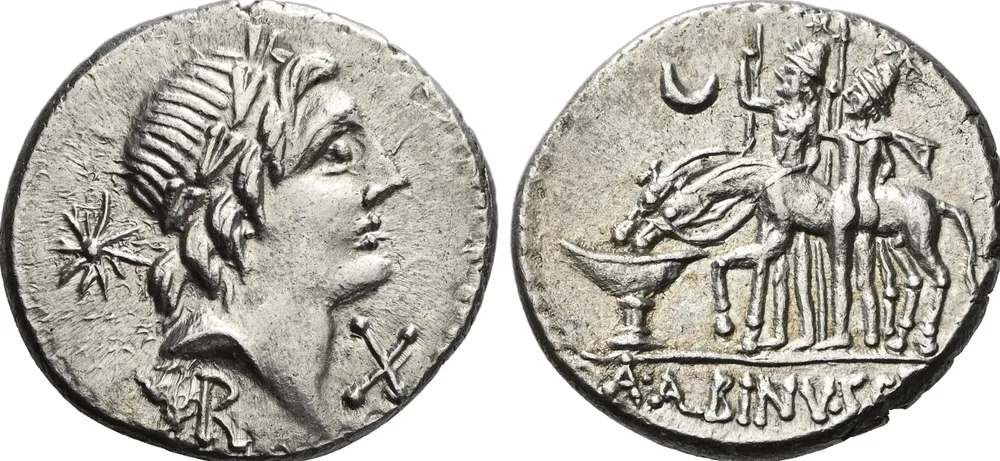
Obverse: Laureate head of Apollo, right; behind, star with variable number of rays. Dotted border.
Legend: R
Symbols: Obverse before, x | Obverse field, Cross
Reverse: Dioscuri watering the horses in the Lacus Juturnae. Dotted border.
Legend: A ALBINVS S F oA ALBINVS S F
Comment: The Caecilia gens was one of the most powerful families in the Republic, with numerous consuls and generals, while the Poblicia gens, with an older tradition, had lost part of its prominence at this time. The union of both in this broadcast reinforces the political nature of the series.
The period in which it was coined was marked by growing social tensions that would lead a few years later to the social war. The senatorial families reinforced their prestige through broadcasts with a strong symbolic load, which combined religion, myth and propaganda.
The obverse presents the laureate head of Apollo, accompanied by a star with variable rays and control signs. Apollo, associated with light and prophecy, transmits a message of harmony and order. On the reverse the Dioscuri appear watering their horses in the Lacus Iuturnae, a sacred fountain in the Roman Forum linked to the nymph Juturna, where according to tradition they appeared after the battle of Lake Regilo in 496 BC. This image evoked victory and divine protection, reinforcing the collective memory of Roma.
The tradition of Lacus Iuturnae was deeply rooted in Romen memory. According to legend, after the battle of Lake Regilo in 496 BC, the Dioscuri appeared at this sacred fountain, mounted on their white horses, announcing victory to the Romans and quenching their thirst there before miraculously disappearing. Since then, the place was consecrated to the nymph Juturna and was venerated as a sanctuary of healing and purification. Representing this scene on the coin was equivalent to remembering the direct intervention of the gods in favor of Roma and reinforcing the idea that the city was still under their protection.
There are two variants of this type, with the legend written as A ALBINVS S F in some copies and O ALBINVS S F in others. These are common die differences in large-volume issues, which do not alter the main meaning but show the breadth of the coinage.
Provenance: Numismatica Ars Classica (2024)
Price: 10,265 €
Other references
| Crawford: | 335/10b |
| DR: | 321 |
| BMCRR (Grueber): | Italia 722, 723 |
| B (Babelon): | Postumia 6 |
| RSC (Seaby): | Postumia 6, 6a |
| FFC (Fdez., Fdez., Calicó): | 1068 a 1070 |
| RC / RCV (D. Sear): | 219 |
| CRI (Sear Imperators) 49 - 27 BC: | |
| CRR (Sydenham): | 612b, 612c |
| Cal (Calicó): | 1213, 1214, 1214a |
| RBW: | |
| Other authors: |
• Read the article about catalogues of Roman Republican coinage on our blog