DR-302 | Crawford: 320/1
Lucius Iulius Caesar
Lucius Iulius Caesar
Gens: Julia
Moneyer: Lucius Iulius Caesar
Date and mint: 103 BC - Rome
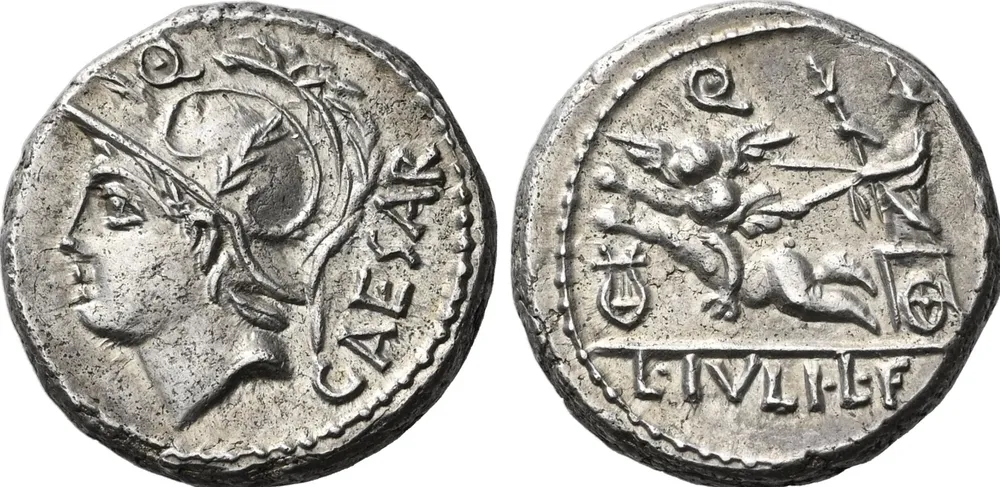
Obverse: Bust of Mars, left, helmet with long crest and feather on each side. Dotted border.
Legend: CAESAR
Symbols: Obverse above, control mark | Reverse above, control mark | Reverse below, lira
Reverse: Venus in cupids' biga, left, holding scepter in right and reins in left. Dotted border.
Legend: L IVLI L F
Comment: FIRST DENARIUM IN WHICH THE NAME CAESAR APPEARS
The denarius of Lucius Julius Caesar was minted in Rome in the year 103 BC. by a member of the Julia gens, one of the oldest and most prestigious families in the Republic. This moneyer man was Mark Antony's uncle, since the triumvir's mother, Julia, was his sister, and also a direct ancestor of the future dictator Gaius Julius Caesar.
From his political career it is known that he was a quaestor and later a praetor, although his importance lies above all in his role as a moneyer man. This issue is especially significant because it is the first Roman coin on which the word CAESAR appears definitively written, thus consolidating the cognomen that would end up marking the history of Roma. Previously, there was another denarius (Crawford 258/1) where it read CAISAR, but this is the first time that the spelling CAESAR is fixed on the coin.
The year 103 B.C. It was marked by Marius' campaigns against the Cimbri and Teutons, in the midst of the reorganization of the army after the defeat of Arausius. Roma was experiencing a period of social and military tensions in which family propaganda took on special importance to reinforce the authority of the great people.
On the obverse appears the bust of Mars with a helmet decorated with a crest and feathers, accompanied by the inscription CAESAR. The choice of the god of war refers to the values of discipline and military courage, while giving strength and solemnity to the family cognomen. The reverse depicts Venus on a biga pulled by Cupids, holding a scepter and reins. This image alludes to the myth of the divine origin of the Julius, who considered themselves descendants of the goddess through her son Aeneas, thus linking their lineage with the founder of Roma and with the same Trojan genealogy. The message is twofold: warrior strength with Mars and divine legitimacy with Venus, projecting onto the name CAESAR a symbolic program that would have long continuity in the history of Roma.
Provenance: Numismatica Ars Classica (2024)
Price: 2,310 €
Other references
| Crawford: | 320/1 |
| DR: | 302 |
| BMCRR (Grueber): | Roma 1405, 1406 |
| B (Babelon): | Julia 4 |
| RSC (Seaby): | Julia 4, 4a, 4b |
| FFC (Fdez., Fdez., Calicó): | 764, 765, 766 |
| RC / RCV (D. Sear): | 198 |
| CRI (Sear Imperators) 49 - 27 BC: | |
| CRR (Sydenham): | 593, 593a |
| Cal (Calicó): | 631, 632, 633 |
| RBW: | 1175 |
| Other authors: |
• Read the article about catalogues of Roman Republican coinage on our blog