DR-279 | Crawford: 309/1
Aulus Manlius Quintusf Sergianus
Aulus Manlius Quintusf Sergianus
Gens: Manlia
Moneyer: Aulus Manlius Quintusf Sergianus
Date and mint: 118 BC/107 BC - Rome
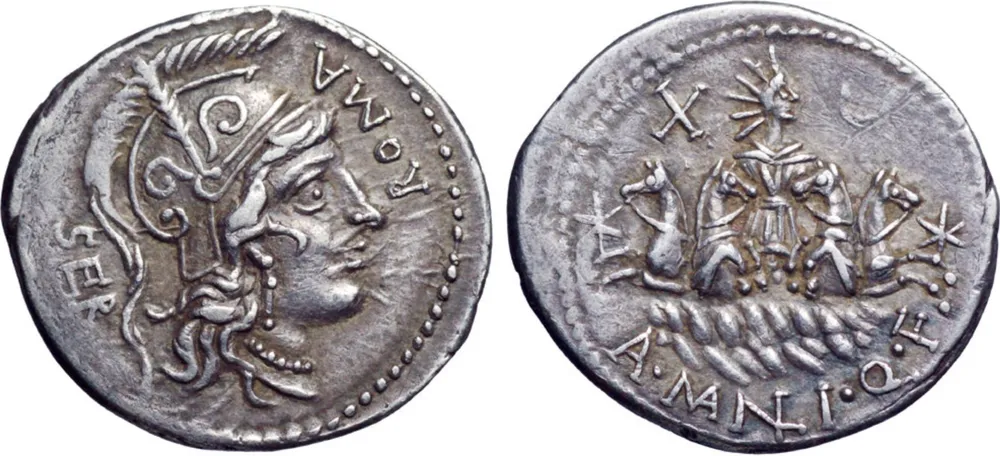
Obverse: Bust of Roma, right, helmet with feather on each side. Dotted border.
Legend: SER ROMA
Symbols: Reverse left field, x
Reverse: Sun in quadriga, from the front; on each side, Star; to right, Cross; below, waves. Dotted border.
Legend: A MA NLI Q F
Comment: The Manlia gens was one of the oldest patrician families in Rome, with a long history of magistrates and soldiers. Among its most famous branches were the Torquati, associated with the famous episode of the torc taken from a Gaul, and the Vulsones, with wide projection in republican politics. The Sergian cognomen is less known, but reveals another family line within this powerful lineage.
The moneyer Aulus Manlio Quintus f. Sergiano appears documented in this broadcast, and sources indicate that he later carried out a military legacy around the years 107–105 BC, coinciding with the campaigns against Jugurtha in Africa. Its moneyer and military activity links it to a period of strong war tension, in which Roma needed both to reaffirm its identity and maintain the morale of its citizens.
The coin was minted in Rome between 118 and 107 BC, which places its circulation in years of great instability. On the external level, the Republic was engaged in the war against Jugurtha, which would expose the corruption of the military commanders and trigger a far-reaching political crisis. Furthermore, in 113 B.C. The threat of the Cimbri and Teutons had begun, which would soon pose a risk to Italy. This atmosphere of uncertainty and open war marked the iconography of many contemporary broadcasts.
The message of the coin is reflected in two complementary planes. The obverse features the head of Roma with a winged helmet and feathers, a symbol of authority and the Republic itself. The reverse is much more unique: it shows Sol driving a chariot from the front, accompanied by stars, a cross and some waves at the bottom. We interpret this set as a cosmic allegory, in which Sun represents the invincible force and the universal order that protects Roma. The stars and waves could refer to the celestial and marine elements, reinforcing the idea of dominion over nature and destiny. The choice of this motif, linked to the Manlia family, projects the image of a Roma sustained by the light and eternity of the sun, a message of hope and victory in times of war.
Provenance: Roma Numismatics (2013)
Price: 5,395 €
Other references
| Crawford: | 309/1 |
| DR: | 279 |
| BMCRR (Grueber): | Italia 509 |
| B (Babelon): | Manlia 1 |
| RSC (Seaby): | Manlia 1 |
| FFC (Fdez., Fdez., Calicó): | 838 |
| RC / RCV (D. Sear): | 186 |
| CRI (Sear Imperators) 49 - 27 BC: | |
| CRR (Sydenham): | 543 |
| Cal (Calicó): | 923 |
| RBW: | 1152 |
| Other authors: |
• Read the article about catalogues of Roman Republican coinage on our blog