DR-261 | Crawford: 297/1a
Tiberius Quinctius
Tiberius Quinctius
Gens: Quinctia
Moneyer: Tiberius Quinctius
Date and mint: 112 BC/111 BC - Rome
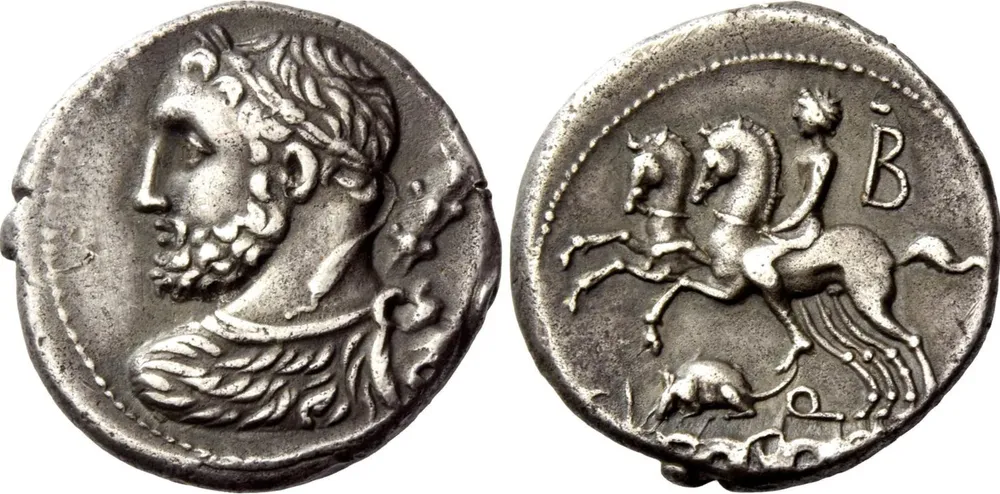
Obverse: Bust of Hercules seen from behind, head turned to the left over the right shoulder. Dotted border.
Legend:
Symbols: Reverse below, Rat, left | Reverse behind, control mark
Reverse: Desultor, left, with cuirass. Dotted border.
Legend: TI Q D S S
Comment: The gens Quinctia was an ancient patrician family of Roma, with a lineage dating back to the first centuries of the Republic. Among its most prominent members are Lucius Quinctius Cincinatus, a symbol of civic virtue, and Titus Quinctius Flamininus, the general who proclaimed the freedom of Greece after the battle of Cynoscephali in 197 BC. The cognomen of the moneyer has not been recorded, and its figure is practically unknown beyond this coinage.
We hardly have any specific historical data on Tiberius Quinctius. His presence as moneyer magistrate probably places him in the first steps of his public career. The issue includes the formula D S S (de senatus sententia), which indicates that it was minted by decision of the Senate, which gives this coin a special character within the republican series.
The coinage took place in Rome in 112–111 BC, at a time when the Republic was facing serious challenges. Abroad, Roma was preparing for war against Jugurtha, king of Numidia, a conflict that would break out that same year and would test the effectiveness of the army and the corruption of the ruling class. At the same time, the Cimbri and Teutons began to threaten the northern borders, presaging a period of military crisis that would mark the following decades.
The coin's message combines two very significant images. The obverse shows a bust of Hercules seen from behind, with his head turned, a rare representation that emphasizes the heroic strength and protective virtue of the demigod. On the reverse appears a desultor, an acrobatic rider who jumped between horses in circus games, represented with a breastplate. Our interpretation is that this reverse is not limited to a sporting motif, but rather exalts skill, discipline and the ability to maneuver, qualities necessary for Roman cavalry in a time of imminent war. The combination of Hercules and the Desultor conveys a message of physical strength and tactical skill, virtues that Roma needed to face the military challenges of the late 2nd century BC.
Provenance: Numismatica Ars Classica (2016)
Price: 600 €
Other references
| Crawford: | 297/1a |
| DR: | 261 |
| BMCRR (Grueber): | Italia 566 a 568 |
| B (Babelon): | Quinctia 6 |
| RSC (Seaby): | Quinctia 6 |
| FFC (Fdez., Fdez., Calicó): | 1086 |
| RC / RCV (D. Sear): | 174 |
| CRI (Sear Imperators) 49 - 27 BC: | |
| CRR (Sydenham): | 563 |
| Cal (Calicó): | 1228a |
| RBW: | |
| Other authors: |
• Read the article about catalogues of Roman Republican coinage on our blog