DR-253 | Crawford: 296/1e
Gnaeus Cornelius Blasio
Cneo Cornelius Blasio
Gens: Cornelia
Moneyer: Gnaeus Cornelius Blasio
Date and mint: 112 BC/111 BC - Rome
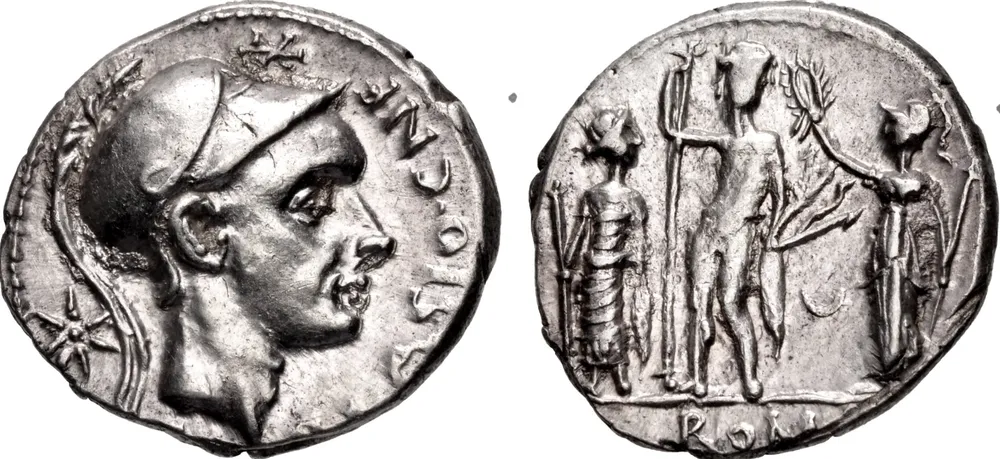
Obverse: Bust of Mars, right, Corinthian helmet. Dotted border.
Legend: CN BLASIO CN F
Symbols: Obverse above, x | Obverse behind, Wreath | Reverse field, Like and
Reverse: Jupiter standing between Juno and Minerva and holding the scepter in the right hand and the thunderbolt in the left hand - Juno holds the scepter in the right hand, Minerva holds the scepter in the left hand and crowns Jupiter with the right hand. Dotted border.
Legend: ROMA
Comment: The Cornelia gens was one of the most influential families in Rome, with numerous branches and political and military figures of great relevance, from the Scipios to Sulla. The Blasio cognomen corresponds to a poorly documented line, whose most visible member is this moneyer, Gnaeus Cornelio Blasio, known for his issuance of denarii in the early years of the 2nd century BC.
No specific data is preserved about de Blasio's personal career, beyond his role as moneyer magistrate. The broadcast that bears his name is set in Rome around 112–111 BC, in a period marked by the imminent war against Jugurtha in Numidia and growing barbarian threats in the north. The city was experiencing a climate of uncertainty, and currency became an ideal medium to reinforce symbols of authority and legitimacy.
The obverse of this denarius features a bust with a Corinthian helmet, which Crawford clearly identifies as Mars, the god of war. However, some scholars have suggested the possibility that it is a representation of Scipio Africanus. The resemblance to preserved sculptural portraits of this general has fueled debate, although there is no definitive consensus. Whether Mars or a historical hero, the choice of bust underlines the military values of Roma and the prestige associated with the Cornelia family.
The reverse is equally significant: Jupiter appears in the center, with scepter and lightning bolt, accompanied by Juno and Minerva. Juno holds a scepter, while Minerva crowns Jupiter, thus reinforcing the supremacy of the supreme god of the Roman pantheon. The scene conveys a message of power and divine legitimacy, presenting Roma as protected by the Capitoline triad. Our interpretation is that the coin combines religious tradition and warrior values, projecting the Cornelia gens as guarantor of the favor of the gods at a time of military challenges.
Provenance: Classical Numismatic group (2020)
Price: 400 €
Other references
| Crawford: | 296/1e |
| DR: | 253 |
| BMCRR (Grueber): | Italia 629 |
| B (Babelon): | Cornelia 19 |
| RSC (Seaby): | Cornelia 19 |
| FFC (Fdez., Fdez., Calicó): | |
| RC / RCV (D. Sear): | 173 |
| CRI (Sear Imperators) 49 - 27 BC: | |
| CRR (Sydenham): | 561b |
| Cal (Calicó): | |
| RBW: | |
| Other authors: |
• Read the article about catalogues of Roman Republican coinage on our blog