DR-241 | Crawford: 288/1
Cetegus
Cetegus
Gens: Cornelia
Moneyer: Cetegus
Date and mint: 115 BC/114 BC - Rome
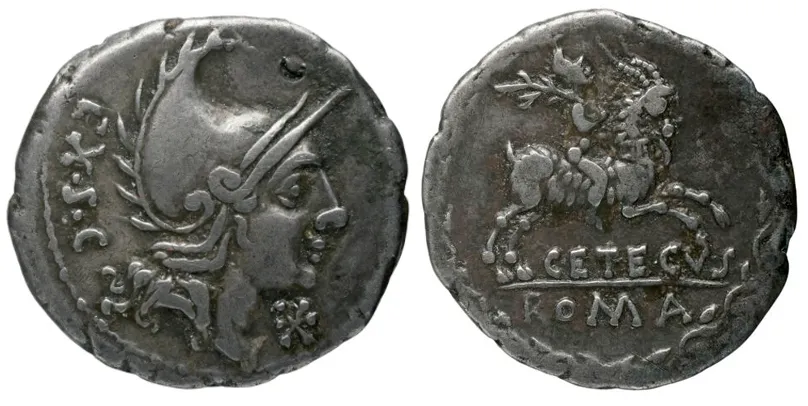
Obverse: Bust of Roma, right, Phrygian helmet. Dotted border.
Legend: EX S C
Symbols: Obverse before, x
Reverse: male figure on goat, right, Phrygian helmet and holding Rama on right. border ivy wreath.
Legend: CETEGVS ROMA
Comment: The Cornelia gens was one of the most influential in Rome, with numerous family branches and highly relevant figures such as the Scipios or Sulla. The Cetegus cognomen corresponds to a minor line of the family, little documented in the sources, which means that this currency appears almost exclusively through this issue.
No clear data is preserved regarding his figure about his political or military career, beyond his role as responsible for the coinage. This reinforces the idea that, in many cases, the moneyers were young at the beginning of their cursus honorum, with little subsequent historical projection.
The coin was minted in Rome around 115–114 BC, at a time of relative calm after the political turmoil of the Gracchi, although with latent tensions that would erupt shortly after in the war against Jugurtha and, in subsequent decades, in the internal conflicts that marked the end of the Republic.
Regarding the message of the coin, the obverse features the head of Roma with a Phrygian helmet, reaffirming the identity and authority of the city. The legend EX S C indicates that the broadcast was authorized directly by the Senate, something unusual in this period and which suggests a special circumstance. The reverse is one of the most enigmatic of the Republic: a male character with a Phrygian helmet, mounted on a goat and holding a branch, surrounded by a plant crown. Traditionally it has been identified with Attis, a figure associated with the Phrygian cult of Cybele, although some catalogs interpret him as a young Dionysus, based on the presence of ivy as an ornament. Both readings are possible, and it is likely that the message had a religious background linked to fertility, nature and oriental cults, perhaps with a symbolic link to the coin's own family. The absence of direct literary sources forces us to move into the realm of hypothesis, but the truth is that it is a unique type that transmits a message of vitality and divine protection at a time of political transition in Rome.
Provenance: Bibliotèque National de France ()
Price: €
Other references
| Crawford: | 288/1 |
| DR: | 241 |
| BMCRR (Grueber): | p. 271 |
| B (Babelon): | Cornelia 18 |
| RSC (Seaby): | Cornelia 18 |
| FFC (Fdez., Fdez., Calicó): | 611 |
| RC / RCV (D. Sear): | 165 |
| CRI (Sear Imperators) 49 - 27 BC: | |
| CRR (Sydenham): | 553 |
| Cal (Calicó): | 472 |
| RBW: | |
| Other authors: |
• Read the article about catalogues of Roman Republican coinage on our blog