DR-172 | Crawford: 235/1b
Sextus Pompeius
Sextus Pompeius
Gens: Pompeia
Moneyer: Sextus Pompeius
Date and mint: 137 BC - Rome
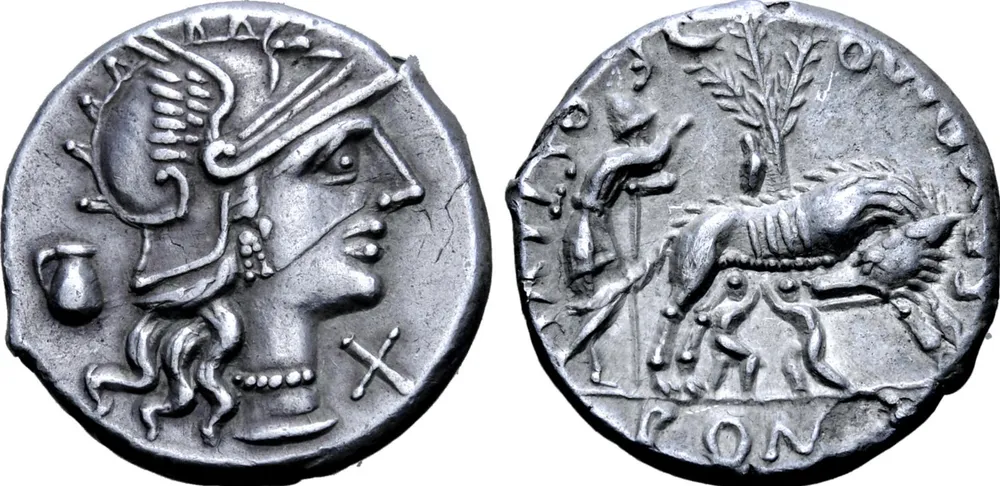
Obverse: Bust of Roma with helmet, right. Dotted border.
Legend:
Symbols: Obverse before, x | Obverse behind, Jug
Reverse: Wolf, right, nursing twins; behind, tree (ficus Ruminalis), with a bird perched on the trunk and two birds perched on the upper branches; on the left, Faustulus, identified by the inscription FOSTLVS. Line border.
Legend: SEX PMO ROMA
Comment: The Pompeia gens, of plebeian origin, acquired political prominence from the 2nd century BC. Several of its members reached magistrates and military positions, but the most famous would be Gnaeus Pompey the Great centuries later, a key figure in the final crisis of the Republic. One of his ancestors was Sextus Pompey, a coiner in 137 BC, whose issue left one of the most influential and enduring scenes in Romen mythology.
Roma was then experiencing a period of territorial expansion and consolidation, especially in Hispania, where the campaigns against the Celtiberians required large resources. In this context, the coin became a propaganda vehicle that not only exalted Roma, but also allowed magistrates to link its name to values and traditions recognized by all citizens.
On the obverse there is a bust of Roma with a winged helmet, accompanied by the legend ROMA, a classic motif on early republican denarii. The reverse, however, introduces a decisive innovation: it is the first time that the Capitoline she-wolf nursing Romulus and Remus appears on a Roman denarius. The scene is completed with Faustulus, the shepherd who rescued them from the Tiber, identified by the legend FOSTLVS, and with the ficus Ruminalis, a sacred tree associated with the founding myth, from which birds hang from its branches. On the trunk appears a bird that is usually identified with a woodpecker (picus), an animal sacred to Mars, mythical father of the twins. According to Plutarch, both the wolf and the bird were sent by Mars to protect and feed Romulus and Remus, reinforcing the divine character of the scene.
The richness of detail is exceptional for a Republican coin of this era. Each element—the wolf, the twins, the tree, the birds, Faustulus—reinforces the sacredness of the story and places the origin of Roma under the direct protection of Mars. The fact that the shepherd appears named in the legend is equally striking: it was not common for mythical characters to be identified on the coin. This detail points to a political intention of the moneyer: to link the gens Pompeia with the figure of Faustulus, the first protector of the founders of Roma.
The iconographic choice was not accidental. At a time when plebeian families competed with the great patrician lineages for political visibility, resorting to the founding myth allowed them to project prestige and legitimacy. With this broadcast, Sextus Pompey linked his name to a central episode of Roman identity, appropriating a symbol shared by the entire community.
This denarius not only marked a milestone in republican moneyer propaganda, but also inaugurated a motif that would have a very long posterity. The Capitoline she-wolf with Romulus and Remus will reappear in later denarii, such as those of the Plautii brothers in 47 BC, and will be taken up in imperial broadcasts from Augustus to late ancient Roma. The image became a universal emblem of the city and remains so today.
Due to its iconographic innovation, its political intention and its enormous subsequent influence, this denarius is considered one of the most emblematic pieces of early republican numismatics. What began as a propaganda gesture by a plebeian magistrate ended up giving Roma one of its most enduring symbols.
Provenance: Roma Numismatics (2020)
Price: 655 €
Other references
| Crawford: | 235/1b |
| DR: | 172 |
| BMCRR (Grueber): | Roma 926 var |
| B (Babelon): | Pompeia 1b |
| RSC (Seaby): | Pompeia 1b |
| FFC (Fdez., Fdez., Calicó): | 1023 |
| RC / RCV (D. Sear): | 112 var |
| CRI (Sear Imperators) 49 - 27 BC: | |
| CRR (Sydenham): | 461 var |
| Cal (Calicó): | 1150 |
| RBW: | |
| Other authors: |
• Read the article about catalogues of Roman Republican coinage on our blog