The Year of the Five Emperors
The year of the five emperors: power, propaganda and transformation of the denarius
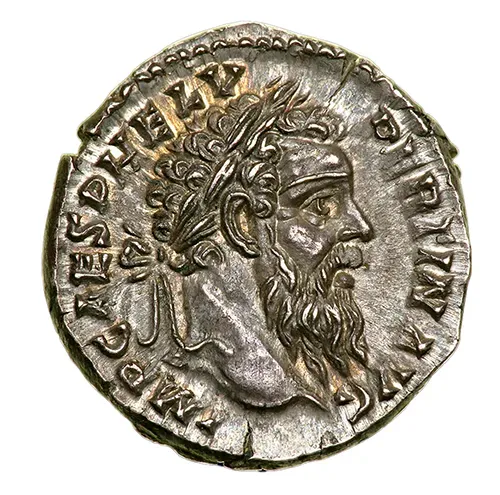
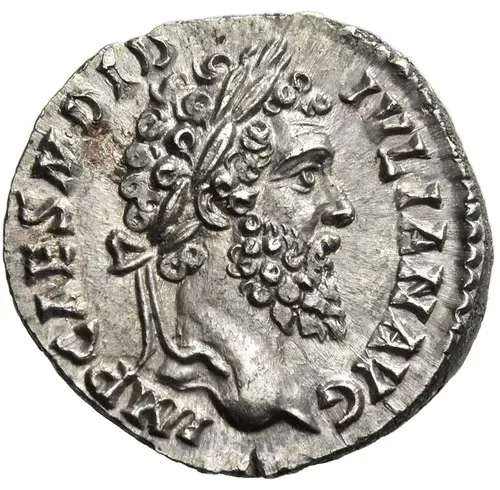
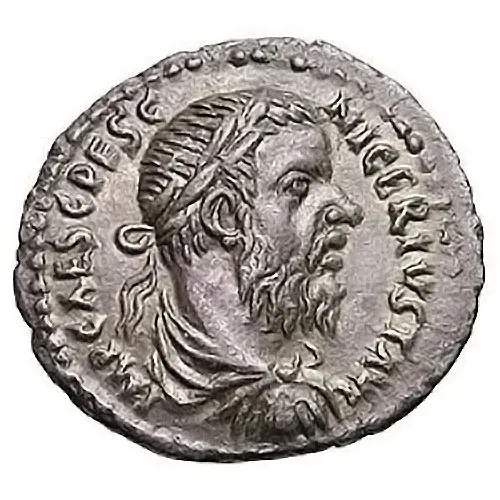
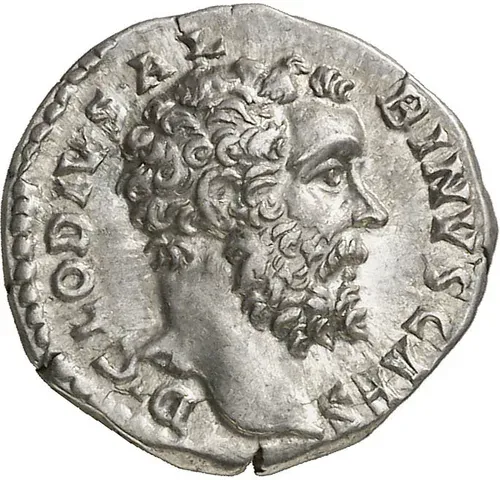
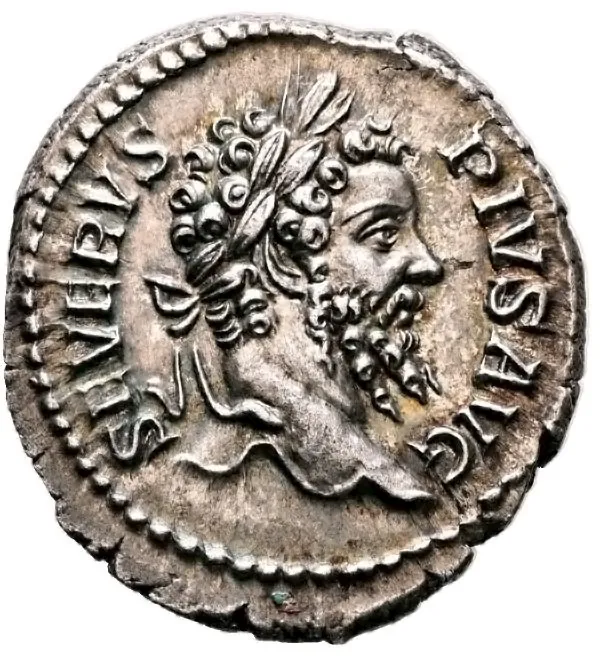
After the assassination of Commodus, the Roman Empire entered one of the deepest and most revealing crises in its history. In the course of just a few months, one emperor was assassinated, another acceded to the throne through an auction organized by the Praetorian Guard, and several generals proclaimed themselves emperors from different parts of the Empire, giving rise to a situation of fragmentation of power without immediate precedent.
The year AD 193 was not only a succession of ephemeral governments, but a moment of structural transformation in which access to power stopped depending mainly on traditional institutions and was conditioned, in an increasingly evident way, by military support. In this new scenario, the legions were consolidated as the true foundation of imperial power, while the denarius became an essential instrument to project and legitimize that power through propaganda.
The map of power after the death of Commodus
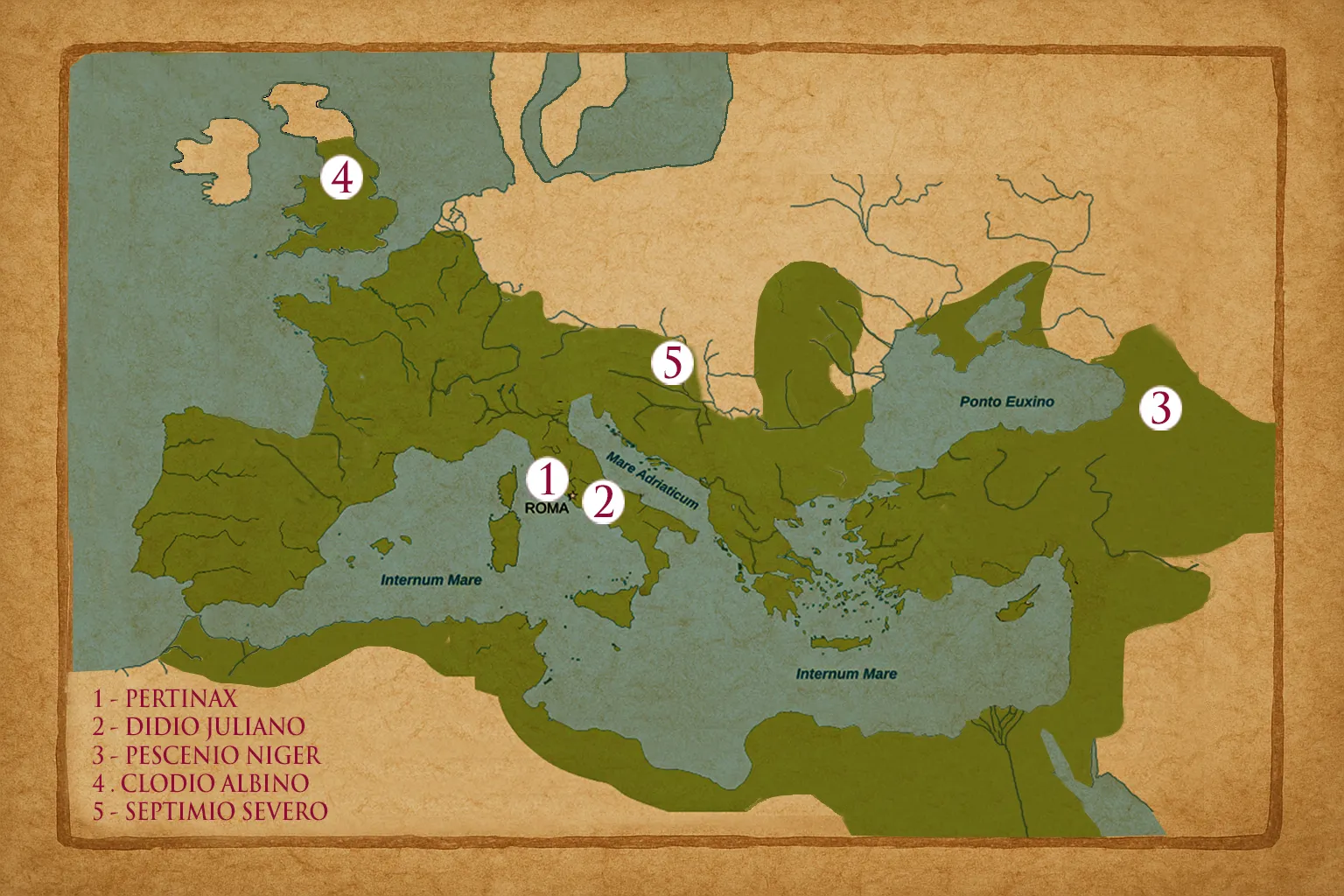
To understand the development of this crisis, it is essential to place its protagonists at the beginning, since their geographical and military position decisively conditioned subsequent events.
In Rome, Pertinax, a veteran senator and former general, was proclaimed emperor by the Senate with the intention of restoring order after the death of Commodus, in an attempt to recover institutional authority. Also in the capital was Didius Julianus, another high-ranking senator who, although not initially in power, was in a privileged position to influence immediate events.
In the East, in Antioch, Pescennius Niger served as imperial legate in Syria, controlling several legions and some of the richest provinces of the Empire, which provided him with a solid power base both from a military and economic point of view. In Britain, Clodius Albinus led an important army, although geographically far from the political center, while on the Danube, in Upper Pannonia, Septimius Severus commanded experienced troops on one of the most active frontiers of the Empire, which placed him in a particularly favorable position in a context of conflict.
These five men, distributed in strategic points of the imperial territory, were not emperors simultaneously nor did they all obtain the same degree of recognition, but they did participate in the same dynamic of confrontation in which traditional legitimacy became progressively subordinated to the real capacity to impose power through the army.
Pertinax: institutional restoration without a military base
The Senate tried to regain control of the state by naming Pertinax emperor, whose career as an administrator and soldier made him a respected figure, although he lacked a solid base of support among the troops. His reign, which extended from January 1 to March 28 of the year 193, was extremely brief, a circumstance that is reflected in a limited but very coherent monetary production from an ideological point of view.
His denarii, minted in Rome and characterized by the legend IMP CAES P HELV PERTIN AVG
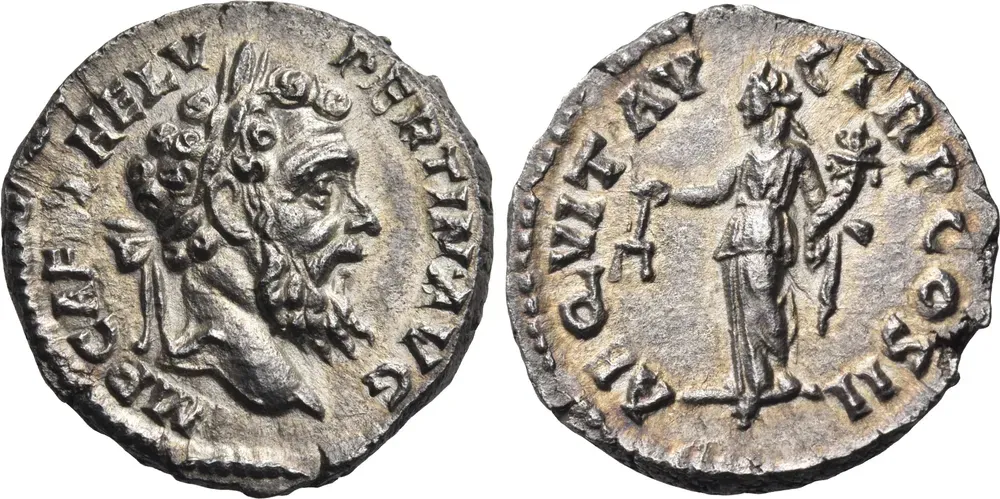
Denarius auctioned at NOMOS in 2018 for €7,195
They develop an iconographic program focused on the restoration of order, in which allegories appear such as Aequitas, a symbol of justice and institutional balance, Providentia, which refers to foresight in government, or Laetitia temporum, which projects the idea of a new beginning for the Empire. To these messages are added references to imperial liberality and supply, configuring a discourse aimed at transmitting political, economic and social stability.
However, this program reveals a fundamental weakness, since it omits any explicit reference to the army, which at that time constituted the true support of power. Pertinax attempted to impose discipline and reduce privileges in the military ranks, also offering a donation lower than that expected by the troops, which provoked the rejection of the Praetorian Guard, which ended up assassinating him, showing that institutional authority was no longer sufficient to sustain imperial power.
Didius Julianus: legitimacy without real power
After the assassination of Pertinax, the Praetorian Guard staged an extraordinary episode by auctioning off the imperial throne, with Didius Julianus being the one who offered the largest sum and came to power without having effective military backing. His reign, which lasted from the end of March to the beginning of June 193, was even shorter than that of his predecessor, and his monetary production, reduced to a few types, clearly reflects this fragility.
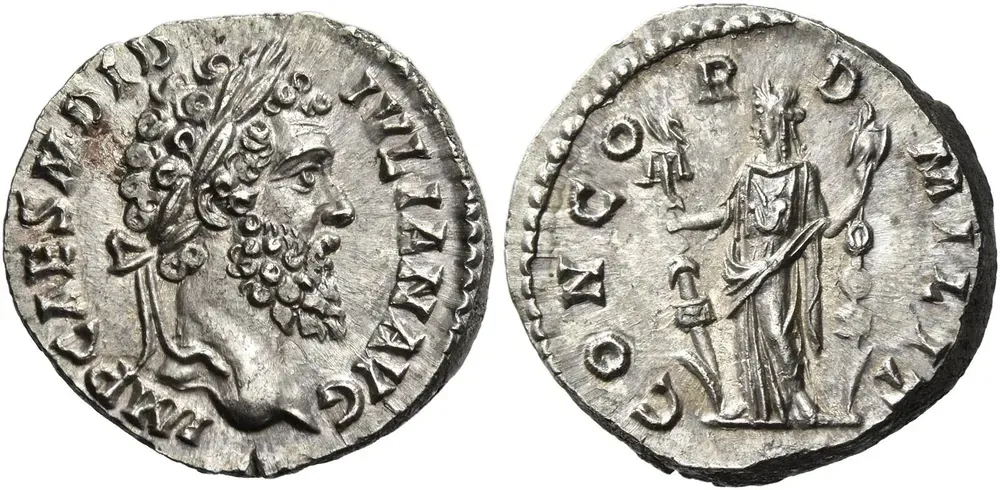
Denarius auctioned at Ars Classica Numismatics in 2022 for €19,515
Julian’s denarii present his laureate bust on the obverse and on the reverse they use traditional allegories such as Concordia, Fortuna or Securitas, as well as the globe as a symbol of universal dominion, configuring a discourse aimed at transmitting stability and control. Added to this are issues in which his wife, Manlia Scantilla, and his daughter, Didia Clara, appear, associated with divinities such as Juno, Pietas, Fortuna or Hilaritas, in an attempt to project an image of dynastic continuity.
This iconographic program, however, could not compensate for the absence of royal power, since Julian had acquired Rome, but not the Empire. When Septimius Severus advanced toward the capital at the head of his legions, the Senate withdrew its support and ordered his execution in early June 193, ending a reign that exemplified the limits of legitimacy without military backing.
Pescennius Niger: victory, justice and military power
While short-lived emperors followed one another in Rome, in the East Pescennius Niger built a much more solid candidacy for imperial power, being proclaimed emperor by the Syrian legions in Antioch during the spring of the year 193, with the support of the eastern provinces.
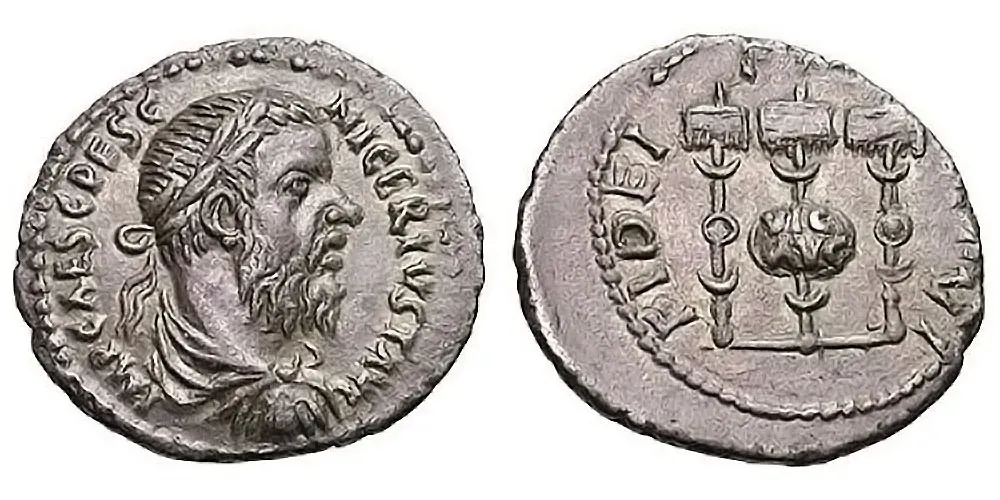
Denarius auctioned at Gemini 2009 for €8,225
His monetary production, significantly more abundant, exceeds one hundred types of denarii, which reflects intense propaganda activity in a relatively short period. In them he appears with the legend IMP CAES C PESC NIGER IVST AVG, explicitly highlighting his status as a just emperor (Iustus), and his reverses articulate a coherent discourse based on three fundamental axes.
Firstly, military victory, represented by figures such as Victoria, Mars or Minerva, which underline his ability to prevail on the battlefield; secondly, stability and the return to order, symbolized by Fortuna Redux; and thirdly, justice as the foundation of his legitimacy, expressed through Iustitia. To these elements are added references to prosperity (Felicitas Temporum), economic stability (Moneta) and divine legitimation through divinities such as Jupiter or Apollo.
The result is a direct and effective propaganda program, focused on the combination of military power, legitimacy and stability, without resorting to dynastic elements. Despite this, Niger was defeated by the troops of Septimius Severus in 194 and executed after trying to flee, putting an end to his imperial aspiration.
Clodius Albinus: the breakdown of political balance
Clodius Albinus, governor of Britain, began his career in this conflict as an ally of Septimius Severus, who appointed him Caesar with the aim of securing his rearguard while fighting other rivals, formally integrating him into the system as a possible successor.
His monetary issues reflect this evolution, beginning with a prudent and fully institutional discourse, focused on the stability, prosperity and continuity of the Roman order, but progressively incorporating his own imperial virtues, such as justice, clemency or the fidelity of the army, which configure an increasingly autonomous image.
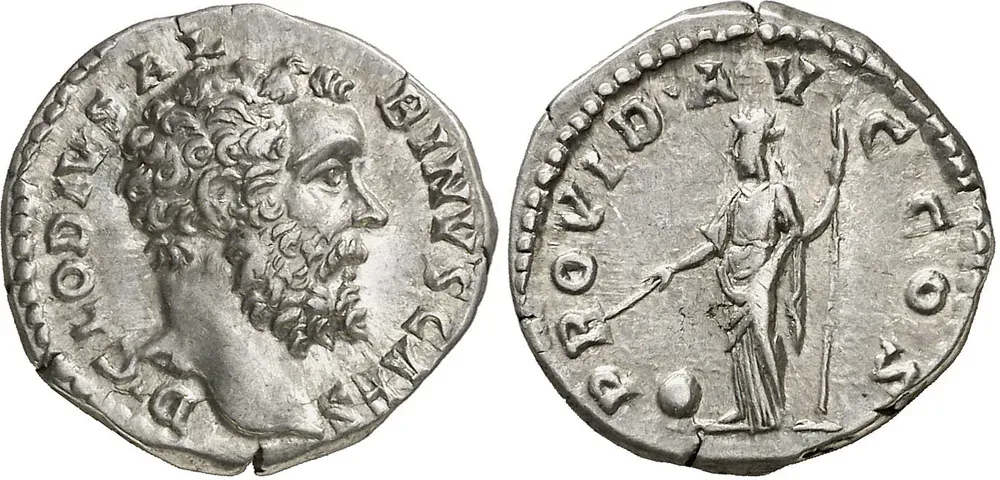
Denarius auctioned at Aureo & Calicó in 2013 for €1,300
The breaking point occurred in the year 195, when Severus elevated his son Caracalla as successor, altering the political balance and leading Albinus to proclaim himself Augustus. From that moment on, his discourse changes and adopts a clearly military character, with references to Victoria, Mars, Iuppiter or Hercules, reflecting the imminence of the confrontation.
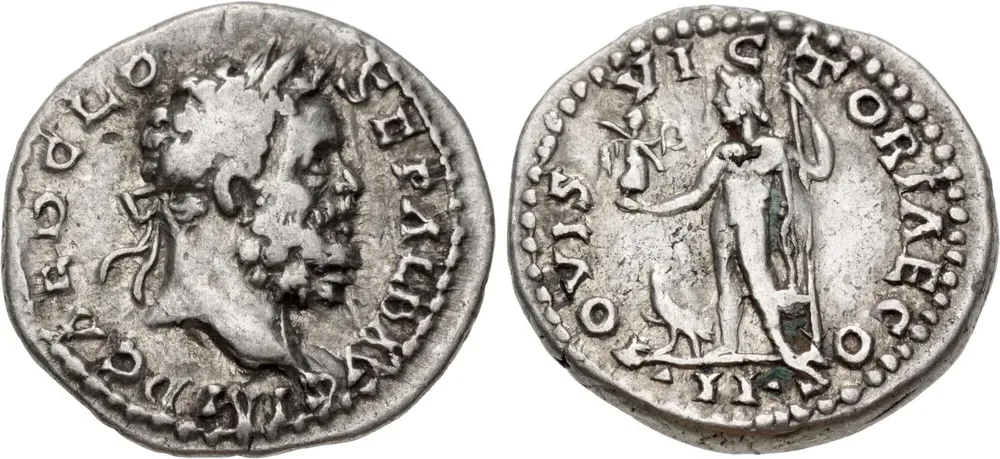
Denarius auctioned at CNG Coins in 2020 for €1,204
The war culminated in the year 197 with the battle of Lugdunum, where Albinus was defeated and died after the conflict, thus closing his attempt to access imperial power.
Septimius Severus: from military power to dynasty
Septimius Severus represents the consolidation of this new model of power, since, proclaimed emperor by his troops, he marched on Rome, took control of the capital and reorganized the Praetorian Guard, replacing it with soldiers from his own legions.
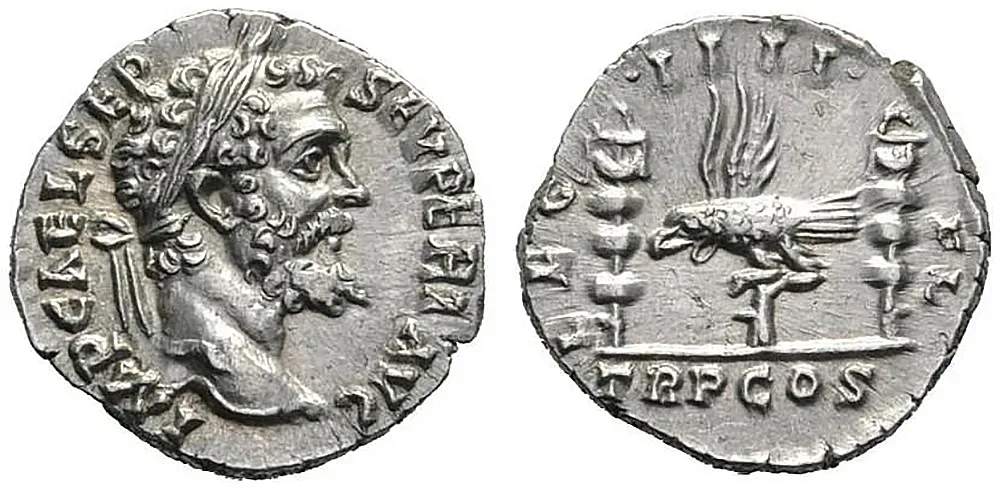
Denarius auctioned at Ars Classica Numismatics in 2015 for €576
His denarii allow us to clearly follow the evolution of his political discourse, which in the first phase is based on institutional legitimation through the adoption of the name Pertinax, visible in the legend IMP CAE L SEP SEV PERT AVG, while the reverses show the central role of the army through references to its fidelity and power.
During the war against Pescennius Niger, propaganda intensifies with issues that highlight victory and military virtue, such as VICTORIA AVG, VIRTVS AVG or FIDES EXERCITVS, and after the victory in the East the discourse is oriented towards prosperity and stability, with legends such as FELICITAS TEMPORVM or SAECVLVM FRVGIFERVM.
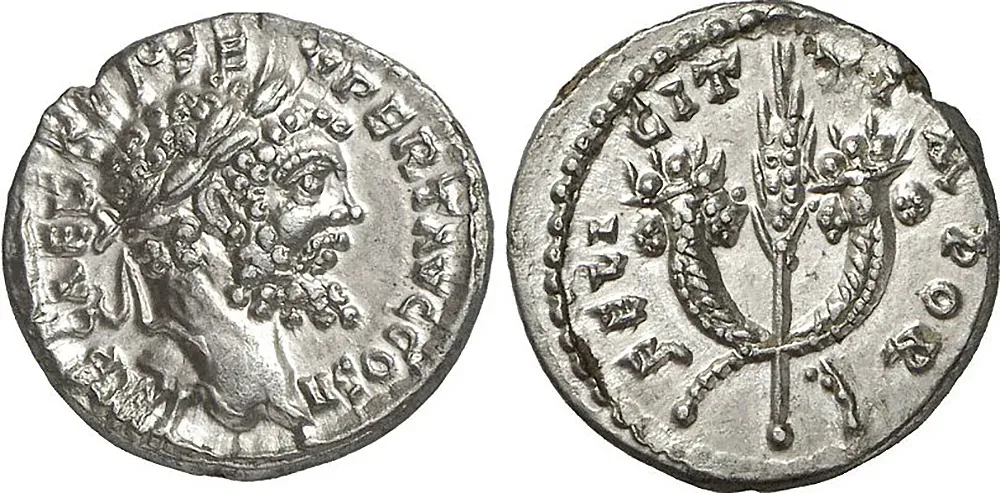
Denarius auctioned at Heritage in 2016 for €370
At the same time, Severus began an ideological transformation by progressively disassociating himself from Pertinax and adopting a language typical of the Antonine tradition, visible in legends such as SEVERVS PIVS AVG, reinforcing this strategy through symbolic integration into the dynasty of Marcus Aurelius and the change of his son’s name to Marcus Aurelius Antoninus.
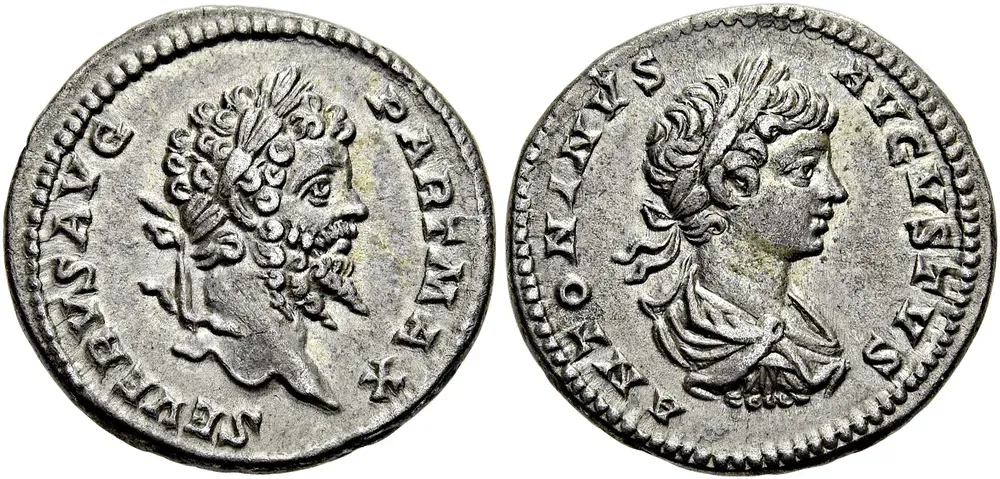
Denarius auctioned at Gorny & Mosch in 2022 for €2,600
After the defeat of Clodius Albinus in the year 197, his position was definitively consolidated, and the monetary discourse abandoned the warlike tone to focus on stability, with references to PAX, SECVRITAS or CONCORDIA. In the year 198, by elevating Caracalla to Augustus and naming Geta Caesar, he formally established a new dynasty, incorporating his family in monetary issues as a guarantee of continuity of power.
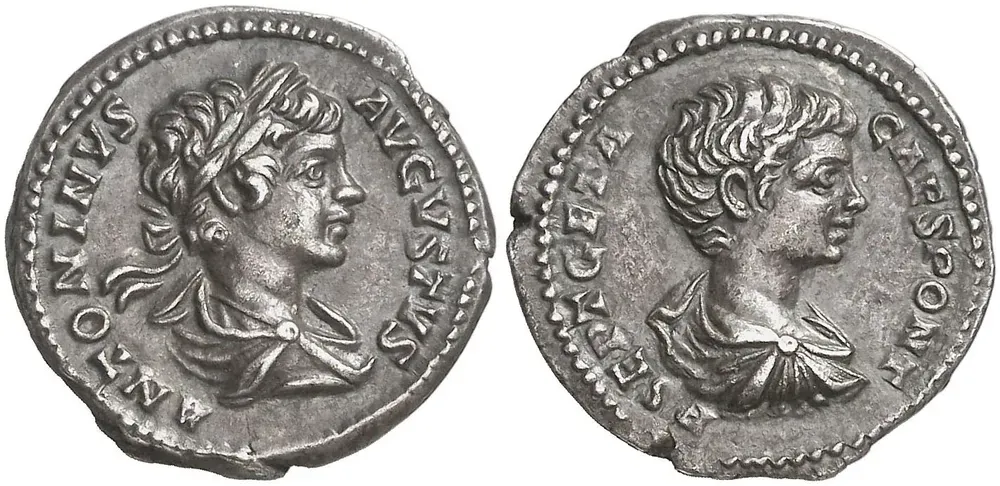
Denarius auctioned at Aureo & Calicó in 2012 for €2,600
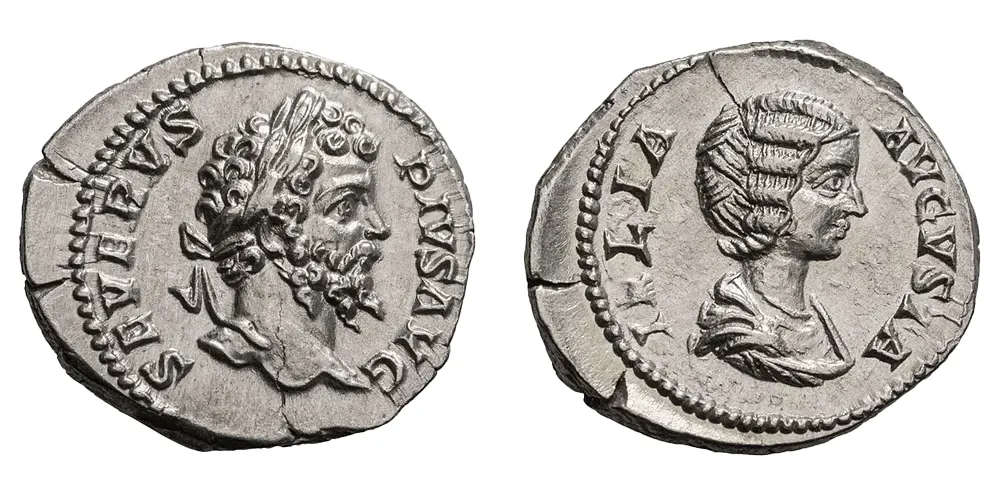
Denarius auctioned at Harlan J.Berk in 2015 for €2,902
The transformation of the denarius: a consequence of the war
The political crisis had a direct consequence on the monetary system, since at the end of the reign of Commodus and during the brief government of Pertinax the denarius still maintained a relatively high purity, around 65–70% silver, which guaranteed its stability as an economic reference.
However, the context of civil war profoundly altered this balance, since each candidate for power needed to finance military campaigns, pay their troops and ensure their loyalty, which considerably increased spending.
With the arrival of Septimius Severus, this process was decisively accelerated, so that between the years 193 and AD 196, the silver content of the denarius fell rapidly to around 55%, subsequently continuing towards levels close to 50%, reflecting a structural change in the nature of the coinage.

From that moment on, the denarius ceased to be a relatively stable silver coin and became a progressively degraded issue, in which copper acquired a growing role, marking the beginning of a transformation that would culminate a few years later with the introduction of the antoninian by Caracalla.
Conclusion
The year AD 193 was a turning point in the history of Rome, not only due to the succession of emperors, but also due to the change in the rules of power, which from then on would depend fundamentally on military support.
The denarius, as a reflection of this system, evolved in parallel, going from being a relatively stable coinage to becoming an instrument increasingly conditioned by the needs of the state.
In this sense, the so-called “year of the five emperors” does not only represent a political crisis, but the beginning of a new stage in which power, army and coinage were definitively united.