Julius Caesar Denarii
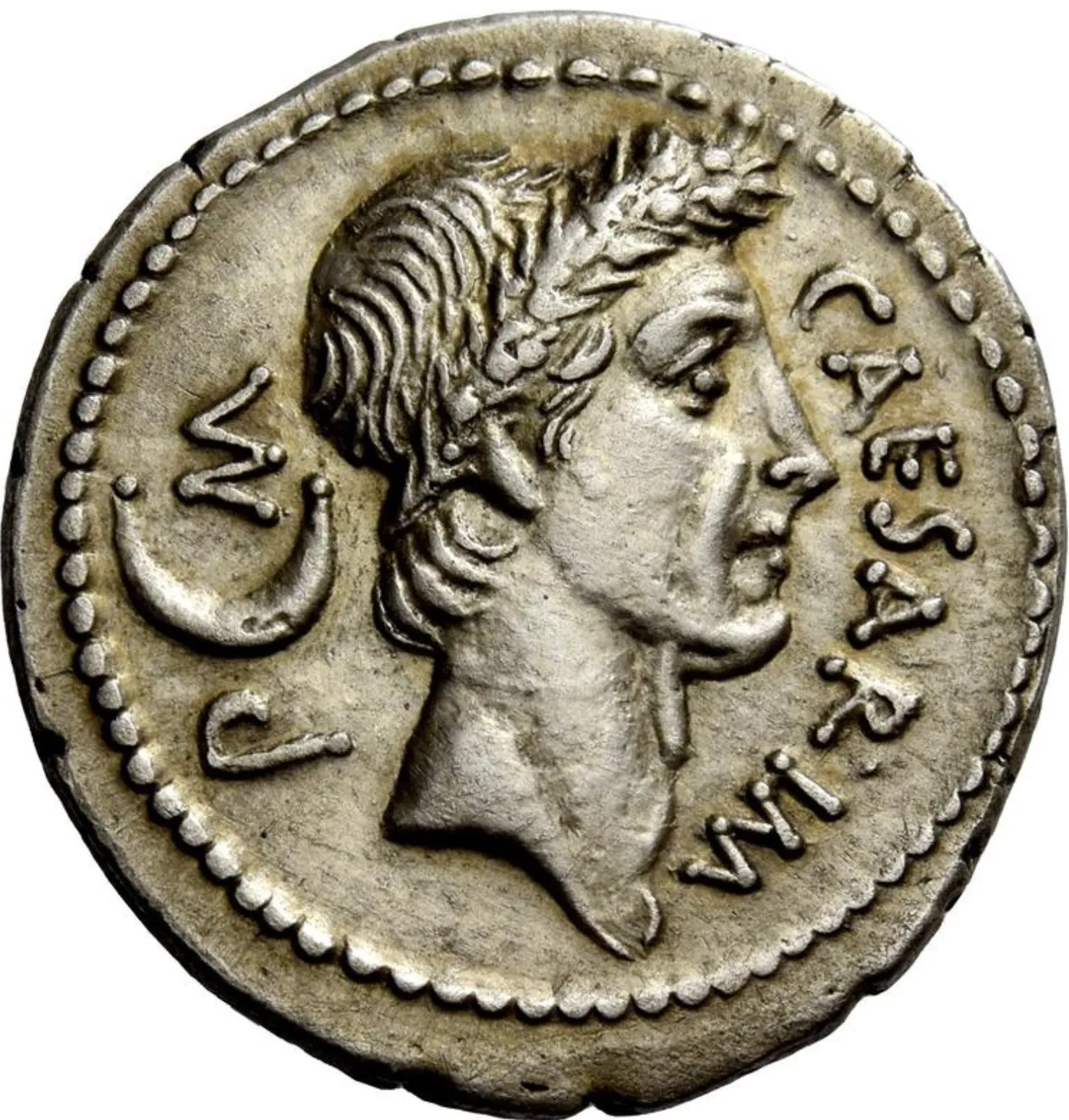
Julius Caesar’s denarii should be divided into three groups:
- Denarii struck by Julius Caesar. Crawford: 443/1; 452/2; 452/4; 452/5; 458/1; 467/1a; 467/1b; 468/1; 468/2; 482/1.
- Denarii with or without Caesar’s bust, struck by moneyers. Crawford: 457; 480/4; 480/6; 480/7a; 480/7b; 480/8; 480/2a; 480/2b; 480/2c; 480/3; 480/17; 480/5a; 480/5b; 480/9; 480/10; 480/11; 480/12; 480/13; 480/14; 480/18; 480/20; 480/21 480/15; 480/16; 480/19.
- Posthumous denarii with the bust of Julius Caesar. Crawford: 485/1; 488/1; 488/2; 490/4; 494/16; 494/24; 494/39a; 494/39b; 525/3; 525/4a; 525/4b; 525/4c; 526/2; 526/4; 534/2.
In total, there are 50 denarii: 10 denarii struck by Julius Caesar on which his bust does not appear, another 38 denarii struck by Octavian, Mark Antony, Agrippa and different moneyers on which his bust does appear, and 2 more on which his bust does not appear.
A - DENARII STRUCK BY JULIUS CAESAR (First Group)
1# THE ELEPHANT, 49 BC.
Caesar entered numismatic history with a clear message: “Julius Caesar, Pontifex Maximus, crushes Rome’s enemies with the strength of an elephant.” Some believe this may have been a message aimed at Pompey’s followers, but if we consider that the Gauls carried their carnyx, a kind of animal-headed trumpet similar to the serpent being trampled by the elephant, it could well refer to the Gauls.
His first denarius (Crawford 443/1), struck at a travelling mint, has an obverse with the implements of the Pontifex Maximus, alluding to his holding of the office since 63 BC. The reverse shows an elephant crushing a horned serpent or dragon. It is a very common denarius that appears in almost every auction; unsurprisingly, Crawford records a total of 735 obverse dies and 833 reverse dies.
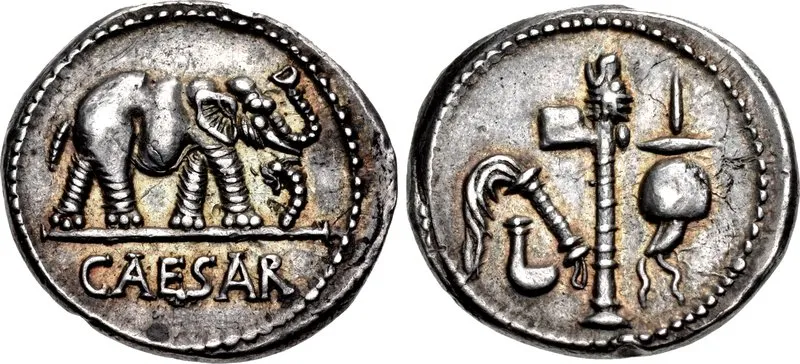
Personally, I like to distinguish three types or styles: the pot-bellied one, the long-legged one and the ugly one. The images make the idea clear:
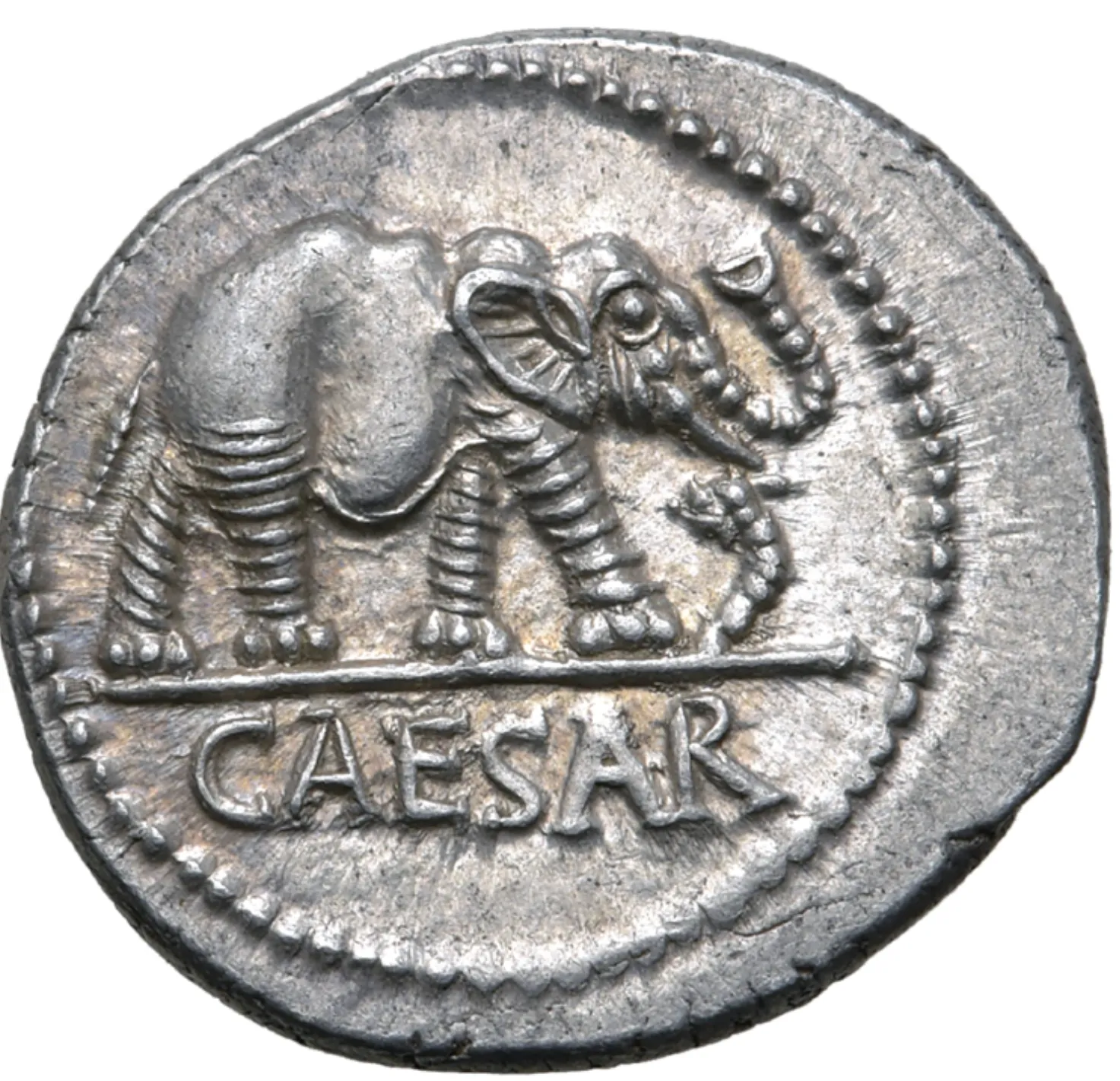 | 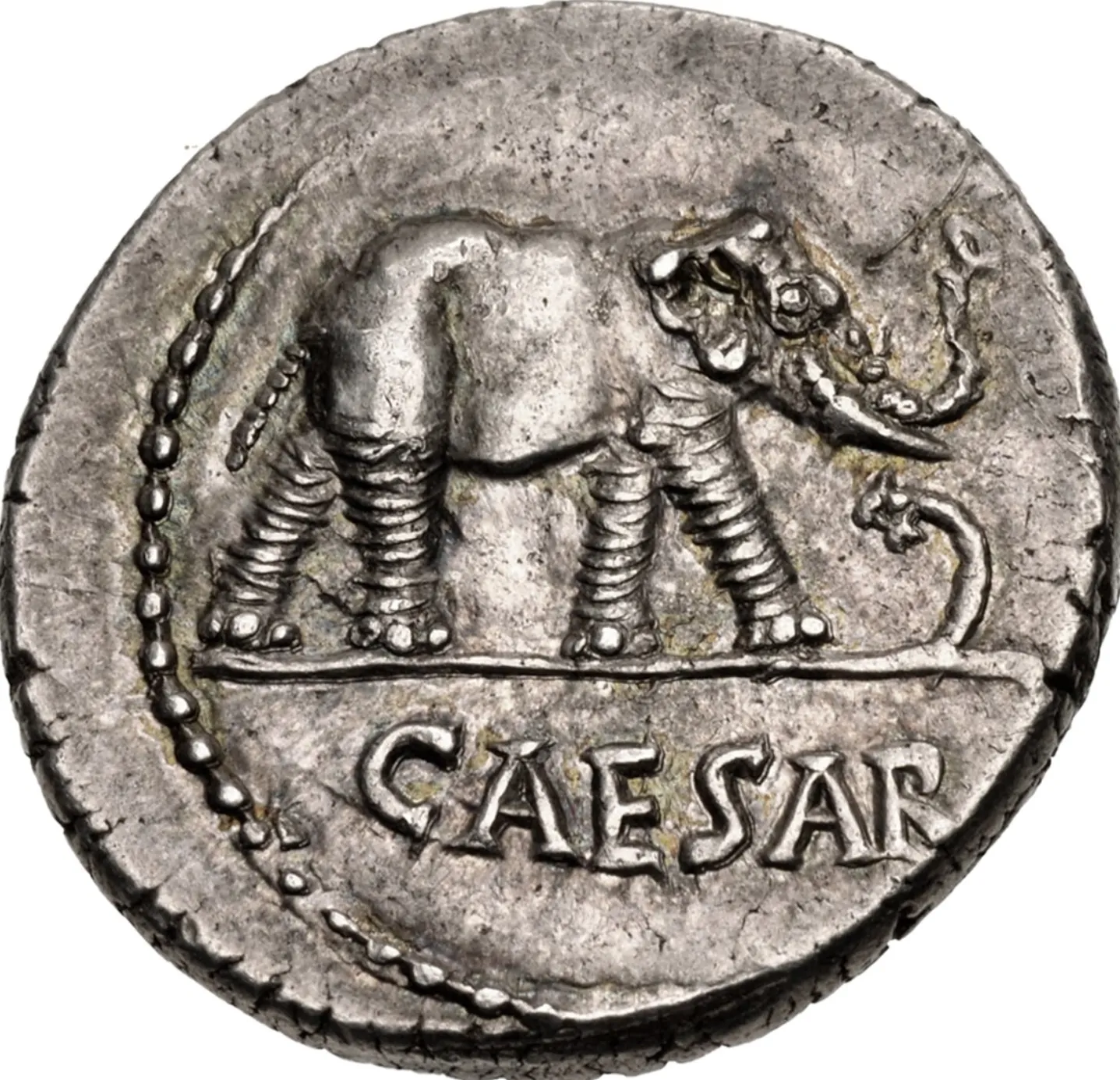 | 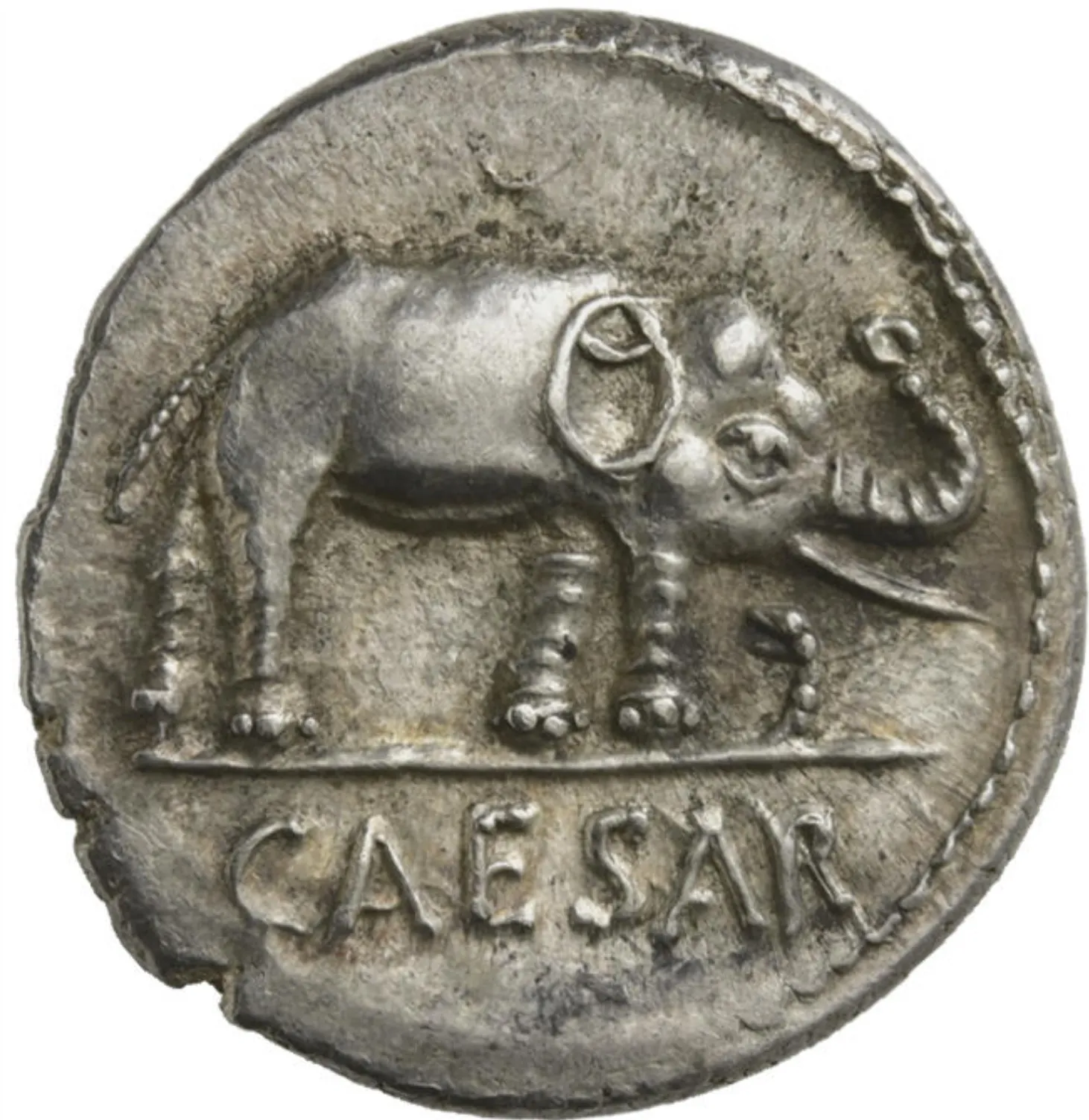 |
However, there are at least six types or distinct issues of this coin. Three types are distinguished by features of the elephant: fatter or slimmer, with a longer or shorter trunk, with longer tusks, or in a cruder style. There are also rarities in which the exergue reads CA2ESAR (the 2 acting like a reversed S), CAESAR with joined AE, or CASESARC.
As for the year in which this denarius was struck, some authors place it in the period 54-51 BC, in the middle of the Gallic War. At that time all legal coinage was produced under senatorial control, and the salaries of the troops under Caesar’s command were paid from the public treasury, so Caesar had no need to mint coinage.
However, with the outbreak of hostilities between Caesar and Pompey, when Caesar crossed the Rubicon in 49-48 BC, senatorial control over coinage effectively disappeared, and Caesar then needed large quantities of denarii to pay his legions. He later had to face Pompey and his followers, leading to the Battle of Pharsalus in 48 BC.
2# GALLIC TROPHIES, 48/47 BC.
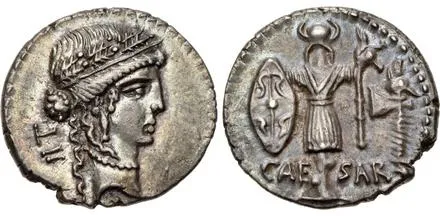
In his second monetary issue, produced at a travelling mint between 48 and 47 BC, Caesar struck a group of five coins: one aureus, one quinarius and three denarii. Their obverses are the same, while the reverses show some differences.
On Crawford 452/2, the obverse shows a female head wearing an oak wreath. Although it may not be possible to identify the deity with certainty, the oak wreath recalls Caesar’s policy of saving citizens’ lives. The deity could be identified with Pietas or Clementia, although not all specialists agree with this interpretation. The reverse shows Gallic trophies. The message could well be: “Caesar, through clemency, wins victories over the Gauls.” (Obverse/reverse dies: 63 / 70).
3# GALLIC CAPTIVE, 48/47 BC.
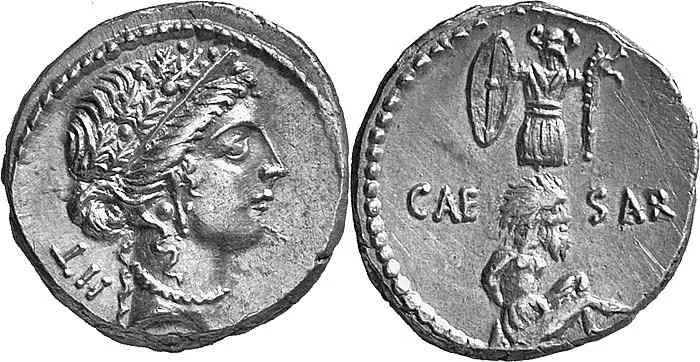
In this same group of three denarii we find Crawford 452/4 and 452/5. The obverse shows a deity wearing a pearl necklace, diadem and oak wreath, probably Pietas. On the reverse, the axe has been removed and a captive appears beside the trophies. Some believe this could be Vercingetorix, although he was surely not the only Gaul with a beard and long hair.
This type is considered extremely rare; 30 obverse dies and 33 reverse dies are known.
4# VENUS AND AENEAS, 47 BC.
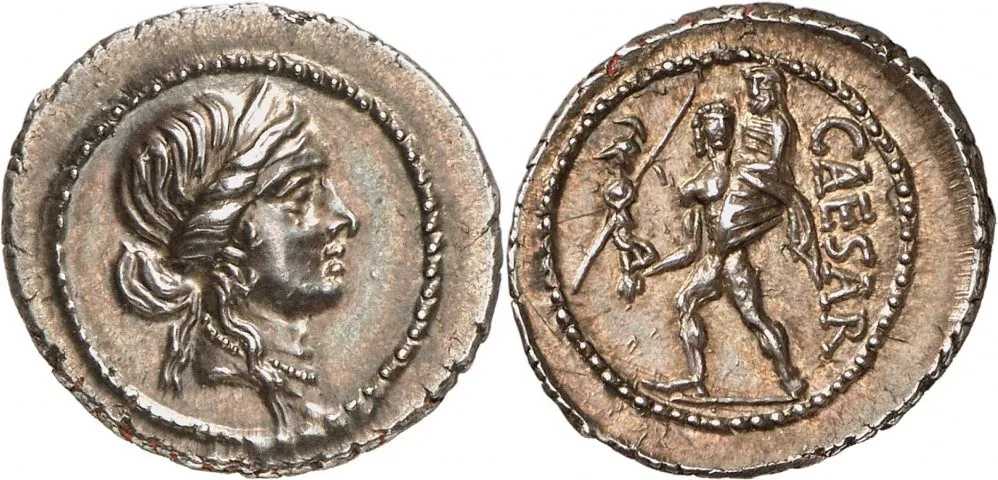
At the end of 47 or beginning of 46 BC, Caesar produced his third issue, with denarii struck for the African campaign (Crawford 458/1). Venus appears on Caesar’s coins associated with Aeneas carrying Anchises, creating a new message. On the obverse is Venus, the Roman goddess from whom the Julian family claimed descent and also the mother of Aeneas. On the reverse, Aeneas carries his father Anchises while fleeing Troy. The Trojans would ultimately be linked to the foundation of Rome.
For this coin, struck at a military mint in North Africa, 390 obverse dies and 433 reverse dies are known.
5 and 6# CERES, 46 BC.
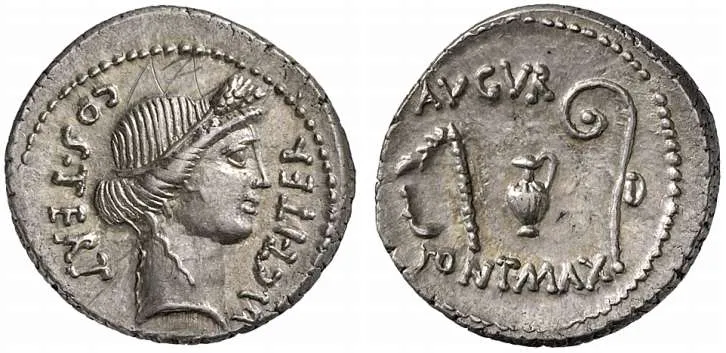
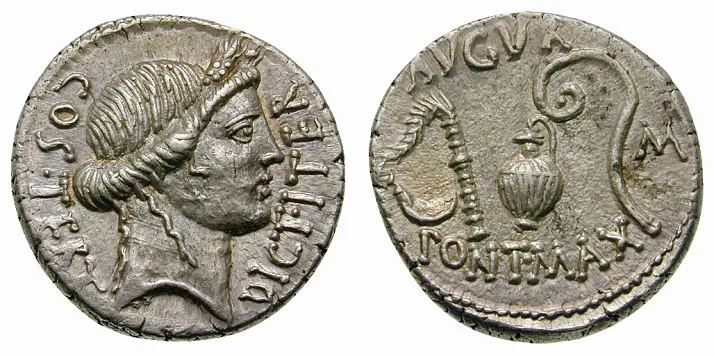
In his fourth issue, in 46 BC, CERES appears wearing a grain wreath. She was the goddess who travelled the world distributing seeds, and from her name comes the word cereal. This issue was struck at an uncertain mint, probably a military mint in Africa, after the victory over the Pompeians at Thapsus. This denarius has two variants (Crawford 467/1a and 467/1b).
On the obverse, beside the goddess Ceres, Caesar is identified as dictator and consul. The reverse again shows the implements of the Pontifex Maximus. In one case the letter M appears, for munus or gift; in the other, the letter D appears, for donativum. Evidently, both were used as Caesar’s donatives, either for his troops after winning the civil war or to satisfy the plebs.
(Dies for the two varieties, obv./rev.: 123 / 137)
7 and 8# CAPTIVE GAUL, 46 BC.
Between 46 and 45 BC, Caesar produced his fifth issue, made up of two similar denarii (Crawford 468/1 and 468/2), struck at a mint in Hispania. These are new types referring to Gaul, with a certain similarity to his second issue, but in this case the obverse no longer shows Pietas; it shows Venus. Beside the Gallic trophies on the reverse appears a female figure representing subdued Gaul.
Thus, reverses with Gallic trophies were issued first, then reverses with Gallic captives, and finally a female figure who may represent conquered Gaul. In addition, the obverse is no longer represented by Pietas, but by the goddess Venus, a clear allusion to the origin claimed by the Julian family.
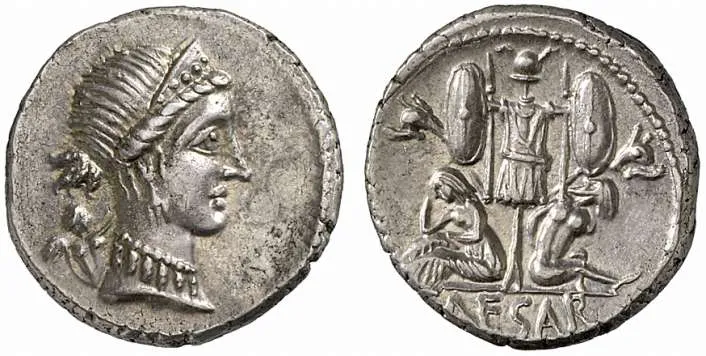
Obv.: Head of Venus right, wearing necklace and diadem; Cupid behind. Rev.: Trophy with oval shield and carnyx on each side; on the left, a seated female captive with her head resting on her right hand; on the right, a seated bearded captive with his hands tied behind his back; in the exergue, CAESAR. (Crawford 468/1; obv./rev. dies: 135 / 150).
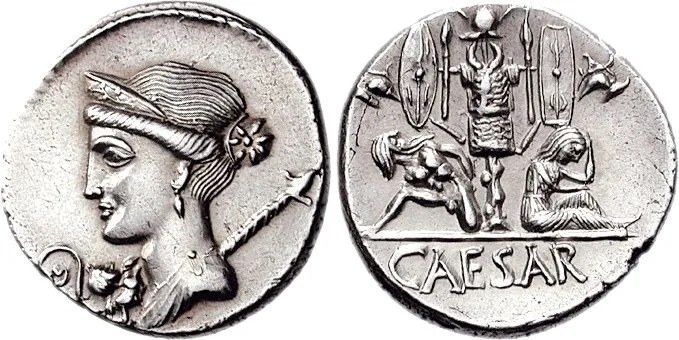
Obv.: Bust of Venus left, draped, wearing diadem and with a star in her hair; Cupid on the shoulder, sceptre behind and lituus to the left. Rev.: Trophy with oval shield and carnyx to its right, rectangular shield and carnyx to its left; on the left, a kneeling bearded captive with his hands tied behind his back; on the right, a seated female captive with her head resting on her right hand; in the exergue, CAESAR. (Crawford 468/2; obv./rev. dies: < 30 / < 33). A rare and scarce specimen.
9# THE UNCERTAIN TYPE, 44 BC.
In 44 BC a denarius was struck that has caused major disagreement among specialists: some consider it the last solo issue of Julius Caesar, others the first of Octavian, while others argue that it should belong to a series issued in 48 BC with Gallic messages.
This denarius was most likely struck in 44 BC, although the month is unknown, and it was produced at an uncertain mint. Many questions remain around this coin.
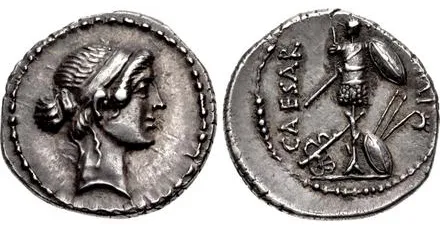
Obv.: Head of Venus right. Rev.: Trophy; to the left, chariot; to the right, oval shield, two spears and carnyx; on the left C. CAESAR or CAESAR, upward; on the right IMP, downward. (Crawford 482/1; obv./rev. dies: < 30 / < 33). Very rare specimen.
CNGCOINS NOTE: Considered by Crawford to be the last denarius struck by Julius Caesar, the Gallic chariot beneath the trophy is the key to identifying it as RRC 482. It has never been clear whether this was the last issue of Julius Caesar or the first of Octavian, but Michael Crawford treats it as a very late issue of the Dictator, RRC p. 94: “No. 482. The titulature of this very rare issue resembles that of no. 480/-5 [Julius Caesar, the first issues with Mettius, Buca and Macer]; there is no evidence for where it was struck”; RRC p. 736: “for the chariot, which forms part of the trophy of no. 482, compare the chariot on no. 448/2” [the Vercingetorix question is explicitly linked to Caesar’s victories]. David Sear considers it an early Octavian issue, but without positive evidence; he acknowledges that CAESAR IMP matches the RRC 480 types, but has difficulty understanding why a Caesar type struck in early 44 BC would allude to his victories in Gaul. The fact that an anomalous die reads C.CAESAR IMP (see the coin illustrated in Arma et Nummi) instead of CAESAR IMP does not help Crawford link the coin with the RRC 480 series. Bahrfeldt and Woytek accept it as Caesarian because of the types. Bahrfeldt suggests a date just after the Gallic Wars and a Sicilian mint, as with the Allienus denarius; Alföldi in 1971 SMB also discusses this. In my opinion, Crawford’s dating to 44 BC breaks down once the titles do not exactly match the RRC 480 series. In the absence of that, since the obverse and trophy type are similar to RRC 452 and RRC 468, and especially considering the chariot, I would have to agree with Bahrfeldt and place this type in 49 or 48 BC as a campaign issue.
Extremely rare, with no examples seen in major auctions between the Ryan sale in 1952 and the Lanz example in 2007. [Andrew McCabe]
B - DENARII WITH OR WITHOUT CAESAR’S BUST STRUCK BY MONEYERS (Second Group)
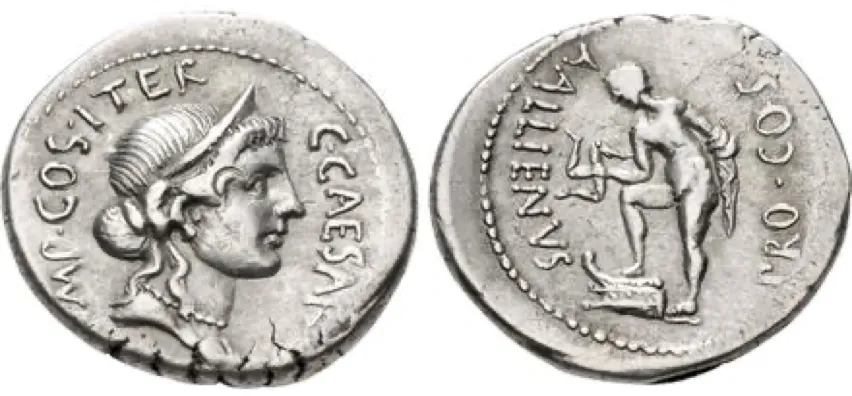
Aulus Allienus (proconsul in 47 BC). Without Caesar’s bust.
Obv.: Diademed bust of Venus right; before, C. CAESAR downward; behind, IMP COS ITER upward. Rev.: Trinacrus left, resting his right foot on a prow and holding a triquetra in his right hand, with a cloak over his left arm; around, A. ALLIENVS. PRO. COS. (Crawford 457; struck in 47 BC in Sicily; obv./rev. dies: < 30 / < 33)
Shortly before his assassination, Caesar pressured the Senate to allow his bust to appear on coins. The number of moneyers increased to four (Quattuorviri) and, for the first time in Roman history, the bust of a living individual would appear on coinage.
In total, 24 denarii with Crawford references were issued by the following four moneyers while Caesar was alive:
- Lucius Aemilius Buca, 5 denarii.
- Marcus Mettius, 5 denarii.
- P.Sepullius Macer. 11 denarii.
- C.Cossutius Maridianus. 3 denarii.
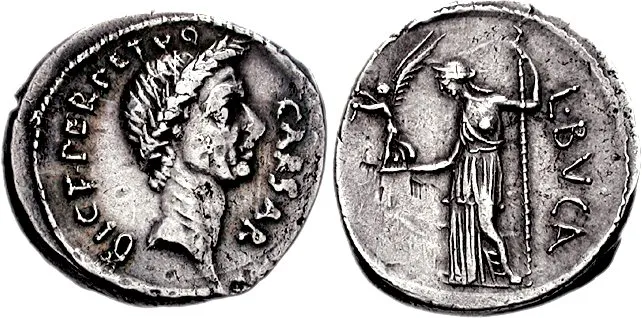
Lucius Aemilius Buca (5 Denarii, Crawford 480/4; 480/6; 480/7a; 480/7b; 480/8)
Crawford 480/4. Obv./rev. dies: 36 / 36
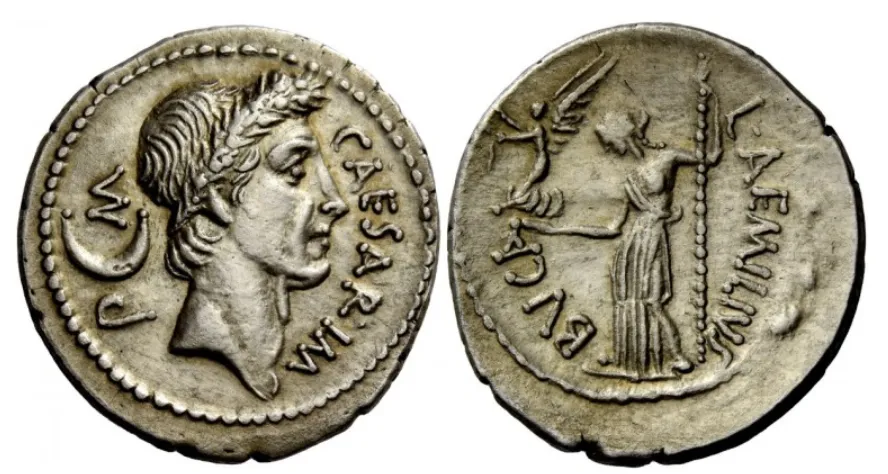
Crawford 480/6. Obv./rev. dies: 11 / 17
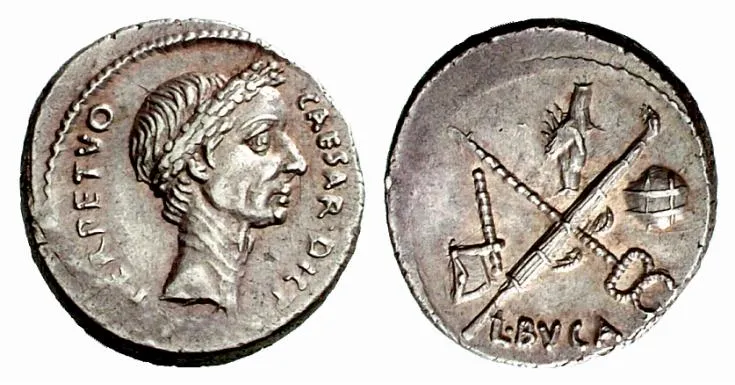
Crawford 480/7a
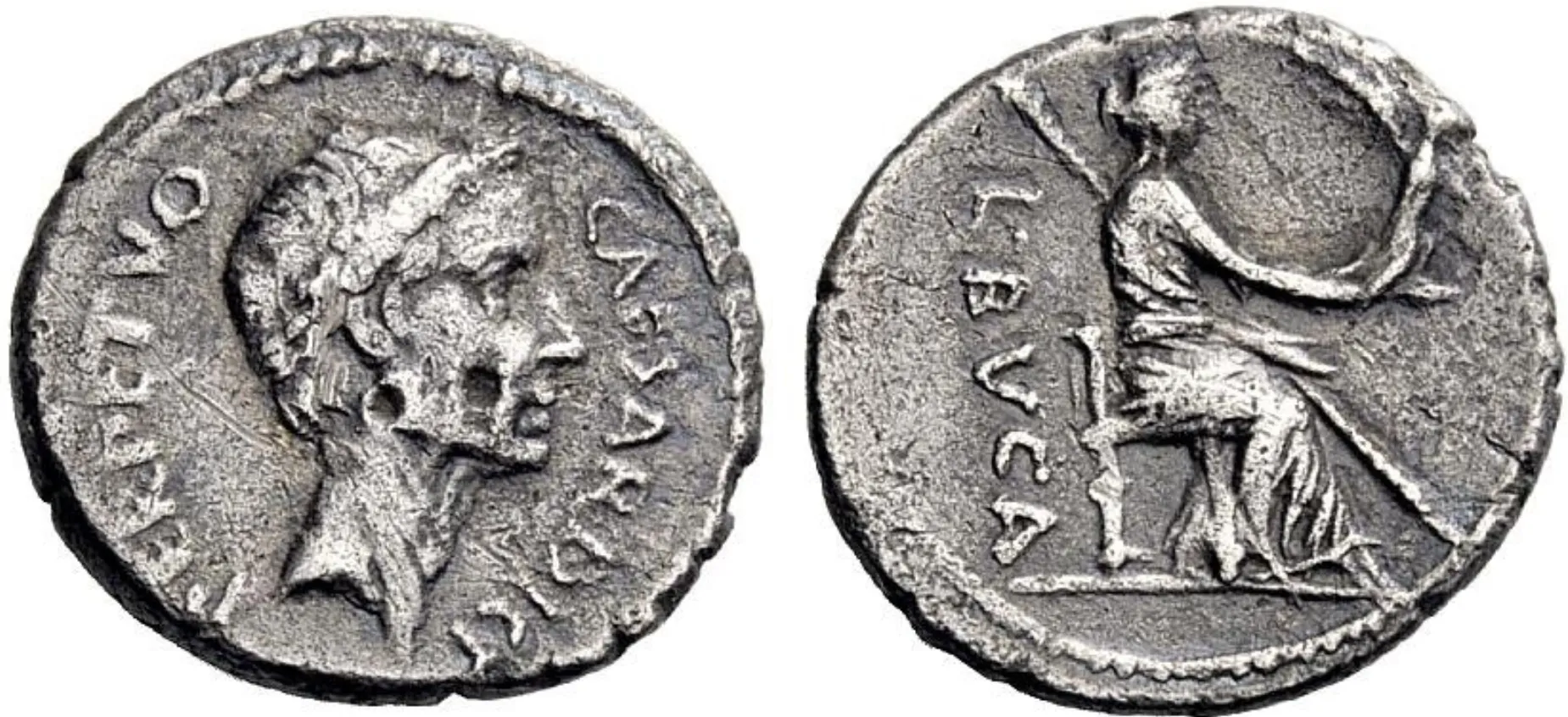
Crawford 480/7b Obv./rev. dies: 1 / 2 (a) and 12 / 15 (b)
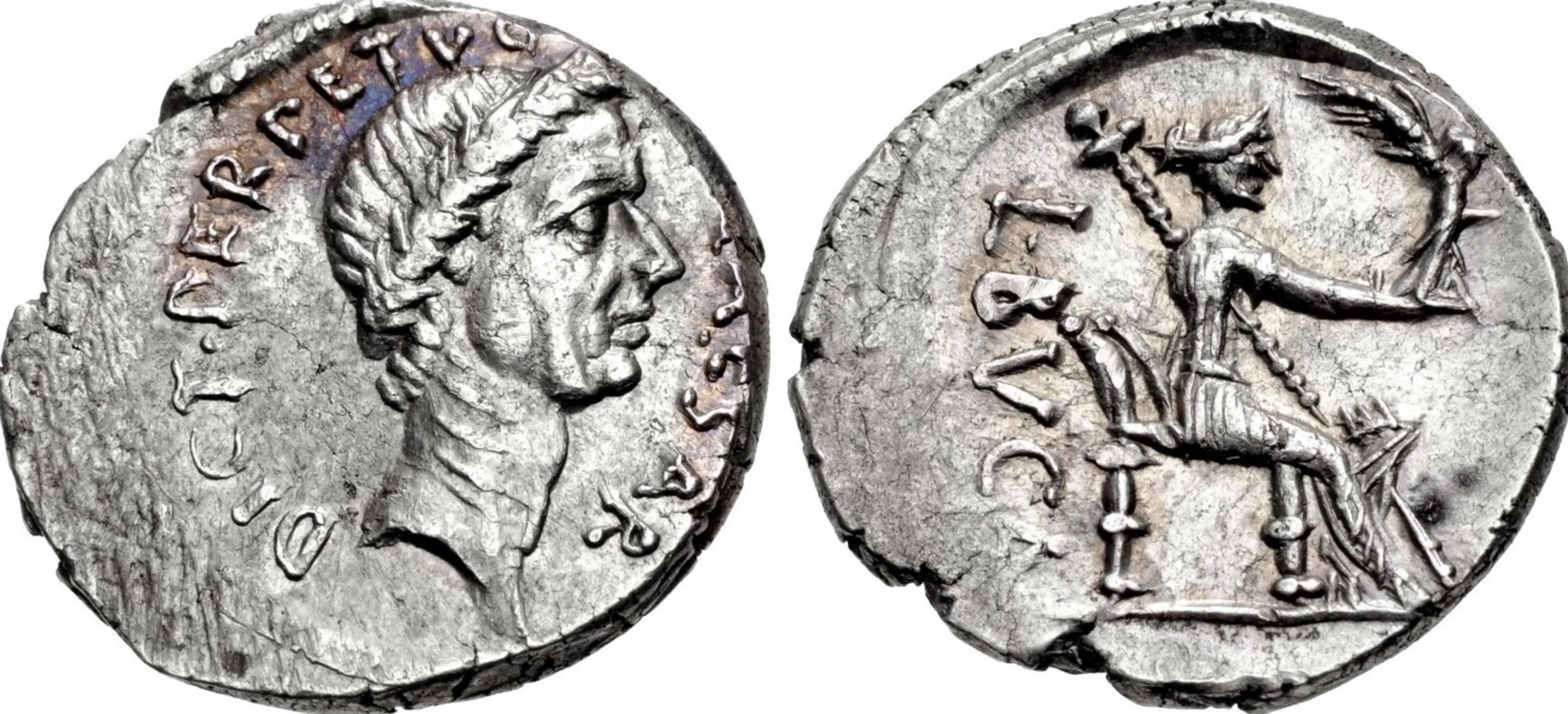
Crawford 480/8. Obv./rev. dies: 24 / 28
Marcus Mettius (5 denarii. Crawford: 480/2a; 480/2b; 480/2c; 480/3; 480/17)
Crawford 480/2a,b,c. Obv./rev. dies: 8 / 7 (the three varieties)
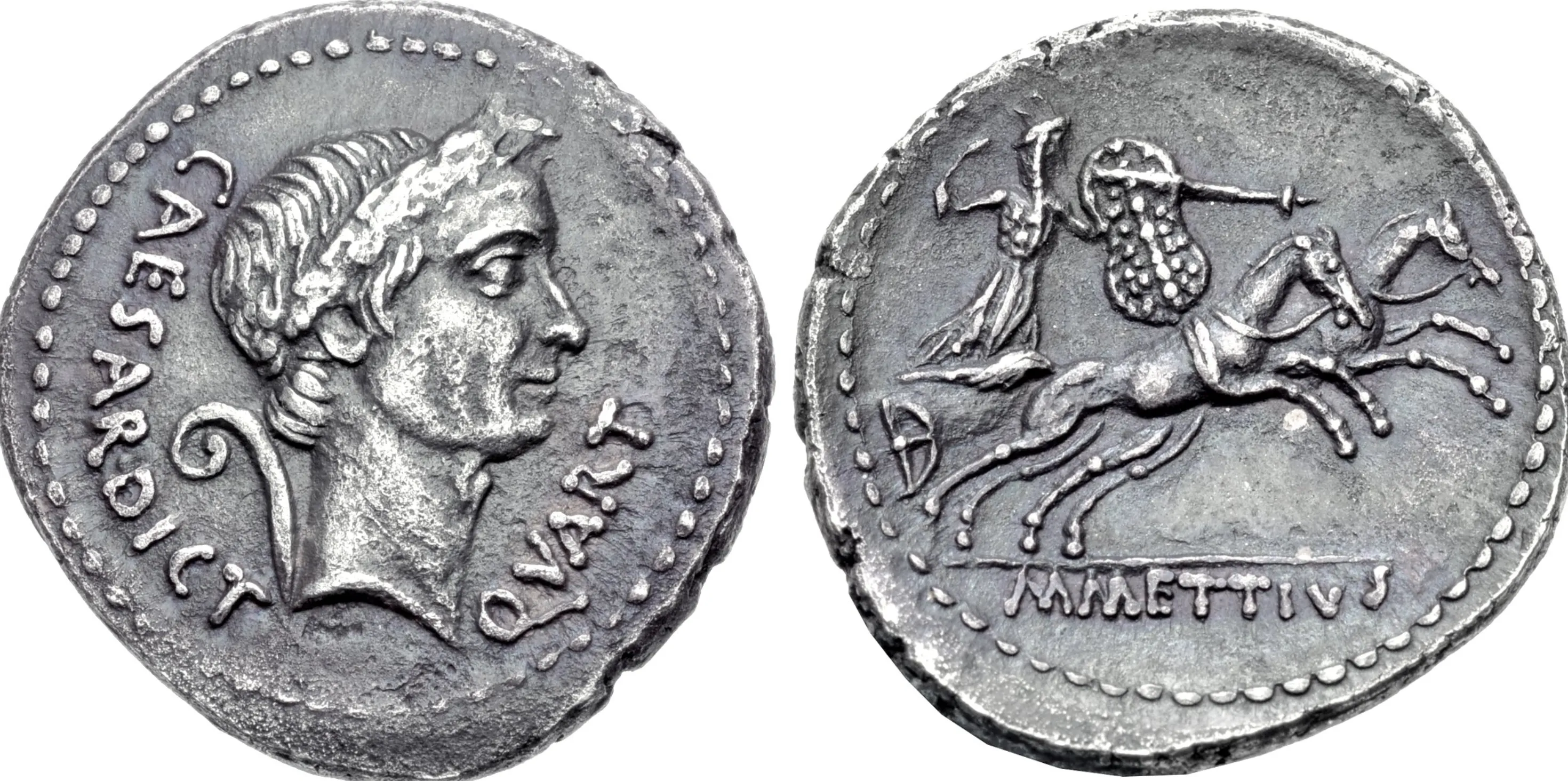
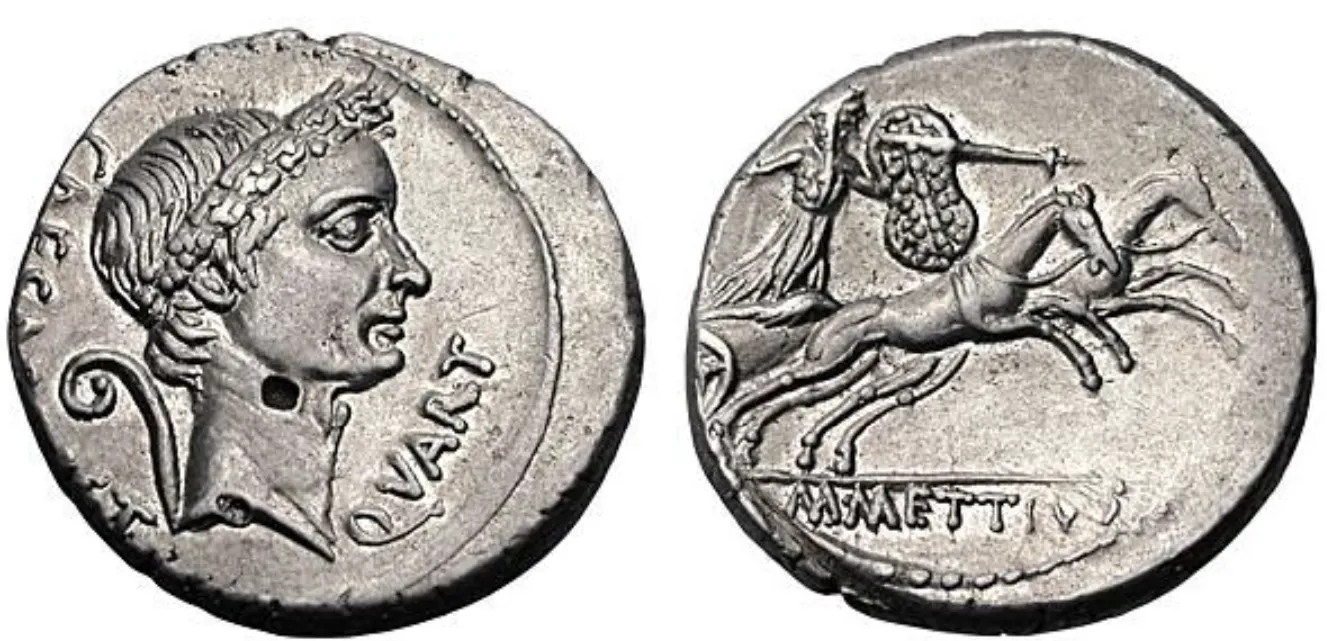
*with the obverse lituus turned to the right.
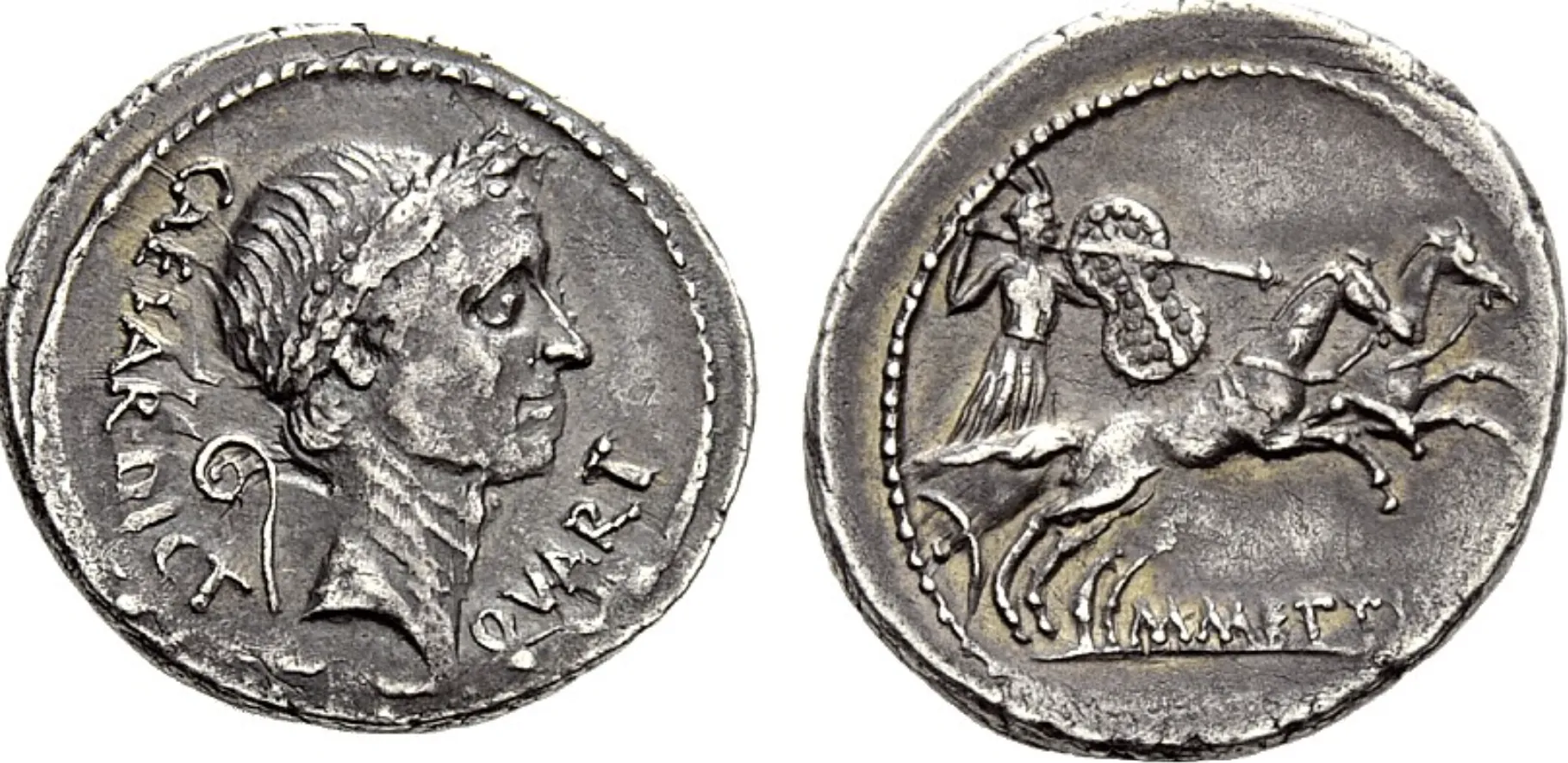
Crawford 480/3. Obv./rev. dies: 36 / 45
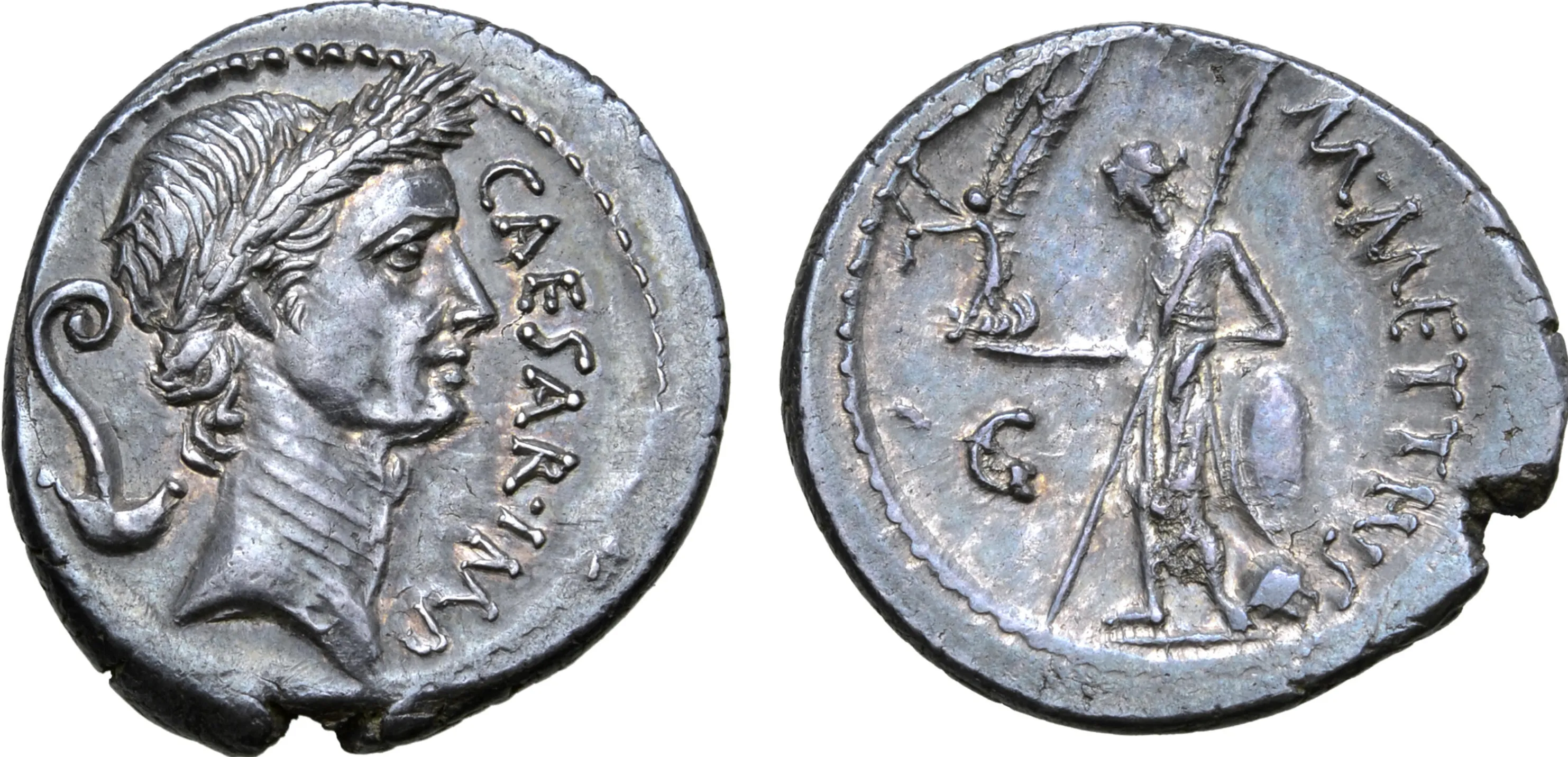
Crawford 480/17. Obv./rev. dies: 28 / 40
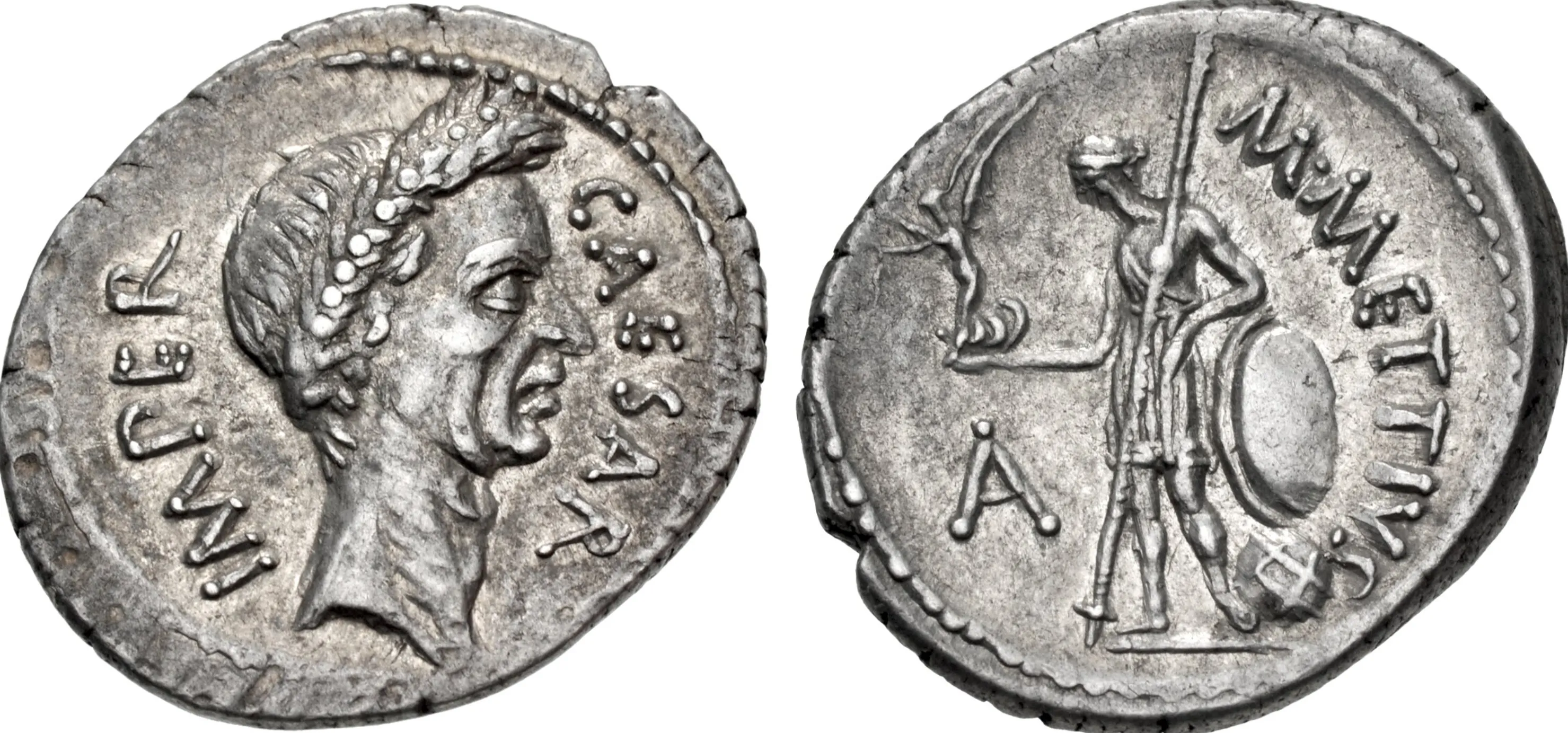
P. Sepullius Macer (11 denarii. Crawford: 480/5a; 480/5b; 480/9; 480/10; 480/11; 480/12; 480/13; 480/14; 480/18; 480/20; 480/21.)
Crawford 480/5a,b. Obv./rev. dies: 45 / 42 (both varieties)
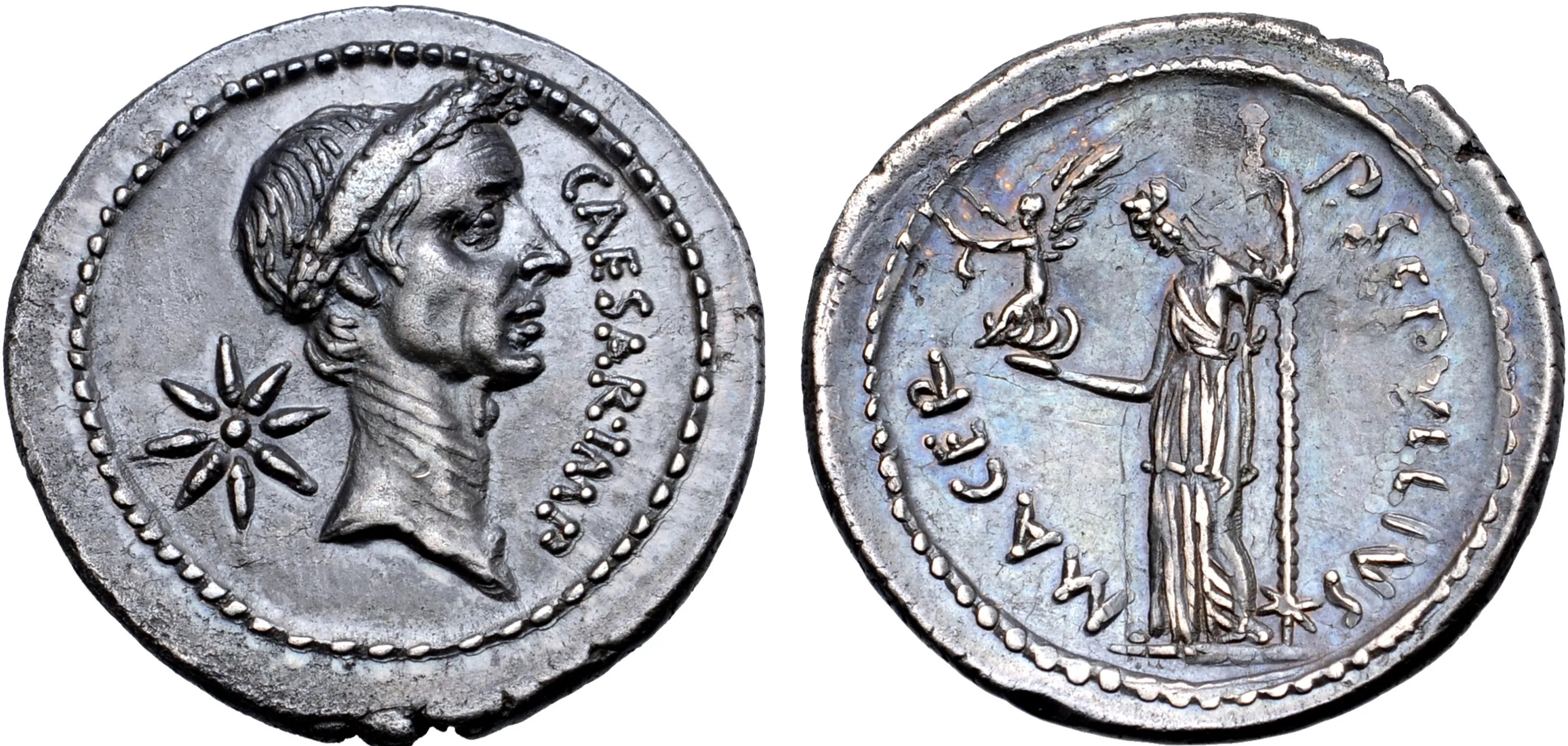
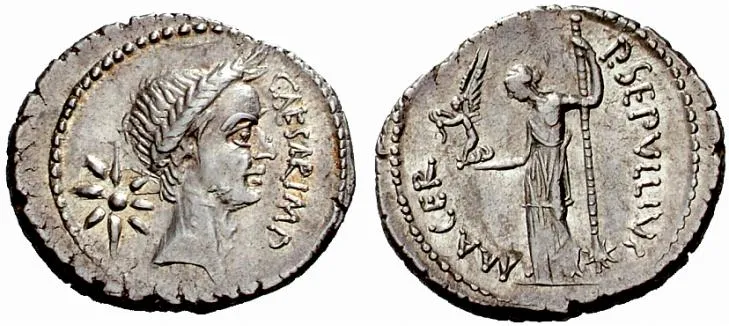
Crawford 480/9. Obv./rev. dies: 1 / 1
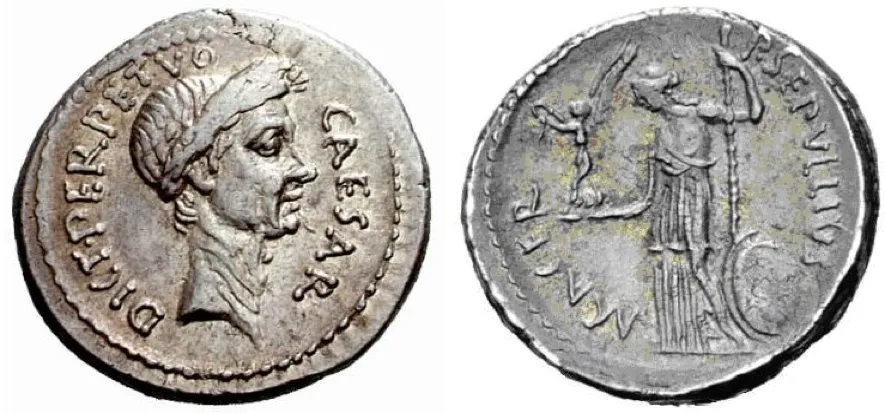
Crawford 480/10. Obv./rev. dies: 12 to 20 / 15 to 23
Rev.: Similar to 9, but with MACER downward.
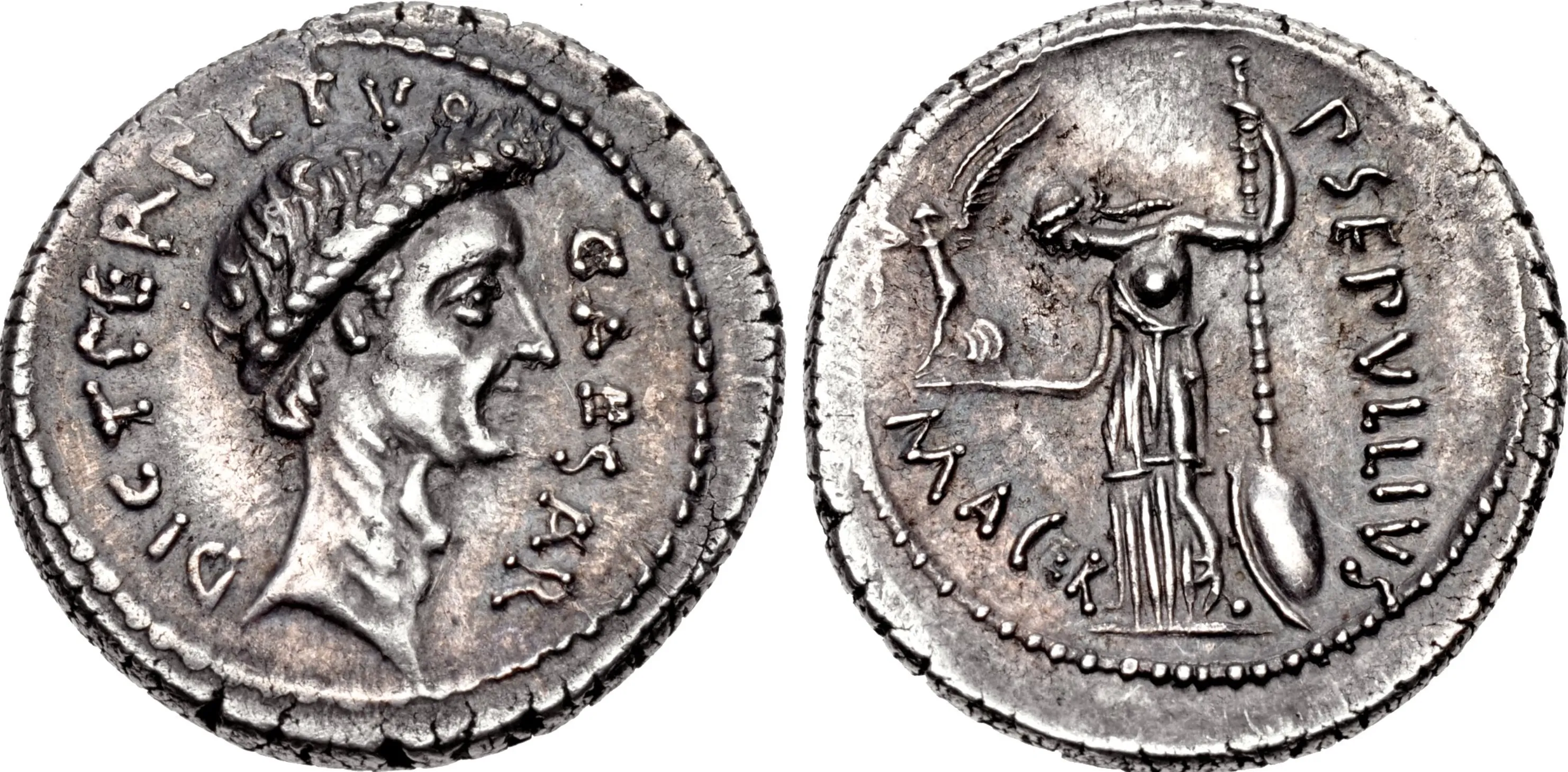
Crawford 480/11. Obv./rev. dies: 17 to 21 / 20 to 24
Rev.: Similar to 10, but with a star at the base of the sceptre.
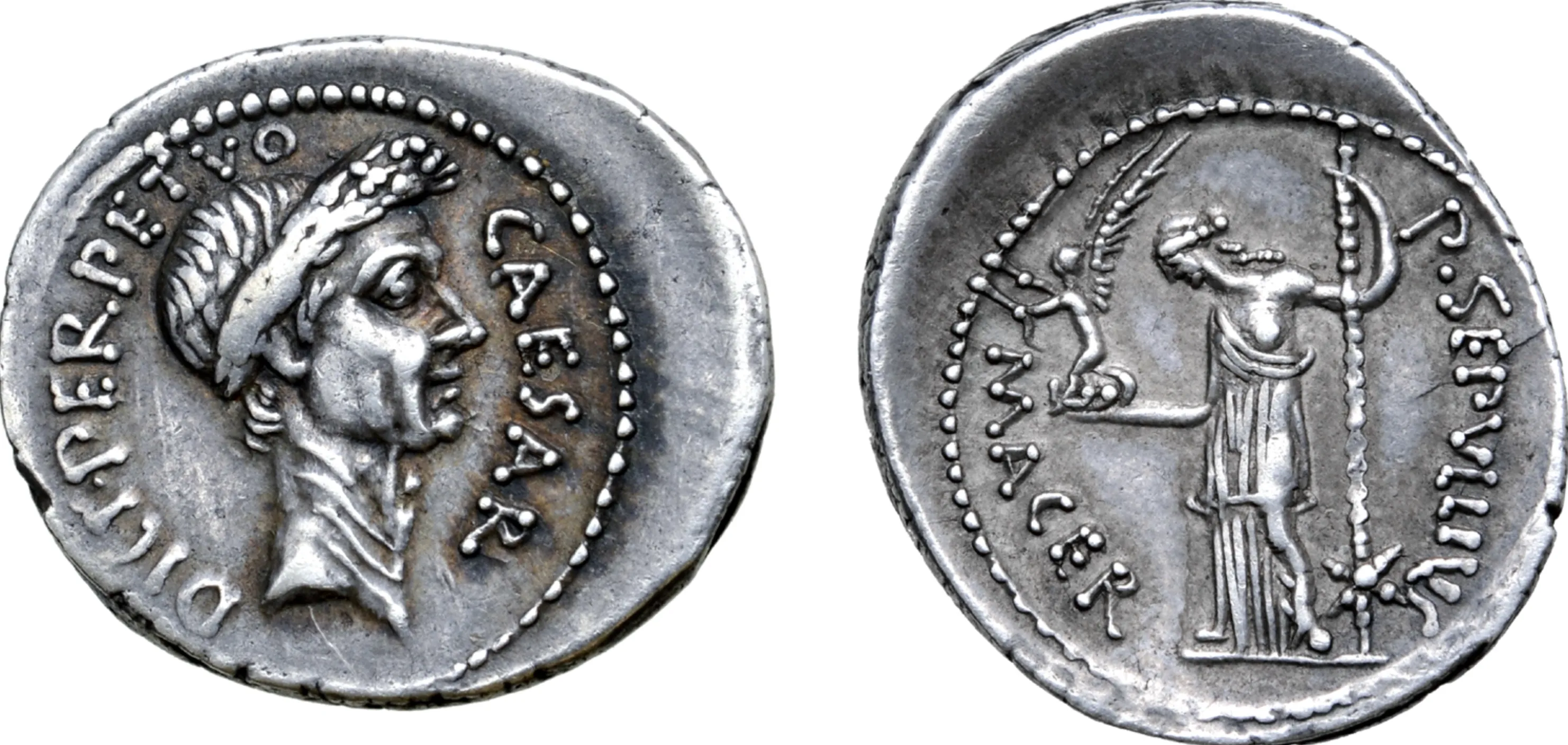
Crawford 480/12. Obv./rev. dies: 1 / 1
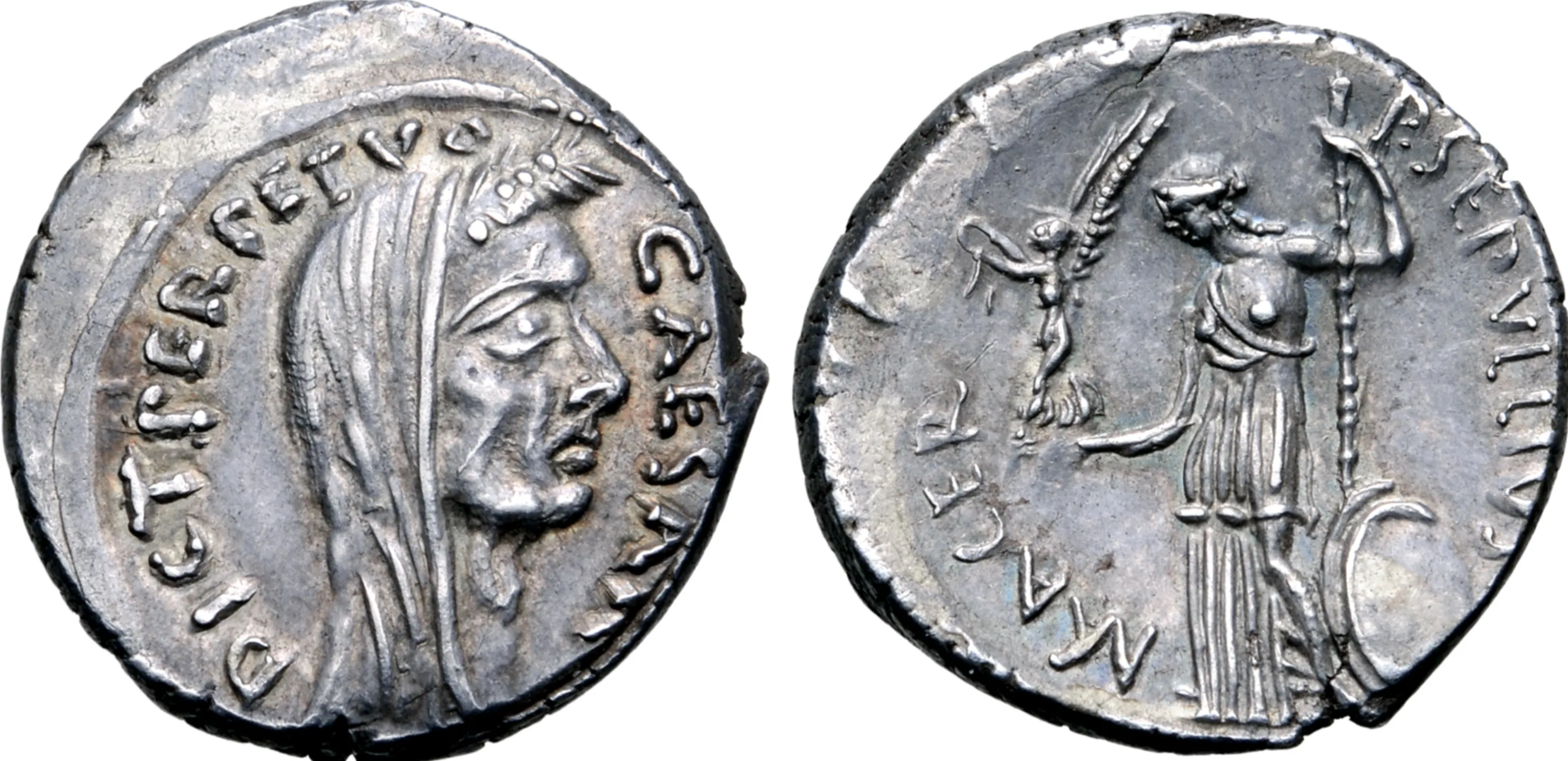
Crawford 480/13. Obv./rev. dies: 73 / 68 to 76
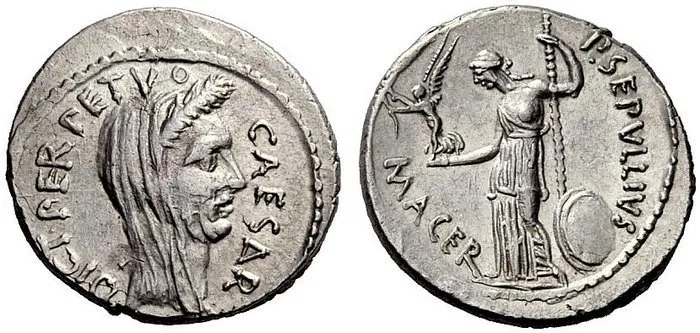
Crawford 480/14. Obv./rev. dies: 7 / 5 to 9
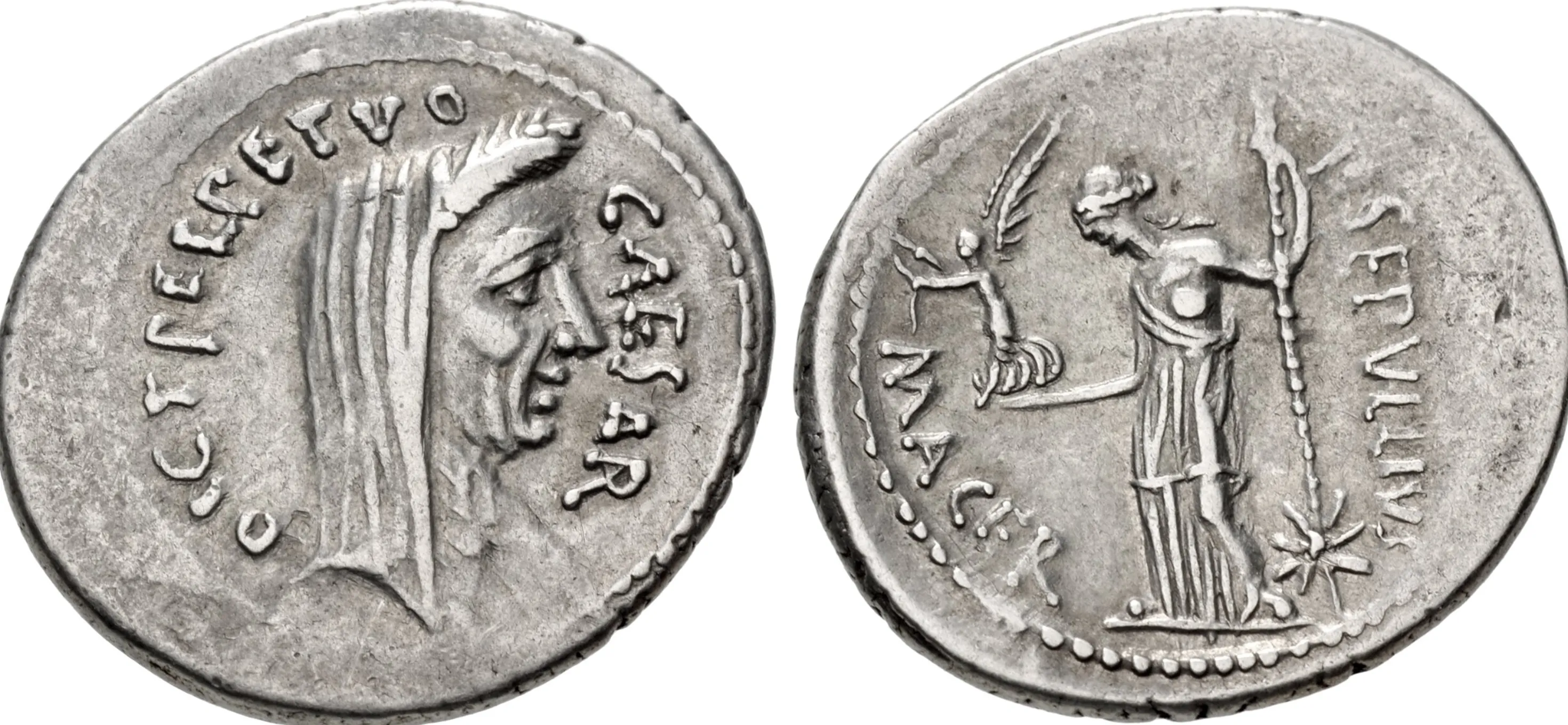
Crawford 480/18. Obv./rev. dies: 6 / 8
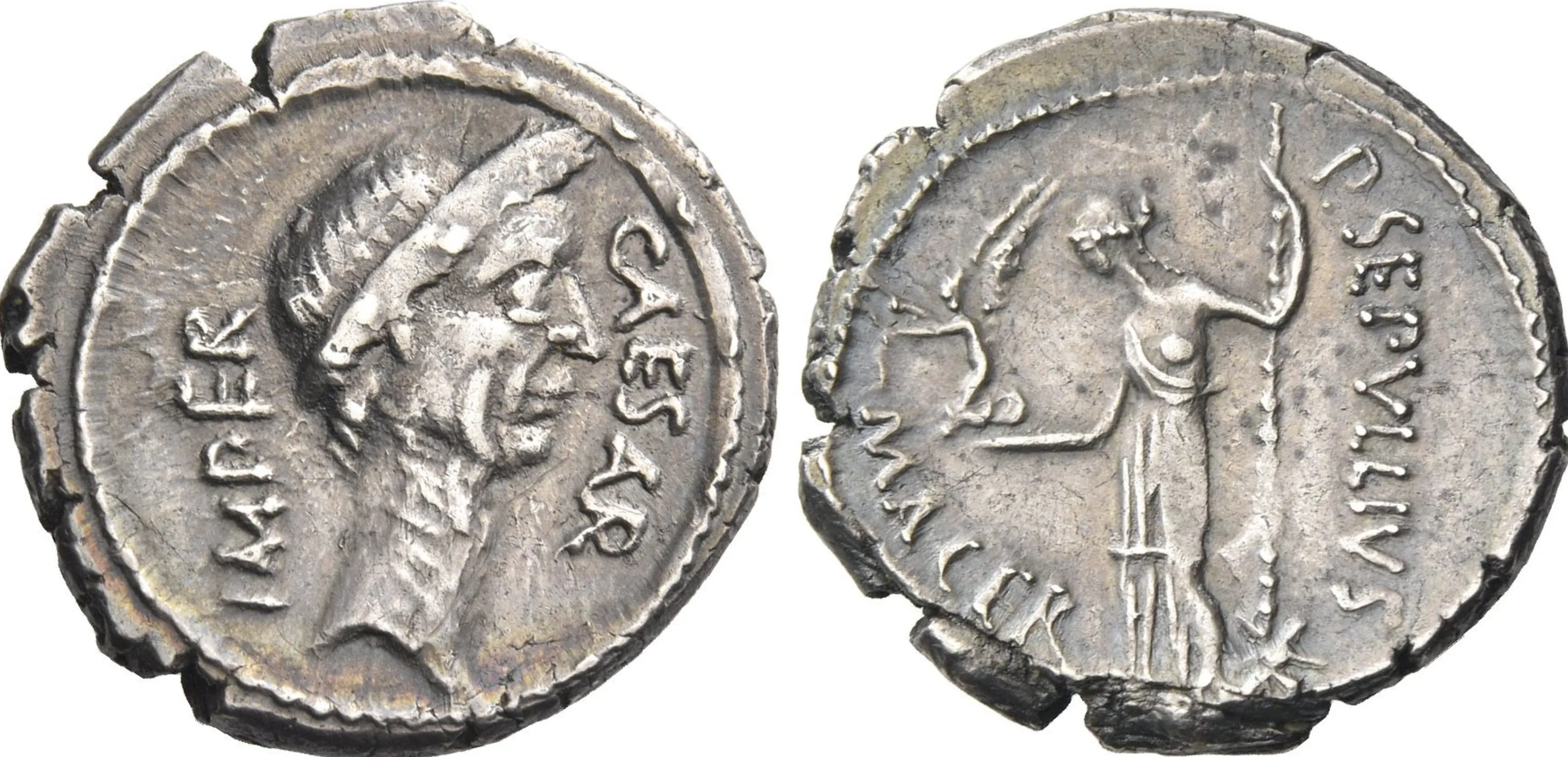
Crawford 480/20. Obv./rev. dies: 1 /1
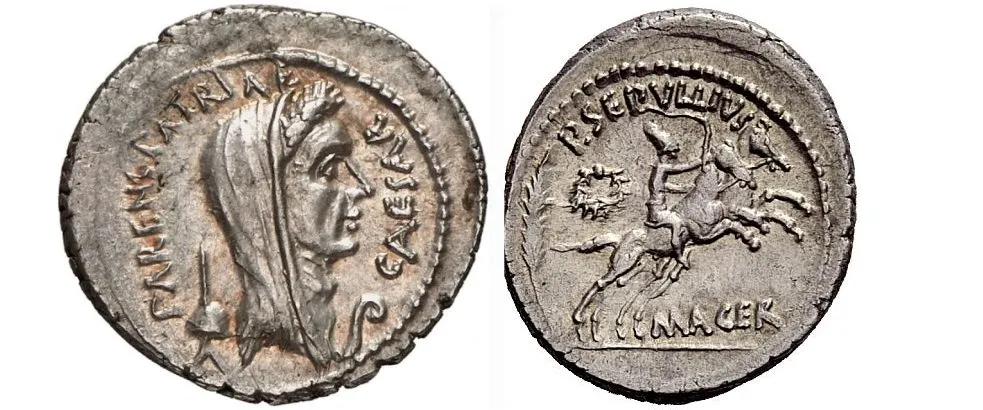
Crawford 480/21. Obv./rev. dies: 5 / 3 to 6
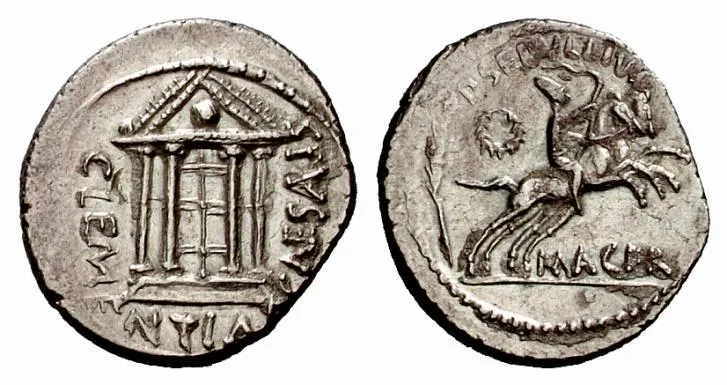
C. Cossutius Maridianus (4 denarii. Crawford 480/15; 480/16; 480/19)
Crawford 480/15. Obv./rev. dies: 5 / 5 to 13
Obv.: Laureate head of Julius Caesar right, veiled; before, CAESAR; behind, DICT IN PERPETVO. Similar to 12, but with the legend DICT PERPETVO (P. Sepullius Macer).
Rev.: Venus standing left with Victory in her right hand, resting her left elbow on a shield which in turn rests on a globe. To the right, C. MARIDIANVS. (Venus has no sceptre).
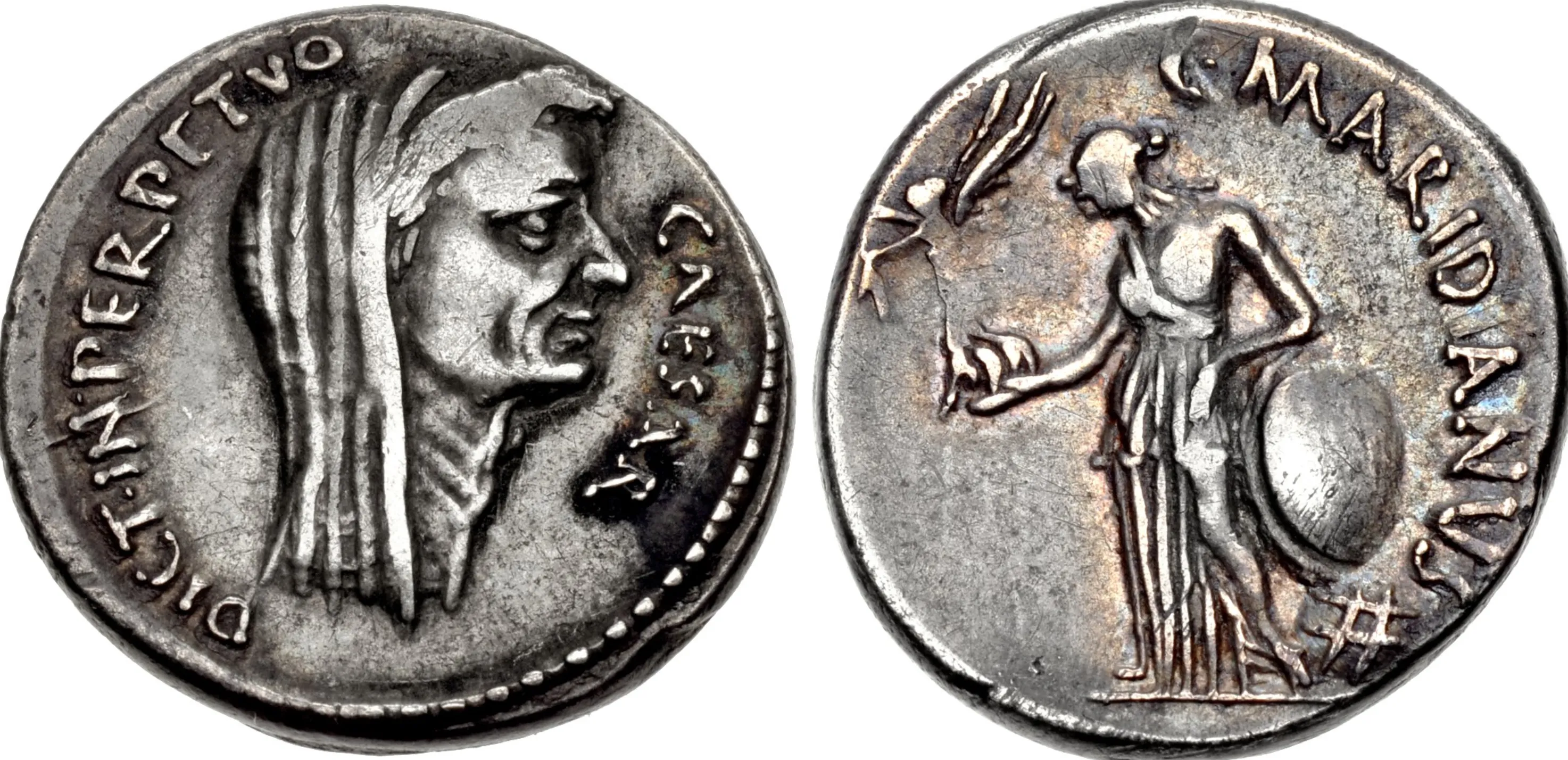
Crawford 480/16. Obv./rev. dies: 10 / 5 to 13
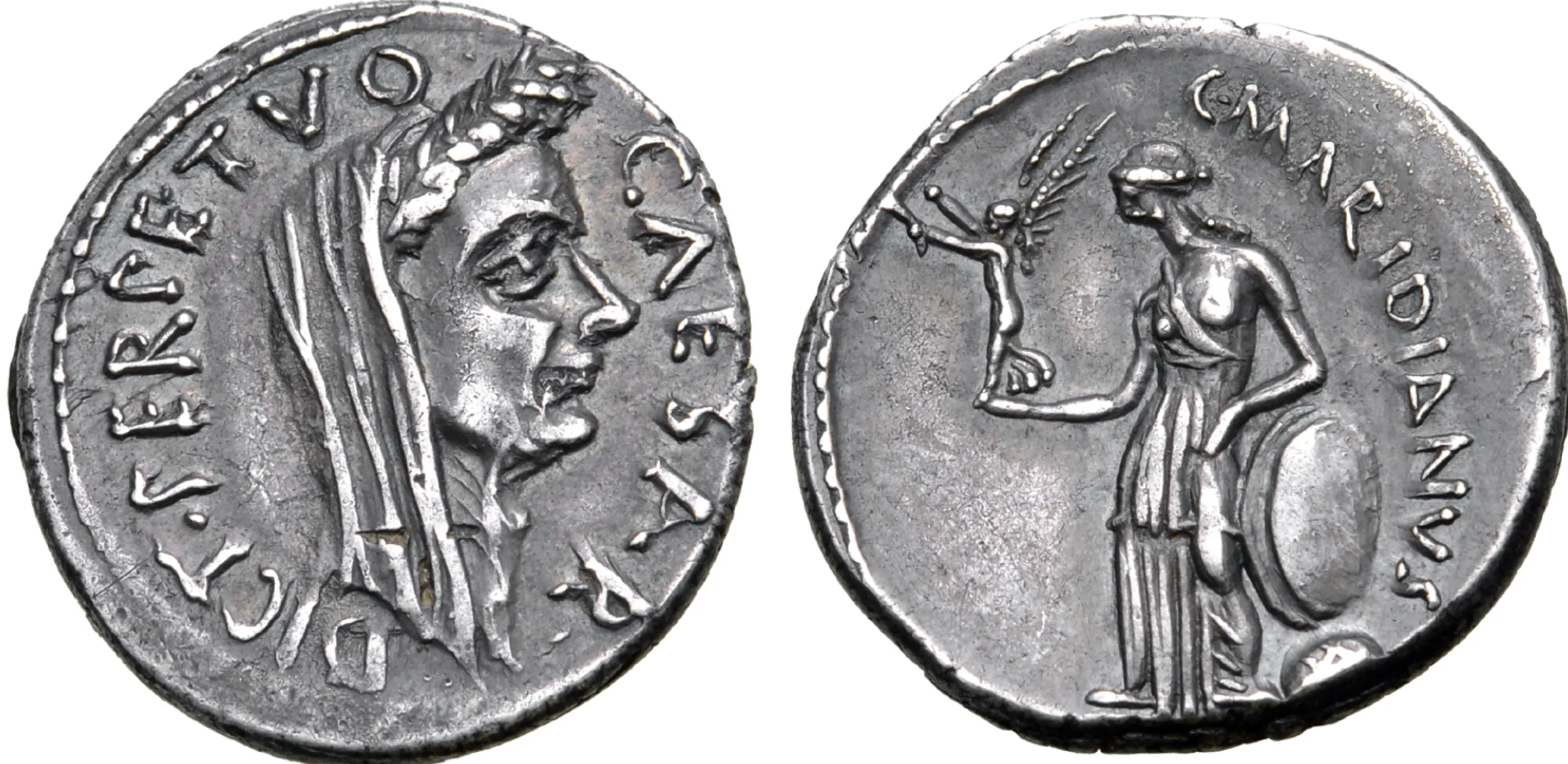
Crawford 480/19. Obv./rev. dies: 14 / 14
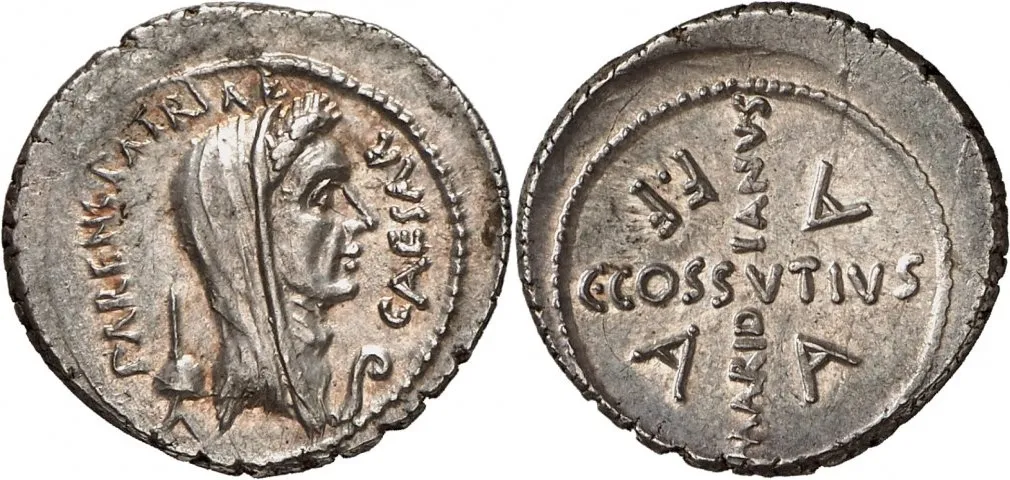
In several cases the dies for these denarii were interchanged, both obverse and reverse dies, even among different moneyers. As a result, in some cases it is extremely difficult to determine the exact number of dies used for each type, especially when a specific die was used for two or even more types.
C - POSTHUMOUS DENARII WITH THE BUST OF JULIUS CAESAR (Third Group)
After the death of Julius Caesar, Mark Antony, Octavian, Agrippa and other moneyers issued up to fifteen denarii with Crawford references on which the bust of Julius Caesar appeared: 485/1; 488/1; 488/2; 490/4; 494/16; 494/24; 494/39a; 494/39b; 525/3; 525/4a; 525/4b; 525/4c; 526/2; 526/4; 534/2.
- Lucius Flaminius Chilo, 1 denarius.
- Mark Antony, 2 denarii.
- Octavian, 1 denarius.
- P. Clodius, 1 denarius.
- L.Livienus Regulus, 1 denarius.
- L. Mussidius Longus, 2 denarii.
- Ti.Sempronius Gracchus, 4 denarii.
- Q. Voconius Vitulus, 2 denarii.
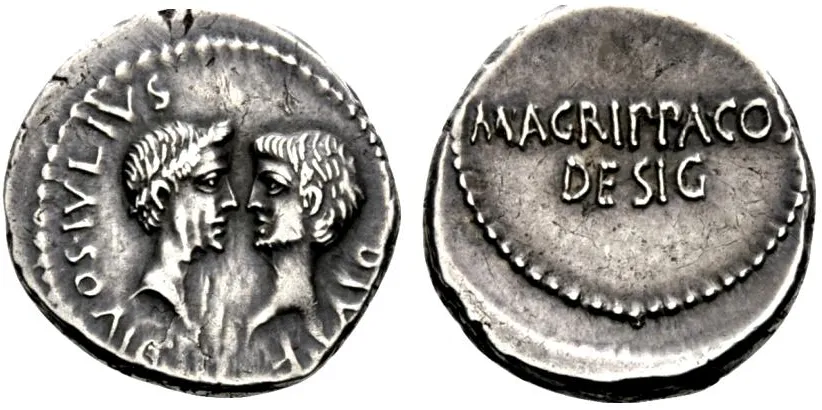
- Marcus Vipsanius Agrippa and Octavian, 1 denarius.
Lucius Flaminius Chilo.
Crawford 485/1. Struck in Rome in 43 BC. Obv./rev. dies: < 30 / < 33).
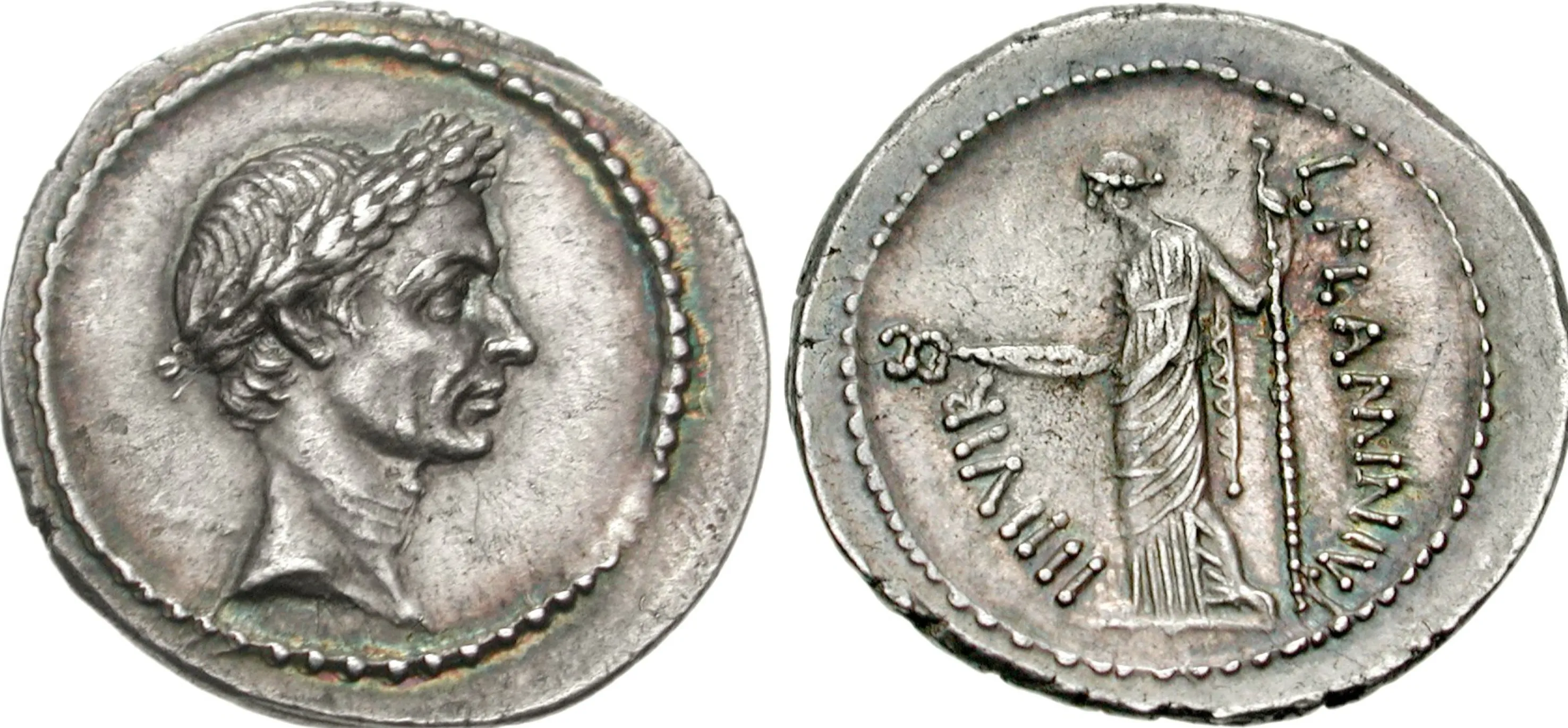
Mark Antony.
Crawford 488/1. Struck at a travelling mint in Transalpine and Cisalpine Gaul in 43 BC. Obv./rev. dies: < 30 / < 33
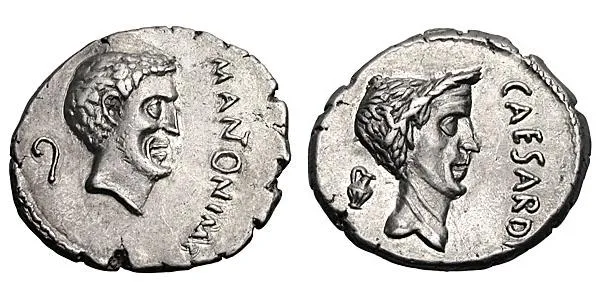
Crawford 488/2. Struck at a travelling mint in Transalpine and Cisalpine Gaul in 43 BC. Obv./rev. dies: < 30 / < 33
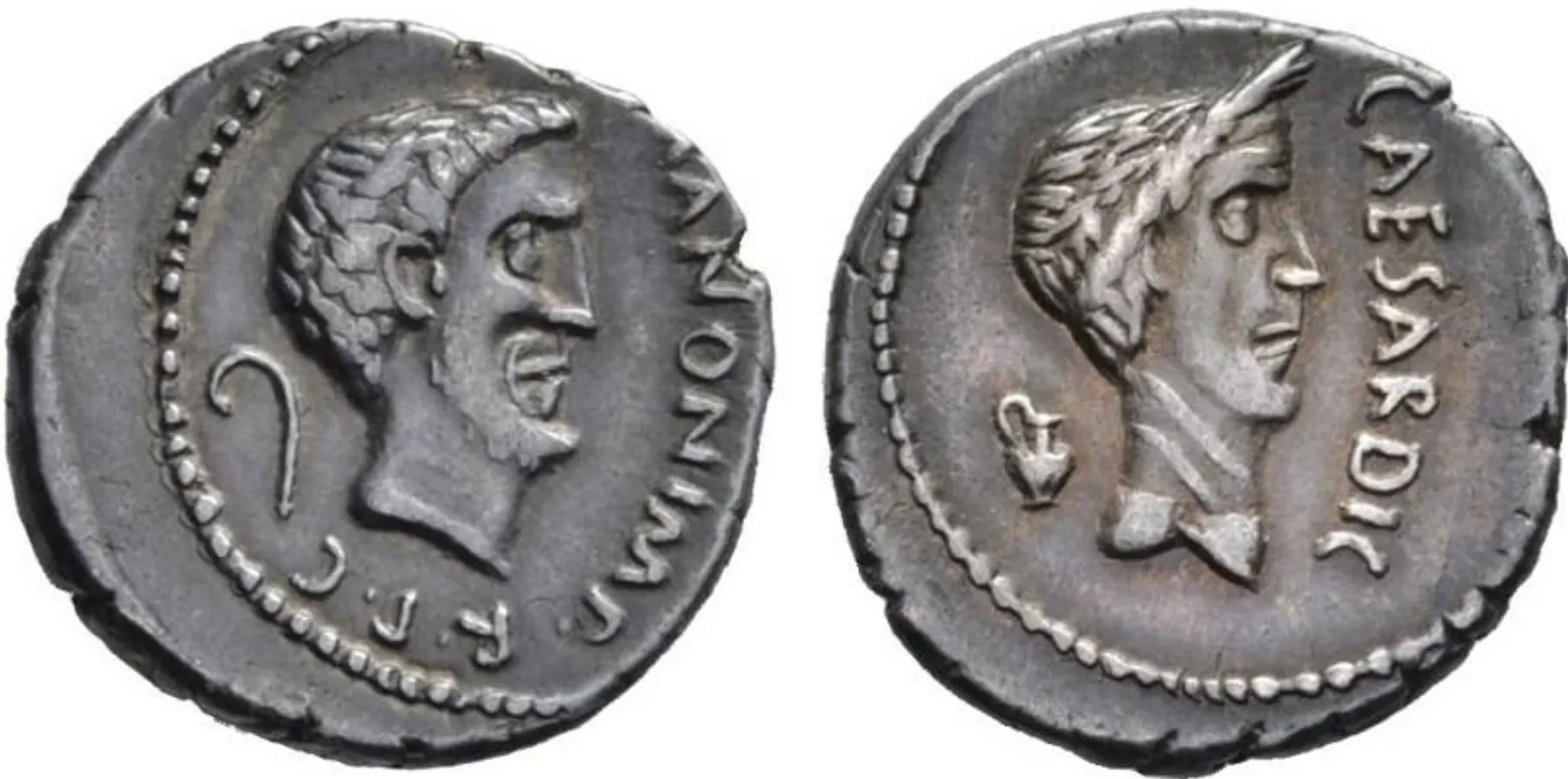
Octavian.
Crawford 490/4. Year 43 BC. Obv./rev. dies: 1 / 1.
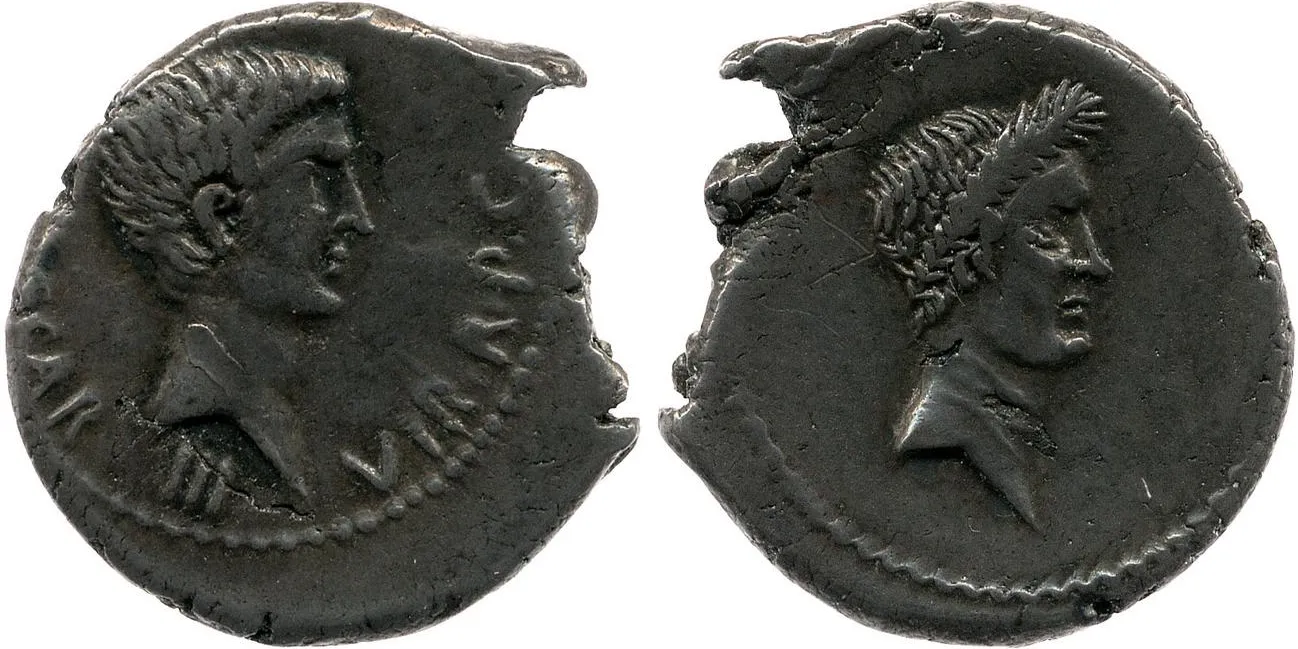
P. Clodius M.f. IIII VIR A.P.F
Crawford 494/16. Denarius struck in Rome, 42 BC. (Crawford 494/16). Obv./rev. dies: < 30 / < 33
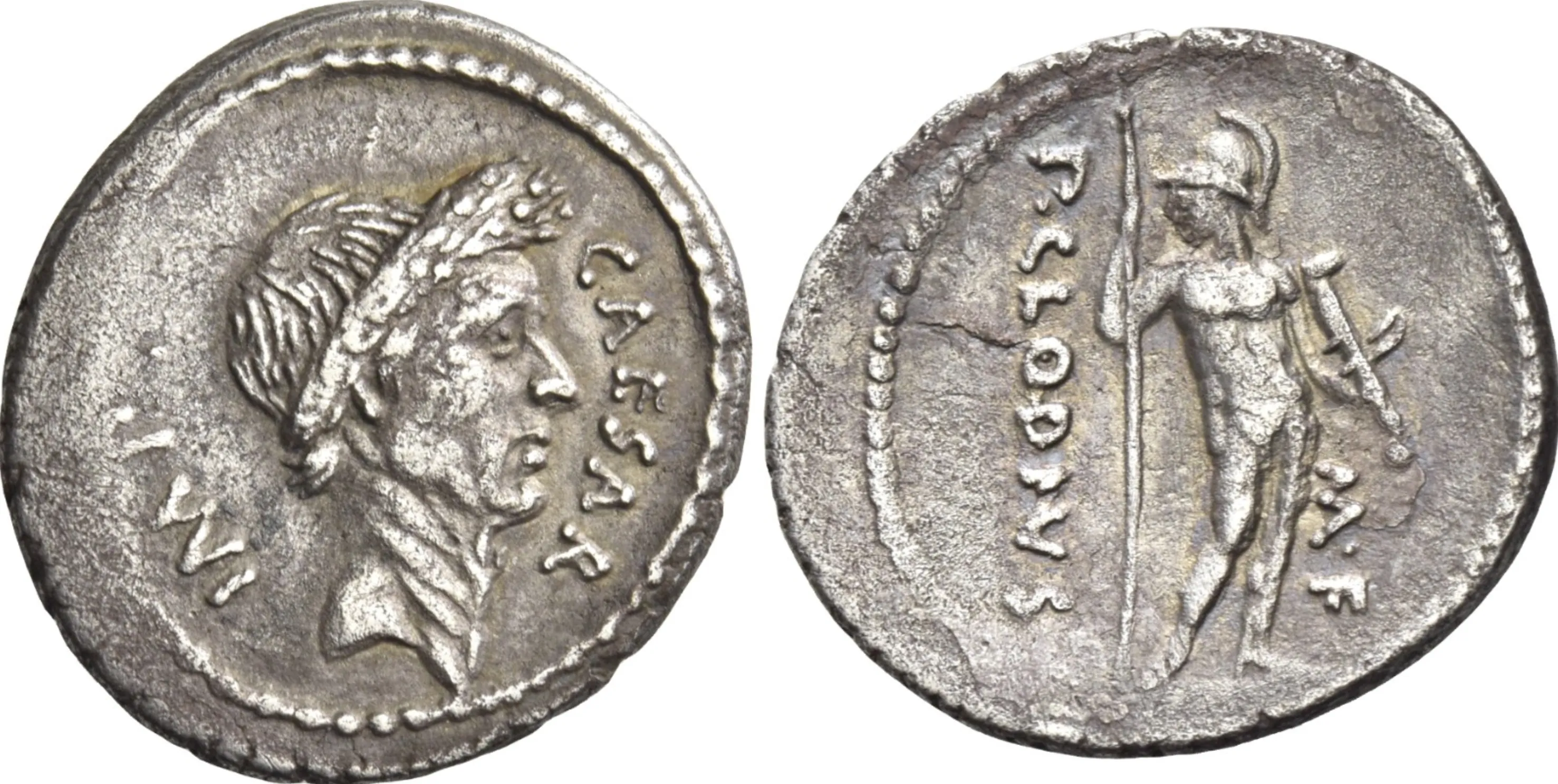
with Caesar’s bust. Mars symbolizes the determination to avenge Caesar’s death. The same type was also struck with the busts of Augustus and Mark Antony instead of that of Julius Caesar.
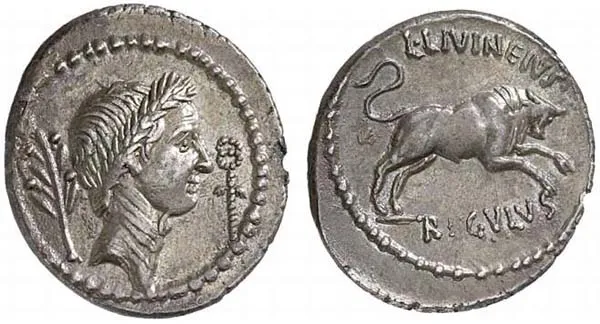
L. Livienus Regulus IIII VIR A.P.F
Crawford 494/24. Rome, 42 BC. (Crawford 494/24). Obv./rev. dies: < 30 / < 33
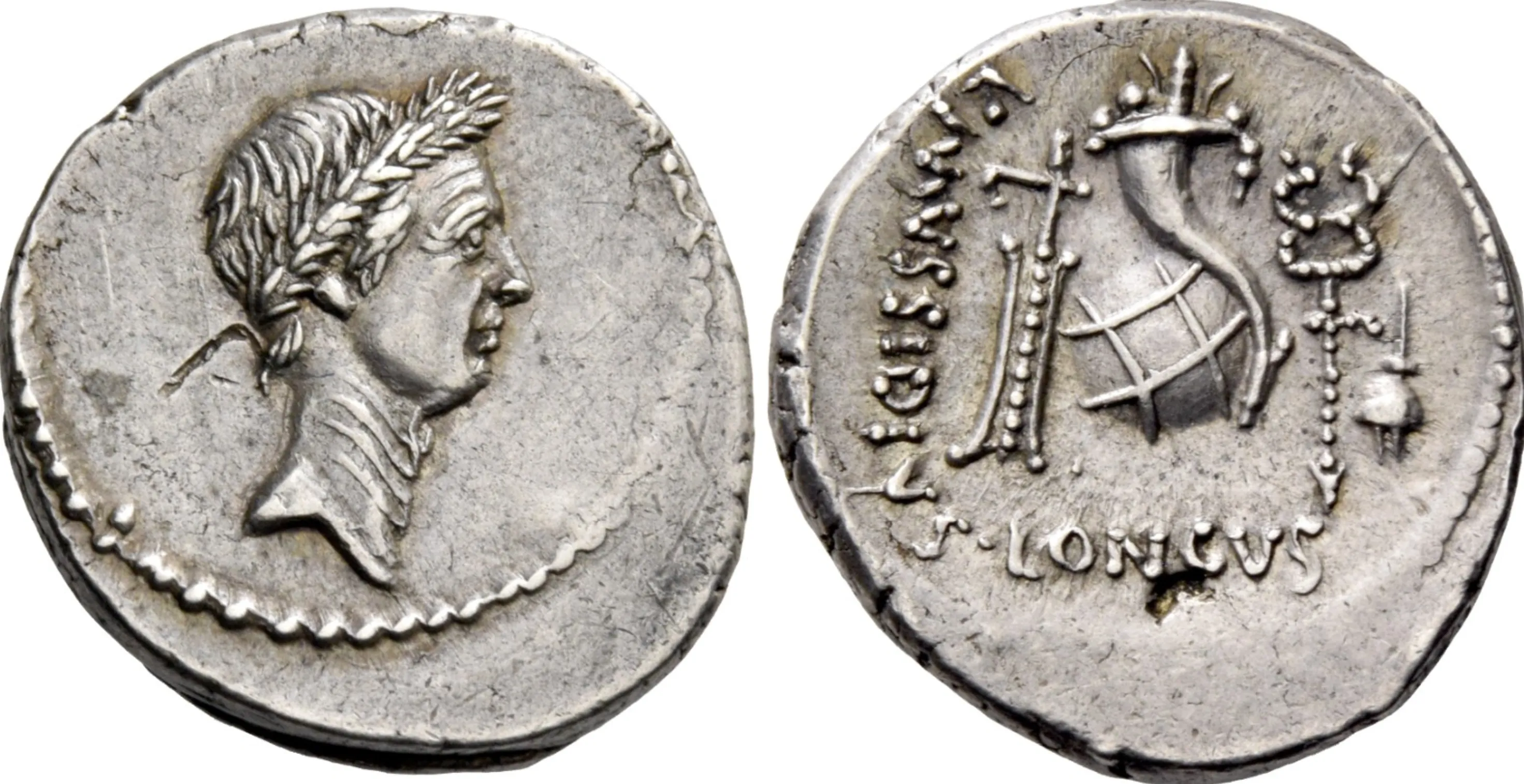
L. Mussidius T.F Longus IIII VIR A.P.F
Crawford 494/39a. Rome, 42 BC. Obv./rev. dies: < 30 / < 33 for the two varieties.
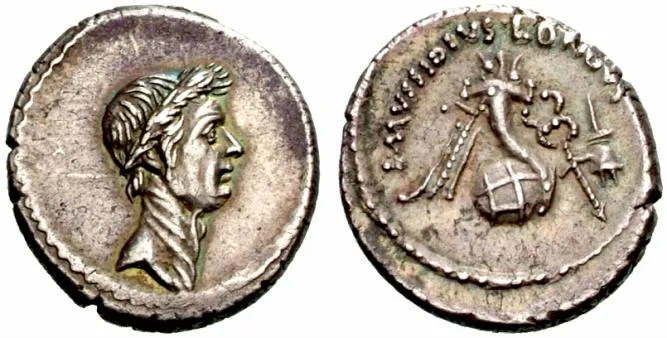
Crawford 494/39b. Rome, 42 BC. Obv./rev. dies: < 30 / < 33 for the two varieties.
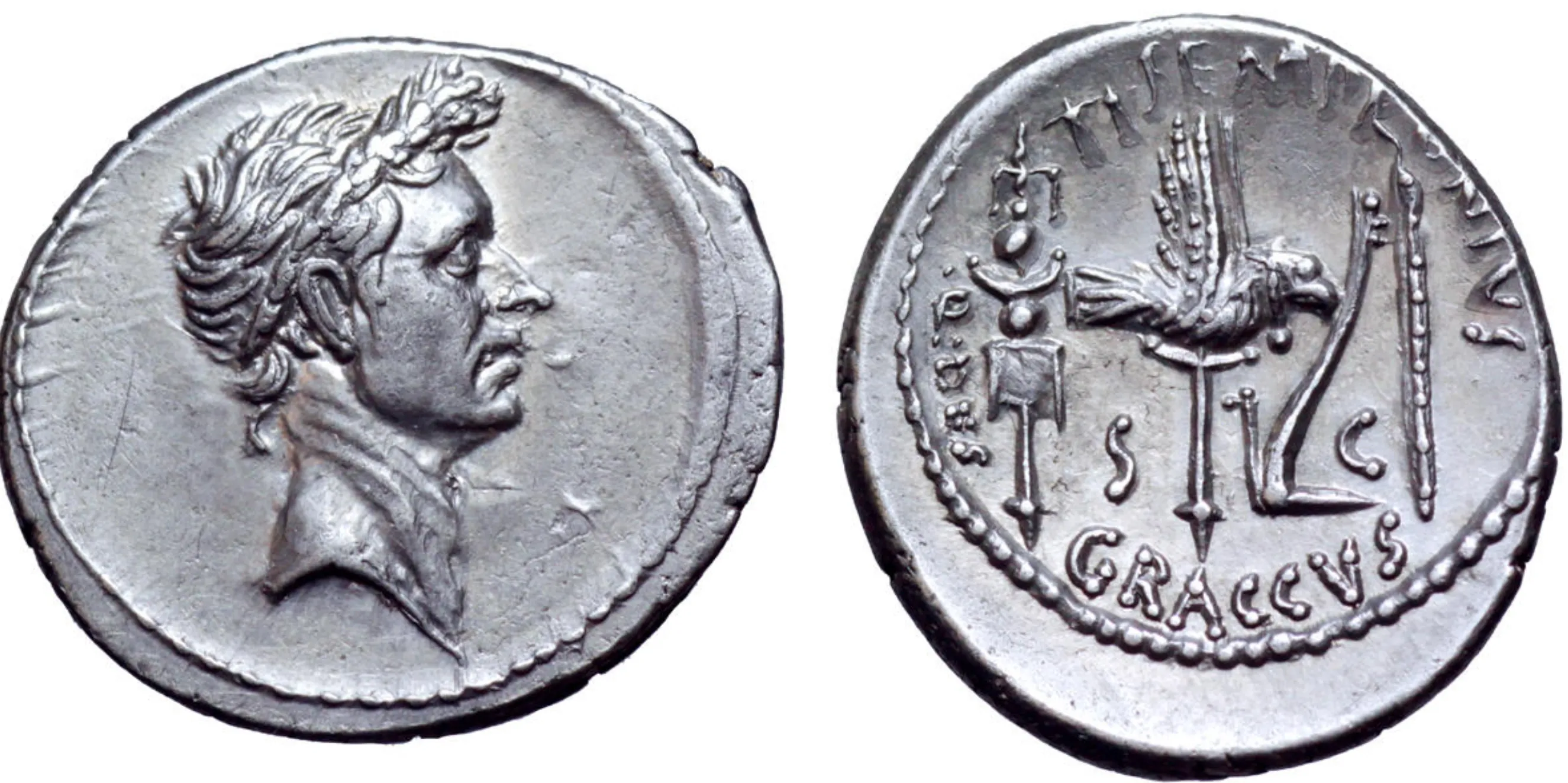
Ti. Sempronius Graccus IIII VIR Q. DESIG
Crawford 525/3. Rome, 40 BC. Obv./rev. dies: < 30 / < 33
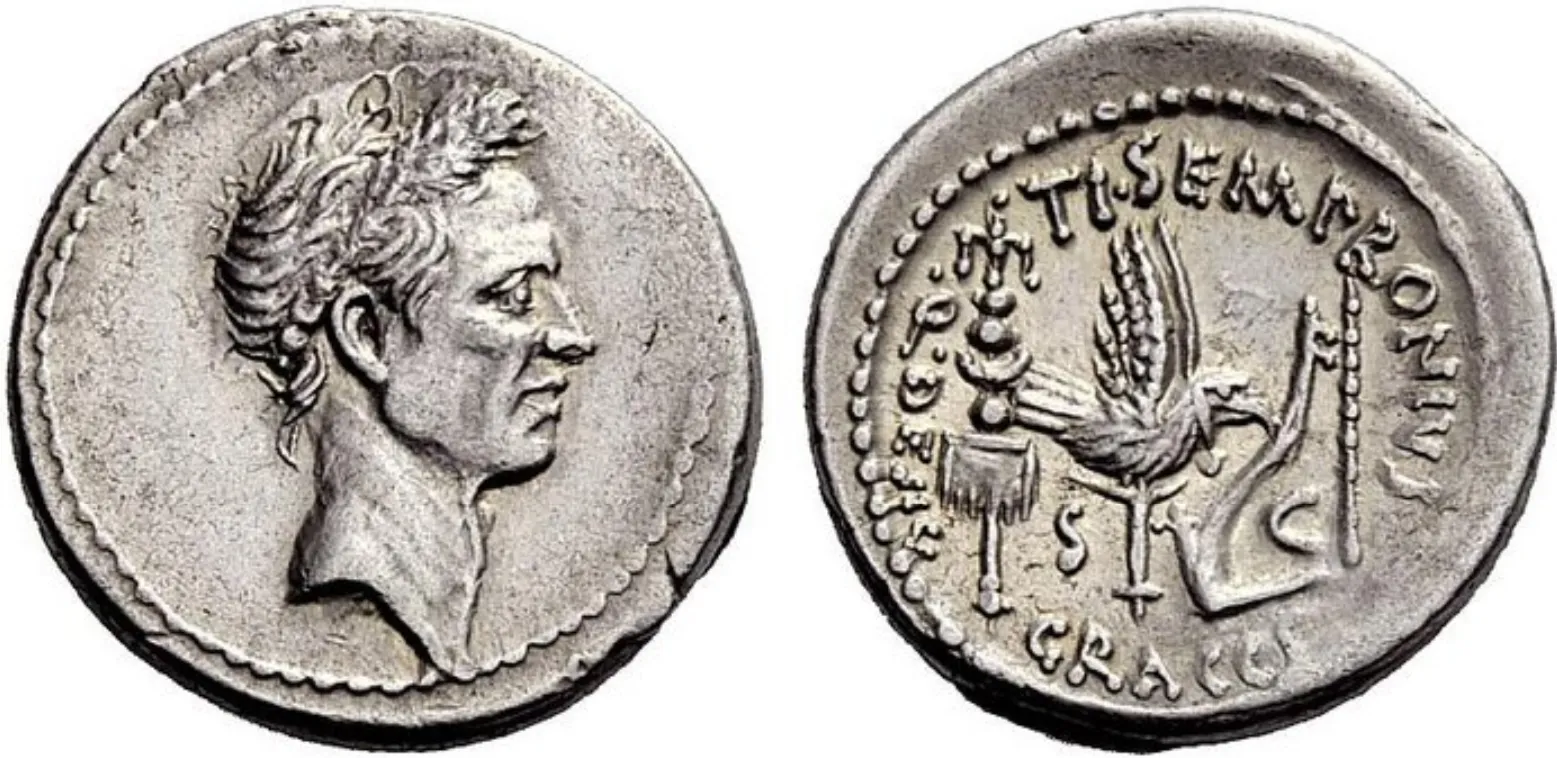
Crawford 525/4a. Rome, 40 BC. Obv./rev. dies: < 30 / < 33 for the three varieties
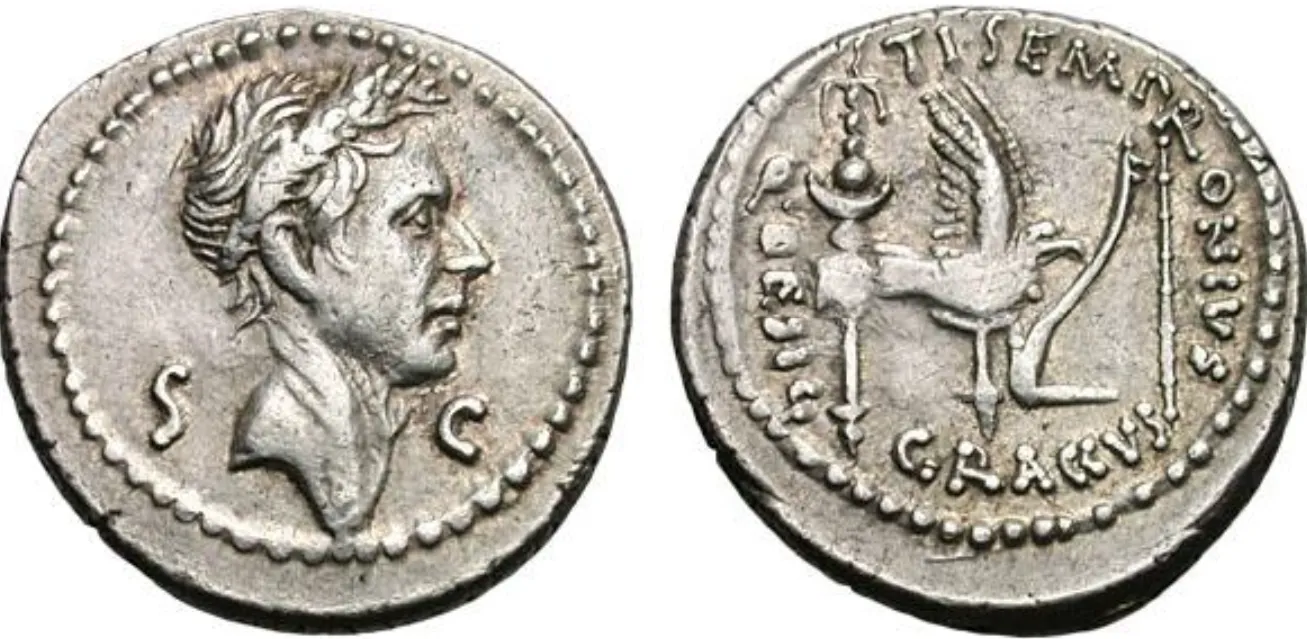
Crawford 525/4b. Rome, 40 BC. Obv./rev. dies: < 30 / < 33 for the three varieties
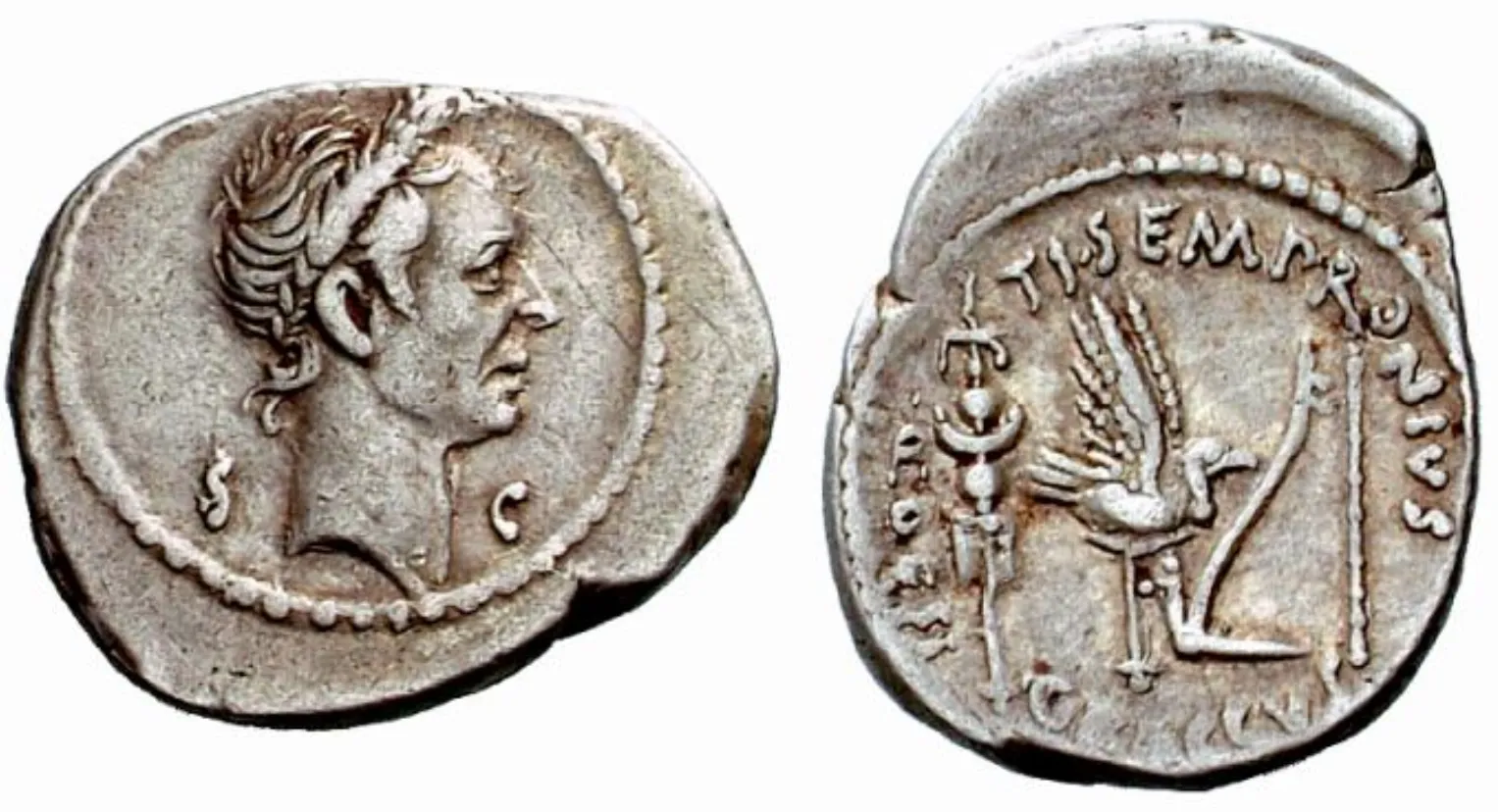
Crawford 525/4c. Rome, 40 BC. Obv./rev. dies: < 30 / < 33 for the three varieties
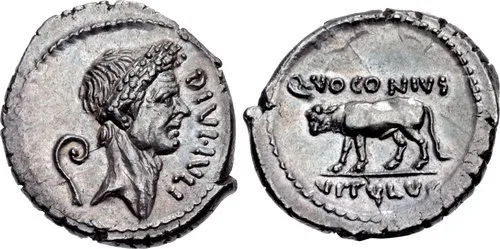
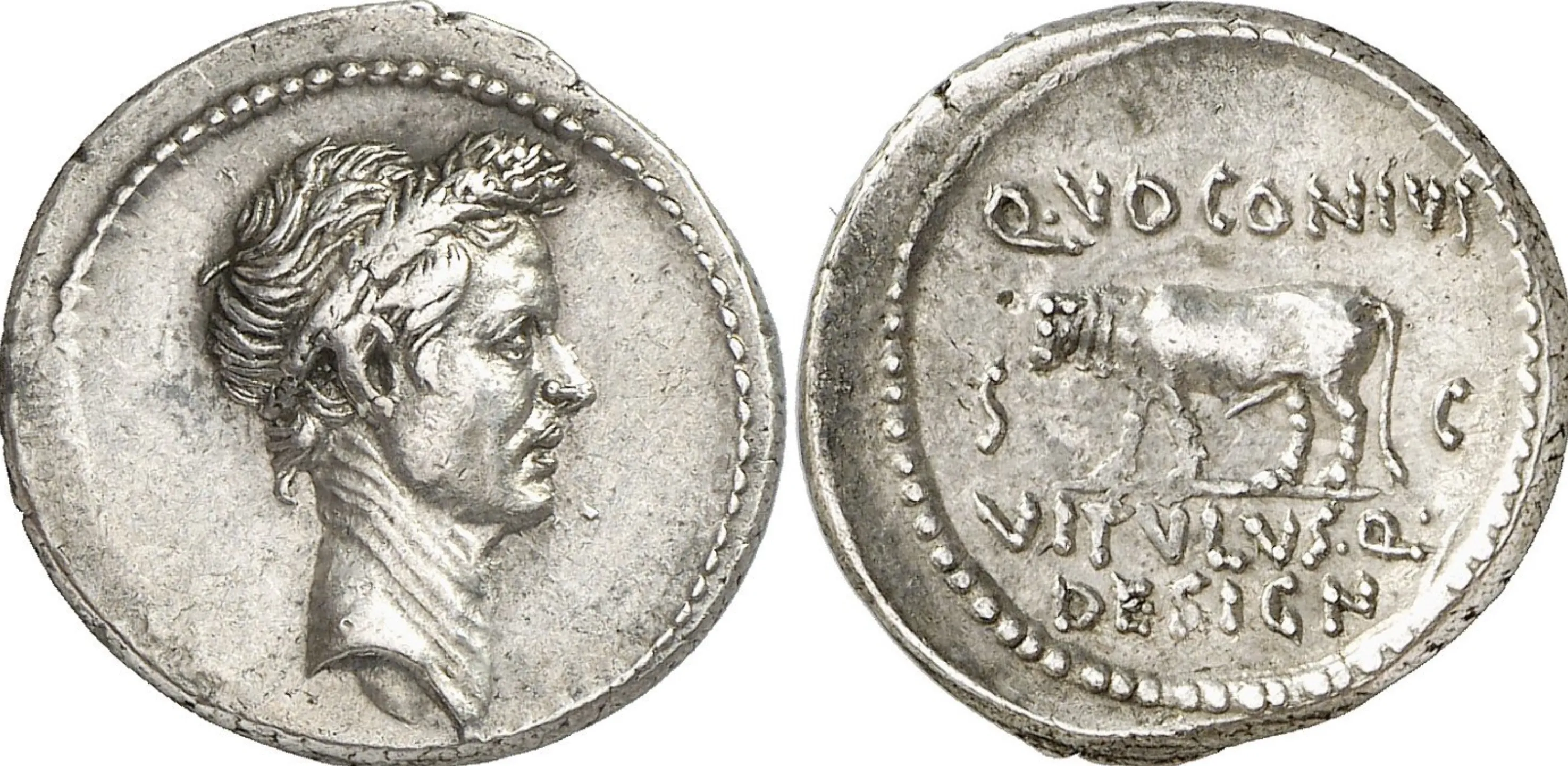
Quintus Voconius Vitulus
Crawford 526/2. Rome, 40 BC. Obv./rev. dies: < 30 / < 33
Crawford 526/4. Rome, 40 BC. Obv./rev. dies: < 30 / < 33
Marcus Agrippa / Octavian.
Crawford 534/2. Rome, 40 BC. Obv./rev. dies: < 30 / < 33
BRIEF CHRONOLOGY OF THE LIFE OF JULIUS CAESAR
100 BC - On July 13, he is born in the Subura, Rome.
84 BC - He marries Cornelia and is appointed flamen dialis, priest of Jupiter.
82 BC - He leaves Rome, fleeing Sulla.
79 BC - He completes military service in Asia and Cilicia.
78 BC - He returns to Rome after Sulla’s death.
72 BC - He serves as military tribune.
70 BC - He is elected quaestor of Hispania Ulterior.
68 BC - His wife Cornelia dies and he marries Pompeia, daughter of Pompey.
65 BC - He is appointed curule aedile and offers grand spectacles thanks to Crassus’ financial support.
63 BC - Elected Pontifex Maximus.
62 BC - Sent as propraetor to Hispania Ulterior.
60 BC - He returns to Rome and forms the First Triumvirate with Pompey and Crassus.
59 BC - Consul for the first time.
58 BC - Appointed proconsul of Gaul. In March he leaves for Gaul. Battles against the Helvetii and Germans.
57 BC - Campaign against the Belgae and first exploration of the British coast.
56 BC - Renewal of the triumviral pact with Pompey and Crassus at Lucca.
55 BC - First expedition to Britain.
54 BC - Second expedition to Britain. Cassivellaunus falls.
53 BC - Crassus dies during an expedition against the Parthians.
52 BC - Vercingetorix is defeated in September. Pompey is appointed consul sine collega.
50 BC - Final operations in Gaul.
50 BC - He is ordered to disband his troops and submit to Pompey.
49 BC - The Senate declares him an enemy of Rome. In January he crosses the Rubicon. The Civil War begins. In October he is appointed dictator.
48 BC - Caesar defeats Pompey at the decisive Battle of Pharsalus, August 9. Pompey’s followers take refuge in Africa.
47 BC - Battle of the Nile; Alexandria surrenders and Caesar leaves for Syria.
46 BC - Battle of Thapsus. He defeats the Pompeian army of Caecilius Metellus in North Africa.
46 BC - Gnaeus Pompey the Younger and Titus Labienus organize resistance in Hispania.
45 BC - Battle of Munda. Caesar defeats Pompey’s last supporters. Titus Labienus and Gnaeus Pompey die.
44 BC - He is officially named dictator perpetuo and is assassinated on March 15.