GENS CAECILIA Crawford 374-2
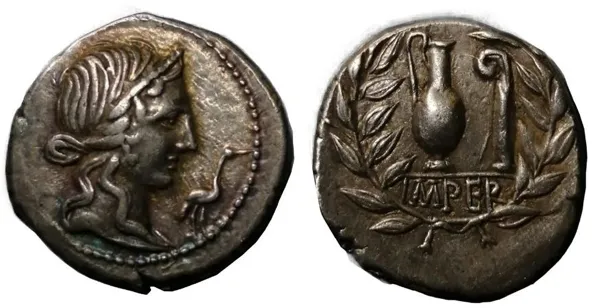
Legend ./above:IMPER., all within a laurel wreath.
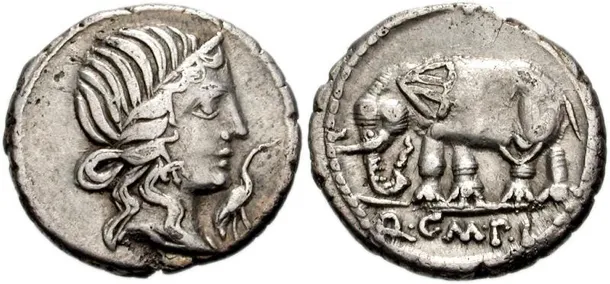
The Caecilia family was first patrician and then plebeian [1]. The first member of the family to obtain the consulship was Lucius Caecilius Metellus Denter in 284 BC. For a time it was one of the leading families of the Roman Republic. They made a family tree that made them descendants of Caeculus, mythical founder of Praeneste and son of Vulcan, or of Coecus, mythical companion of Aeneas. They used the cognomina Bassus, Denter, Metellus, Niger, Pinna and Rufus. The elephant appears on many of their coins and seems to be the symbol of the family, alluding to the victory obtained by the consul Lucius Caecilius Metellus in 251 BC against the Carthaginians in Sicily during the First Punic War [2].
Our moneyer, Quintus Caecilius Metellus Pius was the son of Quintus Caecilius Metellus Numidicus. He began his career in the war against Jugurtha, king of Numidia under the orders of his father who, due to the intrigues generated by Gaius Marius and his opponents, was recalled by Rome and replaced in his position by Gaius Marius in 107 BC. Later these same rivals managed to exile him in 100 BC. His son’s continuous requests meant that two years later his father was able to return from exile, an action that earned him the nickname Pius [2,3].
He actively participated in the civil war or bellum marsicum for several years, in which he defeated the Italic leader Quintus Poppaedius Silo. At the very end of the social war in 87 BC, the uprising of Lucius Cornelius Cinna took place, who besieged the city of Rome together with Gaius Marius. The senate asked Quintus Caecilius Metellus Pius to negotiate as consul, but Cinna’s occupation of Rome and the executions decided Metellus Pius to leave Rome and head to North Africa. He remained in African territory until the end of 84 BC when he landed with an army in Liguria and joined Sulla on the Appian Way in his advance towards Rome. A year later he was sent to northern Italy by Sulla where he pacified Cisalpine Gaul by defeating the antisilani. In reward for his services he received the position of Pontifex Maximus on the death of Quintus Mucius Scaevola in 82 BC. and two years later he was appointed consul alongside Sulla. After his consulship, he was sent to Hispania as proconsul to direct the war against Sertorius, who openly opposed the regime established by Sulla. Sertorius defeated Metellus Pius several times that he needed Pompey’s help to reduce the resistance. In 75 BC, four years after his landing in Hispania, he managed to defeat Hirtuleius, quaestor of Sertorius, in Italica and later in Segovia where he died. Still, the war did not end until several years later when Sertorius was betrayed and murdered. He celebrated a triumph with Pompey in 71 BC. He had no offspring so he adopted Publius Cornelius Scipio, who would be known from then on as Quintus Caecilius Metellus Pius Cornelianus Scipio Nasica. He died in 63 BC in Rome [4].
This series does not belong to a regular issue minted in the mint of Rome by the triunviri monetalis under the command of the senate, but rather corresponds to a series of issues made by a magistrate invested with the imperium. The legend EX S.C does not appear. because it was within the prerogatives of the imperium to be able to mint coins in cases of need. The first military coins, nummi castrenses, made their appearance between 90-80 BC and were minted on the different fronts of Rome, the East, Gaul and Hispania to cover the expenses generated by the wars [5].
Both Babelon and Grueber date this emission between 79-77 BC, once the consulate of Metellus Pius in Rome had ended and the province of Hispania Ulterior was assigned under the charge of the proconsul, imperium proconsular, to face the threat of Sertorius. Therefore, the mint would be located in some uncertain place in Hispania [2,5]. Crawford, on the other hand, dates this series to 81 BC and associates it with some mint in northern Italy, Cisalpine Gaul, when our coiner was sent by Sulla to defeat the anti-silani [6].
Both hypotheses have pros and cons, in theory, it would be an anomaly for Metellus Pius to be able to mint currency without displaying the powers granted by the imperium under the command of Sulla and on Italian soil. It is more reasonable to think that it would be minted once Hispania was obtained as a province with the rank of proconsul and, therefore, between 79-77 BC. Furthermore, the exergue legend on the reverse: IMPER, seems to support this claim. However, the scarce presence of treasures in Hispania containing this series seems to contradict these facts. Based on a series of finds, Grueber points out that the treasures of Carrara and San Miniato were hidden in Italy at least in 79-78 BC, probably during the insurrection of M. Lepidus. These occultations contain the series issued by Metellus Pius, but do not contain issues from the Roman mint as large as those produced by Naevius Balbus, L. Papius and M. Volteio, which may be indicative that these treasures were brought from Hispania. This would explain the presence of this coin, which was minted on dates similar to those of the Roman mint mentioned [5]. However, Crawford dates the treasures of Carrara and San Miniato between 91-79 BC, so the coinage between 79-77 BC would not be possible, the deadline would be 79 BC [7]. Furthermore, although Metellus Pius did not hold any magistrate in 81 BC, it is possible that he was privati cum imperium, that is, an individual who was not a magistrate who was granted the imperium with a strategic mission. In this case the legend of the exergue: IMPER could refer to the power granted in this case by Sulla to carry out a mission and, therefore, it would be feasible that the series was minted in Cisalpine Gaul in 81 BC [8].
To this day it is only known with certainty that this series was issue between 81-77 BC in some uncertain place in Hispania or Cisalpine Gaul.
The struggle between the optimate and popular factions in the senate crystallized brutally in the decade of 90-80 BC, when Sulla marched on Rome, laying the foundations for the personalisms that appeared later and that based their power on the army to achieve their ends. Although Sulla instituted a series of reforms that, in theory, returned power to the senate, the precedent he established by advancing on Rome caused the end of the republic several decades later. Once the reforms were made in Rome, Sulla headed to the East to confront Mithridates, king of Pontus, which meant the resurgence of the anti-Silanes and the establishment of the Cinna regime. He carried out proscriptions against his enemies and caused the exile of many prosilanos and opponents of Cinna, among them, Metellus Pius, who headed to Africa. After the defeat and capitulation of Mithridates in Dardanos, Sulla returned to Italy, where various figures joined him in his advance towards Rome, some convinced of Sulla and others who, although they did not share his ideas, knew that he was the winning side. Pompey and Metellus Pius were two of the men who joined Sulla, providing troops for the coming war. After the defeat of the antisilani and the complete conquest of Italy, Metellus Pius was appointed consul in 80 BC and later proconsul with government over Hispania where Sertorius opposed Sulla. It was in this context that Metellus Pius coined the series in question to pay the troops [4].
OBVERSE:Diademed head of the Pietas to the right, stork in front.
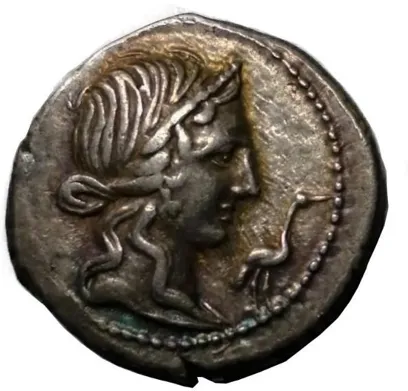
The bust of the goddess Pietas that appears on the obverse alludes to the title of the moneyer, Pius. Quintus Caecilius Metellus received this nickname because of the affection shown towards his father, exiled by Gaius Marius and Saturninus. His continuous efforts and prayers to the people of Rome allowed his father to return from exile in 98 BC, which is why the senate and the people granted him this nickname. The stork was the emblem of piety, representative of the devotion due from people to gods, from children to parents or from children to their country [3]. In this case, divinity represents the devotion due from children to parents, paternal affection and not piety in general. It was our imperator who was the first to use this title as a cognomen.
The stork appears as a complement to the Pietas on later coins of Mark Antony [8].
REVERSE:praefericulum and lituus.
Legend ./above:IMPER., all within a laurel wreath.
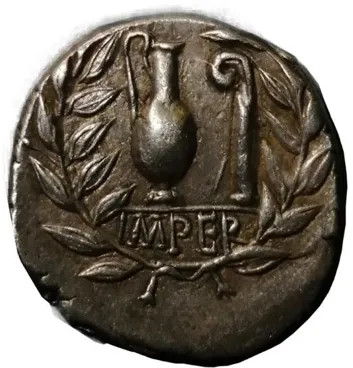
Priestly symbols reflect political and religious authority. They appear for the first time in the 130s BC, and between the end of the 2nd century BC and the dictatorship of Sulla they do not appear again. The lituus and the praefericulum or capis represent the office of Pontifex Maximus, which was granted to our moneyer’s uncle, Lucius Caecilius Metellus Dalmaticus and which was also held by Metellus Pius. It was the most important religious position in the Roman religion [2].
The lituus, coming from the Etruscan tradition, was a curved staff without knots, of which two types are known: lituus augurum, of the augurs and lituus auguralis, of the pontiffs. Also, by association with the theology of victory, it expressed the maximum imperium of a leader with divine charisma. The praefericulum was a metal glass or jug, used by priests in their sacrifices to contain the wine for libations. It had a prominent mouth and a single tall, long, raised handle [3]. In the case of this series, these symbols can be related to those of the augurs, priests who interpreted the will of the gods by studying the flight of birds, from the auguraculum on the Via Sacra. Therefore, it may be related to the omens that were taken before the departure of Metellus Pius to Hispania and that may have predicted the success of his enterprise by commemorating it on these coins. This fact is highlighted by the presence of a laurel wreath that reinforces the idea of victory over Sertorius. The laurel wreath is a common attribute in representations of victory on other Roman coins.
Crawford, on the other hand, does not believe that the reverse has this meaning and relies on the fact that the elements represented are similar to those shown on the reverse of the Crawford-359 denarius issued by Sulla and other prosilane coins, which indicates that they may have had a special meaning for him. The lituus and praefericulum are normally symbols associated with augurs, but in the year Craw-359 was issued Sulla was not an augur. Although in theory they could allude to the augury of an ancestor of Sulla, Crawford believes that it is more likely that he considered them a symbol of the imperium and, therefore, would refer to his desire to obtain the imperium iustus. If so, the duo lituus-capis would have been stripped of its religious meaning to express only the political aspect of the position of augur, the idea of a divine right by which the leader exercises power [6].
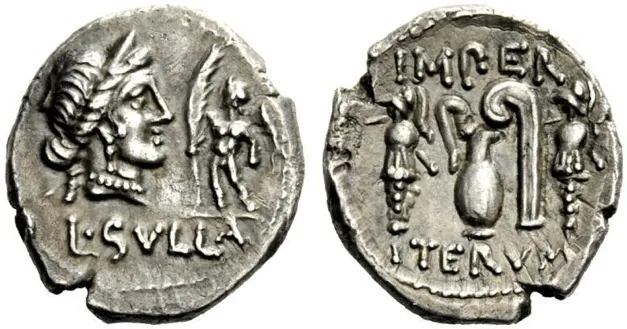
These symbols are seen on the coins of Q. Caecilius Metellus Pius Scipio, the general’s adopted son, which were minted in Africa some years later [8].
This series is made up of 2 denarii with the same obverse and different reverse. One has the elements explained and the other features an elephant, symbol of the Caecilia family.
[1] Cohen H. Overview of the coins of the Roman Republic. 1857.
[2] Babelon E. Description Historique Et Chronologique Des Monnaies de la République Romaine. Vol 2. 1885.
[3] http://numismaticantigua.blogspot.com/2014/11/las-acunaciones-de-q.html
[4] Roldán J. M. History of Rome. The Roman Republic. 1982.
[5] Grueber H. A. A Catalog of The Roman Coins in The British Museum. Vol 1. 1910.
[6] Crawford M. H. Roman Republican Coinage. Vol 1. 1974.
[7] Crawford M. H. Roman Republican Coin Hoards. 1969.
[8] Lopez Barja de Quiroga P. and Lomas Salmonte F. Javier. History of Rome. 2004
[9] Grueber H. A. A Catalog of The Roman Coins in The British Museum. Vol 2. 1910